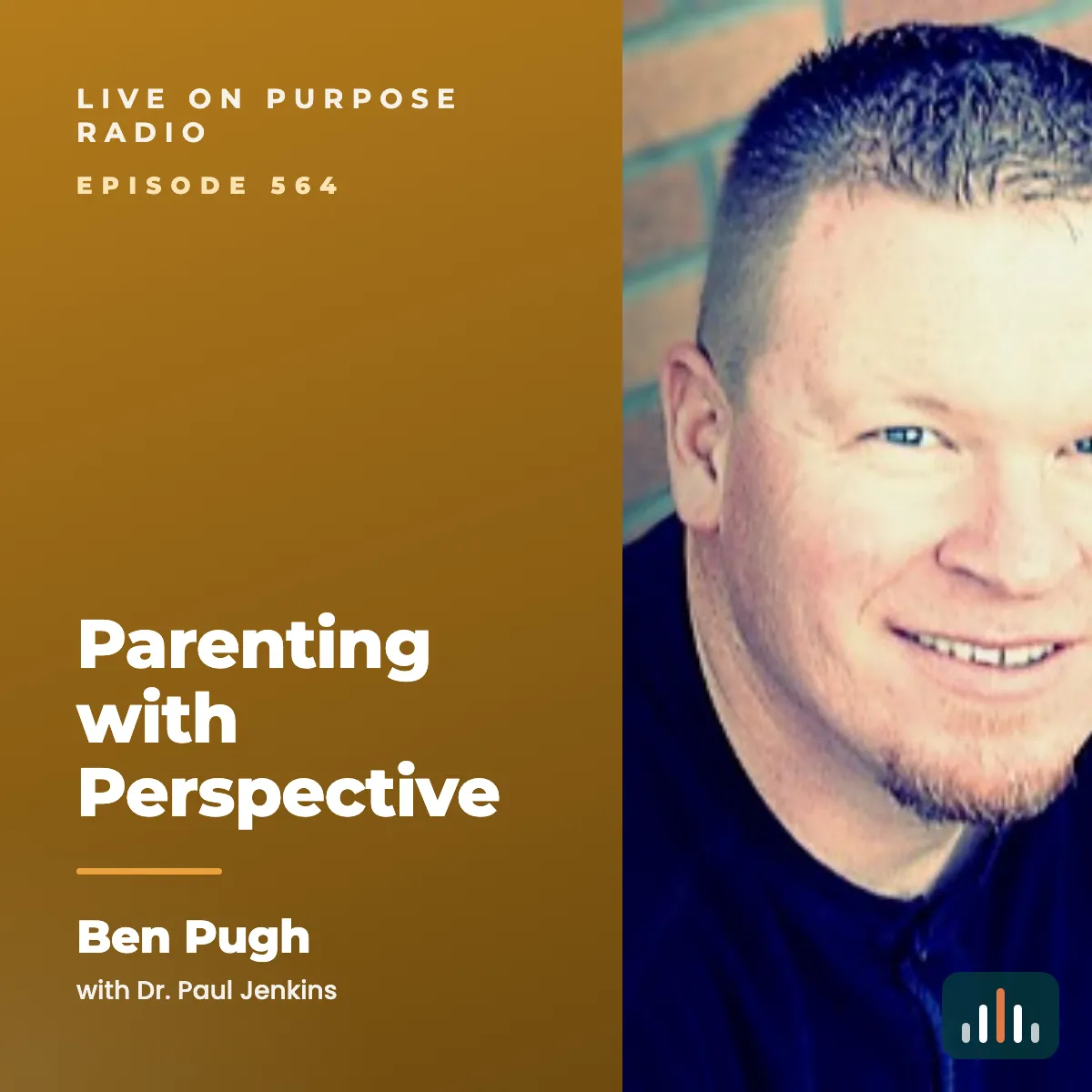
This is Live On Purpose Radio episode 564, parenting with perspective with Ben Pugh. Now is the only time to create and live the life you love. I'm doctor Paul Jenkins, the positivity psychologist. My job is to connect you to powerful positive psychology principles that immediately upgrade your relationships, business, and mental health. Are you ready?
Let's jump in. Hello, everybody. Welcome back to Live On Purpose Radio. This is doctor Paul the shrink who expands your life with another episode of Live on Purpose Radio. And joining me today is Ben Pugh.
Ben is a parent coach. He works with parents, and he works with teenagers. But he's coming from kind of an unlikely background, perhaps. This is the kid who, as a teenager, set the bus on fire, and now he's coaching teenagers and parents. I don't know if that's usually part of your introduction, Ben, but I had to just slip that in.
Welcome to Live on Purpose Radio. Yeah. Thank you. And the funny thing is I'll do free consults sometimes where I'll, like, talk with the parent and the teen, and I'll tell them that story. And they'll be like, wait.
That's you? I heard about you on so and so's podcast. You're over here. And... Yeah.
So sometimes people don't put... No. No. The... They don't connect the dots, but, yeah, that was me.
When I was a teenager, I accidentally lit my school bus on fire with rubber cement. And contrary to what all the adults told me, my life wasn't ruined, and it wasn't over. And I've grown up to... I was a high school principal for five years, and now I'm a parent and teen life coach. So And you continue to coach, on several different layers, both parents and teenagers.
You know, it's interesting. And just to follow-up on your theme for a minute, parenting with perspective, I know you and I talked about this on your podcast a while back. That perspective is so important, and I see a lot of parents who get all tied up in knots because their kid lit the bus on fire or whatever. Right? And and we have a tendency as parents sometimes to predict all of these negative outcomes, and you're living proof that that doesn't necessarily mean that your team's going off the deep end or they're gonna ruin their life.
That perspective, I think, is is important to remember. So I like to call it catastrophizing. And I think as human beings, we're hardwired to catastrophize. Like, we... The brain naturally seeks out the negative.
Like, that's how we evolved to... Like, when it's getting too cold, we're like, oh, I hate the cold weather. I'm gonna move south. Like, that's how our brain was wired. The problem is it doesn't serve us when we're parents because if we're catastrophizing and telling our teen, hey.
You've ruined your life. Your teen is also going to be catastrophizing and thinking, oh, no. I ruined my life, and it's not a powerful place to live from. No. In fact, that causes less favorable outcomes when we get into that kind of mental space.
I'm I'm curious, Ben. In all the work that you've done, now you were a school principal, a high school principal. Yeah. You're you're a sports coach too. In fact, I think I need to turn you loose at some point so you can go coach football team.
Yeah. You you coach in that arena. You coach with relationships and life coaching. You've been to the life coach school with Brooke Castillo. You...
You've done your your diligence here. You've paid your dues to set yourself up as a coach. But with all that rich experience, Ben, I'm wondering, what is it that parents need to know Maybe about their teenagers that if they just laid hold on this thought, it would change everything. What comes to your mind when I ask you that? Yeah.
One of the first things that, like, one of the secrets I talk about often is that your teen actually wants a relationship with you. The only problem is your teen wants you to create that connection. They want you to build that relationship. And a lot of parents try and do it the reverse. Like, this is what's important to me.
Come on, team. Get on board. Come connect on these things that I value. And that's one of the things... When I started exploring with this belief, no.
My team, he wants to connect with me. It's just my job to figure out how to do it. Like, that... That's on me. My mind seemed to just open up like, oh, well, if that's our job, here's how we could do...
Here's what we could do. Here's ways for connection. And I think too many parents have a real poor relationship with their teenager because they're putting too much of that responsibility on the teen, and they're not taking responsibility for, like, hey. My team wants to connect with me. How can I create those points of connection?
Taking a higher level of responsibility for that. That... I would agree with you a 100%, Ben, because in my career, I've seen exactly what you're describing here, that parents are expecting their teen to change something or do something differently or somehow conform to what the parent wants, and then then we'd have a good relationship. Yeah. And that seems to be a bit of a trap, doesn't it?
Yeah. And not... Like, I love that you said it's a trap because, like, that's one of those things. If you're stuck in that trap, it is hard to let go. And, you asked a question on my podcast that, it's super simple.
I I don't even know that you'll remember that you said this, but you kinda used an example of a parent and grades at school. And in my mind, I pictured a mom saying, like, you want me to let my teenager fail? And you said something to the effect of, what's the alternative? Like, you can't afford, like, a... What do you mean let him?
And that, I think, is kind of this idea, like, you've got to realize, wait. I've gotta let go of this stuff that I can't control and manage my own mind, my own emotions, and connect with my teenager from there. And I see this in sports all the time. Like, we have grown men and women at sporting events. Like, we're expecting our teen athletes to act mature, be good sports, but the grown ups can't even do that.
And this is where I always tell parents, if you catch yourself wanting to change something in your teen, find a way for you to be the change that you want to see. Your teen is not listening to you. Parents, I'm sorry to be the one that breaks this to you, but they don't listen to you. But subconsciously, they are watching everything that you do. And if rather than trying to tell them, hey.
This is what you should do. This is what I want you to do. This... Like, stop talking about it and show them through your own example. Like, hey.
Like, be the adult you wish your teen was or would grow into being. Mhmm. There... There's an old saying about, I can't hear what you're saying because what you're doing speaks so loudly. Yeah.
Yep. Showing it to them. There's a level of humility that's required here, Ben, and this is tough for us as parents because of one psychological factor, and that is that we know we're right. Oh, it's not just that we think we're right. No.
No. This is a different level. We know we're right. And that has us digging in our heels and sometimes getting into power struggles with our teenagers that we really don't have to. Yeah.
Let let me talk on this for just a second. Being right is an illusion. Like, being right that... Like, this is... Like, if you watch...
I'm... I don't get into politics. I'm not political. But, like, the thing that divides the political parties is both sides thinking that they're right and the other is wrong, and we're the good guys, you're the bad guys. If you get into that mentality where you think, hey.
I'm right. You're only a teenager. How could you possibly be right? You're wrong. That will create strain in your relationship with your teen.
And one of the most powerful things that you can do as a parent is position yourself as the learner. Like, I don't... Like, I wish more parents would just admit, like, I have no idea what I'm doing. No one trained me on how to be a parent. You didn't come out with a manual.
Thank goodness for your mom. That would have been terrible. But, like, I'm just doing my best, and I trust that my teen is doing my... His best. If I get into right or wrong, like, man, that disconnects me and my team so fast just because I position myself as being superior, and no one wants to have a relationship build on that dynamic.
You know, Brett Williams, a colleague of mine, wrote a book called You Can Be Right or You Can Be Married. And I love the title. But he he makes this point, and it applies to parenting too. Because if if you had to choose between being right or being in relationship, which one would you pick? Relationship.
Hands down. Now some people are really attached to being right, but it's... There's there's a psychological hurdle here, Ben, because it's not just that we think we're right. We know we are, and we don't even think that we're thinking that. Yeah.
Right? We just... Because our belief system drives everything that we do. And the parents that I've worked with through my career, because of their religion or their upbringing or their culture or their training or whatever it is, they just operate from a place of knowing that they're right without even acknowledging that they know that they're right. Yeah.
And it... I think as coaches, part of our job is to illuminate the obvious. Right? But there's obvious things you never notice, like the feeling of your shoes, for example. It's like, oh, there they are.
Yeah. It's obvious, but you don't notice it until it's called to your attention. And that's been my experience with parents that a lot of them have these deeply ingrained beliefs and thought patterns that they don't even realize they have. They're just operating as if all of this is true. Everything that they believe.
You know? We... I interviewed Richard Nisbett on my show, on on this podcast, And he wrote a book called Thinking, which was actually endorsed by Malcolm Gladwell, of all people. He knows his stuff. He studies cognition and reason and thinking.
And he said the number one error that we make as human beings is that we believe what we think. Yeah. I believe it. Well, as a coach, you totally see that because that's the world that we live in. Right?
That world of thoughts and examining what our thoughts are. I... But most people don't stop to do that. Yeah. I had an interesting experience the other day watching a football game.
So I'm, like, on the field, one of the coaches, and most people... The first people that they blame if there's, like, pressure on the quarterback is the linemen. Lineman, get your block. Like, gotta block someone. It always is the line's fault.
Anyways, I was watching... I'm a lineman coach, so I watch the line. And I watched my lineman. I saw a blitzing back air come, and it was the fullback's responsibility to pick him up. Well, one of the other coaches was just convinced that it was the lineman's fault.
And he's like, no. Here's what I saw. Like, this happened, this happened, this happened. I'm like, no. But this is what I saw.
I'm like, we were both coming from the belief that we were right. Now, obviously, when I watched the film, and I was the one that was right. But... No. Well, of course.
You know you're right, Ben. But, like, we automatically believe. And here's the thing. Your mind spends all of its time trying to prove you right. And if you don't manage your mind, you're just gonna go around in this little box thinking that you're right.
Everything outside of what you believe should be happening is wrong, and this is gonna be a miserable place to parent from. Well, that problem that we know that we're right has us treating each other terribly. I mean, this is what causes wars Yeah. At at a grander scale. Right?
But when you bring it back home, knowing that you're right is alienating you from your teen. And that probably is one of the most profound things that I see parents realize when they get into a coaching scenario. And I've even asked parents straight up. Look, would you rather have your kid do what you want them to do or have a relationship with them? And they don't even see that that's the choice.
But the thing is, probably, you can't get them to do what you want them to do anyway. That's up to them. Yep. Ideal... Or, I mean, ultimately, it's their call.
Right? And so if you opt for that, you probably aren't gonna get what you want anyway. If you opt for the relationship, you're more likely that they're going to take you more seriously. Yeah. Have you seen that?
That's one of the principles that I teach parents because, like, I had a history teacher when I was a sophomore. I looked up to this man. Like, he was one of my heroes. And when I would be a knucklehead in school, this man knew exactly where my locker was, and he'd come talk to me. And he'd be like, dude, I expect more out of you.
Like, what... What's going on? And I love this man. I did not want to disappoint him. I was a better student because of the relationship that he built with me.
And if you are waiting for your teenager to get better grades, stop lighting school buses on fire, like, whatever it is you wish your teenager would do so that you could have a better relationship with them, I'm telling you that's backwards. That's like sitting in front of a fireplace in the middle of the winter, folding your arms and saying, you make me warm, and then I'll put wood on the fire. No. You have to do your part first. You gotta build that relationship.
It's like you gotta put wood on the fire. You gotta light the fire. You gotta put in all this work before you then get the warmth. And I just I I too. Like, I'll be honest with you guys.
I have an almost 17 year old, a 14 year old, a 10 year old, an eight year old, and I'm guilty of the same thing, and I'm supposed to be this parenting expert. But when you focus on getting your teenager to change so that you can then have the relationship, it's just as backwards as thinking the fire should give you some warmth, and then you'll go ahead and put some wood on it. Mhmm. I like that analogy. It's it's a little anxiety provoking for a lot of parents to hear what you're sharing.
Yeah. Because they... They've got it in their head that their job as a parent is to make sure that their kids, their teens, well, make sure that they... Right? Make sure that they...
Whatever. Fill in the blanks. Make sure that they do their homework and make sure that they're a good citizen. Make sure that they treat their siblings with kindness and respect. Yeah.
A lot of parents really believe that that's their job, and and it causes them some anxiety to hear a coach like Ben Pugh saying, hey. Focus on the relationship. That's where... And and you take the initiative to do what is necessary to create that relationship because they're gonna think, well, what am I supposed to do then? Just let him fail?
It's like, what's the alternative? Like, one of my... I had a client early on. He was in my membership, and we're talking about control. And one of my favorite things to do is to have parents do a t chart of control.
And on the left hand side, we list all the things that you can control. That list is usually pretty short, by the way. And on the right hand side, we list all the things that you cannot control. And this particular dad, like, we're having a good discussion, and he's finally starting to, like, let go and realize, yeah, I can control this. And I'm like, well, let's just imagine that you could.
Like, how far would you have to go to control your team? And my thought was he'll say something like, oh, yeah. I could, like, lock the doors or put bars on the windows, and he's like, dude, I am the head of anesthesiology in this hospital in Canada. I could medically sedate my kids for, like, months at a time. I was like, awesome.
Like, why don't you do that? He's like, well, number one is illegal. There's that. Yeah. And he's like, they would never progress.
They would always live in my basement. Like, they would never advance, and that was a moment where all of a sudden he's like, yeah. Not only can I not control this, but turns out I don't actually want to control this? No. I need to give them their autonomy.
So... Or else, like, the more I try and control, the more likely it is that they just come back and wanna live in your basement forever because they're like, mom and dad, I need you to control this for me. I never learned how when I was a teenager, when the stakes were lower, by the way. But Right. That's something that I learned years ago from some of the the wisest parenting minds probably that ever hit the circuit.
Jim Faye Faye and Foster Klein, Parenting with Love and Logic. Do you remember that? Yeah. This is this is archival stuff now. I mean, there's still...
The Parenting with Love and Logic is still alive and well, but Jim Faye and and Foster Klein were the ones who were teaching this back when I was learning it. And they they talked about how the price tag for your children or your teens learning any life lesson or principle, the price tag for that goes up every day. Now is the cheapest, most economical time for your kids to learn anything. Earlier is not an option. Later is more expensive.
So like this anesthesiologist client that you have, you know, the realization of, hey. That would rob them of an opportunity to learn whatever they need to learn right now. And later is just more expensive. So I've appreciated that perspective too. Right now is the best time for your kids to learn anything.
Yeah. And I think this is a good point to bring up something. Like, when we talked about how you can't control your teens, I was a foster parent for ten years, by the way, and I learned a very powerful lesson. Like, they might not even be in your house in the morning. Like, they could take off at night.
Yeah. What I talk about, like, you can't control your teens. What I am not saying is that you should just let your teen walk all over you and that you should be a doormat parent. Like, I would still recommend that you have a healthy dose of boundaries, and I believe that... Absolutely.
Yeah. I believe that boundaries are important, like, for a parent. If you don't set boundaries, how will your teenagers know how to set boundaries? And one of my favorite things to think about, like, with my... So I have teenage sons, and I set boundaries.
And when they're not happy about it, I'm, like, this is just a lesson. Like, if you're on a date and your date sets a boundary and says no is no, like, it's okay to not be happy about it, but respect the boundary. Like, my teenage daughter... Or she's not a teenager yet. Thank goodness.
But, like, I want her to learn that, hey. I can set boundaries. Absolutely. It can make you so mad and so upset, that's on you, but this is my boundary. And so when we do talk about, like, hey.
You can't control your teen, there also has to be this balance. Like, there are still boundaries. And the way you set and uphold boundaries as a parent, that's gonna inform your teenagers. Like, hey. This is how it's done.
Like, the better you get at setting and enforcing boundaries, the more opportune... The more likely they will be at setting boundaries that are good and appropriate for them. And let me just make a comment about boundaries because I agree 100% with what you're saying here, Ben. And their psychological health depends on it. Yes.
Yep. There's studies all over the literature that say that the the kids need boundaries. Teenagers need boundaries. And when you say set and enforce, right after you said you don't control these things I know. So let me just address that for a minute because setting a boundary is not controlling your teen.
Yeah. They still get to decide whether they will respect that boundary or not. And you as a parent get to be prepared for that. The enforcement of the boundary doesn't mean that you force them to comply to it. It means that you become extremely consistent with the consequences that you control that come up as a result of violation of that boundary.
Yeah. And can I add one thing? Like, consequences, most people get all hung up on the crappy negative consequences. And there's two sides to that equation. Like, you get to control...
Like, when your teen lives within the rules and does what you'd asked, like, that's a There's consequences for that. Positive consequences. Yeah. Well, even the word itself, consequent con, the Latin root of that is with. And then the sequence part means that it follows some particular order of events.
Yeah. So it's a natural following. It comes with the choice. And a lot of parents abandon the consequence and go to the old three r's of parenting, rant, rave, and rescue, where they ball them out and bail them out. Yeah.
And then that robs them of the learning experience. We have to be willing as parents to allow our kids to experience and fully own the consequences for their choice regarding the boundaries that you set up. Yeah. You can't make them keep the boundaries. Yeah.
I always tell parents boundaries are for you. Yes. We're Right. For teens benefit, but, like, the boundary, like, hey. You can borrow my car.
You can be out till midnight. That's when you're expected to be home. If you're not home, like, whether or not your kid gets home by midnight, that's on your team. That's on them. You own the part of the boundary.
Hey, man. You were half an hour late, so I'm not gonna let you use my car this weekend. Like, you're just con... The boundary is literally for you. It's you knowing what am I willing to do as a parent, what am I not willing to do as a parent.
If my teen, you fill in the blank here. Right? If they do whatever Yep. Yep. I will...
And then fill in the blank. And it's more for you than it is for your teen. Well, you guys, you don't have to do this alone. I've invited Ben here because he is a master parent coach. This guy knows his stuff and working with parents and with teens.
And, Ben, you've got a website, benpewcoaching, I believe, is is what it is. Right? Dotcom. Yep. And and that's Pew spelled p u g h.
Did I get that correct? Correct. Ben pugh, p u g h, coaching dot com. That's where you can find Ben. He offers a membership.
He does one on one coaching. He's got a fabulous podcast called Impact Parenting with Perspective where I was featured couple of months ago. You can go listen to that episode if you want. I'll put the link in the show notes. You don't have to do this alone.
Hire Ben, or come in to Live On Purpose where we have parent coaching programs available for you. You can just go to liveonpurposeradio.com/help, and we'll get you some help. K? We'll get you hooked up with what you need. You don't have to do this alone.
Ben, thank you for sharing some of your wisdom today with our audience here at Live On Purpose Central. Are there any parting words that you wanna leave with our audience before we sign off? Just real quickly, this has come into my mind a couple of times lately. When I was a high school principal, I kept on remembering that when I was a student in school, I did not enjoy school at all. And one of my taglines as a principal, I would tell my teachers, hey, if you aren't enjoying school, your students aren't enjoying school.
So let's find ways to make this learning process fun and enjoyable. Let's make it a party with a purpose. The same is true as a parent. If you are not enjoying raising your teenager, chances are your teenager isn't enjoying being raised by you. Yeah.
So my leaving invitation would be find ways to enjoy your parenting. Your teenager is only gonna be a teenager for so long, and then they're gonna move out, and you're gonna have this long relationship with them where they become a parent, they're living on their own, and a lot of that relationship will be dependent upon how your relationship is right now as a teenager. So if you aren't finding it being fun, if you're not enjoying yourself as a parent, chances are your teen isn't either, and take responsibility for that. Like, you find ways that you can enjoy parenting. Make it a party with a purpose.
And if you need help doing that, I I just hung out with a bunch of my members. We went to an escape room in Linden, a a series of escape rooms. It was so much fun. Like, find a way. Make it fun.
Your team will thank you. I promise. Oh, I love that. That's a great note to wrap up on today. Folks, you've heard it from Ben Q here at Live on Purpose Radio.
It's time to go apply what we've learned and live on purpose. Did you get what you came for? Give yourself the gift of taking real action on what you realized today. Please share this episode with someone you know would value it, and leave us a rating too. It's time now to live on purpose.
Open the transcript on its own page ↗