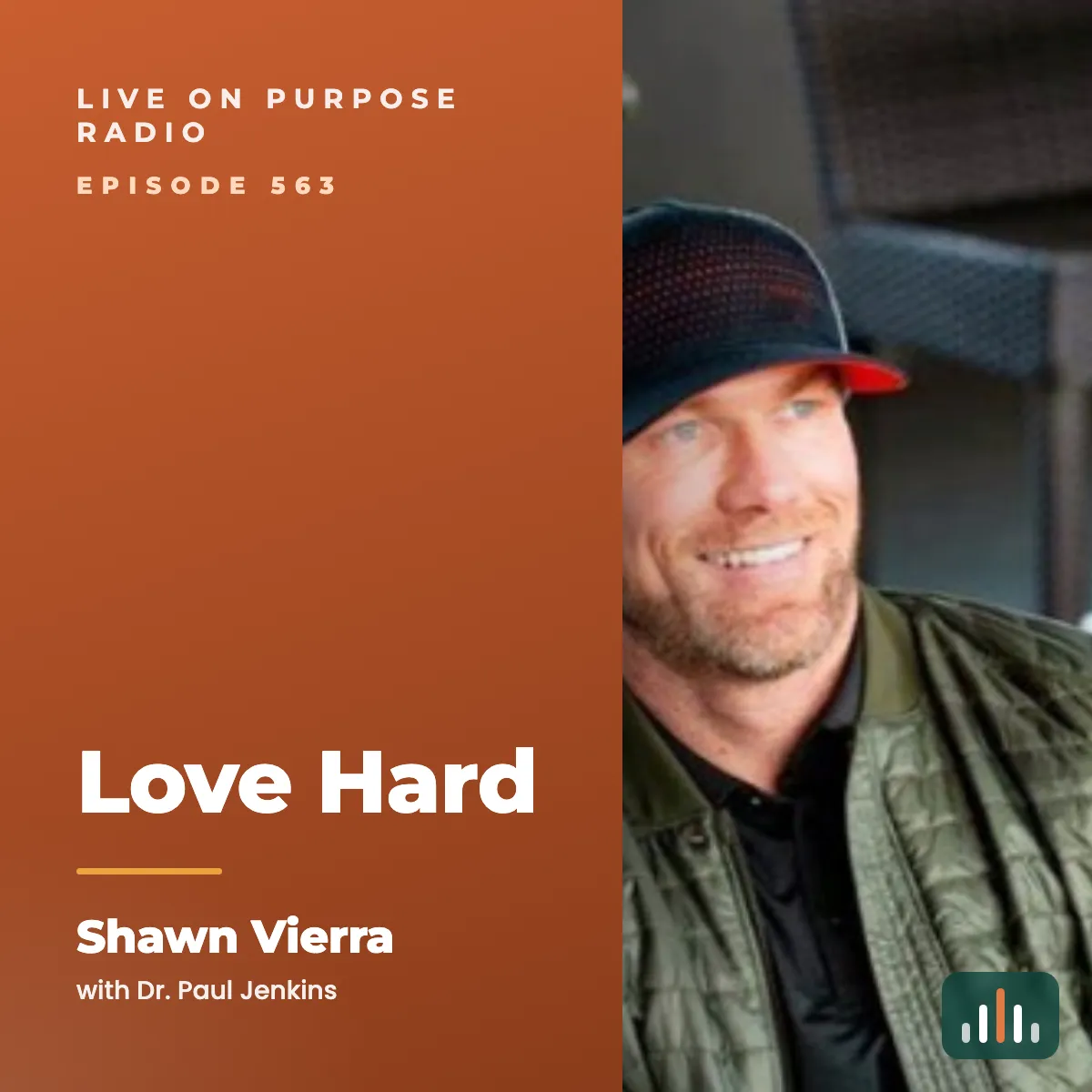
This is Live On Purpose Radio episode 563, love hard with Sean Viera. Now is the only time to create and live the life you love. I'm doctor Paul Jenkins, the positivity psychologist. My job is to connect you to powerful positive psychology principles that immediately upgrade your relationships, business, and mental health. Are you ready?
Let's jump in. Hello, everybody. Welcome back to Live On Purpose Radio. This is doctor Paul, the shrink who expands your life with another episode of Live on Purpose Radio. Joining me today is Sean Vieira.
He is the founder and primary driver of an organization called Love Hard. And I love what this organization is doing because they are saving lives, raising awareness, about suicide, what we can do about that, and transforming trauma into triumph. Welcome, Sean. Yeah. Thanks, doctor Paul.
Good to see you again. It was good to see you. You and I got to share the stage, share the mic at an event recently. Okay. I think it was a powerful impact type of an event where people were coming together to learn principles that allow them to move forward and and do what we call on this show, live on purpose.
Right? Right. Yeah. And I think either life pushes you around or you figure out the principles that allow you to do that, to live on purpose. Yes.
And so as we get into a little topic, that you have some familiarity with, Trauma... I've almost decided... Sean, you can tell me if you agree or not. Yeah. I've almost decided that trauma is universal.
K. Meaning, welcome to Earth. Hards... Hard stuff is gonna happen here. Right.
You're gonna get bunged up and dinged up and knocked around, and you're also gonna have some amazing, fantastic, wonderful experiences. But it's kind of a dangerous place and inherently trauma happens. Right. I don't know. I'm just...
I'm almost thinking that's universal. What are your thoughts about that? Yeah. Absolutely. I think, you know, in our foundation, it's why as we focus on youth and and we've really expanded out to parents now and and adults in general, you you don't really grow without these.
I don't think life... You know, as much as we would like to avoid these issues, these challenges, these trials, life wouldn't be life without them. And I'm... I don't know that I've ever learned anything from winning. I've learned and I've grown and I've become a better version of myself through challenges, through loss.
It's... I've gained a perspective of gratitude through those things. I've learned to enjoy the moment with my kids. And it's not just through my trials, but I think we have the ability to look at other people's and learn from those if we so choose. I have friends that have lost young ones.
They... They've lost their own, you know, kids, whether it's a a tragedy that they couldn't control, whether it was, you know, death by suicide. And and so, you know, in in all of these things, I think, if we change the perspective that hard things are things that should be avoided at all costs, and it means if something bad happens to us, we're bad people or we deserved it, and we flip it and we understand that, hey, we were trusted with this, and this was potentially engineered specifically for us. This trial was specifically for us to learn something that we needed to know or learn or gain and or be able to grow, learn, and pass on to other people because we have the abilities to sort of metabolize this trial in a certain way that as you're doing, you can now help people from it. And so, you know, I lost my dad to suicide when I was 15 years old, and I wouldn't wish that on a worst enemy.
However, for me, I can celebrate and honor my dad by pushing the messaging, that hopelessness doesn't have to be the only way out, and we try to build and, you know, and these students typically that we work with is the understanding. We wanna build them up so high that suicide is never an option. Right? If you love your life so much and you have learned healthy coping skills, on a spectrum and hopelessness is over here and, you know, living a a full happy life is over here, still full of challenges, but the the perspective that these things are happening for us and not to us, and then the gratitude that things are not worse, then these young kids have a chance to go, hey. I'm bigger than my problems, and my self love is so great, and my self acceptance is so great that the bullying or the failure or the challengers, the trials, or the or the the trauma that we can't escape in this life isn't going to ruin me.
This is a powerful, important message, and it goes in the face of what some of the traditional beliefs are about this because... And you hear this all the time in the media or sometimes in the culture of what I call victimhood. Right. That culture of victimhood that says, because this thing happened to me, now my life has to be broken or fractured or defined by this thing that that happened. It means I'm less than.
It means that I was... You know, that that I'm a victim because, again, whether it's God or the universe has basically said, you're not worthy of happiness, and so I've given you this trial to break you down and and make you miserable. And, you know, to your point, when I lost my dad... I have a brother who's six years younger than me. And, luckily, my sort of natural inclination is to use challenges, trials, and trauma as jet fuel to become better.
And my brother, unfortunately, his response was, let me numb this. Let me run from this, and he used heroin. So for the last twenty three, twenty four years, we've lived both, you know, very different lives coming from the same trauma. I have Right. Amazing kids.
I was married for fifteen years. I'm really great friends with my ex wife. I've built several businesses. I traveled the world. I started a, nonprofit in Africa called Give a Dam in 2009, and we changed lives through capturing rainwater so that these people could have a, you know, a a better a better life.
And all of that was really powered by, dropping ego from trauma and doing self work and understanding, hey. I wanna understand why I'm sad, why I feel broken, why I feel hopeless. And I wanna take care of that from the inside out so that I'm not faking happy, so that I'm not faking joy, so that I'm not, you know, at my kid's birthday party living mentally in my trauma as a victim or frozen by it, but then I can process it and and enjoy my five year old's birthday more because I realize how precious that moment is. So I'm not scrolling Instagram. I'm not worried about work.
I can be present with my kids in a way I couldn't have because that traumatic instance with my father, it changed my whole life for the better, as crazy as that sounds. It set me on a trajectory to change thousands of people's lives. In 2002, the foundation impacted 46,000 people in its very first year of existence, and a lot of that came from from funding Weber School District's, mental health initiatives and training therapists to become trauma certified. And now, you know, for every year, 35,000 students in that district have no cost access to this life thing... You know, life changing trauma therapy that changed my life and so many others.
And that's just something that's available to them every day that they're in school at no cost to the family, the school district, or the or the student. And that's what can happen. You know, I I shouldn't be on stages. I shouldn't be speaking. I shouldn't be writing a book.
I shouldn't be leading a foundation, an anti suicide foundation. I should be coaching people. I shouldn't be a fitness, you know, on my way to be a fitness trainer and a coach. I should be a heroin addict according to what people categorize the response to trauma being. And probably most people would have said, hey.
You know what? We get it. We get why you're this way. We get why you've given up and become, you know, hopeless and worthless and and all of those things because you went through so many hard things. And I just wasn't willing to accept that as my existence.
I said, you know what? My dad's death is going to allow me to just keep one dad here or a family that otherwise wouldn't have been. And if I can say one dad or one mom or one one student, one child giving up, then my dad's death wouldn't have been in vain. And everything that we know now that we didn't back then about mental health and therapy and medication and and all these treat outs like, I mean, and everything else. You know, really, nobody has to get to that point of hopelessness, and and I think that's what can come from pain and trauma is the most happy, full, authentic version of yourself with a perspective of gratitude.
And and I'll tell you, doctor Paul, I have never been more happy in my life, and it's after all of the hardest things I've ever been through. Right. After. Not avoiding them, not pretending like they don't exist, not because I've lived a a perfect life with no trials, and I've been through some, you know, neglect, child abuse. I could go on and on.
That was my childhood Yeah. From five until 15. And when I was 15 years old, my dad took his life and died by suicide. So I guess you could say I have excuses that I could make. And what I wanted to show people was that, you know, I was good at suffering in silence.
Nobody knew what I was going through. Nobody knew how hard those things were. Not even my mom knew some of the things that had been... Had happened to me. And post, losing my father, I really understood that, you know, I mean, for a few years, I'll tell you, I was, it was really hard.
But it was it was a trauma in my adult life when I thought, you know what? I don't have to be sad. I don't have to be miserable. I have an opportunity to be the most happy version of myself, and it's essentially a choice that I'm gonna make. And I'm gonna be grateful that I had my dad for as many years as I did instead of ungrateful and sad that I don't have him, and he died in such a tragic way.
But, you know, what can I do with my life? Can I show people that I've healed through the therapy that I've been through and that I'm healing through serving other people? I think this... People look at this foundation and are like, man, what a great guy to help all these people. And I'll tell you, it does...
It it it has helped so many people, but you know who it's helping the most? You know who it's helping is me. Yeah. And so there... There's just so many ways to look look at all of these things and flip it so that you can be authentically and genuinely happy and enjoy the rest of your life.
And along the way, you know, I think the spice of life is to inspire other people based on the things that you've been through. You know, I can't speak to to a lot of things. I can speak to a few, like trauma and therapy and recovery and and happiness and enduring joy. And I can also speak to, you know, the two paths of life that trauma can can give you the opportunity to choose. I think we all have that choice.
Yeah. But until we see it as a choice, it's not. Right. And that's the problem with some of this traditional thinking because there is a bias toward, hey. If trauma happens, you're gonna be screwed up from that.
And and... But the the people who inspire me the most on this planet all have a trauma story. Right. And they have chosen chosen to handle it in a different way. You don't like what you're saying.
Sean, not not being willing to curl up in some victim heap in the corner. Right. And and I'm not saying that you should just ignore it and pretend like everything's peachy. Exactly. You learn this through therapy.
I'm sure that you've got to acknowledge and honor your feelings. How are you supposed to feel when something traumatic happens? Well, you're human. You're supposed... It's supposed to hurt.
Right. And and that doesn't mean that you have to stay there or be stuck there. And and it will reveal to you... You've you've mentioned this earlier. It will reveal to you what's really important.
It will have you showing up differently in your key relationships. It'll have you thinking differently. And you either... And I... I've kind of simplified that in my coaching programs where it's either a victim mentality or it's a hero mentality or an agent.
I like to use the word agent because an agent has some control over what's going to happen regardless of the circumstances. Yeah. Yeah. I agree. I think you're exactly right.
And and a couple of points, if you look at... And this is... These are things that we spoke about on stage not too long ago. But you look at a hero and a villain, and their back stories are typically very similar. Right?
The hero, and and the villain have a traumatic past. One of them said, the world hurt me, so I'm gonna hurt the world. And the other one said, the world hurt me, so I'm gonna make sure that it won't hurt anybody else. And the hero steps out and says, you know, I I will take what I've learned, and I will use my my pain to fuel me to go, you know, Batman and and the Joker. Right?
I'll go defend those who can't defend themselves because I have felt the pain that's been dealt out. And the joker's response is everyone's gonna suffer because I've suffered. And, you know, and I think in that sense, we have to understand you don't... You know, I guess I liken it to the gym when I'm speaking or when I'm coaching people is there's... When you go to the gym, it's not pleasant.
It's not a spa day. Right? If you're gonna get something out of that session, you need to lift until your muscles fail, which means they're burning, which means they're pumping, which means you're exhausted, you're sweaty, you're uncomfortable. It it can be... You know, it's it's strenuous.
It's painful, so to speak. I was at the gym this morning, and I lifted until my muscles couldn't lift anymore. So there was a level of discomfort, and then lactic acid comes in, and you're sore afterward. And and that's that's when we're growing. That's when we're growing.
We're breaking down all of the the the the tissue, the fiber so that what? It can grow back stronger. Stronger. And then the recovery portion of that, which, you know, you could liken it to to therapy for the for the mental instance is, you know, what are you eating after you lift? What are...
Are you resting? Are you getting water? Are you getting supplements? Are you making sure that your body has what it needs to be able to take the work that you've just done or the trauma to your muscle you've just act like you chose to go inflict trauma on your muscles. That's what's happening at the gym.
We're inflicting trauma on the muscle and and the the muscle and and the tissue and the fibers. And then we and then we go and we say, okay. I'm gonna go get a massage. I'm gonna sit in the sauna. I'm gonna sit in the hot tub.
I'm gonna get a smoothie. I'm gonna fuel my body with supplements and healthy food so that it can recover and actually capture and utilize the trauma and just put it through to make me a stronger version of myself. And I think it's the same. You know? My handle is shawn biera not mental fitness because you have the same opportunity to to break down.
And it's not that you're breaking down your mind, but for me, it was breaking down ego. My trauma helped me to go, hey, if I can't be vulnerable, if I'm just gonna hide everything, if I can't tell my mom, my family, my significant other, if I can't show people that I'm a real person, there's no there's no growth in that. And I actually think there's no existence. There's no real life there. I think that we're just hiding who we really are, and that's what we all need is I need you to be you.
I need you to be the most authentic version of you. So does your so does your significant other. So do your kids. And with these parents, I think, you know, especially dads, especially men, we think we're broken if we go to therapy and we're not... And and we're less valuable.
We've had these hard things happen to us and all this stress and this pressure of being a man and leading a family, being a breadwinner and having to, you know, rub dirt in our wounds because society says that. And then on top of it, if we go to therapy, we get made fun of. We get teased. Our, you know, our our our buddies in the locker room are like, oh, you're going to therapy again. You know, it feels like something that means that we're weak.
And in fact, eliminating those things is what makes us strong. Being vulnerable with our wives and our kids and telling them that we love them and telling them, hey. You know what? I I am struggling. I I am having a hard time, but it's not gonna beat me.
I'm gonna go do what I need to do to be healthy and to be more happy and and more grateful than I was before. What's weak in my opinion, I feel like I can speak to this because I've been through it. What's weak to me is giving up. What's weak to me is leaving your kids behind because you didn't do the work, because you you said, you know what? For my dad, for a long time, there was a lot of resentment and anger because I felt like he gave up and he abandoned us.
And, you know, I can't judge what he went through. I have no idea the pain he was going through. But to me, that's where the weaknesses is in in not leading into your feelings and your vulnerability. Doesn't mean you have to be weak and you're crying all the time to everybody and you're making your problems everybody else's, but there's so many things we can do. Eating right, getting to the gym, going to therapy, mentally fit and physically fit, like like you say, the mental hygiene.
Man, what a better dad I am now than I was before. Or trauma therapy. And even the perspective of losing things to understand, while my kids are here, I'm gonna enjoy every moment with them. I'm not gonna be the dad that's checked out. I'm not gonna be the dad that doesn't coach baseball, basketball, football, misses drill performances.
I'm not gonna be the one that says no to a late night, you know, write request for my daughter. Like, if I can get fifteen minutes with her as a 15 year old to drive to a friend's house, I'm I'm driving fifteen minutes to her to take her fifteen minutes, to drive home fifteen minutes, and waste thirty minutes of driving alone to get fifteen minutes with her because I understand how lucky I am to have her when some parents don't have their 15 year old daughter. The perspectives, so much richness in what you've just shared with us, Sean. And, you know, as you were talking about the heroes and the villains, and they have a similar backstory, but then there's some choice point. And I'm looking at your hat that says love hard.
That's the name of your organization that that is literally saving lives and helping to raise awareness around suicide by inviting people to do just that. Mhmm. And as I was thinking about the the hookup between the villains and the and the heroes, you know, and that choice that they make, life is going to beat us up. I I started out with that saying, I think trauma is universal. You are going to take some hits.
And once you do, you have a choice, love or hate. Love or hate. And I choose the word hate because people hate the word hate. But, honestly, if it's not love, what is it? Right.
And if I choose to go hurt people because I've been hurt, that's a hate choice. If I choose to go heal people because I've been hurt, that's a love choice. Yeah. And I I love that about what your hat is communicating to us. Will you talk for just a minute about love hard Yeah.
And how you came to that? Yeah. Thank you. So so love hard. Let's just start with that, and then and then I'll be brief in describing the foundation and why it started.
But, it's about it's about loving the hard things. It's about appreciating that we're alive and we have the opportunity to experience hard things. And, you know, secondarily, it's about loving others hard and not holding back. I think as a man, it's really easy to be so macho that you never tell your kids you love them. You never tell your wife you love her.
You never tackle her with hugs and kisses after work because you're too macho for that. And they may not know how much you care about them. Your kids may not know because you're holding back. You're not loving them hard enough, and and something happens, and they grow older, or you lose them, or you pass away, and you've missed an opportunity to let them know no matter what happens on this earth, your dad, your mom loves you as as hard as... I I don't wanna leave anything on the table.
I don't... There's one life. No regrets. I wanna make sure my family knows. My my significant other now, even my ex wife, my kids, my mom, my sister and brothers, my friends and family, people I don't know on stage, people I get to meet, I wanna let them...
I wanna love them as hard as I possibly can and be the guy that's like, you know what? Yeah. I love you. I tell my guy friends. We'll be on the phone having a conversation about golf or getting together or work or whatever, and and I'll say, hey, man.
Thanks a lot. Love you, bro. And some of them just sit on the phone like, alright. Bye. And then some of them some of them now Thanks.
Some of them now are like, hey. Love you too. Right? And that's what loving heart is all about is maybe maybe that person needed to know it. Maybe that person needs to know it a lot.
And I just think the regret that you have when there's no time on the clock at the end of your life, I I don't think anybody says I wished, I would have said I love you less and showed love less. Yeah. And, you know, the second important part about the name and what it stands for is to love yourself, but to especially love yourself when it's the hardest. When you feel like you've failed, when you feel like you've messed up, when you've been through something that could easily make you feel like you're not enough. It's it's to love yourself through the hardest moments and when it's the hardest.
It's a reminder that when things get hard to keep loving others, like you said, you know, love your enemy. And I think there's a lot to that. There's no winner when you dole out hate. There's just no winner, not for you and not for the person. But, man, you know, I've been I've been in situations where I've had to choose.
This person is is actively hurting my life as if...... Hate. Mhmm. And and and my response has been, kill them with kindness. If I can do any...
You know, I'm a Christian, and I think if I can do anything, it is that I... I'm not gonna tolerate. I'm gonna set boundaries, and I'm gonna distance myself from from toxic relationships or people that don't have my best interest in mind. But, man, I can part with them in a way that that makes them understand, wait a minute. What just happened?
He should hate me, and I wanted him to hate me, but he was nice. He was kind. And I've had and I've had instances where I've had to confront people face to face for very serious offenses, and the response was kind and understanding and forgiving. And we're talking life devastatingly important crucial things that were happening. And I had to look these people in the face and say, I forgive you right off the bat.
And, you you know, they... This confrontation that I'm talking about, they walked away. And ten minutes later, they came back to me, shook my hand, and said, I just wanna tell you thank you for the way that you handled this because you should have beat my face in. Those are his words. And he said, my perspective on Christianity changed.
My perspective on people that believe in God and Christ changed. And the opinion of myself, which is why all of this happened, changed. And so if the... You know, imagine a world where that was the response. How many fewer hard things would we go through if people were healed and people chose to love hard?
And so I think it's a reminder, you know, when you feel hopeless and you feel worthless that you... And those times, that's when it's most important to love yourself and love others. Absolutely. Powerful. It's so simple.
So simple. Simple and easy aren't the same thing because the traditional thinking out there kind of leads us in a a whole different direction. Right. But it also saves lives, and I mentioned that earlier. I think that's what your foundation is doing, with this message of love heart.
Tell us tell us how we can connect to that, Sean. Thank you. It is changing lives, and and I appreciate you having me on and talking about this. You can go to let'slovehard.org, which is our foundation's website. You can follow us on Instagram, love.hard14three, also Facebook.
We we started simply because I thought, you know what? We have this captive audience of students, and the suicide rate in schools across the country is skyrocketing. And I thought, you know, what if we were graduating hundreds of thousands of students into young adulthood with a clean slate mentally? If they were starting families, starting careers, and going off from high school graduation and were were shoving these kids out, what if while they were in school, we helped them address their trauma so that they weren't propagating and and promoting, or carrying with them the trauma that had happened to them from birth until high school. A lot can happen in those eighteen years.
Mhmm. Man. You know, we've got these kids captive for eight, nine months out of the year. We need more programs so that they're not harming themselves, so they're not harming others, and also so that they can just be happy and enjoy their school years. And there really isn't a lot of really helpful things in our school districts, obviously, because we're losing so many students.
And I thought, you know, what what could have existed when I was in high school and lost my dad that does it now that I can help create? And so now our main focus is a lot of training and education. We have the What Now workshops. We have the What Now podcast, which is helping parents primarily understand, you know, what now? Life is real.
You read a book. You hear Jay Shetty in a phenomenal, you know, podcast clip or you hear your podcast. But what happens when, you know, Jay Shetty doesn't live with you? He can't coach your family. You can't live in a home with somebody when mom and dad are tired and distracted and their kids are going through things.
And so the What Now podcast aims to help create organic vulnerability in the home so us parents can help their kids feel loved, seen, heard, accepted. So that... And and also help teach them, how to cope, right, and how to speak, and how to say, hey. I'm not doing okay. I'm feeling hopeless.
I'm I'm being bullied, or I don't love myself. I'm struggling right now, and do so in a way that they trust mom and dad. Because even with great intentions, sometimes as parents, we mess everything up. And we say, you need to be this or you need to be be that or you're not meeting our expectations as a family. And our family can't...
You can't be a failure in school because our fam... We can't have that. We have the nicest house on the block or we're the Viera family. We can't have failures. And maybe the student, you know, the the kid is a terrible student, but they're a phenomenal human being.
They have talents elsewhere. And school doesn't mean anything, but we put so much pressure on them accidentally because we want them to succeed. We want them to get days. We want them to be successful in life, and we end up pushing them away. We end up making them feel feel more isolated.
And so we're working a lot more with parents and kind of those what now series that we're doing. But in school districts, we're really trying to bring life changing therapy at no cost so that money is never an issue. Everyone has access to the therapy. It's AR therapy, advanced resolution therapy, and it literally eliminates the physical and emotional pain left behind by trauma. So you never get to that point of feeling hopeless.
You never get to that point of feeling worthless. It it... I've done it. It's what changed my life. It's why I told you I got good at suffering in silence, but I went through this therapy, and I couldn't be well in silence anymore.
I needed to tell the dads. I needed still the people following me on LinkedIn and Facebook. Hey. I don't know if you're listening, but this therapy changed my life. Check it out.
And then it became producing reality TV in Miami to try to end suicide, and then speaking, and then working with school districts, and then funding, you know, $20,000 to Weber School District to bring this therapy in. And then and then the Love Heart Foundation just exploded, and now everyone's buying the hats and the hoodies and the t shirts because once they get an understanding of what it means, in addition to, you know, I think I think we did a good job of just creating the branding. When they understand that the money back to school districts, to the students... To their students, to their kids, and the school districts that their kids are going to, and now it's expanding throughout the country. We have sales all over the country for the hats, which is funding, you know, therapy and initiatives and teaching other school districts what they can do.
But that's our primary focus is let's graduate these kids mentally healthy so they're not making a... You know, it's not a trauma response to get into a relationship. It's not a trauma response to use drugs, alcohol, or anything else to numb anything. Let's remove all of that. And then what would happen if half a million, a million students across the country that were graduating did so with a mentally, you know, clean slate mentally?
It it changes the world. It literally does. Awesome. That's our goal. Let's lovehard.org.
That's where you can find the foundation. You can see the work that that Sean and his team are doing to get this message out and provide these resources primarily to the kids. We're also supporting parents, the podcast. Go connect with Sean over there at Love Heart, and let's see if we can spread this message a little more because I believe it's going to make a huge difference out there in our world. Sean, thank you for joining me today.
Thanks, Matt. Thank you. I appreciate it. It's been such a good time. Glad to connect with you.
You guys, this has been Sean Viera at Live On Purpose Radio. You've heard it. It's time to go do it. Let's go live on purpose. Did you get what you came for?
Give yourself the gift of taking real action action on what you realized today. Please share this episode with someone you know would value it, and leave us a rating too. It's time now to live on purpose.
Open the transcript on its own page ↗