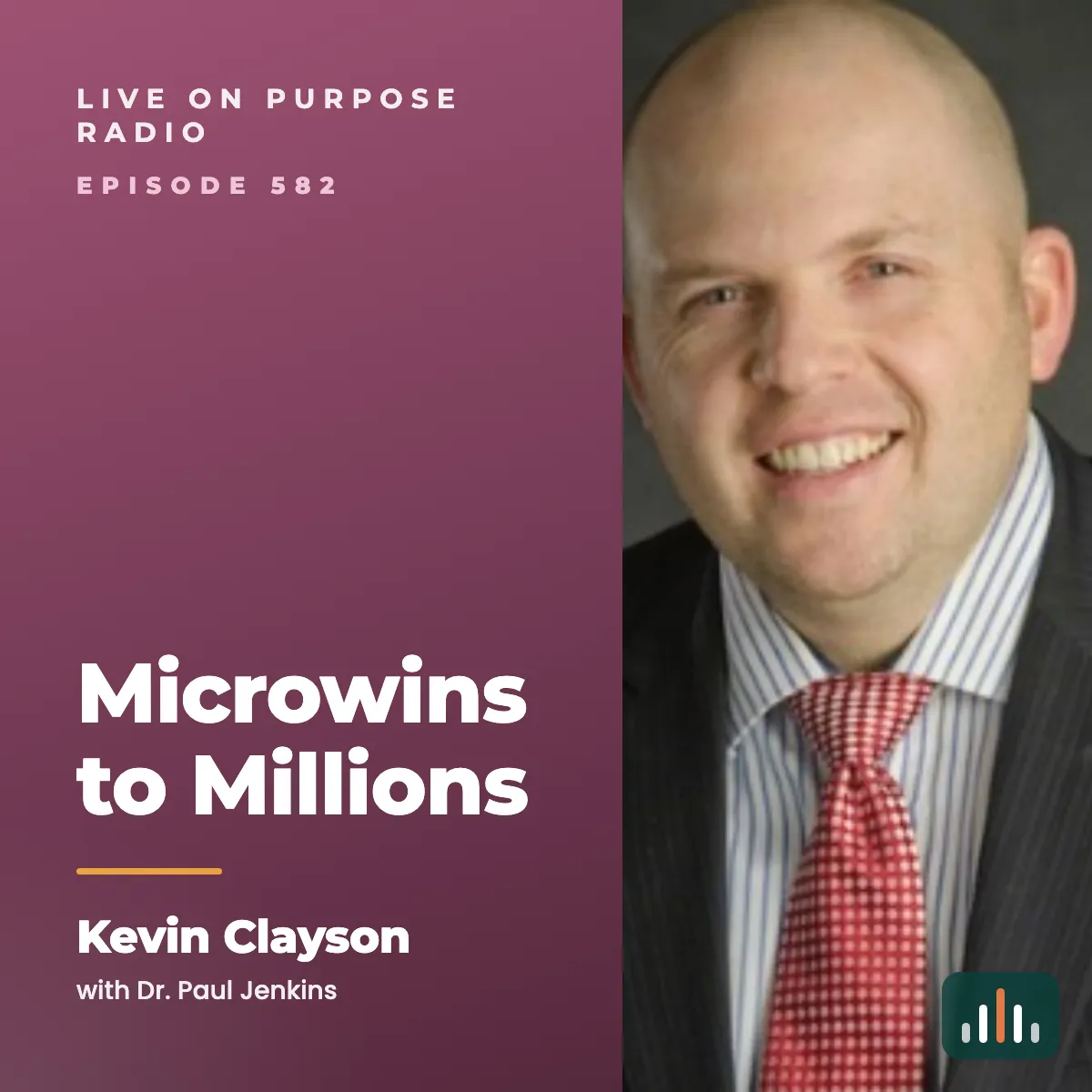
This is Live On Purpose Radio episode 582, micro wins to millions with Kevin Playson. Now is the only time to create and live the life you love. I'm doctor Paul Jenkins, the positivity psychologist. My job is to connect you to powerful positive psychology principles that immediately upgrade your relationships, business, and mental health. Are you ready?
Let's jump in. Hello, everybody. Welcome back to Live on Purpose Radio. This is doctor Paul, the shrink, who expands your life with another episode of Live on Purpose Radio. Joining me today is a returning guest to the podcast.
You may remember an episode from years ago called Flip the Gratitude Switch. And the author of that book, Kevin Clayson, has graciously agreed to come back to Live On Purpose Radio to grace us with his presence. Welcome to the show, Kevin. Thank you. And agree...
No. This is more like I begged you to come and hang out because you're so awesome, and I love this audience, and I am so grateful. And I... We we we should look up. Now look.
Here's what I am pretty sure of. I know when I published Flip the Gratitude Switch. K? It was in August 2016, and I would imagine we probably did the podcast around that time, which we... That you and I have been hanging out, and I've been learning from you and and loving you to pieces now for five, six, seven years altogether, which is crazy to think about.
And I could tell you I have it on good authority because I'm looking at myself on the Zoom. I have not got any more hair or any better looking. And the entire time, that's... I could tell you that. Well, that's an opinion because you may have gotten better looking.
Okay. May... Maybe. There's a chance. Okay.
I I have found... And I... I'm saying this only partially in a sparring, jesting way as we're having some fun together because you and I are good friends. We are. But I have found that as people apply principle in their life, it changes their appearance.
It does. Yes. It makes them more attractive. Yeah. The entire countenance shifts.
It's true. Yeah. And and so that's why I say you may have become more attractive, more good looking in that time. But I do That's all subjective, obviously. Yeah.
We're... I gotta tell you something. Kate, I was actually... I know we're gonna get into the episode, but you and I weren't... I love to be tangential with you because you're one of the few people in this world that that I can share just the most important thoughts with because you're such an incredible thinker, and the way you view and perceive the world is just special.
And I think if anybody's listening to this podcast, you know that. And and, you know, people like us sometimes, doctor Paul, we wonder we wander around the world, and we have thoughts that maybe not the rest of humanity has. Right? The way we view things, the way we interact with the world is different. And and today, I had this...
I had kind of one of those experiences. I was at the mall doing some shopping. I was buying something for my beautiful wife, and I went to this, store where there's some shoes. And I I started to talk to the cashier. Now she had great energy.
Right? She was probably, I don't know, 19, 20, 21. She was young. Right? And...
But she had great energy, just really nice. And I loved... I worked retail for many, many years, and I love it when you go into a retail establishment and the people actually seem like they enjoy being there or being... Talking to you as opposed to, you know, you go into some retail places, and they're like, please don't look at me. Please don't make eye contact.
I'm gonna assume that you don't exist. Well, that was not this young lady. She was just kind of exuberant. And so she started to talk to me, and, we started to talk about what I was getting my wife. She had got something recently for her boyfriend.
And in the middle of this conversation, she's like, I love your energy. And I said to her, hey. Right back at you, kiddo. And it was so interesting to me because then I started to walk through the mall. There's a lot of people shopping there today.
And I was just looking at faces and looking at body language, and I really thought about... I'd been in multiple stores today, and I thought about, was there somebody else who energetically I would have said to them, hey. I love your energy. And and maybe there was one, but the majority of the people that I interacted with, you could tell they were just there showing up, doing what they had to do, doing the bare minimum, not necessarily thrilled with life, liberty, and the pursuit of happiness. And, and and I was just like, wow.
There really is something about taking principles, not just acknowledging they exist, but acknowledging they exist and then internalizing and living those principles that quite literally changes what you just described, your entire countenance, your... The way you show up energetically, how you interact with people, and your attractiveness. You know? It's funny because I never ever felt like I was... I...
You know, I wasn't, I'm not Brad Pitt, but I... My wife is way more... She's way more beautiful than I deserve, and I always felt like the... I had at least a shot with with interacting with people and developing relationships, whether that was romantically or from a friendship, because I have lived by a principle that is not in our book, but it's a book that I absolutely love. And I know it's one that you love, and it's one that I think of all the time.
And it is from, it's from, Dale Carnegie's book, How to, Win Friends and Influence People. Right? Is it Dale Carnegie? Right. It is.
Right? And, and he says that in that book, there's principles. And one of them that I just... It's one of those things that stuck out that I've never forgotten. It's this, be intensely interested in other people.
And I've always... I love that. If you can actually be interested and have a conversation with somebody and love them for where they are and who they are, it's amazing how that can transform that relationship. And it's one of the reasons why I love you to pieces, doctor Paul, because that is who you are. What you're describing right now could launch us into a whole other episode.
Yeah. It really could. Because this is this is embodied in what I call the influence quadrant, which is one of the the models that you are trained and certified in as a certified positivity practitioner. I'm just gonna slip that in because the amazing Kevin Clayson is, in fact, a certified positivity practitioner. There are principles that determine all of life's outcomes.
And I want to use this as a kind of an introduction to your new book. You collaborated with Steve Earl, and we didn't invite Steve because he's kind of a party pooper. That's right. Well, actually, he's got... He's he's Canadian.
We don't want... We don't want that. You know? His family is the only thing that bumped him from having conversation with us today. That's right....
Both support his priorities in that way. So Steve is with his family today. But you and Steve Earl have collaborated on this new book, Micro Wins to Millions. Yeah. And I use that as the title of this podcast.
I told you you can use it as the title for your book as well Thank you. Appreciate it. Which is cool. Which... I already applied.
I are... That's how much of an action taker I am. I already applied. Applied it months ago, years ago as you've been working on this book. So micro wins to millions.
And let me just give a little personal introduction to this book if I could, because you and I, first... My first introduction to Kevin Clayson was when you were on the stage, on the mic, in an event that was all about real estate investing. I was sitting in the audience, and I heard this energetic fellow up there on the stage who talked too fast. Yep. That's right.
I I was laughing. I was connecting to principals. You're a very talented speaker, and that was my first introduction to you. But at the time, you were working with a a company that you learned a lot from Yeah. As you learned principles of real estate investing, and you have now combined with Steve to create a company Yeah.
That applies all of those principles that were working but is grounded in very, I I I wanted to use the word eternal. Mhmm. Eternal principles of truth. Yeah. And as I'm reading through the book, I'm noticing that it's all about connecting to principle.
Yes. First, at a personal level and then using your purpose in life to help guide the decisions that you make in something like real estate investing. Yeah. Well, Kevin, I applied a number of strategies earlier in my life. Now when you read my book, Pathological Positivity, you might remember that chapter one is titled lightning strikes.
Yes. You know, you're going along through life and you're minding your own business and then boom. Out of nowhere, this thunderous bolt of lightning just takes your feet out. And for me, it was a bankruptcy. Part of the context around that bankruptcy was the strategies that I had been applying in real estate investing.
I was young in my career. So, well, actually, I was fairly well established in my career, but this was a turning point for me. This is about halfway in my career, about fifteen years ago. And I wanted to get into real estate investing. The strategies that I was hearing were were very appealing.
It's like, oh, I can make a lot of money with very little work. Yeah. The... I mean, the flag should have been going up in my head right about then because I know work is a principle, and I know if I'm in it for the money, I'm not in it for the right reasons. And so there...
There's money there. Yes. But it's driven by more fundamental principles. And when I read your book, Kevin, micro wins to millions, I even wrote you an endorsement on this book because I'm like, okay. Finally.
Here we have a book that is not based on strategy. You do have strategies. Yeah. But it's not based on strategy. It's based on principle.
Yes. And for me, principles are eternal natural laws that are always on... Like gravity. You never get up in the morning and think, oh, wonder if gravity's on. Right.
Hence to be. Right? And many of those principles are principles of personal development and psychological wellness that I teach in my career, but apply across any industry. Yeah. So when I saw what you and Steve were doing with this, what it did for me...
Now remember, I'm been kinda gun shy after going through a bankruptcy when I Sure. You know, crashed and burned the last time I tried to do real estate investing. But I know it's not because of the real estate investing. It's because I got distracted from principle and adhered to strategies that may be successful in some markets. If you can identify the principles that drive it, then you can adjust the strategy to be successful in any market.
And I hope I'm not speaking out of turn here. No. That's perfect. Part of what it did for me, Kevin, is it reignited my interest, desire, and now intention to get back into real estate, but to do it in a way that is completely principle based. And I'm gonna let you help me with that.
Oh, that's awesome. Oh, thank you. That is so exciting. And I love that that you came away from the book with that because let me tell you something. When...
We've been... Our our our family, our friends, our clients, you know, we've got we've got a couple thousand clients across all 50 states. You know, we've been helping people successfully invest in simple and conservative investment real estate for fifteen years, Steve and I together working in some capacity. We've done over $1,000,000,000 in real estate transactions with our clients. We haven't made a billion dollars.
Let me be clear. In terms of volume of real estate transactions, we've done over a billion dollars... Over 5,000 purchase transactions. And if you take a look at a fifteen year track record and 5,000 transactions and that much volume, you... You're gonna learn a few things because real estate is never easy.
Real estate is always hard. We... That's one of the first things that I hope people get when they read the book is that you have to adhere to principle because the principles will guide you through the darkest moments of the real estate journey, but there is almost nothing on the planet that can create the kind of wealth and economic independence that real estate can, but you have to be willing to stick it out. It's going to require time, and it's gonna to... It's going to require work.
There are so many real estate gurus and coaches and all of these people who will literally jump on TikTok, jump on Instagram, make it sound so easy. Why? Because they wanna generate leads so that they can sell stuff to them, and they don't really care about what the outcome is. We are the exact opposite. We would rather scare people away and work with those that actually wanna do something of significance and understand that it's going to take some time to get there.
And and the way that we come at that is we take a principle based approach to real estate. And so as we were looking at, you know, as all... As we had so many of our folks saying you guys really should put everything you've been doing into a book, and I started to sit down and really map out, like, what would that book look like? And it was like, well, it could be a strategy book, and I could talk about the strategy, which we do. I mean, the subtitle of the book is The Moneyball Real Estate System, which effectively is the the realest strategy Yeah.
That we're employing under the micro wins to millions sort of philosophical background, and I'll kinda describe what that means here in a second. And as I started to... As we started to write things out and sort of flesh out the ideas, I went, you know what? We have to write a book that is 100% principle based for this reason. I know...
And I felt like this when I wrote flip the gratitude switch, and I know you felt like this as an author as well. The likelihood of somebody reading our... The entirety of our book whenever we publish one is is slim to none. Right? I mean, the...
There there are people... Like, you and I were avid readers. I listen. You read. You speed read, which is awesome.
But but there's so many people that don't actually get through all of the books, and I wanted to make sure that if somebody picked up this book and all they did was read the first couple pages, just the introduction, they'd come away with an enlightenment and an understanding that would hopefully help them as they move forward in their life. And then I wanted to repeat that process inside of every single chapter. And as we started to think about what the principles were, we went, wait a second. This can't just be a real estate book. Although it absolutely is a real estate book, it has to have a principle based approach to real estate so that the principle by itself could be a blessing to someone.
And then when they see now that the principle is real and they understand what the principle can mean and now they apply it to real estate, now you've got this magical combo of principle and strategy that allows you to move forward. Without one or the other, you either have just a personal development book, which is fine. We love personal development books. But even personal development books, you may you may have principles, but if it's not tactical, if you can't apply it, if it just sounds really pretty and good, it doesn't really matter. On the strategy side, like you just, talked about a minute ago with real estate, if all you have is a strategy of this is how you do real estate, you're missing a connection that's actually...
And this is the key. Micro wins to millions means you are going to stack small little victories one on top of the other in order to achieve a large result. But more than that, the the the main philosophical underpinning is this. It's not just about stacking the micro win. It's about stacking the micro win and celebrating the micro win for what it is, what it represents, the progress that was made, and that excitement, that celebration, that gratitude fuels you to then go and stack another micro win as opposed to, I'm shooting for this large massive goal.
And I worked so hard and I don't get it. And now I feel some sort of a letdown, and then I wonder if I'm ever going to do it again. But if you can micro win your way to millions, that means you're doing small things time and time again. You're celebrating each one, and then you are doing as our good friend doctor Benjamin Hardy talks about in a great book called the Gap and the Gain. He says, now you're looking backwards at what's been accomplished and celebrating that, which then fuels you to continue to accomplish and stack micro wins on your way to millions as opposed to saying, I'm here.
I wanna be there. I have so far to go, and then that somehow was sort of a defeating idea. And then if you fall short of whatever that large goal is, then you feel like you somehow haven't accomplished something. Are you kidding me? Listen.
If you wanna go run a marathon... And and look. I've run I've run four full marathons, which should be a surprise to anybody looking at me, but I have. And I'll tell you what. If you go run a marathon, okay, I get it.
If you don't cross the line at 26.2, you... You're gonna be like, oh my gosh. I'm a failure. Are you kidding me? What if you only got to 25?
Are you telling me that that's not an accomplishment if you got to 25 miles? Do you know how many people have never even considered going that far? And then we will look at ourselves and say, I didn't cross the finish line at 26.2 miles of the marathon. I must be worthless. No.
You have 25 miles of proof that you are worth significant... Significantly more than you realize, And that's the idea of micro wins. One step at a time, one win at a time, one victory at a time, celebrated as you go in order to fuel the large result and taking a principle based approach to that concept, combining it with strategy to create something that should be a blueprint, not just for real estate success, not just for growing financial opport... Opportunity in your life, but for literally shifting the way you view and interact with accomplishment and achievement in your life to create more joy and more happiness, which in turn will fuel more achievement and more accomplishment. And that's that's why we were so excited to do the book in this way.
Well, that's why you got an invitation to come to Live on Purpose Radio again. Well, thank you. Because what you're describing here, Kevin, is a very specific application of the model of positivity that most of our listeners here at Live On Purpose Radio are very familiar with. And you guys, if you're not, go to liveonpurposeradio.com/themodel and get a PDF copy of this with a little description of what I'm talking about. Because, Kevin, you're saying, look.
It is what it is. Yep. Where you are financially is what it is. Yes. What if you could celebrate where you are Yes.
And create a feeling of gratitude, that's your other book. It is. Gratitude and Peace, which flips the switch to the energy that you then take to creation mode. Yes. And you can take wherever you're...
This is one of your principles. Start from where you are. That's exactly right. That's right. Where else are you gonna start from?
You can sit around all day saying, well, I wish I would have done this twenty years ago. Yeah. Just like planting that shade tree. That's right. When is the best time to plant a shade tree?
Twenty years ago. When's the second best time? Right now. Yeah. Exactly.
So celebrate where you are. That's what first caught my attention as I was reading this book, Kevin, because it is such a profound psychological truth that where we are is perfect for us. It is. It's great. Now as you're listening to this, dear listener, you might be saying, my what it is isn't perfect.
Look. I'm coming from a place where my current what it is includes my son has cancer. Okay? And that has nothing to do with real estate or finance, but life has nothing to do with real estate and finance. Those are just tools that we use to live our lives.
Right? Right. When you come to peace and gratitude with exactly where you are, you realize this is the perfect starting place for what is to be, and that doesn't exist yet. We haven't created it yet. Yeah.
I love that. So true. And your model is so genius, and it is 100% in alignment. You know, the the book, I should say, is completely in alignment with the model. And all we've done is we've said, if we take a look at...
And then here's the other thing that I I just think is so critical in terms of the difference between, like, principles and knowledge or or strategies. And I I mentioned this in the book. You know, if you take a look at a principle, right, a principle being this underlying truth, as you said earlier, an eternal truth that sort of will continue no matter what the scenario may be. In the book, I use the example of, you know, a hundred years ago or a couple hundred years ago, you know, the idea of bloodletting or or or getting leeches, right, to to suck disease or sickness out of the body, that was no state of the art. It was state of the art, and the principle was to heal or or make the person's life better.
The knowledge that they had, the strategy that they used is now outdated, but the principle is still intact. Today, the principle, my my, my awesome niece who, you know, my sister, her, her daughter just had her colon removed at, like, age 30. I mean, it's just been a real struggle. And I look at these doctors as we've been visiting her in the hospital, and the principle that they have, that they're living by, that they are... That their their career is tied to is the same as the medical professionals two hundred years ago.
It's to try to fix the problem and make the person feel better. That's the principle. But the strategies today are quite a bit different than they were a couple hundred years ago. So the knowledge that was applicable then is not the same knowledge that's applicable now. And sometimes, I think we get confused with knowledge and principle, and that's one of the things we've tried to do in this book is keep it very evergreen.
So it's like, look. The principles are... Boom. We have the 12 principles. The strategy in the way that we use this principle with this version of real estate is as follows.
And that's kind of how we designed the book too is when we were going through and writing the book, I was like, I don't want it to just be a real estate book because I I just... I, again, I go back to the idea. I always think about the one person sitting quietly on their couch on a Sunday afternoon, maybe reading the book, and I I don't just think about them. I don't think about how much money they're gonna make, how much real estate they're gonna do. That's all great if it happens.
What I think about is I think about that moment when they're reading a page and they have that tiny little and that is a a it's a it's a motivation for movement, and it creates action for them that would not have existed otherwise. And that person in that moment with that phrase on that page, that is why we wrote the book. And I wanted to make sure that we had enough of those throughout so that regardless of whether or not somebody wants to do real estate, regardless of whether or not somebody wants to utilize real estate in a financial way, you know, they still will get something out of the book. And so the chapters are are quite unique in that the first part of every chapter demonstrates the principle. Mhmm.
We state the principle, and then we have stories, personal stories, business stories, both Steve and myself that we've had in our lives. And we use those stories and that articulation to demonstrate and sort of prove the principle. Then the second half of each chapter, we go, okay. Now that we know that that's the principle, how have we applied that principle in real estate? And then we show how that principle applied in real estate creates this result.
And that's ultimately what the Moneyball real estate system is that we articulate and talk about in the book. And the hope there is that somebody will go through that book, come away with thoughts and feelings about these principles, and then maybe even apply it in their own lives with simple and conservative real estate because we know dang well that if anybody's going to get ahead over the long run, so many of us look at our lives. We look at our income. If we're not entrepreneurial, I know a lot of people here probably are, but there's a lot of people who are not entrepreneurial. And they try to look at the world and they go, how am I gonna make more money?
What am I gonna do? And the only option they have is to work harder, get more degrees, go back to school, and hope that somebody that they don't control will give them more money, give them a promotion, or whatever the case may be. Entrepreneurs look at it, and we go, how do I start another business? How do I create another product? How do I come up with an idea that I can share with the world?
And then we feel like we're in a little bit more control. Well, whether you're an entrepreneur and a business owner or just kind of, you know, working, and doing your best to try to get ahead financially, real estate can play a profound role. But most people think I have to be super wealthy to do real estate. I've gotta have millions of dollars to do real estate. Most people think I couldn't do it on my own because I don't know how to do it.
There's there's so much uncertainty in in what it should look like, where should I be investing, how much should I be investing, what type of real estate, should I do single family homes, should I do multifamily, should I do apartments, should I do Airbnbs, you know, should I do, should I do wholesaling, should I do flipping, should I do lease options, should I do, you know, the BRRRR method, And then we go, oh my gosh. What am I supposed to do? I don't know where I need to go. I don't know how much money I need. I don't know what kind of real estate to do.
And we've only ever done one kind of real estate really well, which is single family residential real estate, simple and conservative in awesome neighborhoods where we do the majority of the work for our clients. But what we've done in this book is saying, look. We don't expect everybody to come and work with us. So we literally take the principles and unlock every bit of strategy, how we select properties, how we select markets, every bit of, of strategy that we use in order to select markets and select properties. We give you precisely how we calculate numbers and how we do the math in order to evaluate properties and show you what that means.
We talk about the benefits of real estate and how it creates multiple profit centers for you as opposed to just one where you put money in a four zero one k and an IRA. You have one way for that money to do well for you. The market has to go up. And if it doesn't, then you're in trouble. Real estate's different than that.
In the book, I articulate seven separate profit centers in real estate that whether you go do real estate or not, you need to be aware that there's other things out there for you so you can make strides towards economic independence. And spoiler alert, what we have found is the magic number for our clients. And just in general, if you can somehow, someway, get to 10 properties that you own, which may seem like a monumental task for somebody that hasn't even invested in real estate, but that's why we put it in the book. How do you not worry about 10 properties? How do you just go get one?
And if you don't know how to get one, how do you start where you are and get to the point where you can get one? And then what if that one could buy your next two, and those two could buy your next four? And then you organically multiply the portfolio over time. It's principles that allows that to happen, and we unlock it all in the book, both the principal side and the real estate side, because we just know that that's what we needed. And nobody was there to tell us.
So we figured it out in the school of hard knocks and then now been able to take it to thousands of people, but we've never before announced it in this way and shared it with the world. We're literally saying, here's the book. Go duplicate. If you could do this on your own, please do because we want this for people because I know it'll change their lives. And that's why it's micro wins to millions.
The millions is great, but if you don't make millions, that's okay. Millions should be an idea. Whether that's hundreds of thousands, tens of thousands, or millions, it's stack micro wins in order to get the big result and celebrate as you go. That's the crux of the book. I just wish I could find somebody who's passionate about this.
Yeah. If you find someone man, Kevin. I've been looking too. I get you going on this. I know.
You just take up, which is something that I love because you're taking something that you have some unique experience and expertise. And let me just comment about that because I met both you and Steve years ago when you were working in a different company. Yeah. Where... You say the school of hard knocks.
You guys have been in the trenches. Yeah. You you know what it's like to to apply a strategy that fails and leaves you in a financially desperate position. Absolutely. Kevin, you and I have talked about this personally quite a bit.
I've I've been through a bankruptcy. I know what that's like. Yeah. You've been scrubbing toilets to feed your family while you're publishing a book. Yep.
That's right. You've shared that story with me before as well. So one thing I appreciate about you and Steve is that you're not just taking an idea that you picked up somewhere and now going and trying to make some money off of it. In fact, I know your heart. And as you share your passion about these principles and your...
It's kinda like Elon Musk who goes out there and open sources the technology for electronic vehicles. And and now look at all the electric vehicles. He's changing the planet as a result. And I see you and Steve coming from a saint... A similar heart and mindset to focus on the principles.
And, yes, let's let's give the technology to people. They can work with us if they want to, and we're really good at it. And I'm gonna choose to do that, by the way. That's not necessarily an endorsement. It's just a declaration.
Well, thank you. Because why should I go learn to do everything that you guys already know how to do for me? So... Yeah. But that's not the purpose for the book.
The purpose for the book is to get these principles into people's hands with some realistically duplicatable strategies they can go do it themselves if they wanted to do this. Can I share with you? I mean, there's so many principles in the book that I love love love love love love love love love love love love. Like, all of them are so impactful and have been so impactful in my life, both in real estate and in real life. But I I love the last principle we talk about, and and and I don't know how much time we have, but my guess is we probably wanna wrap the episode soon.
So can I share? It's the last principle of the book, but can I just share it briefly? Okay. Yes. The last principle in the book...
And I'll talk briefly on how it relates to real estate just so everybody can kinda see that that that we talk about principle, we relate it to real estate, and how it all comes together. The the print... The last principle in the book is the power of one. And, you know, I come from a, I I don't know, background of feeling as though I had to accomplish massive things. Right?
I thought with my book Flip the Gratitude Switch, I had to sell millions of copies, and I had to be, you know, on stages every single day all over the world, and everybody needed to know my name. And I had a really awesome experience as I was kinda going through that stage of my life and realizing that I'm gonna choose to seek the quiet applause of heaven as opposed to the thunderous ovation of the crowd. And, for me, it's about individual moments, and it's about individual actions that nobody ever may know about, but that power that power of one can be so profound and impactful. You know, we don't understand what the power of a smile can do, what the power of one text in the middle of somebody's life's storm can do. I had, just as an example with Flip the Gratitude Switch, you know, we wrote the book.
We put it out into the world. I was contacted years after, and, there was a woman, I won't share her whole story, but, she was on the brink of taking her life. And she was about to make that move, and her daughter entered the room, and it interrupted what she was going to do. And not long thereafter, she was on Facebook, and she saw something for, the the book Flip the Gratitude Switch. She got a hold of it.
She got a copy. She read it. She reached out to me years later and told me that that moment, and not me, the strategies and the principles in the book got her out of a really dark place. And today, she is thriving, and she is doing so well. It wasn't the power of the one book.
It was the power of that one moment and that one share on social media that somebody shared, the power of that one sentence, because I guarantee there was a moment in the book, because it happens whenever we read a book. There's a moment, that one moment that shifts the trajectory of everything else. There... It was the power of that one moment, and now I look at the cascading effect of what it's meant to her, and it's incredible. When I think of real estate, you know, we think, oh, I'm a real estate investor.
Big whoop. Listen. When I go buy one property, k, not only is that gonna change my family's financial life because that one's gonna buy two and those two are gonna buy four, and I can multiply that out where maybe I own 10 properties and millions of dollars of real estate. But if I suck it all the way back down to just that one and I go get that one property, I love this. The mortgage professional that helps me makes money.
The real estate professional on both the buyer side and the seller side makes money so that they could put food on their table. The property manager makes money. It's not just the property manager. It's the rehab crew that's going in and fixing the property up, and it's the suppliers that supply the materials for the rehab crew to pick that proper... To fix that property up.
So it's the people in the transaction. It's the rehabbers. It's the property managers. It's the family that moves into my property and has a place that they can call home because we only buy... We talk about this in the book.
We only buy homes in certain types of neighborhoods that are three bed, two bath, two car garage because that's where families wanna live and where they need to start. And we're living in a world where more and more of us don't even wanna own a home. We wanna rent, and so if we could provide that place for them. So now we're impacting the the professionals that helped us with the transaction. We're impacting the people that are renting the property.
We're impacting that neighborhood because of the way that we select tenants and the way our property managers work with us. And then all of that, whether it's all of the professionals and everybody that went to work on the property, and we think about all the money that it represents and what it could do for them and the family that lives in the home. But you go... You you add all of that together, and it pales in comparison to what it means financially for you as an owner of that one property, which is crazy to me. So the ripple effect, the power of one in in in act, indeed, in real estate, it is this it is this...
It is throwing this small pebble in the midst of a of a a a lake that looks like glass. And while it may not seem like a large pebble, the ripples will extend far beyond that pebble hitting that water in the center, and that is the power of one. That one moment, that one choice, that one property, that one thing that you finally decide to do because you're not so focused on, I don't know how I'm gonna get to the end. I don't know how I'm gonna achieve the big result. Forget about that.
Suck it all the way back into that one next little thing because you don't know what the power of that one is going to represent for you and someone else. But I can tell you it'll be more profound than you realize. That... That's the last principle in the book that we talk about, and it's... I'm just...
As you could tell, I'm really passionate about it because it's something I've had to learn the hard way, doctor Paul. I've had to learn it the hard way. Me too. Did not realize that that was real. I did not realize the impact we can have in moments when we don't even realize we're having an impact.
And, yeah, that's... So thank you for letting me share that. It's just something that means so much to me. I'm so glad that you shared it, Kevin, and this is literally the way that we get to change the world. Yeah.
As you were talking, I was realizing the the home that a family lives in is at the foundation of our economy. Yes. It is. And for a lot of good reasons. And that's why I think real estate has always been part of a solid portfolio.
I'm excited to to add it back into mine and that you and I get to partner up on doing that. I'm I'm glad to. You guys, I hope you're gaining something from... I know that you are. Because every time I bring Kevin on, he inspires us.
Here's the thing. As we launch this episode... Now I don't know if you're listening to this in in the time that it's produced or later on. But if you're catching this in the thirty days from the time this episode launches on 01/04/2024 to a month later, there's a Kickstarter campaign that is going on to support this book and you get to have as you... If you believe in this cause like I do, you can participate in this Kickstarter event.
I'm setting up a special link just for the listeners of Live On Purpose Radio. Go to liveonpurposeradio.com and then enter this, m two, the number two, m. That stands for microins to millions, but do m, the number two, m, book. And that will link right over to the Kickstarter campaign. Go jump in.
Okay? Now if you're listening to it after that Kickstarter period, then you'll find microins to millions. Just go wherever you find your books, and you'll find it. Yes. And and we're going to promote this, Kevin, because I believe in what you're doing.
As a listener of the show, I invite you to use that link to participate in that Kickstarter program. That's the way you can get connected to Kevin and all the things that he's doing there. Thank you so much. Thank you. It's always fun to have these conversations, and I don't think we're done yet.
Good. We have a lot more to do together in life and and even if we wanna hang out and talk more today. Look. I got nothing better going on, and there couldn't be anything better than this. So...
You know? Well, I hope that you as a listener have gained something, valuable from this. You know what to do with it. Share it, and it's time to take what you've learned and go live on purpose. Did you get what you came for?
Give yourself the gift of taking real action on what you realized today. Please share this episode with someone you know would value it, and leave us a rating too. It's time now to live on purpose.
Open the transcript on its own page ↗