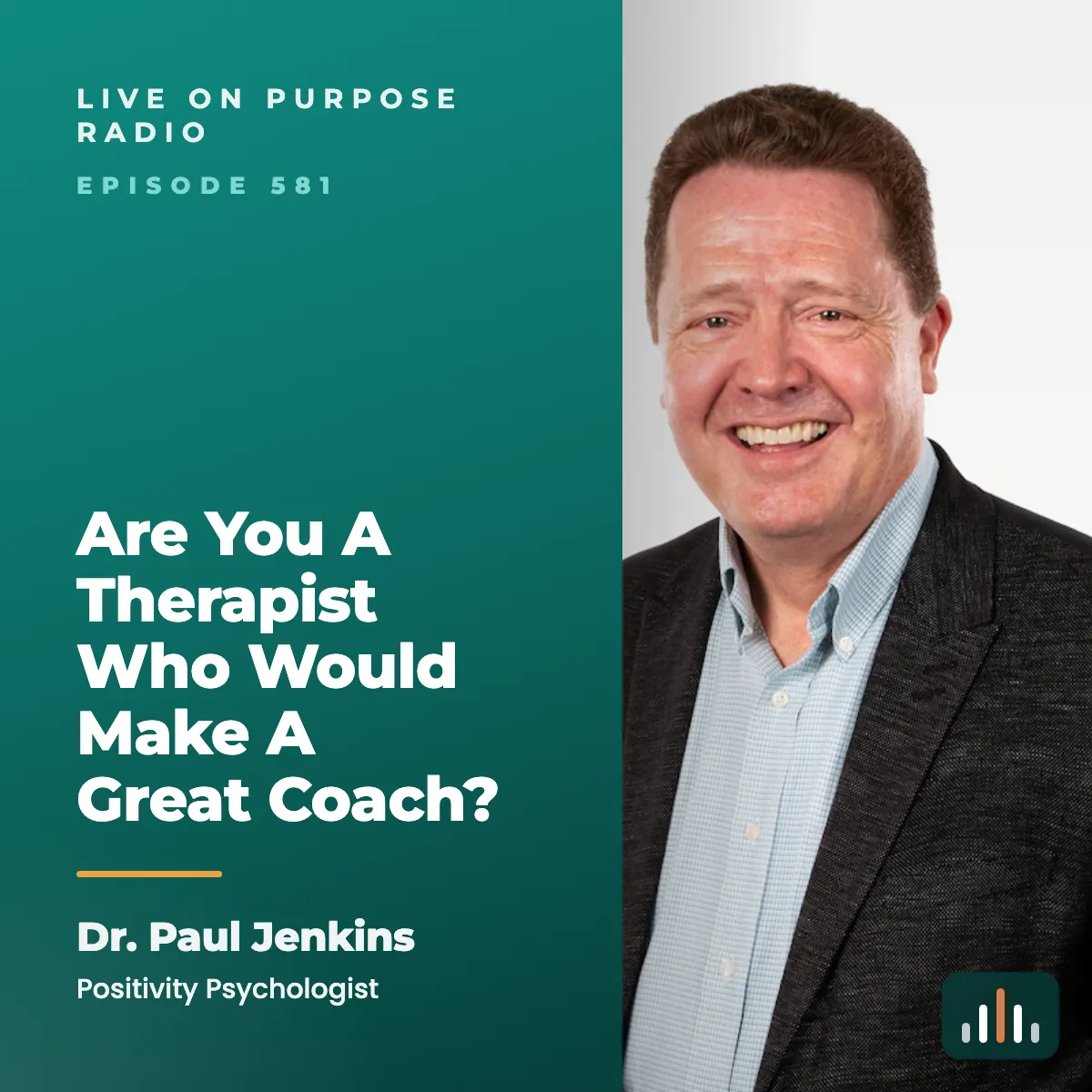
This is Live On Purpose Radio episode 581. Are you a therapist who would make a great coach? Now is the only time to create and live the life you love. I'm doctor Paul Jenkins, the positivity psychologist. My job is to connect you to powerful positive psychology principles that immediately upgrade your relationships, business, and mental health.
Are you ready? Let's jump in. Hello, everybody. Welcome back to Live on Purpose Radio. This is doctor Paul, the shrink who expands your life.
And, you know, I've made a transition in my career. I've talked about this a little bit before. I used to be a traditional psychotherapist. After I got my PhD in clinical psychology, For the first fifteen years or so, I had a traditional outpatient child, adolescent, and family psychotherapy practice, and I gained so much from that experience. It was amazing to work in the field of mental health and to function as a therapist.
I have since made a transition over to coaching, and there's a lot of reasons for that. Here are five things to consider. If you are a therapist who might make a great coach, and maybe you've even thought about it. If you're a fellow therapist out there, I'm talking to you today. And even if you're not a therapist, listen up because there might be some principles that would really resonate with you, especially if you have heard somewhere in your mind or heart a calling to help others in bigger and more impactful ways.
This might be for you. Okay. So here are those five considerations. Number one, there's a spectrum of mental health. If you think of your mental health, your emotional well-being, your psychological functioning all on a spectrum or a continuum.
Clear over on the left end is the sick end of the spectrum. That's where we have diagnosis, pathology, treatment, all that fun stuff. What's on the other end of that spectrum? This is what really gets me excited and lights me up. And to understand the other end of the spectrum, let's go to the middle first, which is health.
Health meaning not sick. You'd think health is the opposite of sick, but I put it right in the middle because, well, like your physical health. You can be sick in bed with a fever, throwing up. There comes a time you can get out of bed, and you're not sick. But that doesn't mean you're truly fit, thriving, prospering.
That's on the other end of the spectrum. And there is an underserved population right in the middle. And what I mean by that is that everyone has issues. Have you noticed? Look around.
Yes. Everyone has issues. Welcome to the planet. But the people who are picking up therapy as an intervention tend to be over on that left end of the spectrum where there's something diagnosable there because in the therapy world, you get to have a diagnosis and a treatment plan. Well, what about those people who don't quite qualify for the diagnosis, but they're not really clicking and thriving in their life either?
Well, those are the middle of the spectrum people. And I feel that experiences... Common human experiences of depression, anxiety, questions about life purpose, or struggles with relationships, that all falls in the middle of the spectrum. And maybe it doesn't qualify for an official diagnosis, but it certainly impacts your quality of life. And, unfortunately, the term psychotherapy sounds a little like therapy for psychos.
And I think that's so unfortunate because the processes and the principles that we practice in therapy can be very useful for everyone else too, but they don't sign up because they don't want the diagnosis, so they don't qualify for the treatment. And that's why this is an underserved population. People clear over on the other end of the spectrum are hiring coaches. Believe me. You go watch an NBA game.
These high level athletes have a whole team of coaches, and I'm not talking the other players that push them. I'm talking the coaching staff. There's a head coach, and then there's a whole bunch of assistant coaches helping them to achieve their highest potential. I've seen this in the business world. I've seen it in professional development that the high functioning folks hire coaches all the time, and the people who have identical...
Identifiable diagnoses are hiring therapists. But what about the people in the middle? That's the underserved population. And so I invite you to consider that as a therapist, as a mental health professional, as someone whose heart is in helping people. See if you agree with me that there's an underserved population right in the middle, And that might open up some possibilities for you as a mental health professional.
K. Here's consideration number two. You have, as a mental health professional, specialized training and experience that could easily adapt to serve another population, the people in the middle of that spectrum. I know this because I know what kind of training you've received. I I went through a PhD program in clinical psychology.
I know what kind of good skill sets you develop in the mental health field that could easily be adapted to work with other people. Just consider that for a moment. Now you might be thinking as we get into this conversation that you have a therapist friend or a sister or someone who's in the field that maybe would like to hear this. Would you please share this episode with them? Just take a moment to do that.
Okay. Now let's go on. Here's consideration number three. Coaching as an industry is generally free from the restrictions and regulations that are placed on the therapy field in the industry of mental health. Now this is both good news and bad news because being largely unrestricted and unregulated means that there's a lot of people coming into the coaching industry that may not have the same moral, ethical standards that I've seen a lot of mental health professionals to have because of those restrictions and regulations.
There's a lot of hoops to jump to become a mental health professional. I know because I am one. Coaching doesn't have those same restrictions and barriers to entry. Now this is good news too because it means, well, you're free. You're free to do a lot that you can't do in a therapy setting because it's free from the restrictions and regulations that are required there.
I won't spend a lot of time on that because I I know from my own experience that there are some frustrations that you can run into because of the regulations, and they're there for a reason. When we practice therapy, we are working with what is considered to be a vulnerable population, and that's why it is a licensed activity and is subject to all kinds of restrictions and regulations. Coaching is a completely different mindset, and the the people who are accessing that service are not considered to be a vulnerable population. There's no diagnosis that is given, and so the restrictions are not in place, at least as of yet. You never know what's gonna happen with government restrictions and regulations.
So, we'll see what happens in the future. But as of the recording of this podcast, it's generally free from those kinds of restrictions. Now as a trained professional, you're still going to use your good judgment and ethical decision making in any services that you offer, but there's a lot of freedom there in the coaching field as well. Let's go to consideration number four. Your good work, and please hear from my heart, from my therapist's heart to yours, your good work that you do with people is worth more than what you get paid.
I remember having a conversation with my mentor and dear friend, Randy Hyde. Doctor Hyde, we were working together at Preferred Family Clinic in Provo, Utah, and I had a conversation with him once at a time early in my career. And I said, I just really would love to get to a point where I could be paid what I'm worth. And Randy looked me right in the eyes, and he said, I could never pay you what you're worth. And there there were several meanings embedded in that.
I mean, he's a dear friend of mine, and he always was so affirming. And and, as my mentor, he just wanted me to know that my value was immeasurable, which I appreciated him for on a personal level. But he also was saying at a professional level, the compensation that is typically available for a mental health professional is not what they're worth. That you are doing better, more work, than you could possibly be paid for. The work that you do as a therapist is life changing, life saving.
It saves and enriches key relationships. What is that worth? You couldn't possibly be paid what you're worth. I can tell you, as someone who's been in both worlds, that since I entered the coaching industry and used that same skill set and that same experience to help people at a bigger level, helping more people, I am being compensated far better than I ever was as a therapist. And that is fun, but, also, I would invite you to not get into coaching if you think it's just a way to make a lot more money.
I think you get into it because you feel called to really serve people and have a bigger impact, and the money is available. There are business models that will allow you to put an economic engine behind it. I still remember a conversation I had with one of my mentors, and it kind of tipped me over at the time. This was my financial adviser, Les McGuire, and he has since passed away, and I'm... I miss his wisdom.
But he told me at the time, he said, Paul, you need to create more value for more people, and he's my financial adviser. Right? You need to create more value for more people. And I'm like, I do good work. I do...
What do you mean create more value for more people? I work all day every day doing good work for my clients. He said, I know. I know. I know.
I get that. But the economic answer is always to create more value for more people. And let me just put a perspective on that for you. If you go to my YouTube channel, Live on Purpose TV, did you know that there's a Live on Purpose TV? It was very different from the podcast, Live on Purpose Radio.
Here, you get the philosophy and the interviews with thought leaders. The Lumberbuss TV is a a YouTube channel that, for the first several years, focused primarily on positive parenting. But if you go to the YouTube channel, you're going to see we have almost 420,000 subscribers at the time of this recording. Now it changes every day, and that's humbling to me. That's generating approximately 10 to 12,000 views every day.
And as a therapist, that blows my mind. As a coach, I look at it and say, awesome. Okay. We're reaching some folks. We're we're creating more value for more people.
As a therapist, I was fortunate if I could serve 20 people in a week. 20 to 30 people was a full time load. K? And now 10 to 12,000 views a day? Wow.
Now you you might argue, okay. But they're not really your clients. No. Some of them are. K?
And that's part of the business model. You... As you create more value for more people, you also create more demand for the good work that you do that makes a huge difference services. I won't get into that too much, but realize your good work is worth more than you get paid. And the solution is to create more value for more people.
Okay. Let's go to that fifth consideration. You already have a sense... Just look inside of your heart and mind. You already have a sense that your sweet skills could be put to a greater purpose and use.
Do you feel that? I know I was feeling it, so I still feel it. I still feel that there are things I could do better, that somehow the skills and experience I have could be put to a higher use and a greater purpose. And and I'm on a constant journey to define that. Part of my practice now, the...
A big part of it actually is training and supporting and certifying positivity practitioners. That includes therapists, but it also includes coaches. It includes authors and speakers and parents and teachers, people who have the calling to help and serve others through principles of positivity. If I can help you with this, I'm all over it. K?
Because that... And it's not for everybody. Don't worry. If it's not for you, I hope you enjoyed the episode, and share it with somebody that you think would would appreciate it as well. But if this resonates with you, I invite you to take the next step to fill out a little quiz.
K? I've got a quiz put together for you that will help you to see where you are in the process of becoming a certified positivity practitioner. To get to that quiz, just type in the name of this podcast, liveonpurposeradio.com. Go to that URL, liveonpurposeradio.com/practitionerquiz. You got that?
The name of the podcast, liveonpurposeradio.com/practitionerquiz, and that will pop you right into a little survey that you'll take. And I'm going to ask you to just see how clear you are about seven different areas that I think are really important if you want to get into this kind of work or expand it the way I have into a coaching practice based on principles of positive psychology. Go take a look. And if it resonates with you, we'll have a conversation. I'll let you know what's coming up.
We've got a certification event just around the corner, and there are chances for us to work together and collaborate on what I feel is some of the most important work on the planet. I hope you got what you came for today. It's time to go put what we've learned to use and live on purpose. Did you get what you came for? Give yourself the gift of taking real action on what you realized today.
Please share this episode with someone you know would value it, and leave us a rating too. It's time now to live on purpose.
Open the transcript on its own page ↗