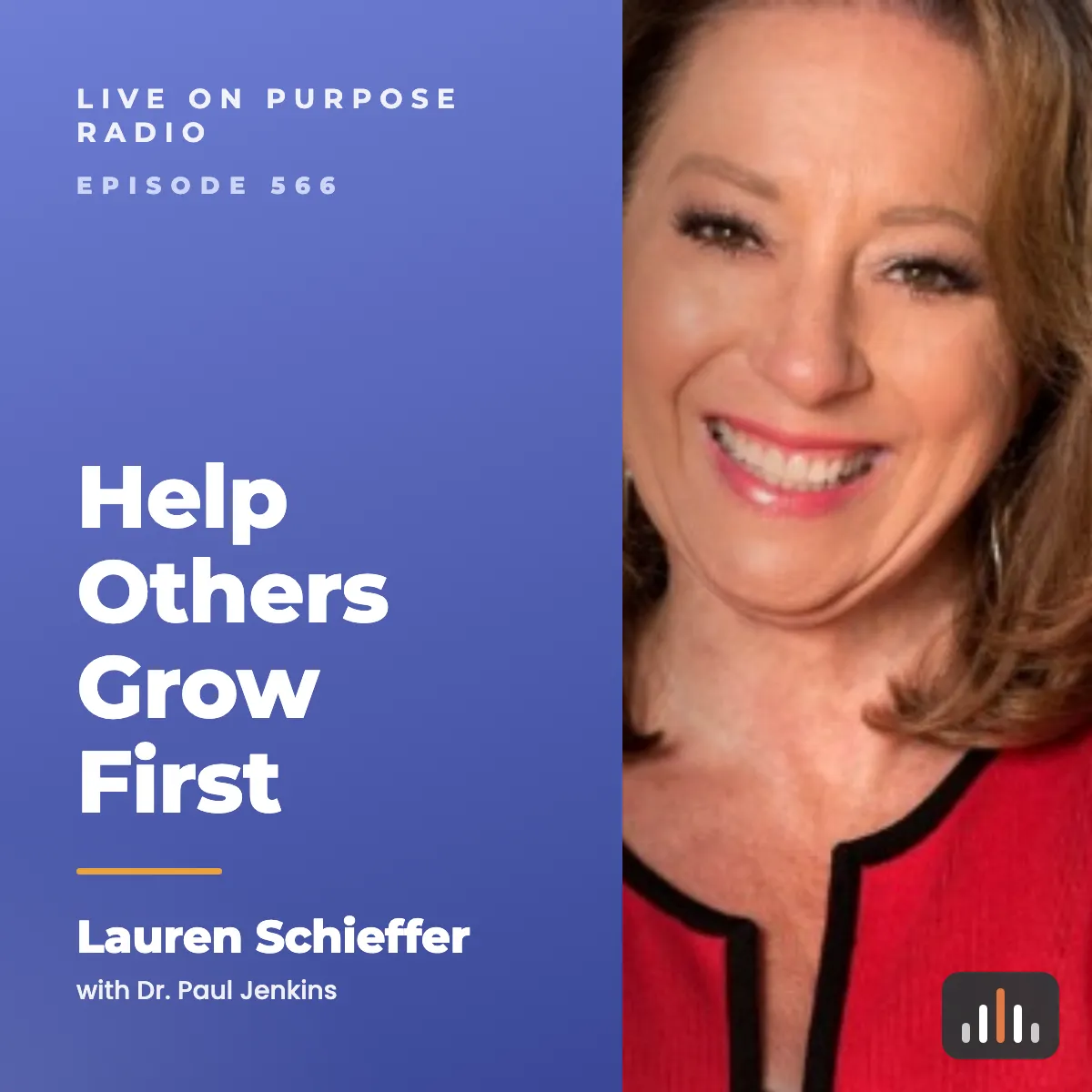
This is Live on Purpose Radio, episode 566, help others grow first with Lauren Schieffer. Now is the only time to create and live the life you love. I'm doctor Paul Jenkins, the positivity psychologist. My job is to connect you to powerful positive psychology principles that immediately upgrade your relationships, business, and mental health. Are you ready?
Let's jump in. Hello, everybody. Welcome back to Live On Purpose Radio. This is doctor Paul the shrink who expands your life with another episode of Live on Purpose Radio. Joining me today is the colonel's daughter herself, Lauren Schieffer.
Welcome to Live on Purpose Radio, Lauren. Thank you, doctor Paul. I am just privileged to be here. I am so glad that you're here, and I've been looking forward to this for some time. Lauren, your new book, Help Others Grow First, and there's a subtitle there, how smart leaders attract and retain great employees.
This caught my attention. Now I've followed your work for a while. We've been colleagues in the National Speakers Association for probably close to a decade now. And and I've known what you do, but when I read this book, it occurred to me that you and I have the same job, and that is to illuminate the obvious. Indeed.
Your your book was packed with such powerful, practical content around leadership and what it means to be a leader. But almost every point, I was like, oh, well, yeah. You know, it it occurred to me that this was obvious, but you don't always notice it. And sometimes these principles get lost as a result. That was my overall impression as I read through this book.
The obvious is not always apparent, and the simple is not always easy. Well, this obvious but unnoticed thing, sometimes I, will bring this up, like, when I'm doing a keynote or training. And just call your attention, for example, to your shirt. Everybody, as you're listening to this episode, do you feel your shirt on your body? Well, yeah, now now that it's been called to your attention.
Right? But our brain our brain has a way of just tuning those things out, and I think a lot of the principles that you identified in this new book of yours are in that space. You have carefully thought about what is it that allows great leaders to attract and retain the kind of people on their teams that are really gonna help move the needle forward. And I I think, listeners, as you read Lauren's book, you're gonna have a similar experience to what I did, that it will be like, oh, well, yeah. It...
It's obvious, but unnoticed. And, Lauren, you did a great job of illuminating the obvious there. Well, thank you very much. What, what prompted that book is the greatest challenge that employers and organizations are having as we come out of the 2020, mutual trauma that we all existed... That we all lived through.
The lockdown and the pandemic, is how do we attract and retain great employees? And for most people, it's a consistent uphill battle. And they seem to be fighting the revolving door syndrome all the time. And that's because the workplace in twin... The the employees in the workplace in 2023 are looking for something completely different than has ever been offered before.
They're tired of striving for success, and they're looking for significance. And if we can offer them that, we can engage, keep, and they will be loyal, those employees. You threw out a word that I think we need to dig into just a little bit, significance. Mhmm. There's a huge difference between success and significance.
So talk about that for a minute and why that's so relevant in in our world today. Well, most of us are programmed to chase success. Success is inwardly focused. It's about how much money I make, what my title is, what my achievements or my accolades are, where my parking spot is. It's about me.
Significance, on the other hand, is outwardly focused. Significance has nothing whatsoever to do with how much money someone makes. Significance is about how many lives I touch and the manner in which I choose to impact them because how we impact others is a choice. It's a choice we make every day. Significance is about a universal we rather than about me.
The colonel... I quote my father all the time. You know that. Mhmm. The colonel used to say, anyone can be successful, kiddo.
Making money, losing it, making it back, that's easy. Choose to be significant, kiddo. The the the shift in that focus is profound. And when it comes to leadership, Lauren, the thing that I love about this is that leaders who are self focused are typically not actually leaders. Boom.
Exactly. They just think they are. Yeah. And the the real measure of a leader, dad used to say, you will know that you are a significant leader. When people who talk about you don't talk about what you've achieved for yourself, but rather what you've accomplished to benefit others.
So it it has nothing to do with with things that we collect in our lives that we think are important. It... It's about how much impact we've had for others. That's what significant leadership is. And coming back to the discussion about what employees are looking for nowadays, they're looking for a measure of significance.
Mhmm. Our communal brush with death, so to speak, in the pandemic... I don't know about you. I lost good friends. I lost good friends in the pandemic.
Our communal brush with death has made everybody rethink what's important, and that is extending to the workplace. Mhmm. So we have to figure out how to engage that brand new workforce. You know, Lauren, as I was reading your book, it occurred to me that if we would pay a little more attention to what it is that has actually influenced us as human beings, we we would know better how to show up as leaders. Mhmm.
The the significance that you're talking about here. I think of people who have had a profound influence on me. And one that comes to mind is one of my little league basketball coaches, coach Klein. Is this big German guy who is coaching these these little pee wee's playing basketball. I'm like, my mom signed me up.
I think she figured it would be, you know, good for me to get... I was not very athletic. Lauren. My my nickname in high school was Yoda. And it didn't it didn't have to do with all the wisdom I had gained at the ripe old age of 12.
Right? Why not? Do or do not. There is no try. But, anyway, I remember this experience with coach Klein when he pulled me aside after one of our games, And he put his big German arm around my little scrawny shoulders and said, Paul, thanks for coming.
We couldn't have done it without you. And I knew darn well they could have done it without me. I think I maybe made one pass to an actual teammate. I didn't score any points. You know, I I can play basketball now, but I didn't get my growth spurt until I was a junior in high school.
But this coach, it wasn't... You know, most of my coaches... I remember most of my little league coaches when I was growing up had a, come on, you guys. You can do better sort of an attitude. Coach Klein's focus was very much in this area that we we can put under this umbrella of significance.
He became a significant leader in my life because his focus was on how I felt about me. And everything that he was doing was was based around that, and he earned the right to influence me. Mhmm. Potentially, if I'm going to extend, that thought concept out potentially by changing one word rather than you can do better, you can do it. I believe in you.
You can do it. Mhmm. My godmother used to, have a habit that I picked up from her of telling everyone in every chance she got, I appreciate you. And she knew that life was short. My godfather, was lost in Vietnam.
And, her second mother... Her second husband, I guess, my step godfather, perhaps, also went down in Vietnam and was, a prisoner of war for a year and a half. So my godmother had, an unusual perspective on the shortness of time. Mhmm. And she used to say, we need to take the time to let people know that we appreciate them now.
Mhmm. Because tomorrow's not guaranteed. So tell them now. Right. And and that also is part of leadership.
That's a habit that that I have picked up that sometime I I do without thinking to tell people I appreciate them. Mhmm. Whether it's the cop or the or the police... The the garbage man or the person busting my table or share... Or refilling my water.
Mhmm. So... And the coach did that for you. We couldn't have done it without you. Yeah.
Which is his way of saying I appreciate you. Right. I'm thinking of leaders that I work with too. I've got a couple of corporations that I I consult with and I provide some training for their employees. And just the fact that they have hired me to come in and work with their people says a lot about them.
Because as a psychologist, my focus is not on the hard skills that they learn in their specific industry, But it's on the... They used to call these soft skills, learn. And I'm hoping that that trend is changing because the soft skills, so to speak, of of interpersonal dynamics and creative starts with you and me because they are not soft skills. They are essential skills. They are the fundamentals, the prerequisites, the essentials.
Yes. I believe that. Mhmm. And I see a lot of people with high technical skills who who are not very good in their essential skills. Yep.
But these two leaders in particular that I'm thinking of, one is in an accounting firm, and the other one is in an IT company who recognize that it's not about success. It's about significance. And success comes as kind of a strategic side effect, I think, when when that focus shifts as as you've so artfully described it here today. And I see that manifesting in these two companies. It it shows up in their bottom line, but it shows up very prominently in the satisfaction and the energy level and the motivation of the people who work for them and with them.
It's more of a work with them kind of a mentality. Yes. Yes. And I... My...
I I say that often and my experience has proven that that if we focus through... Focus all of our efforts through a lens, a filter of significance Mhmm. Success follows in the wake Yes. Naturally. A strategic side effect.
Strategic side effect. I like that. I do too. I heard that from one of my coaches, years ago, and it's always stuck in my mind that you don't focus on that. It just shows up when you focus on the right things.
Mhmm. That is correct. So so, Lauren, I'm I'm thrilled that you brought up this idea of significance before success. When you are working with an organization, when you're training, when you're speaking, where do you start to help people grasp that idea? What Start with nine essential starting point.
The nine essentials of significant leadership. The nine essentials of significant leadership. That sounds like it's a whole book. Yes. That is the foundation of the book Help Others Grow First.
Yes. I've had the privilege of sitting at the feet and learning from some truly significant leaders, in addition to my father. My father was a significant leader. Some of them I knew because of who my father was and what he did for the Air Force. I had the opportunity to meet people.
Some of them I, have learned and been mentored by on my own. All of them had certain characteristics in common. And I steeped down those certain characteristics into the nine that I thought were the most important, which I subsequently trademarked as the nine essentials of significant leadership. Mhmm. And, I can just rattle them off for for you here.
They come in a certain order for a reason. Yes. Essential number one, understand your own values. Value, no s. Understand your own value.
Mhmm. We cannot treat other people with respect if we don't respect ourselves. I... That is true. And it's not about self confidence in the job.
It's about self esteem in the human being. Mhmm. Understanding that we have value inherent in us that is, cannot be adjusted by any external force. Right. It just is.
I love it. That is required for us to respect ourselves and therefore, essential number two is respect to all people. Mhmm. And that's that one is kind of a a a tricky concept for many people to grasp because I word it that way on purpose, respect to all people. I have met people in my life.
I've observed, encountered people that for whatever reason, I cannot respect them. Maybe it's their words. Maybe it's their behaviors. Maybe it's, the choices they continually make, differing ethics, whatever it is. I can in no way respect them.
That doesn't mean that I don't make a daily choice to treat them with respect. Right. So that essential is respect to all people, not necessarily respect for all people. The colonel said you don't have to respect everyone, Lornan. You have no right to disrespect anyone, young lady.
Well, that's about how you show up. That's needs to be your character. Exactly. So essential number one and essential number two, are also what I call my two pillars of serenity and success. Mhmm.
Solid understanding of my own value as a human being because I exist, and a daily choice to treat all people with respect. Whether or not I like what they think, say, or do, I still choose Yes. To treat them with respect. Essential number three, act with integrity at all times. Mhmm.
And it's that great philosopher, anonymous, who said, integrity is what happens in the dark. So my definition of integrity is doing what is right because it's right every time, whether anyone is looking or not. Yes. So act with integrity at all times. And maybe especially when they're not.
Especially when we think they're not. Someone Right. Good point. Is always watching. Mhmm.
And even if it's not someone here on Earth with the cameras and and everything, and if you believe in a higher power, which I know that you do, and as do I, they're always watching. And even if you don't believe... If someone doesn't believe in a higher power, our subconscious is always watching. Always watching. And shame shame robs you of your self esteem.
True. So those are our first three. Essential number four, open your mind to new possibilities. A closed mind cannot grow, and a closed mind cannot lead. Essential number five, cast a vision.
Now casting a vision may seem like leadership one zero one material, and and to a certain extent, it is. But significant leaders look beyond the vision for the company, the department, the division. Significant leaders find a way to figure out what that vision looks like for each person they lead. What's it gonna look like, be like, feel like, smell like when we get to where we're going together? Why should it matter to them?
What's in it for them? That's how significant leaders cast vision. Mhmm. Define. Yes.
Essential number six, communicate respectfully. You know, for years, I thought that there were three kind... Three ways to communicate. You can be passive, you can be aggressive, or you can be assertive. Now if you're passive, people are gonna steamroll all over you.
If you're aggressive, you tend to repel more people than you attract. For years, I said truly successful people are assertive. Well, about a decade ago, I challenged myself to a higher standard. And therefore, I have no choice but to challenge my audiences to a higher standard, and that is respectful communication. By its very nature...
Pardon me. By its very nature, respectful communication is assertive. I've discovered that not all assertive communication is necessarily respectful. That's true. And may border on the aggressive.
Exactly. Exactly. So, that's why our essential number six is communicate respectfully. Say what you mean. Yes.
Mean what you say. Don't be mean when you say it. Essential number seven, lead by example. The colonel used to say there are three and only three ways to lead. By example, by example, by example.
And that's...... Could've guessed that third one. You could've. You probably could've because you're a smart guy. And that's not just in the office because your team is watching you everywhere.
They're watching how you treat the cashier in the grocery store and the busboy in the restaurant. And whether that candy wrapper falls out of your hand into a trash bin or onto the sidewalk, they're washing they're watching you all the time. Lead by example. Essential number eight, celebrate the results of others. Significant leaders do not look for accolades.
They look to give accolades. And essential number nine is work for our replacement. Our number one job as significant leaders is to replace ourselves. So these are the nine essentials of significant leadership, and that is the foundation of the new book. And to answer your question, which I did not forget, when I start with the company, I always start with the nine essentials.
And that's everything we do from that point forward always filters back through the nine essentials. How does that relate to the nine essentials? Because my experience has shown me that the day to day deliverables of leadership, These are gonna be, you know, increased productivity, increased profitability, increased market share, customer satisfaction, employee engagement, reduced attrition. All of those will fall in line naturally if the leader filters all of their efforts through the nine essentials. That's what makes a significant leader.
Mhmm. And then the success becomes a strategic side effect of applying those nine essentials. Now I will tell you that I've had, a couple of people ask me, well, what's the difference between a significant leader and a servant leader? I mean, there are hundreds of people talking about servant leadership, and that's true. There is absolutely nothing wrong with servant leadership.
Servant leadership is is noble. It asks for nothing in return. Significant leadership does. Significant leadership expects that that which I feed into you, that I, use to help you grow, you take that and you pay it forward into someone else, and that you help them grow so that the significance grows with a ripple effect. That's why significant leadership is one step, I believe, beyond servant leadership.
It adds a layer of richness there that, I think is is really important. Again, Lauren, when we started this conversation, I I pointed out that you're really good at illuminating the obvious. Those nine essentials that you shared and which are also in your book, Help Others Grow First. You've had other books too. You've you've got Colonels of Wisdom spelled c o l o n e l.
Yes. Because I am the colonel's daughter. Because you are the colonel's daughter, and you've... But you've got, I think, a couple of volumes of the colonel's wisdom. I do.
Each of each of the colonel's of wisdom books, there are two of them right now. Number three is is in the works. Oh. Are quotes from my father. Mhmm.
And then I take that quote and I, flesh it out. What did it mean to me? What is the story behind the quote? What might it mean to you? Volume one is, all focused on leadership.
It's a daughter's reflection on leadership. Volume two is all focused on significance and a daughter's reflection on significance. There are 52 quotes in each of those books. So that one could, theoretically, if you desire, use them once a week as a study for for a year. Volume three, when it comes out, and I'm not gonna give you a date on that because I'm because I'm still working on writing it.
But volume three, when it comes out, will be a daughter's reflection on ownership and personal accountability. Wonderful. And all of these can be found through your website Mhmm. Which is lauren schiefer, spelled schieffer.dotcom. Laurenschiefer.com.
That's where you can... And any place you find your your good personal development business leadership books, whether that's Amazon or your, you know, your favorite source. You can find Lauren just to look her up. Laurenschiefer.com. The book that we've focused on today is help others grow first, And this will contain those nine essentials that that, Lauren introduced to you here today on the show and a lot of other really practical, applicable ways that you can become that significant leader.
Lauren, is there some, parting thought that you would like to leave our listeners with today? Anyone can be successful. Choose to be significant. It's a choice. It's a daily choice.
That's perfect. K. You guys, you've heard it from the colonel's daughter herself. It's time now for all of us to go apply it and live on purpose. Did you get what you came for?
Give yourself the gift of taking real action on what you realized today. Please share this episode with someone you know would value it, and leave us a rating too. It's time now to live on purpose.
Open the transcript on its own page ↗