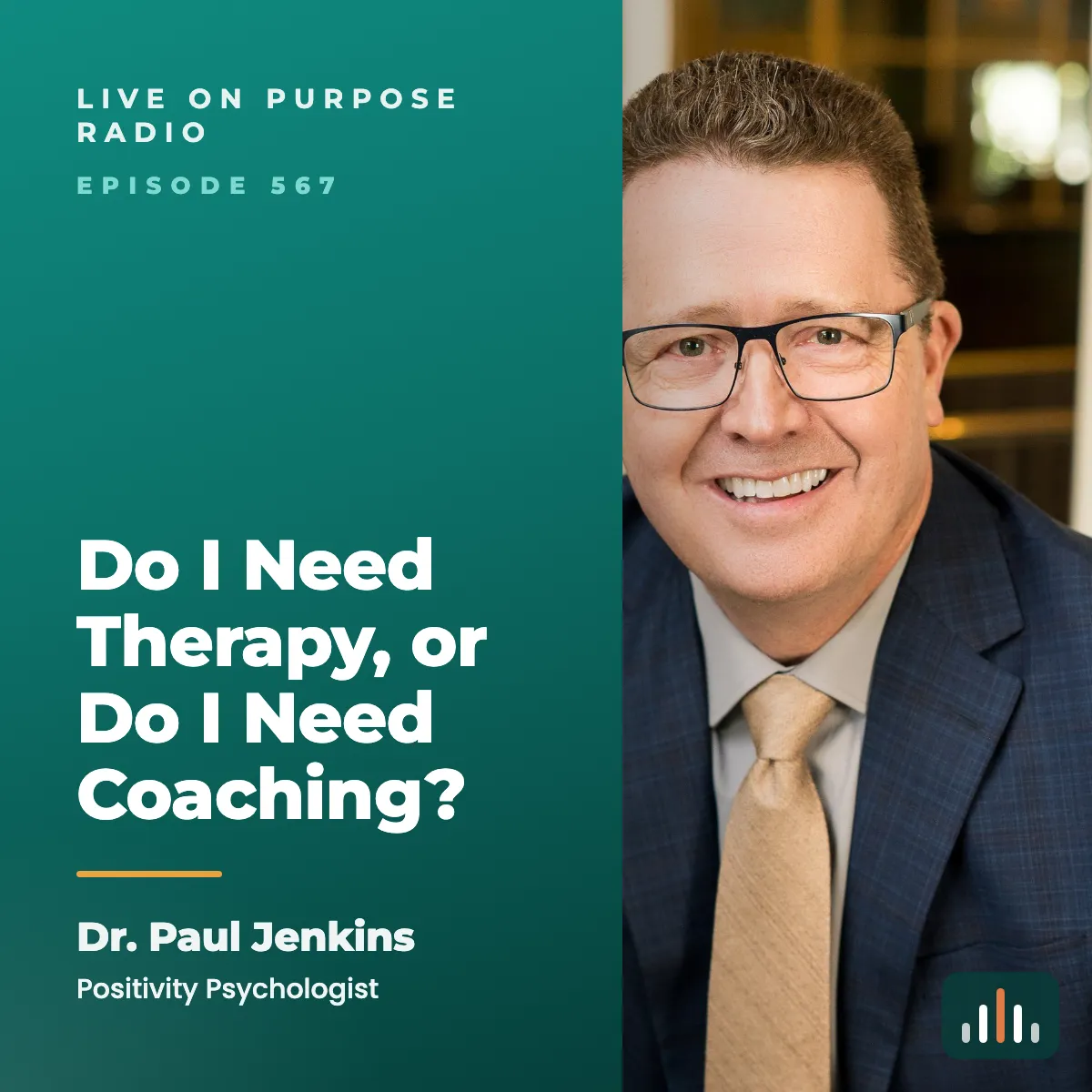
This is Live On Purpose Radio episode 567. Do I need therapy, or do I need coaching? Now is the only time to create and live the life you love. I'm doctor Paul Jenkins, the positivity psychologist. My job is to connect you to powerful positive psychology principles that immediately upgrade your relationships, business, and mental health.
Are you ready? Let's jump in. Hello, and welcome back to Live on Purpose Radio. This is doctor Paul, the shrink who expands your life with another episode of Live on Purpose Radio. I'm going to jump right in here today.
Do I need therapy, or do I need coaching? Has this question come up for you? You know, most of us as we go through life, we encounter challenges or roadblocks or things that come up for us that sort of put us into a funk or get in our way or we feel stuck in certain ways. Welcome to Earth. That's how we roll here.
Now let me put a little context around this because I get this question fairly often. Do I need therapy, or do I need some coaching? The the answer to that is probably yes. Now which one are you going to pick? You'll choose well for yourself if you know the difference and if you know what it is that you're looking for.
Okay? So let's set it up this way. If you think of your mental health, your relationships, your emotions, everything that makes up your psychological life on a spectrum or a continuum. So think of it as going from... Clear over here on the left end is the sick end.
So that's where we have diagnosis, pathology, treatment, sickness. K? Well, what's on the other end of that thing? To understand the other end of that spectrum, let's go to the middle first. That's health, meaning not sick.
K. So think of your physical health, for example. You can be sick, in bed, with a fever, throwing up. There comes a time when you can get out of bed, and you're not sick. That's right in the middle of the spectrum.
But just because you can get out of bed and you're not sick does not mean that you're truly fit, thriving, prospering. That's over here on the right end of the spectrum. So when you think of it on that continuum, the left half of that continuum all the way up through not sick is where therapy is indicated. Okay. Now I'm coming from a history, a background with this.
For the first fifteen years of my career, I had a traditional outpatient psychotherapy practice. I would bring in my clients, give them a diagnosis, which I am still licensed and credentialed to do. And then I would work up a treatment plan and provide for them therapy consistent with that treatment plan. With what goal? Well, the goal in therapy is to get out of bed so you're not sick anymore.
But there was something a little frustrating about that. Now let me just pause from from that description for a moment to acknowledge that there are principles. This is not magic. It's not luck. There are principles that determine all of life's outcomes.
One of my colleagues and a a previous guest on this show, Brett Harward, wrote a book called the five laws that determine all of life's outcomes. Now that's a pretty bold title, but what I love about Brett's title is that it it summarizes very quickly in just the title that principles determine all of life's outcomes. So when I'm talking principles, I mean, like, gravity. K? You never get up in the morning and think, oh, I wonder if gravity's on today.
No. It tends to be. And if you were to jump from the top of a tall cliff, what would happen? For sure or maybe? Sometimes or every time?
See, gravity is always on. It doesn't ask you first if it's okay that it pulls on you all day long. It's just on and you assume that it is, and so you put on your shoes in the morning. You wouldn't need shoes if we didn't have gravity. So that's what I mean by principles.
There are principles that determine all of life's outcomes. And in my psychotherapy practice, I learned and then applied and helped to coach my clients through those principles that allowed them to get different outcomes in their life, whether it was in in depression or anxiety or whatever it was that was getting in the way. K? So those principles allowed us to get to a point where we're not sick anymore. Pretty cool.
But one of the frustrating things for me is that after we got to that point where they're not sick anymore, the insurance company would pull the plug and say, thank you, doc, for all the service. It's no longer medically necessary. So therapy requires a diagnosis, a medical necessity, a a need for treatment. Okay? And it comes from the medical model, which I'm not sure is the best fit, quite honestly, for our mental and emotional well-being.
I think there's a lot of useful concepts there, but I think it gets in our way sometimes too. So we we stop. Right? Right in the middle of the spectrum. Well, that's what therapy is designed to do.
Therapy is not designed to bring about optimal functioning. Therapy is designed to address illness or pathology in a way that gets you out of bed. K? So that's a quick summary of what we're looking at for therapy. So what is coaching?
Well, if we go to the other end of the spectrum... And I have personally moved my practice from the left side over to the right side, and there's some overlap in the middle because everybody's got issues. Have you noticed? Everybody. And it's typical and common for humans to experience anxiety and depression.
I mentioned those earlier as clinical diagnoses, but they are also human experiences. Now a coach is not necessarily licensed to diagnose or treat mental health. I say necessarily because that is a licensed activity, and it requires a licensed counselor or therapist or psychologist to actually give those diagnoses. And I don't give diagnoses anymore in my practice because I focus exclusively on personal and professional and family development coaching through principles of positive psychology. And, honestly, folks, they're the same principles that I used back in my therapy practice, but applied to the other end of the spectrum.
So let me address the overlap in the middle of the spectrum because, like I said, everybody's got issues. Right? Everybody that you know, yourself, me, we all have issues, things that go on, but that does not mean necessarily that we are sick. It probably means that we are human. Welcome to the planet.
Stuff happens here, and we have predictable human responses to those. Unfortunately, and you may have heard me say this before on this show, the word psychotherapy sounds a little like therapy for psychos. And I think that is enormously unfortunate because a lot of people do not benefit from the principles that they can learn and apply in good therapeutic contexts because of the stigmas or the taboos associated with that... The whole end of the spectrum. Does this mean that I'm crazy?
K. And that is such an archaic notion, and I hope that we're beyond that in our society now. But my experience tells me we're not quite. And even people still joke about that around me. I show up to a meeting or something, and they're talking about someone who's having some real problems in their life.
Oh, they could really use you, doctor Paul. Now they're joking a little, but there's still a stigma attached to that. You know? If you need a shrink, does that mean that you're psycho? And I I just see that as so unfortunate because of the amazing liberating principles that can be learned in an effective therapy environment or in an effective coaching environment.
But move over to the coaching side for a minute. Doesn't have the same stigmas attached to it. K? You look at the world of sports, for example, and all of the world's elite athletes and competitors have coaches. Some of them have therapists, but the ones that we see and notice are the coaches that they hire to bring out the best in them.
See, there's a basic philosophical difference between therapy and coaching. Let me clarify that a little more. In in therapy, the main question is what's wrong with you? K. Now I'm overemphasizing that perhaps a little bit, but I remember back in shrink school, we spend a lot of time on diagnosis.
You've gotta figure out what's going wrong so that you can address it and hopefully treat it effectively. So that's the basic underlying motivational issue or question. What's wrong with you, and how are we going to treat that? Or in some cases, what are we going to name it? Because we make up names for stuff in psychology, it makes us feel smart.
And and how useful is that to have a diagnosis but no clear treatment plan? That happens occasionally. Now go over to coaching for a moment. The driving fundamental question in coaching is, what are the principles that will allow me to achieve a higher level of functioning? What are the principles that will allow me to achieve a higher level of functioning?
It's much more adaptive and proactive in its approach as opposed to reactive and treatment focused. Coaching tends to be driven more by the client. Therapy tends to be driven more by the therapist. So there are some basic fundamental issues there that are very different. I I have to insert this too.
Way back when I was in graduate school in the eighties, the nineteen eighties, that tells you how old doctor Paul is. I've been doing this for about three decades. And when I was doing my doctoral dissertation, my chair for my dissertation was doctor Michael Lambert. He is probably best known for his psychotherapy outcome research. He did a a monster study.
This was back in the eighties on... And and early nineties, but he did this monster study on how effective is psychotherapy. So he looked at all of the existing studies, anything that measured the effectiveness or the outcomes of psychotherapy, and he found zero net effect. Zero effect of psychotherapy. Now some of the studies were showing positive outcomes.
Some of them showed negative outcomes. Some of them were neutral. In fact, he found as he dug into the data a little farther that roughly one third of the studies were showing that that one... Or excuse me. One third of the people that were subjects of these studies showed improvement in psychotherapy.
Another third stayed about the same pre and post. Another third got worse, which is a little scary. But having been in the industry as long as I have been, I know that there are some therapeutic approaches that are not particularly helpful. In fact, they violate certain principles that I have come to understand to be important. And so, overall, there's there's zero net effect of psychotherapy.
Now this hit the psychotherapy world pretty hard when he published this, But it it drew our attention to factors that seem to help or the ones that don't help as much. Anyway, I share that with you because one of the questions is, will therapy help me? I don't know. The research suggests that it could, but that depends on you. It depends on the therapist.
It depends on the goodness of fit there. It depends on the therapeutic approach that they take. There's a lot of variables. Now what about coaching? Will coaching work for me?
No. Now I say that because coaching itself will not work for you. But you can work coaching in a way that is enormously beneficial. I know that from my own personal experience. I just hired another coach last week from the time that I'm recording this episode because I found someone who knows some things that I need to know.
I want her to coach me up on those things. I want to know what she knows. I want to understand the principles that she's already learned and is applying in her business and her practice, in her life. So I've hired a new coach. Coaches need coaching.
You guys, I have a PhD in clinical psychology. The coach that I just hired does not have a PhD. In fact, I think she's got an MBA, a business degree. The... But that is irrelevant if you find someone that's a good fit and you work the coaching.
K? The coaching doesn't work for you. You work the coaching. I hope that you see the distinction that I'm making there. Whether you choose to to get therapy or to get coaching, I trust you to choose well for you.
I hope that these distinctions help you to to handle the considerations in a way that you'll pick something that works well. Now here's a little word of advice, a pro tip from an old psychologist. Whether you get into therapy or coaching, that person, that therapist or that coach is working for you, not the other way around. I tell my clients all the time when they start working with me, I say, look. You can fire me at will.
And I want them to know that because they are in charge. They are the reason that we're even doing this in the first place. Some therapists and some coaches get into their ego to an extent that they think it's all about them. I would run the other direction, quite honestly. This person and most of them are really good.
Okay? I I don't wanna disparage the industry as a whole because most of them are really good. Their heart's in the right place. But I want to emphasize that you are in charge. They are working for you, not the other way around.
So whoever you hire, put them to work for you. If you hire me, put me to work for you. If you hire one of my positivity practitioner certified coaches, put them to work for you. Because our whole purpose as coaches or therapists is to improve the quality of your life. It's about you.
Will you keep that in mind? Don't lose sight of that if you are in a position where you're considering either therapy or coaching. Now let's talk for just a minute about where to from here. So you've been considering it. You've thought about the question.
It's come up for you. Do I need therapy? Do I need coaching? My answer would be, yeah. If you're human, you probably do need one of those.
And let's use the word need carefully because you'll do okay without it too. But coaching or effective therapy could help you to function at a higher level and experience a fuller measure of joy in your life, in your relationships, in your finances, in your business. And there are many different specialties out there. If you are in a position where you're considering this and you want someone to talk through this this decision with you, use my resources. I'm going to give you a link right now.
All you have to do is remember Live On Purpose Radio. That's the name of the podcast. K? Liveonpurposeradio.com/schedule. Schedule.
Now I use that extension on this URL because it will take you directly to a scheduling page where you will have the opportunity to, for no cost, schedule a time to talk to one of my master coaches to decide, is this something that that would be good for me? This is a breakthrough call. Bring whatever it is you're concerned about. Talk about how coaching might be able to help you with that. If we can move the the needle for you, what would that be worth?
And we have offerings for any budget. I'm confident to say that because I have programs starting at $67 a month. You probably spend that on beverages, and and you can get some assistance through group coaching and and some of the things that we're doing at Live On Purpose Central all the way up through our very high end, very, I I would say, reassuringly expensive packages. And, honestly, those are not for everyone. They're not.
But if you are at that level, that's exactly what you're looking for. And we have several offerings that are are going to meet your needs at whatever level you're on. So talk to my people. K? Get on to liveonpurposeradio.com/schedule.
We'll put you on the calendar, and you can have a chat with, with my team there. And, hopefully, we can help you out with that. You don't have to do that. That's just a resource that I'm offering to you, and I hope that some of you might take us up on that because that's what we do at Live On Purpose. We are all about saving and enriching key relationships, including the one that you have with yourself.
So, if that would be beneficial to you, please take some action on that. Now as I wrap up this particular episode, I just wanted to return to what I said earlier. I just hired a new coach. I think that we all have a responsibility, first, to ourselves to do whatever we can to get unstuck. Because when you get effective coaching, you start to see your own head trash.
I I put out a YouTube video about this not too long ago when I hired a different coach a few years ago, Jody Moore, and I still just love her and everything that she's doing to make the world a better place and how she's improved my life. But I remember being in the room with Jody in one of these coaching programs, and she was listening to me as I was describing what was going on for me. And at some point, she just responded with this. She said, that's a thought. And it tipped me over just a little bit.
I was like, wait. No. You're not listening to me. I'm trying to tell you what's going on with my life and my business and the yada yada yada, and I'm going on and on and on. And she's simply like, yeah.
And I'm just saying that's a thought. See, I thought I was describing my circumstances. She accurately identified that I was describing my thoughts about my circumstances. You guys, that changed the game for me. Because if it's my thoughts, I can change that.
Yeah. I'm not always so good at changing my circumstances. Some of it just is what it is, and you gotta deal with it. Right? But my thoughts are a choice, and as she skillfully pointed out that it was my thoughts, it just moved the needle for me in ways that it couldn't have otherwise.
My life got better and continues to get better as I engage competent coaches to help me see what I'm missing. It's kinda like being inside of a a bottle, and the the instructions for getting out of the bottle are printed on the label of your bottle. You can't see it. You need somebody outside of your bottle to read the instructions to you so that you can get out of there. That's what coaching is.
But that's the selfish part, k, that my life gets to be better when I get competent coaching. That's the selfish part. It's true, and it's the selfish part. Because then I get to show up and do a better job for more people as I go about my purpose of saving and enriching your seven key relationships through principles of positive psychology. And when I do that better, guess what?
Other people's lives are changed. I'm guessing if that resonates with you, you feel it too. You feel some kind of a calling to do whatever it is you do that that wonderful thing that you can do to improve people's lives, to do that at a higher level, maybe for more people, maybe even make a living doing it. Can you wrap your head around that? Get some good coaching.
Okay. That resource once more, liveonpurposeradio.com/schedule. Go check it out. Get on a call with one of my people. Hey.
And don't use the link if you're not serious about it, please. Because we're giving a half hour of my master coaches time to you to explore this. And if if that does interest you, then that's why we put it there. But take that seriously. Okay?
Liveonpurposeradio.com/schedule. Hope we can help you out with that. I hope you've got something from this episode too. Let's take what we've learned and go live on purpose. Did you get what you came for?
Give yourself the gift of taking real action on what you realized today. Please share this episode with someone you know would value it, and leave us a rating too. It's time now to live on purpose.
Open the transcript on its own page ↗