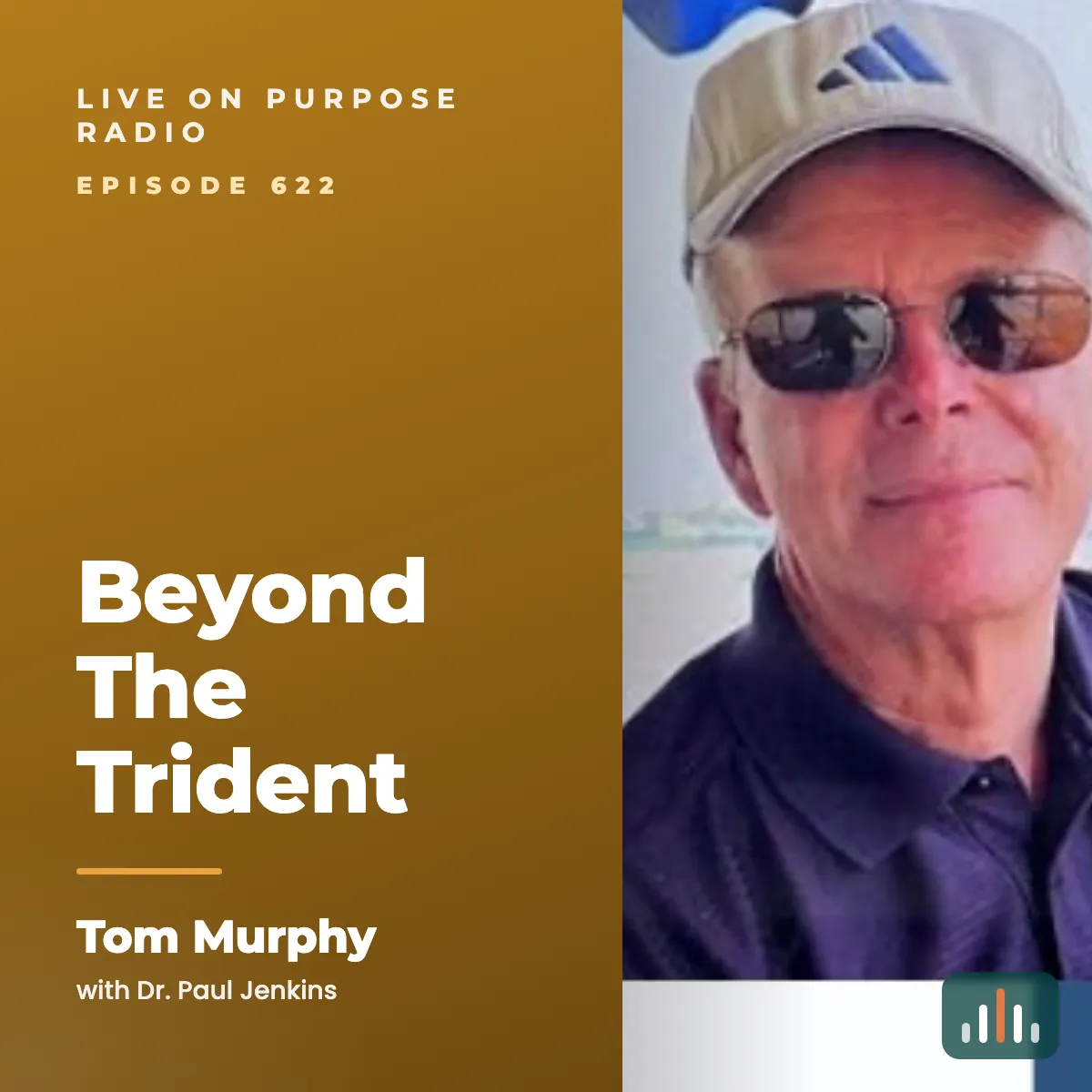
This is Live on Purpose Radio episode 622, beyond the Trident with Tom Murphy. Now is the only time to create and live the life you love. I'm doctor Paul Jenkins, the positivity psychologist. My job is to connect you to powerful positive psychology principles that immediately upgrade your relationships, business, and mental health. Are you ready?
Let's jump in. Hello, everybody. Welcome back to Live On Purpose Radio. This is doctor Paul, the shrink who expands your life with another episode of Live on Purpose Radio. Joining me today is a former commander of Navy SEAL team six.
He's got some incredible life experience that he is so graciously sharing with us today. Help me welcome Tom Murphy. Tom, welcome to the Live on Purpose Mike. Thank you very much, doctor Paul. Thank you for having me.
And thank you for your service. You know, as I read your book, I gay... I I gained an even greater appreciation of what it takes to establish and secure freedom. And freedom is not free. Would you agree with that statement?
Yes. Definitely. You served our country as a navy seal. And I know that that brings up different images for different people. And seal team six, I...
That made the news back in the days when Osama bin Laden was still at large, and and I believe it was SEAL team six that actually brought him down. And you can correct me if I'm wrong on any of that, but can you help us understand a little bit just what a Navy SEAL is? Sure. I'll be happy to start with that. As I was thinking that, most people by this point have some understanding of what a Navy Seal is and what they do, what we did, and what we still do.
The long and the short of it is, commando units have been around in armed forces forever. The Navy Seal is the one that were created by John f Kennedy back during his time as president of The United States, and they they they felt a need for a very offensive, aggressive force that would be able to go ashore from the sea or do things on land. It's an attacking unit. It's the type of thing that is mostly on offense and its purpose is, ambushes, kidnaps, pick up people of interest, things that are basically very front of the line combat operations. We also took over the responsibilities for what was known as the underwater demolition team program or frog men.
And the frog men of World War two in Korea, we have people that had to go into the beaches underwater and blow up the obstacles so the troops can actually get ashore in the landing beaches. So SEALs also do that job now. We also were involved in in trying to get back American hostages, trying to get back downed pilots in combat zones, protecting assets from The United States that might be taken over by other combat forces or terrorist groups. So it's a very offensively minded group, and it's become famous, well, relatively recently because of movies and books and things like that. In the beginning, everything we did was considered classified and not to be talked about.
So, in what era, some of the wives of the team members didn't know what their husbands did for a living, which is kind of ironic. Oh, wow. It sounds very dangerous. Yes. It is.
And that kinda led to my wanting to write a book eventually. Talk to us a little bit about that process, Tom, because, you've obviously seen a lot. And I know it's not the purpose of our podcast here today to go through all the war stories and, and the experiences that have created some trauma for you, for your colleagues, for probably all of our servicemen and women who put themselves in harm's way. But you've noticed, I know from reading your book that you've become very sensitive to the effects of trauma, and you've learned some things about human resilience. And I just love to know a little bit more about why why you wrote this book.
Well, that's an interesting question. Actually, it was to me. I spent twenty five years with the Navy SEALs, of course, and one of the things that you learn, of course, is is the word seal is almost synonymous with trauma. You're going to have trauma, by being wounded yourself or by seeing your colleagues wounded or or killed. You're gonna have trauma in the families that are affected by your actions.
You're gonna have trauma in the... With the people that are the re... Are the... On the receiving end of your actions. And you're also gonna have trauma in the spots in which we do most of what we do.
So, you can almost say that the word seal means you're gonna be exposed to an an enormous amount of trauma. That in itself is just part... Parcel of the line of work that you've chosen, and I think we all get... Got into it mostly as young men. Maybe we did not realize the full extent of the amount of trauma that we were gonna be exposed to.
I think that some of the the wounds that are most difficult to treat when you look backwards aren't just the physical wounds. They are the result of the trauma and getting through the post traumatic stress disorder symptoms that sometimes develop, and not only in the people involved but, with the families. And so I had quite a bit of exposure in my twenty five years as I went up through the ranks of of the various SEAL teams. And, I I... Well, the...
A little backstory that's a little lighter is, I came across an article by a man who was a, he was one of the press writers and and the people... The speech writers for president Kennedy and then for president Lyndon Baines Johnson. And, he kept boxes of stuff and all of his notebooks about what he was learning, and he had them in the attic. And then in the article that I read, he said, I turned 80 years old. And I realized if I had any wisdom to dispense, I better start dispensing it.
I decided to write a book. And I was reading this article and realized I was 80 years old, and it was time for me, if I had anything to say, to go ahead and try to say it. So I have been keeping my notebooks for about forty years, largely as a result of some of what I've been learning about life and trying to answer the big questions of life. You know, what does it mean to be a human being and why are we here and those kind of big issues. And, so I had kept these notebooks for years without a purpose and suddenly realized, oh, sure.
If I'm ever gonna do anything, probably now's the time to try to do it. That led to... Actually, what led to the book. You know, this compilation of your life experience. You've you've experienced much.
You've learned much. And I really got that feel from your book too as as you are trying to dispense some of what you've learned, maybe to, help some other folks who are still struggling to learn what you've already been exposed to? I think that's exactly right. My whole purpose was try to help other people. My whole purpose of writing this book at this age was to try to, provide some insights that had helped me in my path trauma and at the other end.
The subtitle of the book, of course, is A Search Through Trauma for Meaning in Life. And the whole purpose of the book is to try to be helpful. And then throughout the whole book, I reference the sources that I've used over all these years so that I I strongly encourage people to go to those sources. I don't feel that I'm an expert in any part of this. I just feel like I happen to be able to look through the lens of my life and the lessons I've learned and how I've learned them.
And, you could say that trauma, is a bad thing in general, but I I might have to say that without trauma, my life may not have taught me the lessons that led me to where I am now, which is a very good place. So, you can't really be judgmental about it. It is what it is particularly for Navy SEALs, but the book is not just about Navy SEALs. The more I got into the subject of trauma, the more I realized that, trauma comes in all kinds of forms and flavors. You know?
It could be a death in the family, a messy divorce, addiction of somebody that you love. It could be a a crisis of a bankruptcy, financial crisis. It could be just living in Gaza right now, being a human being, happened to have been born there or in Ukraine. You know, trauma is universal. In a recent Gallup poll, I believe, said that eighty percent of all humans are going to experience major trauma or traumas in the course of their life, and twenty percent of us are gonna have post traumatic stress disorder symptoms of one type or another.
So I started looking at this as I was writing the book as a universal problem and a universal, need which was to examine these issues from a broader perspective. But I also should say I wanted to talk about SEALs and not just the seriousness of the operations, but the life filled nature of being a young man, being a SEAL, the boisterousness, the games that we played, to show both sides of ourselves. Most of us grew up starting out relatively innocently, going through the SEAL training, winding up in a combat situations, taking other human lives, realizing that there's also a psychological price you pay for that, and then having a look at results of all of that. So I wanted to show both sides of that equation, and and so the focus is actually, trying to do both. And I hope it becomes interesting because of that, not just, be a teaching book, but the idea was to try to make it make it interesting.
Well, at the end of the day, seals are humans. I mean, not seal animals. I mean And they baby seals Yes. Are humans. Right?
And Very human. Humans are very multifaceted. And I loved what you just said, Tom, about universal. And I believe this too, that that trauma is universal. Welcome to Earth.
That's how we roll here. Yeah. And I think you said, like, eighty percent of people are gonna experience some major trauma, and I'm not sure who decided what's major and what's minor. But there's... I think everyone, probably a hundred percent, experienced some kind of trauma and often repeatedly.
But your experience as as a navy seal exposed you to it on a regular basis at what anyone would agree is a major level. Yes. So that's a test case for human resilience. If seals are actually humans, navy seals, I mean, and they are experiencing major trauma on a regular basis, then that speaks to something about human resilience as well. And I'm just curious what your thoughts are about resilience.
Where does that play in? Well, clearly, you have to be resilient to be a SEAL. It kinda goes, with the, the basic training program, trying to just get through it. 80% of the people that go into Navy SEAL training don't make it through. So the ones that do are are resilient types.
And that's part of the purpose of the training. Right? To weed it out. The purpose of the training is there's a a lot of things that you have to learn in training, but, basically, you're trying to learn, the skills that would make you good in combat. You know, that...
I I did put a quote in the book, though, that says, you know, unfortunately, being good at combat has a downside. It's a it's a heck of a poor thing to have to be good at. So the downside is often felt through the human psyche of the people that are participants, and that's anybody that's ever been in a combat situation in any war in any period of history. You know, I believe that that's true. But I'm not trying to get too deep into that subject in the book as I am trying to say almost every human being, I try to use the lens of a three legged stool in the book.
The three legged stool being mind, body, and spirit, a concept that goes all the way back to the ancient Greeks, Plato, Aristotle, Socrates, who identified that as the three main supporting pillars of every human being. And so I tried to describe what that means, the words mind, body, and spirit, and particularly with regard to spirit because I believe when a human being goes through trauma, often their value system that they bring into the trauma, whether it be patriotism or a good life or or they're doing it for their country or their fellow men, that value system could get badly disabled, distable, unstable, and and and become, the... One or all of the three legs of the stool can become unsturdy. So I use the analogy through the book of the three legged stool because you can see if you're standing on a three legged stool and you don't have three strongly supporting and balanced legs, you're in an unstable position. And it's my it's my proposition in the book that one of the legs that gets most often badly damaged and may not be noticed immediately is the spiritual leg of the human being.
That's a big topic that we might get into in some more depth, but there's quite a bit of science now that is showing that every human being is a hardwired spiritual thing. We come into this. We are biologically hardwired spiritual beings. We wanna know why we're here. We wanna know what's it all about.
We start asking big questions. We're eight or nine years old if we're allowed to, and that that that that spiritual leg... And by that, I do not mean religious per se. I mean, this this desire to understand ourselves as humans, that is a muscle just like any other. And if it's encouraged and strengthened and used on a daily basis, it gets strong and it's very supportive.
But when you go through trauma like many people do in life and don't have a strong spiritual leg, you become very unstable. And I think a lot of the... These... That the world has developed in... There's a wonderful book by, doctor Bessel van der Kolk, you know, the body keeps the score.
It... It's a tour de force of all the types of psychiatric, psycho... Psychological, and medical treatment patterns that have been used to try to help, but particularly combat PTSD, but all types of PTSD. Right. The fact is no one size did not fit all is a conclusion of that book.
Different types of treatments are more effective or lesser treatments for different kinds of problem. But the second big conclusion is that we're we're spiritual component to rehabilitation is a critical component. But, of course, that's a personal decision and hopefully we'll talk about, that a little more. But also, he he he talks about the book that many combat PTSD cases are harder to rehabilitate. And there may be several reasons for that.
You know, you're a strong male often or a female and and you're, in a combat situation and you don't want to admit to weakness and you're also feeling like you should be stronger or you feel like you're there for a purpose, yet you're still... Your psych's not okay with it. So meaning, you can have a different kind of a traumatic experience. But Right. To say that that everybody will have some experience to the kind of trauma that we're talking about.
And Right. If they have three strong legs in their stool, they have a lot better chance of getting back into a normal healthy mental health state. And so that's what I wanted to talk about in the book and, it is kinda funny that I had a friend who read the book and and, she said, your book is kinda like the Bible. It's got, an old testament portion and a new testament. She she said, the new testament is kinda the mind, body, spirit treatment that you can do with a personal need for a spiritual search if you don't have one and the idea that you have to keep looking if you're in a fog of trauma.
And she said the Old Testament part was your stories as seals. And so I said, yeah. I had to write the old testament part because nobody would read the new testament. Yeah. You know, the long and the short of it is, I tried to blend both of those things into one book and then reference all the sources that I've used in the second half.
Well, I think you did a nice job of doing that, Tom. And I I remember you referencing doctor Vanderkolk. I I spent a couple of days with doctor Vanderkolk in a training, a few years back, and and I remember him just bringing in these ideas about how trauma is universal. Different kinds of experiences respond differently to different treatment approaches, and it's it's because of the complexity of the human spirit, the human and mind and body too. So as you look at your three legs of your stool, and I know you depicted that three legged stool on the front of your book Yeah.
To drive that point home. Often I I would agree with what you said there that often we neglect the spiritual aspect, maybe because it's a little harder to quantify or or experiment with. But like you're saying, we're getting more and more evidence even from the the scientific world that this is an important component of human resilience. And I think we're designed as humans to heal. And when we create the right context around that for our body, our mind, and our spirit, we naturally tend toward the healing.
But if we're on that unstable platform, we can struggle with it for years, and some people do with their trauma. That's that's exactly a good point. While we're on the subject of the scientific understanding of of spirituality, it's become a topic for scientific study, of course, spirituality in humans. And a wonderful couple books are written by doctor Lisa Miller. Doctor Miller is a...
She's the clinical psychology program director at Teachers College at University of Columbia. The first book is called The Spiritual Child, and the second one is The Awakened Brain. And they're doing, they're doing clinical studies, longitudinally directed clinical studies, peer reviewed showing that if children grow up in what she's calling an active spiritual mode, meaning they're in a a spiritual tradition in which they are actively involved in it, their brains actually grow differently than if you aren't. And, also, you start looking at predictors of of good mental health. The main predictor of good mental health in these studies is the spiritual aspect of the human being and an otherwise healthy human being.
You know? So you start to see through these studies, it is absolutely important and that I I agree with what you said. I I just read read recently a study that said only one out of five Americans goes to any kind of religious service on a weekly basis anymore. That means four out of five of us aren't bringing this kind of study into the into the homes more likely. And and so a lot of parents, I think, are a little fuzzy about their own beliefs.
Maybe they didn't have a strong spiritual growing up. And I think all of that influences, what has been in many people's lives, pretty much a vacuum recently in The United States. And if you go back forty or fifty years, which I started to do in the research, almost everybody in The United States believed in something or another having to do with religious basis or a spiritual basis in the entire country. And so even if people weren't really active in any church, the... By osmosis, families were getting this idea that spirituality is something that affected the way they act, the the the morals that you use in civil discourse, the way you treat other humans.
All of that was more or less a standard thing, which when we've lost this sense of importance of the third leg of the stool as a country, we're all now gotten ourselves into a situation where we can all see that there's an awful lot of stress people are feeling all over the country, and many people don't even think that they have a third leg of their stool, much less be working on finding a way individually to find something that they can believe in and get some support from it. So that's what I do in the book. I try to to cover some of these things from a concept point of view. I try to cover them from the lessons that I learned and what I was doing when I learned them. Yeah.
The interesting thing, the the book started out... The title of the book was gonna be the three legged stool because of its importance in my mind. But as I got going into having to put more personal stories into the front, the New Testament, or the Old Testament, whatever, it became the three... It it became the, Beyond the Trident because, obviously, I wanted to talk about life before, during, and after being a seal. And so it seemed like appropriate title in the end.
And it didn't start out as a memoir. It started out as desire to talk about the need for for this understanding of how to go through trauma and find yourself at a better place ultimately by paying attention to all three legs of your personal stool. Yes. You know, as you were talking about this just now, I was reminded of something that came to my attention not too long ago. In fact, someone told me, the difference between religion and spirituality.
And sometimes we interchange those terms. Right? But you said earlier that we're not talking about religion per se. It's a spirituality. And this person helped me understand it by saying, religion is for those who are trying to avoid hell.
Spirituality is for those who have already been there. That's very funny, but but there is a difference in the focus. My thought is that all roads home are good roads. If you're getting support from any given religion, it's probably a good place, to be. But if you've if you've lost that, belief in a given...
I grew up a Catholic, of course, and went to a Catholic school and had the standard Catholic. You could be in mortal sin in a moment if you weren't careful, and the confession was required if you didn't wanna go to hell. And there's a wonderful book by an ex priest, Tom Stella, who's... It's called A Faith Worth Believing. And what his whole message is, don't throw the baby out with the bathwater when you when you realize you can't stay out of mortal sin all the time in one religion, don't give up on the thought that spirituality is important to you.
And that was my... By the time I've gotten into, university years and and began looking at the thing more broadly and realized I was constantly in danger of flunking religion, as Tom Stowell put it. And so, I I really just stopped paying attention and, and then didn't pay much more attention until trauma started to overwhelm some of the things I thought I believed in. And that started me on my search, which I talk about in the book, which I believe is important to every human. You know, I've I've really appreciated the role that institutions like religion can play.
And I heard it... Another analogy about this recently, about dynamite, which is made of nitroglycerin, coupled with, a very inert substance that actually stabilizes it and makes it so that you can transport it and you can share it and you can use it. Where nitroglycerin is very unstable, and it'll just blow up anytime you look at it crosswise or not. Yeah. So...
But putting the two together... So I think spirituality is the power, and the religion might create the context in which that power can be delivered safely, to different people. It's just an idea that I found kind of useful along those lines. Various religious traditions have various strengths, of course. But there's different different messages being developed through the dogma of different types of religions.
I feel anything that's making a person feel more loving and feel more compassionate to other human beings is a spiritual path worth looking at and and responding to. And if it's making you feel otherwise in that, possibly, you should look past that particular branch or whatever and keep looking. And that's the whole message I was struck by in life, which is people that have found something are so much more resilient when it comes to trying to get through major trauma. And often, like I say, what you go into the trauma with in terms of belief structure, you come out of it differently. Now you don't feel like the same human being after the trauma as you did before.
And so it's it's incumbent on every human to understand we do have the three legs and understand that this search is important if they don't feel their three legs are strong. And I'd go ahead and say, if you're in any situation in life and you're not too happy with your situation, meaning take a look at the three legs of your stool and and make a self examination and decide whether or not they're supporting you. And and there's a lot of tools. The point being, there's a lot of tools we can use for the mental side of ourselves. There are tools we can use for the body, obviously, and there's an awful lot of work on Yeah.
The importance of of things for the body. And, of course, there are spiritual tools that you can use if you're willing to get outside the box. Don't just stop if you don't have the feeling that the religion that you started with is still what you need right now. Just... Right.
There's an analogy. You know, if you're lost in the fog or the woods of trauma, don't just sit there. Pick a direction. Start to walk. If you find out you're going to the wrong direction, you can turn around and go the other way.
But the point is if you just sit there, you're gonna starve. And that's what I think with a lot of post traumatic treatment is if people can't get to this idea that they need to start looking for help... Strengthen that spiritual leg, they can they can basically be resistant to treatment. And that's true for all kinds of problems on earth, and that's true for any kind of a stress situation of which I would say many Americans are in this. Just look at what's going on in Florida right now.
Look at the trauma that's being caused and look at the stress that people are going through. And so the importance of the spiritual life for human beings is is overwhelming all through life. I'm hearing a strong message from you to keep going, keep looking, keep working on getting those three legs stabilized. That is exactly right. That's my whole message.
Actually, I also try to show what type of learning, what type of books, what type of teachings influenced me. Not because they're the only road, but they are a path. And if people are looking for a path, maybe the path that I took would appeal to them. And if it does, that's wonderful. You've discovered some things along the right way that have been useful for you, and that's all you're saying.
You're not saying this is the answer for everybody. Oh. This has been useful for me. Take a look. That's exactly right.
You know, you reminded me of a country song too. Have you heard the one that says, if you're going through hell, keep on moving. Don't slow down. I think I think that was the Churchill. It said that first, and they made a song out of it.
But that's exactly the point. If you're going through hell, keep going. Keep on moving. You don't wanna slow down or stop because then you'll just stay there. That's right.
Right? Well, Tom, you've created a resource, and I appreciate that. As a mental health professional, I think we're on we're on similar missions here to send a message to world... To the world that there is hope. There are tools.
There are resources available. Your book is called Beyond the Trident. And, folks, you can you can get this book how, Tom? Tell us how we can get a hold of your book. Well, you can get it on Amazon.
They have, the the book copies. We have the ebook copy and an audible book copy on Amazon. The the website for the book is beyondthetrident.com, and you can also get it through the website. And if I have a chance to to say something more, I believe that this issue that we're talking about is extremely important for young young people in general. And I am involved with a group of people that is developing an app for kids based on mind, body, spirit principles to take this kind of information down to the level of eight, nine, 10, 12 year olds and make it fun.
So we're gamifying the app. It's called Lucero Speaks. The word Lucero means light bringer or bringer of light, and it's available. You can look it up through the website or just go to Lucero Speaks and Google. So it's an attempt to point to the value of the three legs of the stool, point to the importance of each human being, assessing where they stand with their own self.
It also talks to about the importance of beliefs, which we haven't gotten to. But, you know, your beliefs create your emotions. And if you wanna change the screen of your life, the way to do it is to start by looking at your own beliefs. So all that got into the book and is into the children's app and in a way that children children can enjoy learning and playing games at the same time they're learning. So, those are the two things that I'd like to talk about today and appreciate the opportunity to do so.
That's, you know, that's a good way for adults to learn too, isn't it? Yeah. And there's a side to that app, by the way, for adults, for caregivers, for, parents, caregivers, or or therapists Wonderful. Children at the level that the the kids are at. Because the surgeon general just...
Yeah. To keep on this subject for one more second, the surgeon general just issued a report saying there were actually two pandemics going on. The second pandemic is what's happening to our kids at the same time with mental health issues. And that is, you know, it's showing up in absenteeism, increased levels of depression, increased levels of isolation. Suicide rates are up for kids as low as eight years old.
I mean, we need to start paying as Wow. And as individuals more attention to all of this. Yeah. It it is the future. Our children are our future, and so it's not just an adult issue.
It's also an issue affecting every human. Yes. It's all of us. Tom Murphy has been our guest today. Folks, you can connect with him at beyondthetrident.com.
That's the name of his book. And share once again the website for the children's app. The children's app is Lucero, l u c e r o, speaks. Lucero speaks. Lucerospeaks.com.
So there's a couple of resources that will be, helpful as we move forward. Tom, I appreciate your presence here today at Live on Purpose Radio. Thank you so much for your contributions. Well, thank you very much for having me. I appreciate the opportunity.
Folks, you've heard it from Tom Murphy. It's time to go apply what we have learned and what we feel inclined to do as a result of being inspired here today by our guest. Let's go live on purpose. Did you get what you came for? Give yourself the gift of taking real action on what you realized today.
Please share this episode with someone you know would value it, and leave us a rating too. It's time now to live on purpose.
Open the transcript on its own page ↗