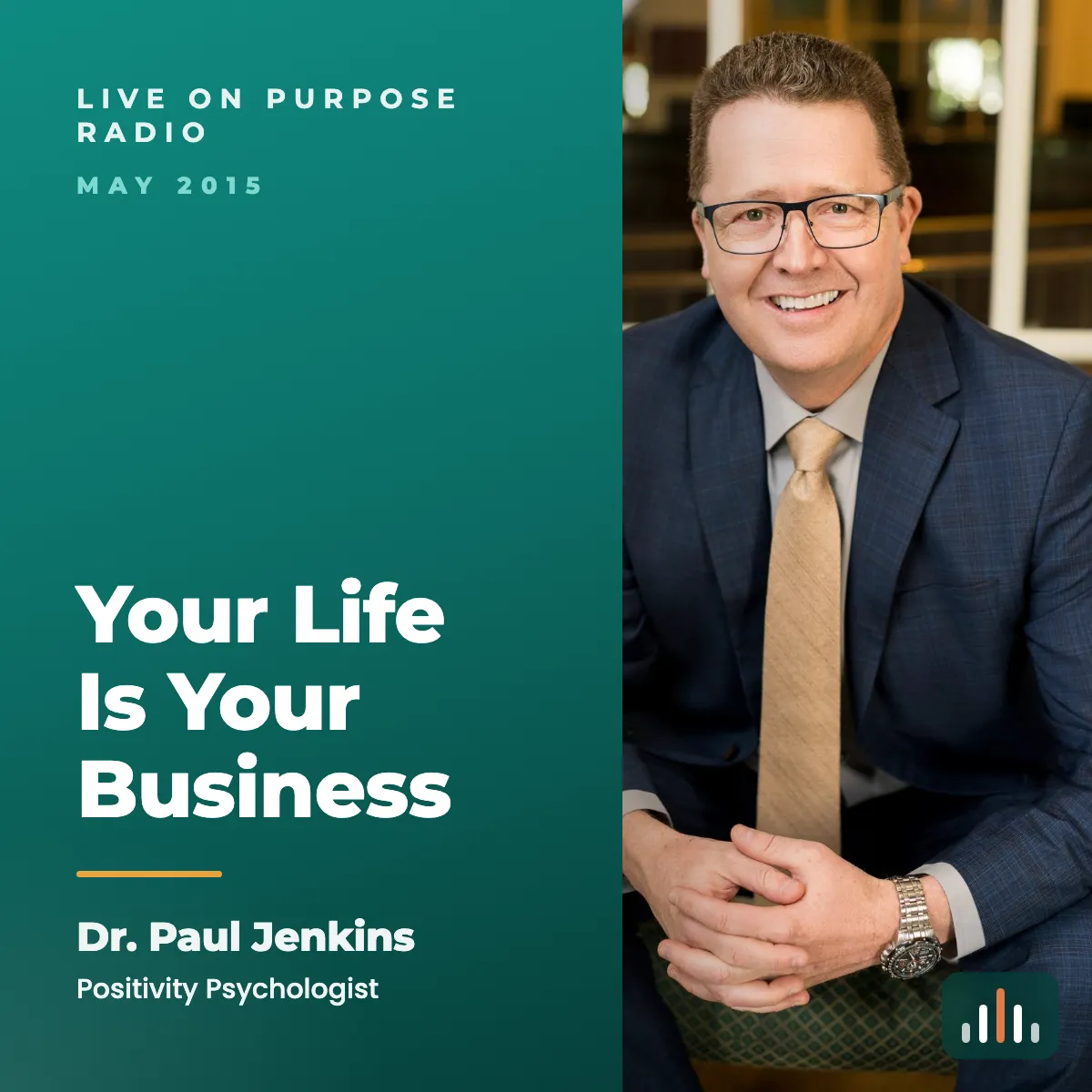
Welcome to Live On Purpose Radio with doctor Paul Jenkins, where you will hear inspiring stories of ordinary people doing extraordinary things. Feed your mind with a regular dose of positive energy and show up for your life every day on purpose. Living on purpose means that you have a purpose and you do it intentionally. And now here's your host, doctor Paul. Hello, everybody.
Welcome back to Live on Purpose Radio. This is doctor Paul, the shrink who expands your life, promoting pathological positivity today at Live On Purpose Radio. My phenomenal guest today is a best selling author, a leadership coach, primarily self leadership, but also spontaneous leadership and some other fun things that we might get into today. He is a speaker, a presenter. His name, Kevin Ormond.
Welcome, Kevin. Welcome, Paul. Thanks. I'm glad to have you here today. I'm glad to be here.
So you're all of those things that I mentioned and more. Yeah. Yeah. I'm six foot two. Let's see what else.
Oh, bunch of stuff. There's all my stuff. Yeah. All kinds of stuff. I'm not gonna I'm not gonna go into the weight, but...
You know, I always thought it was funny when people announce that a new baby is born. Uh-huh. They have to give all of the vital stats, like the length and the weight and everything. What if we started doing that at every networking event? That would be a fun thing to do.
It would be scary for some people. Fun for some, not so fun for others. That's right. Well, you you know, that's one way to break through the barriers. Well...
And we're not necessarily here today to change that particular tradition, but I think we can get some fun things done. Kevin, you authored a book called Me Inc, Your Life is Your Business. That's right. And that's the one that made the, best seller list? Yeah.
Yeah. I hit number three on Amazon with that, so I'm in the top 10. And you've stayed on the best seller list for a number of weeks now. Since I hit it, which was January 27, and I'm still on the bestseller list. Earlier this week Right.
When I looked, I was number nine. And for those of you who need a little date reference, we are recording this show in mid April two thousand fifteen. Congratulations. Thank you. That's awesome.
You are an expert in projects. Among other things. Yes. That's one of the things I am. Well, I I mentioned that because you were telling me just before the show how you pulled off this book.
Yeah. Well, you know what happened is I had, I'd had cancer and some things. I've been sick for several years. I had... That's just very incidental, by the way, who had cancer and major surgeries.
Well, you know, it's a little speed bumps. Life happens to you, doesn't it? You know, funny how that works. And, but I'd had that and a few other things. I'd ended up having, I've had three...
Four major surgeries in the last three and a half years. And, so, you know, I had I had some odds and ends. It gives you time to think, which is kinda good. Gives you time to reassess. Wanted to think differently too.
Yeah. Oh, yeah. There there is something that you can't describe about the feeling of the doctor coming in and saying, kid, you got something that's gonna make you die. This is really serious. If you don't do something about this, you're gonna die.
And, only those who have had that experience can understand the feeling. It is, it is, just... I don't even know how to describe it, but those who've been there know exactly what I'm talking about. I'm about twenty five years post diagnosis myself. Yeah.
Well, you know what I'm talking about. And it's... But to describe it, it's almost like trying to describe the taste of salt to somebody that's never tasted it. It's just... It's hard to do.
Yeah. But anyway, I started feeling good. And so, finally. So... This was a little later.
Yeah. This is about a year ago. Yeah. And I, decided to to move things to the next level with my with my business and and, my career. So part of that was, friends of mine that I mentored with and stuff said, you gotta write a book.
I mean, that's just part of the deal. Well, over the years, I probably started 20, but I actually finished this one. And what happened was that I made that decision in about, mid May or so. A hundred days later, I I was on Kindle. I was, on paperback and Amazon, and I had a 100 copies in my hand.
Wait. Wait. Wait. This doesn't happen, Kevin. Yes.
It did. Oh, my heavens. So you have a I've never read a book before. I want to have a book. Mhmm.
Yeah. My life lacks a book. I want a completed book. Uh-huh. Hundred days later, there it was.
It manifested as a real thing. There it was. And I had a 100 copies in my hand. And I did that little project, my hard costs were $632.46, and that included a 100 copies in my hand. Hold on.
Okay. So I know that we have listeners. A lot of our listeners are business owners Uh-huh. Entrepreneurs. They have they have home based businesses or whatever.
Yeah. So you're saying that if someone in our listener base today Yeah. Has this thought, hey, I would like to have a book, but it's gonna take forever. It's too expensive. You're giving us a real example here that, no, that's not necessarily true.
Not in this day and age. It used to be true prior to the Internet, prior to things like Amazon, prior to things like CreateSpace, which is Mhmm. Is owned by Amazon. And, that used to be true, but that's not true today. That's one of the things that technology has done, is it has tremendously changed, publishing books.
Which makes that an available option to anyone That's right. Who gets the idea in their head like you did. Yeah. Hey, I wanna have a book. Well, it helps if you know how to put a project together because I'd never done it before.
I didn't know all the details and things like that, but I Yeah. I have, I'm an expert with projects. And so one of the things that I did was I was able to put together a team and make this thing happen. And, you can't do it by yourself. And you shouldn't.
No. But even with the team and all the costs, that still was my hard cost number, the one I gave you. So, but again Wow. That's because it wasn't my first rodeo with a with a project. With a project.
It was with a project to write a book. Mhmm. But it wasn't with a project. You found, I'm sure, that there are underlying principles that govern everything. Absolutely.
So you've applied those principles to create a book in a very short timeline. That's right. But those same principles could be applied to any aspect of your life. Well, and that's really what the book is about. Is I took those principles and I, I just simply said, you know what?
Here's the problem. People spend, typically, most people, spend more time, planning a vacation than they do planning their life. And it's like That is really true. And you wonder and you wonder why you don't get any, anything done. You wonder why it doesn't work.
You wonder why it doesn't get accomplished. You don't understand why. And the reason is because you aren't applying the principles that make it work. So the same principles that make a successful vacation could be applied to planning your life. Or writing a book.
Or whatever it is that's on your agenda. Or whatever it is that's on your agenda. You had a little wake up call. Several big wake up calls, didn't you? I've had a number of them over the years.
Yes. Including potentially life threatening or even life terminating diagnoses? Yeah. These things are... I was diagnosed with with prostate cancer.
Oh, wow. Yeah. What, a little over four years ago, I was diagnosed. Well, one of our recent show guests actually trekked to the South Pole to raise awareness for that particular issue. Right.
These things happen. They do. And we mentioned that earlier. Life is what happens to you while you're making other plans. You know what, Kevin?
That is so funny because one of the chapters in my book is titled Surprise. Yeah. There you go. And it's... Yeah.
Expect it. Folks, expect to be surprised. Oh, yeah. No question. It's gonna happen.
And, and so one of the one of the key elements in whatever you do is to is to... It it sounds like an oxymoron, but you have to structure in flexibility. Okay. That's like expecting to be surprised. Yeah.
But but again again, it if if it's not done on purpose, if it's not done with some sort of forethought and some sort of of of a way to handle it, you know, it can really knock you out. It can it can throw you for a loop. Yes. I think that's partially because life tends to hand us things that are urgent but not necessarily important. No kidding.
And so that consumes our time and energy Yeah. Where we end up sacrificing things of greater value. You know, Stephen Covey talked about that, with his four quadrants. And and, and the key is really spending most time in quadrant two, but that's hard to do. And that quadrant two is the things that are important but not urgent.
And that's where that's where leverage exists. That's where value is created. That's where where things can really, change in your life and come together is by is by focusing on those quadrant two elements. Important, but not urgent. Things like exercise, for example.
Mhmm. Not necessarily urgent, but is absolutely important. That's what you're talking about. That and, probably even more directly, relationships. Mhmm.
You know, building and and creating relationships. Right. You know, they, I saw a great quote the other day that said that, children require our presence, not presents. Not these. And so, it's not what you buy for them, it's it's that you're there with them.
And... That you're present in their lives. Yeah. And and and the beauty of that little thing is that that applies to all children, no matter how old they are. It applies to a child of age 100 as much as it does to a child of, of a month.
Yeah. These wake up calls that you had, Kevin, it it it adds perspective, doesn't it? Oh, yeah. Absolutely. Is it...
Am I going to feel good when they put me in my grave that I accomplished this or I accumulated that. Are you gonna die with your music still in you? Yeah. And, and and that's part of part of what really precipitated this this, launching and going where I'm going now Mhmm. Is I've got a lot of experience.
I've got a lot of things that I can add to the world. And, I've got a lot of music still inside me. I'm just a kid. Okay? And, you know, I'm...
Well, I'm younger than Harlan Sanders was when he started Kentucky Fried Chicken, so, you know, not a lot, but it's some. Hang on to that. Hang on to that. And so the the bottom line is that, that it really becomes critical that we go ahead and and and do that and say, you know what? I am not going to go quietly into the night, and I'm not gonna die with my music still in me if I can do anything about it.
So it starts with that resolution. It does. It's a decision, just like so many other decisions. Yeah. Yeah.
You know, it... The power of decision is so far reaching and so profound. You know, the the the thing that happens is a decision that is truly made, not kind of waffly made, but actually heartfelt made. More of a resolution. Really?
Yeah. Yeah. Declaration. Well, even, you know, if you could be more powerful, I would be. Yeah.
Yeah. It... It's just has to be part... You have to incorporate it to be part of your being. The decision has to become part of who you are.
Mhmm. And then from there, principles. Yeah. Applying the principles to actually bring that into That's right. Reality.
That's right. And of course, sometimes the first principle is I gotta learn the principles. If you don't know what they are, you might wanna find out. Yeah. Well, it might be helpful, you know.
But at the end of the day, that's that's... And that's where I found myself at one point, you know, a number of years ago, with a different wake up call, which is another story that we have time for. But the point is that I made that decision then that there are some things here that I have got to do differently. Mhmm. Okay?
And, one of those was a divorce, and, and, I remarried, and now we've been married almost thirty seven years. So I I actually I actually, improved. I actually learned some things. And then incorporated them into my life, and they actually work. I tell you what...
And now I'm married to my very best friend. Nice. And it's almost thirty seven years later, and we're saying, jeez. I still feel like a kid. We feel like we just been married in some ways, you know, and she's great.
I was just thinking as you said that, Kevin. Some of life's experiences, life's lessons Uh-huh. Are so expensive. Oh, man. You better darn well take home the lesson if you're gonna be paying that kind of tuition.
Totally. So I'm glad to hear that you can learn from your experience. Well, and let me tell you something that I learned. I got some bad advice from my dad. He he said, he said divorce is financial suicide, and I believed it.
And, and and so I struggled with my career for a number of years before I finally caught on to the fact that that was just a line of much nonsense. And... It was a story. You didn't have to believe it. It's his story that he believed.
And because I heard it from my dad, I believed it for a while. And just because we believe a story doesn't mean that it's true. Not at all. No. No.
No. That's, what are we talking about there? Confirmation bias and a few other things? Oh, all kinds of psychological principles. All kinds of nonsense, frozen evaluations, non stuff.
Well, we're on to it. We'll be back in just a moment. Thank you for listening to Live On Purpose Radio. We're so glad to have you here. Please come by the website, doctorpauljenkins.com, spelled with a d r.
Doctorpauljenkins.com. On the website, you'll have an opportunity to receive a free download. And while you're there, make sure you click on the social media icons. Come over to Facebook where we will be posting these episodes as well as our YouTube videos and other content and announcements for you to share. Please like us, comment, subscribe, join the conversation.
We're happy to have you with us here at Live On Purpose Radio. Let's all support each other to live on purpose. Doctorpauljenkins.com. Hi. My name is Chris Krone, and thank you for listening to Live On Purpose Radio.
I became financially independent starting from nothing by the age of 26. My purpose is to financially liberate the captive. Are you searching for a realistic proven system in real estate to create enough residual income to retire or fund your dreams? I invite you to learn about a passive turnkey proven system and approach to real estate where my team of 200 experts can do all the heavy lifting to create the freedom you're searching for. Visit www.liveonpurpose.strongbrook.com.
To get a free copy of my book, The Straight Path to Real Estate Wealth, just enter the code free at www.liveonpurpose.strongbrook.com. Success and failure. We think of them as opposites, but they're really not. They're companions, the hero, and the sidekick, Lawrence Shames. Kevin Ormond today at Live on Purpose Radio.
And Kevin, we were talking during the break about how if people Google your name, they're gonna find you easily if They can spell it. Spell it correctly. That's right. I am the only person on the planet with those two names spelled this way, and I'm gonna spell them for you now. Kevin is spelled with a c.
It's c e v I n. Ormond is just like Osmond, only with an r instead of an s. So it's o r m o n d. And, yeah. And if you Google those two names, you've gotta go, last time I looked, clear to the bottom of page seven to find somebody that's not...
Or you can find somebody else. Yeah. So that's the best way to find you It is. Online at least. Well...
Yeah. Or or, of course, again, if you can spell it, kevin ormond dot com. We'll we'll mention that again at the end of the show. Sure. Just spell it with a c, folks.
You'll find it Yeah. A lot easier. Yep. Make sure and add the d on the end. A lot of people forget that one too.
Kevin, it it occurred to me as we were having this conversation today that maybe some things are possible that I didn't think were possible before. It was just all the stories that were in my head. Sure. You're publishing a book, for example, in one hundred days. Yeah.
And not just publishing it, but having a physical copy in your hand Yeah. In that time for Yeah. From from the idea to the completion. Right. That opens up some possibilities.
What else? If you're listening to this podcast, what else could possibly be on the table for you that you didn't realize was before? Yeah. Let's open up that possibility. Just consider maybe there's another story out there that says, yes.
This is possible and available to you. Oh, absolutely. There are all kinds of things that are available. The power of making a decision is so profound. But again, you have to really...
It has to become part of who you are. You really have to make the decision with all your heart. And and and that's, anything else is, it still stays within the realm of a wish. And, Right. You know, and, you know, if you wanna wish on a star, that's great.
But it... But I would rather make that covenant, that commitment, that that that part... Change who I am. So instead of wishing and hoping, we're declaring and doing. We are.
We're making a firm decision, getting clear in your mind about what you want to create. Yeah. And it's okay if you don't know how. No question. And the other thing that comes to mind is is an understanding of what risk is.
You see, the risk is in not doing it. And not making it... That's one of the risks. That is. You know, the the the, people say, oh, it's too risky to do this or that or the other.
It's, the reality is that the very... With very few exceptions, most things are riskier to not do long term. And Yeah. And that's the key. The key is understanding that true risk is a long term thing, not a short term thing.
Bad decisions are made with short term thinking. Yes. And good decisions are made with long term thinking taking the short term into account. And and not taking all of the proper variables into account. Well, that happens anyway.
And you can't predict them all because life is gonna happen to you. But but, but to the extent that you can, the ones that you can predict, the ones you can plan for, you should. Take it on. Yeah. So let's get practical.
Yeah. I'm I'm feeling inspired, Kevin. Are you? Yes. Cool.
That's why I do this show. Well, that's great. I... I'm inspired to be here with you too. I get to hang out with amazing people like Kevin Orman and feel inspired to take on my next project design.
Oh, that's kind of you. I've got a few. Yeah. Let's see.... Up.
But even as you're talking, I'm thinking, okay, well, what story do I have about this? Or what story do I have about that? Yeah. So I'm I'm wrapping my mind around that, and I'm also going to the next step. What are the next practical steps that I can take or that any of our listeners could take?
What comes to mind for you? You've coached people through this. You know, there's a couple of things. First of all, while you were talking, one thing that popped into my head is this. Sometimes the stories are about big.
This is too big or whatever. Sometimes the stories that we have are about small. I'm too small. Well, if you know what's big and small, that's BS. And and so the, the thing the thing about that is to understand that that's what most of these stories are, is their BS.
And the reality is that that we need to recognize that they're just simply a story, a fairy tale, you know, and and they're not the truth. And so part of it, comes in recognizing your stories and realizing what it is that's holding you back. Now k. To to to move that into something that's a little more practical, what what in my book I've done is I've taken, you know, six areas of your life and, just broken your life down into six in six segments, you know, career and, and family and Health. Yeah, health and spirituality and so on.
Right. All these different areas. And, the key is to harmonize. You know, you had Dan Clark on here before. Mhmm.
And, Dan has actually, endorsed my book, which is kinda cool. You can read that in the book when you buy it. But, the the point is that Dan talks about harmony. And, harmony really is about making all the areas of your life play together into the symphony that is your unique tune. Nobody else on the planet has your tune.
Okay. So it doesn't have to match any of the existing prototypes. Totally. And and... And it shouldn't, actually.
It it can't it can't, anyway. I made that mistake early on in my speaking career, trying to emulate others that were successful speakers, and I face planted. Boom. Like this. It was terrible.
I got fired. It was really fun. And coming back on the plane from New York City, which is a tough market, that's where this happened, I was sitting next to a guy who was going to do summer stock, and he gave me, out in Oregon, he gave me... He's an actor. He gave me all these ideas about how to how to present properly because it's so much like acting in some ways.
Yeah. And, and, that was one of the most valuable, mistakes or lessons that I ever received was on that three hour flight from New York to Denver one time. And it's okay to face plant. It is okay to face plant if Painful. You learn the lesson.
Otherwise, you're gonna get to do it again until you do learn the lesson, and that's and that's the thing. Now back to the practical a little bit more, you know, first of all, you have to determine where you are. And so part of that is understanding what those stories are that are holding you back. Part of that is a hard, honest look at your reality, not the story you present or tell everybody. Right.
But what it really is. This is, the Stockdale Paradox, right? Admiral Stockdale, and it's about, he was a prisoner of war during Vietnam for years. And Mhmm. He, he talked about this.
It's in Jim Collins' book, The Good Good to Great. He talks about it. Oh, yeah. But the the Stockdale Paradox is simply that you've got to be brutally honest and still have hope. Yeah.
Okay. And so you've gotta be you've gotta be honest about the the the the reality of yourself. About what is. What is. About where you are.
And so, what I actually, decided to do in my book is I incorporated at the end of each of those sections a little worksheet. And and in that little worksheet, we start out with where you are. Mhmm. Okay? And where you are in the various elements of of your life.
And so... Really, there is no better place to start. Well, there is no other place to start. Anything else is an illusion. Not even.
Possible. Of course, it's not. You can't start from anywhere else. I can't start from yesterday. I can't start from tomorrow.
So you're saying it's okay to acknowledge that. Not only okay, but it's essential It's essential. To acknowledge and embrace that. This is where I am, and that's okay. Yeah.
It is. Well, embrace it in the sense embrace it in the sense that, it's Just being real. It's real, but not embrace it in the sense of this is the way it's always going to be and I'm okay with that and I just have to endure to the end and die die with my music still in me. That is not okay. And and so what you have to do is embrace the reality because you gotta know where your starting point is.
And then you gotta determine where you wanna be. And so in the little worksheet, it's where I am and then it's where I wanna be. And you just work your way through that process and say, where do I wanna be in this aspect, in this area? Where do I wanna be in that aspect, in that area? And, and actually work work it out.
Now, I'm of the age that I'm still pen and paper with that with that sort of thing. I I mean, I I do it online. I... All those kinds of things, and I can do it on a spreadsheet. But there is something about...
Because, I'm a strong kinesthetic learner. So for me, there's something about actually writing... Scribing it onto a paper. Scribing it onto a paper that plants it into my my being better, into my mind, and into my heart better. And and so I would recommend that everybody try it just because sometimes that's the case that you try it with pen and paper.
Mhmm. Just just try it that way. And, but you don't have to. If it doesn't... If you're if you're you're really, really comfortable not doing it that way, it's fine.
Yeah. But do it. And that's the real key. You gotta do something like that. So the essential element here or the principles underlying this, if if we're going to travel a journey and and thinking of it as a journey Sure.
Perhaps... Think Think about your vacation plan. You gotta have your your start point and your end point. Have those clearly in mind, and then you can map out a course between the two, which is enormously difficult to do if you don't know what those end points are. Well, yeah.
And and the other thing that happens is that when life happens on the way, you change what's happening right where you are. Mhmm. So if there's an obstacle, you have to go over it, under it, around it somehow Mhmm. Through it if necessary. But, you don't change the endpoint.
You don't change where you're going. And so, one guy, a friend of mine told me one time, he says, you make your goals in concrete and your plans in sand. Mhmm. And I thought about that. And then that's wonderful because because that means that I can change...
Move the sand around if I have to. If I see a better way to get to the endpoint or whatever. Or if you get blown off course a little bit. It happens. You still know how to get oriented toward, okay, where was I going again?
Sure. And it may be a little different vector, a little different direction than you were going before, but still toward the same angle. Well, and the fascinating thing about that is when you're doing that, you know, call it divine intervention, call it the universe, call it whatever you're comfortable with. But what it does is it gives you it gives you, an an inspiration. You actually...
When you get blown off course, you actually pick up ideas and skills that actually will get you there. See, our idea is a direct line, and the reality is that it always follows the law of the indirect. The law of the indirect. That's right. And so we wanna go from a to b.
You know, I was taught geometry, that's the shortest distance, blah blah blah between two points. The reality is that the shortest distance, when you look at the big picture, is never a straight line. It's a zig zag. It's always, it's up and down, it's sideways, it's over and around, or sometimes it loops, it's... You know...
Yeah. So when you notice that your life is doing this, you're not doing it wrong. No. Not at all. And...
Welcome to Earth. Yeah. Welcome to planet Earth. Yeah. And that's and that's really what happens.
So we have to make sure that we still keep that endpoint in mind, and we still then move toward those things. Yes. That's enormously helpful, Kevin. Thank you You bet. For that.
Now your book is called Me, Inc. M e, comma, I n c, period. Right. Subtitle, Your Life is Your Business. That's right.
Available on Amazon, on Kindle. Right. Your name is spelled c e v I n o r m o n d. That's correct. And there's a .com for that.
There is. That's my website. Is that the way you prefer that people get a hold of you? That's one way. They can also, just again, kevin@kevinorman.com.
That's the email address. That's the email address. And both of those Kevins are spelled with a c. That's right. Now if you can't spell it with a c, okay, you can you can, you can go...
You can send me an email at kevin@kevinwithac. So it's the k e v I n with a c dot com. I own that one too. Oh. So...
I think I'll just remember how to spell your name. That's easier for me. That's a lot easier. We'll go. But it...
But, but that's for the people that can't spell. We'll put up a link on the blog site as well. Yeah. Do that. Do that.
So it is possible. There are steps to get there and principles. It's There are. It's time to take whatever that idea is and go live on purpose by taking it on. That's right.
Kevin, you've got about ten seconds to have the last word here. Well, you know, I'm I'm always happy to, work with people and be, speak and speak. That's what I do, among other things, coach and all those things. But the bottom line is do something. It doesn't happen without action.
Do something.
Open the transcript on its own page ↗