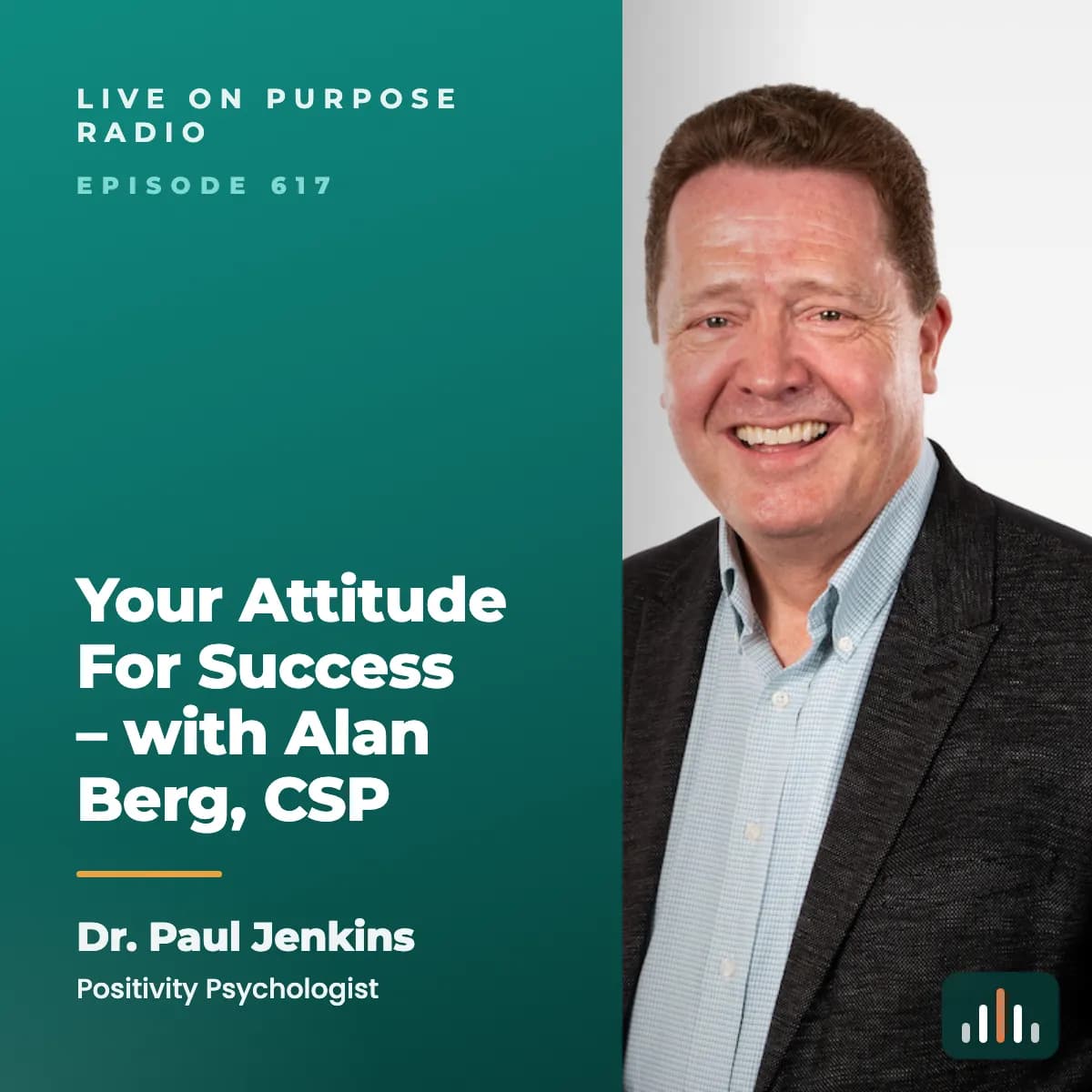
This is Live On Purpose Radio episode 617, your attitude for success with Alan Berg, CSP. Now is the only time to create and live the life you love. I'm doctor Paul Jenkins, the positivity psychologist. My job is to connect you to powerful positive psychology principles that immediately upgrade your relationships, business, and mental health. Are you ready?
Let's jump in. Hello, everybody. Welcome to Live On Purpose Radio. This is doctor Paul Lasrink who expands your life with another episode of Live On Purpose Radio. And joining me on the mic today is Alan Berg, CSP.
He is a global speaking fellow. He's authored 10 books. He's he's an amazing trainer and consultant who has some things to share with us today about the attitude for success. Welcome, Alan, to Live On Purpose Radio. Thank you, doctor Paul.
It... It's just an honor to be with you. I consider you a friend. And when you said would would would I join you, absolutely, in a heartbeat, and here we are. Well, I remember you had an interaction not too many weeks ago where we were at the same event for the National Speakers Association.
And every time I see you there, I have these warm feelings because I consider you a friend too. And you've created some value in my life with your wisdom and with the interactions that we've had. So I'm excited to share you with our audience today. This is an interesting topic, your attitude for success. And as I queue that up, I've shared with the audience here before that my perspective on attitude was shaped somewhat by my son, who is a pilot.
And attitude is, in fact, an aviation term, and it it means the position of the plane relative to the ground or the horizon. Is it a nose down attitude, which hedge into the hard stuff? Is it a nose up attitude, which can give you altitude, another aviation term? And as we look at it as position, I think we take a position about ourselves, about the world around us, about the people we work with. And I know you've learned some things about this.
I know one of your, areas of expertise is in sales. And I love the title of one of your other books too. Stop selling, help them buy. Yeah. And my most popular book, Shut Up and Sell More.
Shut Up and Sell More. Exactly. Which is Log the Safe Lines. So, Alan, I just... I'm queuing that up for you.
I I would love to have you just talk for a minute about why you're so passionate about this. I know you didn't intend to be a motivational speaker because you've got all of this great content Right. About sales, about website design, all that, that you have in your tool belt. But you've discovered something here about attitude that has been really transformational. So Yeah.
It it Walk us through that. It... It's as we pay attention to our own lives and the the people that we're affecting around us. You see how the attitude can be such an important part of the success, and success being something that we have to define for ourselves. We we run into trouble when we let other people define our success because when we achieve that, whatever somebody else said is success, it's often hollow because it wasn't our definition.
So we've Right. Gotten a certain amount of money or a certain size house or drive a certain car or whatever that is. And then we get that, and we're like, okay. Got it. Why do I not feel satisfied?
And that's an attitude thing. Right? That's an attitude. So Right. We we want to be able to choose our own definition of success.
We also have to accept that different points in our life, it means something different. Right? It it really means something different. I'm at a point in my life where I can afford a new car, but I don't drive one because it's just not a priority for me. I I I I drive 5,000 miles a year.
I fly a 100,000 miles a year. To have a car in the garage that's new, that it... Maybe I have payments on just doesn't make any sense, and it's not affordability. I live in a beautiful house. I don't need a bigger one.
I probably need a smaller one at this point. I'm pissed at this point. I hear you. Right? But the definition of success, you know, when you couldn't afford something, you wanted it, and now I can afford it, and I don't need it.
Right? It's an attitude thing. So Yeah. I I wrote this book, Your Attitude for Success, because I was asked to do a motivational keynote, and that's not typically what I was doing. I typically do content speaking.
And even though I might be the main speaker, the main keynote air quotes here for those of you listening, it's still a content driven speech. And I tell people I'm not a motivational speaker, but I do motivate people. I motivate them to take action. I motivate them. Right?
I'm not a comedian, but we laugh when I'm speaking. We're gonna laugh. But it's gonna be actionable content. You're gonna walk away and you're gonna say, wow. That was fun.
I learned something. I can use that. He didn't talk over my head. He talked right to me. Right?
And what I want people to do is take responsibility for their success and understand that it's a choice, that you defining your success as a choice, and and then what do you really need? What do you really want? And then what's really important to you? I know that you've... In your family, you've had some health issues that you've dealt with.
I've had that, which is what kind of, was the the impetus of the book. I was getting my first degree black belt at 42. I started at 39. I was doing taekwondo. Awesome.
And I was getting my first degree black belt at 42, and I was 90% blocked in two arteries. And I had five stents at 42. And then I got my black belt. But that was one of my attitude shifts. The first one was starting at 39, not at nine or nineteen.
Right? Right. At 39, the kids are doing it. That looks like fun. Let me give that a shot.
Right. And and then at forty two, coming to this crossroads where... Wait a minute. You're in the best shape of your life. I mean, literally, the best shape of my life.
I'm getting a black belt. And then getting winded, having the the the sense to go to the doctor and say, this doesn't feel right. You know, I'm getting winded when I'm in this great shape. Do having a family history of heart disease, I thought it was because my dad was overweight and sedentary that he had heart issues. Turns out it's familial.
Probably genetic. Oh, it's definitely genetic. I I now know... I see a genetic cardiologist. I I have hypercholesterole...
Genetic hypercholesterolemia. Okay? My father's mother had five brothers who all died of heart disease. Okay. And my mother had heart disease.
So it was all... Yeah. You come by it honestly, Alan. Absolutely. But there's the choice.
So at 42, I get five stents, and the choice is do I crawl under a rock and say, hey. You know, put a bubble around me, or do I say, no. We fixed the problem, so let's move forward. So a few months later, I got a black belt. And then two years later, I was getting my second degree.
It was getting winded again. Turned out I had some scar tissue building up in a stent, 90% blocked again. Angioplasty. Crawl under the rock? Get the bubble?
No. Get the black belt. I got my second degree black belt. Two years later, I hurt my back, six months from a third degree black belt, and this was an attitude shift again. I had two herniated discs.
I get physical therapy. I got fixed up, and the doctor said, you can go back. Physical therapist said, you can go back. And I said, you know what? I'm afraid I'm gonna hurt my back.
And I can't walk into the TaeKwonDo school afraid I'm gonna hurt my back because I'm focusing on not hurting my back. Right? Right. As opposed to getting the third degree black belt, which wasn't getting any easier at that point. And the shift was, why don't I feel guilty that I'm not going back?
Shouldn't I feel guilty after eight years of training that I'm not going back? And the reason was is I owned the decision as opposed to, oh, oh, Paul. I go back, but the doctor said I shouldn't. Oh, or the therapist said I shouldn't. No.
They said go. Because. Right. And what happened was in this presentation I did called your attitude for success, again, I I can't remember why I chose these stories or these things. I have a graphic.
I can't remember where I got it, and it looked like a playing card, but it... Like a joker. But instead of saying joker, it said victim. Mhmm. And I talk about how we all carry a victim card, but some of us choose to put it away, and some of us choose to wear it like a badge of honor.
And we know those people, and then we know people, and then you come to find out that... What's going on in their life, and you're like, woah. I didn't know that because their card is away. And I subsequently... And I know this is radio, but you can see it over here.
I've subsequently had the victim cards made, which are actual playing cards. And I give them away after the speech, and somebody says, I need one of those victim cards. And I just pull out a deck of cards, and I say, here, take a card. And personally, I took the king of hearts out of the deck, and it's in my wallet because I'm the king of hearts, heart disease. My wife, I gave the queen of hearts, so she's got that, and they're both put away somewhere.
But there's an attitude choice. We know people who choose to live their woes, who choose to live in their sorrow, who Right. There's there's a Yiddish word, siris. Right? And and siris is the heartache, and you just...
They they wallow in that like a like a, you know, like a pig in a pig sty in the mud just wallows in that stuff away. But that's a choice. It's a choice to do that or not, and I've subsequently had other stuff. When I was 49, I had a triple bypass. Last year, I had two more stents.
I was 99% in one artery, 90 in another. But I always go to the doctor when I think something's wrong. And I hear the stories about what the people that didn't, including a cousin of mine whose husband, three months after I had open heart surgery, dropped dead at 54 of a massive heart attack because he didn't go to the doctor and didn't get checked out. And that's... Was a choice.
Not a good one since his father died at 45 of a massive heart attack. You would have think... You would think he would go. So that's that's my health journey, but then now you hear that after you just described me as a global speaking fellow. I'm one of 44 global speaking fellows in the world.
They're spoken in 14 countries. This is since way after having those issues. I've written 10 books. Right? All my books are in Spanish.
One of my books is available in French now. And I'm... Book number 11 is in the works now. It's it's written. We're gonna do the layout and things like that.
And it's not despite the things that have happened to me. It's just along with them that my choice is, okay. I'm gonna compartmentalize that and say I have to take care of my health. If you ask me my priorities in life, I will tell you. My health comes first because I'm no good to anybody else without my health, then the health of my family, and then pretty much everything else.
Right? Because Yeah. Great phrase. A friend of mine who unfortunately has passed of health issues, he said, when you're healthy, you have a 100 problems. And when you're not, you have one.
You have one. And I did a podcast on mine called I Wish You a 100 Problems, and that was the story. It's like... Because I... Because if you have a 100 problems, it means you have your health.
That's awesome. Yeah. Wow. And my mind is playing with what you've just shared, and this is my whole practice. My whole career really is built around what what you're talking about here.
That there's a choice. When you said that earlier, Alan, it occurred to me that it is a choice, but until we see it as a choice, it's not. Right. Well, that's... But isn't that life?
Right? Right. If we have... If we walk through life with blinders on, we miss the opportunities. And I used to be a why should I person, and I turned into a...
Is there any reason why I shouldn't? Right? And, you know, I was a shy kid hanging on my mother's leg. Most people don't believe that if they've met me now, but I was. And, I didn't...
I wouldn't try something unless I felt I could master it. And I was pretty good at mastering things that I could, but I wouldn't even start the things that I didn't think I could. And that was a limiting thing. That was a blinders thing. Right.
And I remember I was VP of sales at this company, and we had a holiday party. I'm out on the dance floor dancing. I get to the bar to get some water, and one of the founders was there. And he goes, Alan, you're always in the middle of whatever's going on. I said, that's because the people doing are having more fun than the people watching.
And I realized it's better to do it and look silly to the people watching, but you having a good time and don't care. And that became, well, why not? And one of those things was, eight months after open heart surgery, I went skydiving for my fiftieth birthday. Mhmm. We do...
We did buy the T shirts afterwards that said skydiving, what's the worst that could happen? But we bought those after. Been buying it after the fact. Yes. I mean, that's After the fact.
After the fact. Yeah. But, are you familiar with Adam Grant? He's a he's a podcaster and an author. He's a professor at the Wharton School.
He's got some many great books. He's got, Give and Take. He's got his latest one called Hidden Potential. And I was listening to the book. I do audiobooks.
I was listening to the book, and he starts off talking about people who are polyglots, people who are good at language as an adult that were not good at language as a child, which is the opposite of what we're told. Right? If you're gonna learn another language, you're gonna do it when you're a child. And I thought he was talking to me, and I'll tell you why in a second. And what was interesting is the reason that they became good at languages as an adult is because they were comfortable with being uncomfortable.
Right. Right? They they were okay with that, and I'd go back to, I wouldn't try it unless I thought I could be good at it. Well, 2013, I started learning Spanish because I was sitting in Mexico. I started learning.
I took it in, you know, grade school. I took it in, you know, in in college, maybe a class, but, you know, Maria puts the pencil on the table, doesn't really help you that much in real life. So Yeah. I was sitting in Mexico, and I was by myself this one night, and I'm looking around, I'm listening, and everybody's speaking English. And I'm thinking, my gosh, we are arrogant Americans that we expect everyone to speak English to us no matter where we go in the world.
And I don't wanna be that person, so I'm gonna learn enough Spanish to be respectful of the people when I come here, not to be able to say, where's the bathroom? I need another beer, but a little bit more than that. So I started learning with Rosetta Stone, and then I did Pimsleur, and I did some other things. That was 2013. And in 2016, again, I don't know why, but in January, I was gonna be speaking in September at a conference in Mexico, And I said to the promoter, who I've known for a few years, I said, I'd like to present in Spanish this year.
And and and she was very excited because we're... This is a Facebook message conversation in Spanish, and she wrote back, you're gonna open the conference, and I wrote back, no. I'm not. I said, I will open the conference in English, but I will close it in Spanish. Because if I open it in Spanish, they're expecting everything in Spanish, but I will surprise them with that.
Well, long story short, she introduces me to a conference in Uruguay that was happening in August, a month before hers. So I ended up presenting in Panama, Uruguay, and Mexico in Spanish in 2016. Wow. And then in, Cartagena, Colombia in 2018, in Guatemala in 2019. I've done some webinars in Spanish.
I've done sales training in Spanglish. And I was talking to a speaker in The UK the other day who's, I think, better at some of the languages than I am, And she said, well, you present in the language. I said, there's two things you have to remember about presenting. First of all, nobody else is talking. So you're not trying to understand anything else, and you've Right.
Prepared what you wanna say. Right? So... And then the second thing is we we get people come to the... Our United States, and they speak in English, but it's not their primary language.
It's not their native language. Right. And I've never once looked at one of those people and thought, my my gosh. Their English isn't any good. I never...
I I don't even think about their English. I just think about their content. So I'm the one who's being critical and saying, hey. This isn't really that good. And they're looking at it going, look at this guy from The US that's that's coming and speaking in our language to us.
Thank you. Right? Thank you for trying. Thank you for trying. So go back to this...
The the book, Hidden Potential. So he's talking about these people that have learned languages. And what I realized is, I'm doing French now on Duolingo. Today was one thousand three hundred and thirty three days in a row. I've done at least one French lesson.
Okay? Wow. And my favorite days are the days where it is just kicking my butt, not the days where I'm getting perfect lesson, perfect lesson, perfect lesson. Right? Because it's not a game for me.
I don't skip lessons. It offers me sometimes to jump ahead, and I never take it because I'm not in a rush. I don't try to finish... Right. It's not like I need to finish this course.
No. I want to be as as fluent as I can get with this. So when it's kicking my butt, it's proving to me you don't know this yet. And then when you get past it, now you know it. It's like if I would do a crossword puzzle, I I wouldn't look the answers up.
I would just come back to it, and I'd come back to it and come back to it because looking up the answers, like, sure. I filled the grid in, but Mhmm. How did I improve? I I didn't improve from that. And that's a shift in mental from earlier where it's finish the puzzle.
Hey. Finish the puzzle. Here you go. No. What's next?
What's next? And and and can I have fun with this? And when I say fun, fun is sometimes, this has happened many times. I've been in an airport, and somebody needs help, and they don't speak English. And I'm looking around because there's usually all people speaking Spanish all around me.
And at these moments, there's nobody there speaking Spanish, and there's a person whose Spanish is their only language needing help. And I'm looking around going, I'm the one that needs to help them. Right? This this this white this white guy grew up in New York speaking English whose family two generations ago is from Belarus is the one who's now helping somebody find their gate in Spanish. Right?
Mhmm. And good. Good. Because I was supposed to be here at that moment. I'm supposed to be here to help that person because there was nobody to help them.
And... But there's an attitude shift. Right? So the first attitude shift was I'm learning it not to learn the language. I'm learning it to be respectful of these other people.
That's the first thing. And then the satisfaction is I've been able to help people with that. And I'll get in an Uber, and their directions will be in Spanish. You know, you sometimes will see that the directions will be in Spanish, and the radio's on a Spanish station. And I'll just talk to the driver in Spanish, and they'll always be surprised like, oh, you know,.
Yeah. Yeah. Yeah. Yeah. And then we'll we'll go, and it's fun.
I'm not there in French. And if you speak to me in French, there's a delay. My mind still goes, hang on. Hang on a second. That sounds familiar.
Yeah. Give me a moment here. And then I I I also do Italian because I might be going to Italy next year, so I started Italian. Mhmm. We just booked a riverboat cruise from Amsterdam to Antwerp, so I added Dutch into Duolingo, so maybe I'll know a few Dutch phrases.
Wow. And that's the why not. Right? Right. Because you think about your choice.
We have twenty four hours in a day, and it's our choice what to do with them. I choose not to watch sports. Not that I don't like sports. It's just, you know, if it's on, I'll watch it. If it's not on, I don't care.
I choose to play music. Sometimes I choose. Like, every night, my wife and I, if we're... If I'm home, we're sitting watching TV, and she might have her phone and she's doing something while we're watching. You know, it's the second screen thing.
Right? Mhmm. I'll be sitting there with my iPad with one earbud in, doing Italian or now Dutch, you know, language lessons. It's just my choice of what to do with that time, and why not? That's, again, the the why not.
I'm going back to what you said earlier also about your definition of success. Mhmm. Because that's how you can monitor how you're doing. Right. And, like like, not skipping a lesson because success is not getting through this.
Right. Success is gaining some level of mastery that... And and not compared to people who grew up speaking Spanish. Right. But compared to where I was yesterday, can I be a little better now?
Right. And that's... That was a lesson I learned with taekwondo. Mhmm. I remember asking the master one time, you know, are we trying to do the perfect punch or the perfect kick or do our forms perfectly?
And he emphatically... This was a guy born in Korea. Emphatically, no. Why not? He said because in his word, they might might paraphrase it.
You can't improve on perfection. If you're able to do the perfect punch, you can't do better than that. Right? And the lesson I've taken with that is I'm never trying to be the best I can ever be at anything. I'm trying to be the best I've ever been at that every time I do it Yes.
But the next time to be better. So I tell people, I don't want this to be the best speech I can ever give when I'm on stage. I would like it to be the best I've ever given, and then I would like the next one to be better, and then the next one to be better, and the next one. I I would like this book to be the best one I've ever written, but not the best I could ever write. And that's that lesson of constant improvement.
And even if it's micro improvement, that's important, and something you've probably spoken about, I I know I've read about it, is we don't often give ourselves enough credit to look back and see what we've accomplished. Right. It's like watching your own kids grow. Right? You don't see them growing, and then your friend hasn't seen them in three months.
It's like, oh my gosh. How did they get so tall? Right. It's that same thing. And if we look back, you know, if I look over my shoulder and see 10 books over here, I'm like, oh, I guess I'm an author.
At what point do you realize that? Yeah. Right. And I say when I wrote the first book, I didn't feel like an author because I think everybody's got one book in them. If they would just tell their own story, you have a book.
Right? Right. And then I did two of the first year. So 2011, I did two books because your attitude for success came out that year also, even though I had no really thoughts about doing it until the feedback I got from it. And then there were a couple of years went by, and then I did another book.
And then a couple of years, and I did another one. And just listening to my audience, I have a book called Why Don't They Call Me? Because people were just complaining. You know? They won't pick up the phone.
They won't pick up the phone. So I wrote a book, Why Don't They Call Me? And when you open the cover, it says, Get Over It. And then it goes into the book. And then during COVID, I was listening to my audience.
I was I was trying to write... Not trying. I was starting to write a book about websites, my second one. And I kept hearing, I'm getting ghosted all the time. Why are they ghosting me?
I don't understand. Why are they ghosting me? So I wrote a book. Why are they ghosting me? Right?
And, so the stop selling and help them buy, the one that you mentioned, my... That's my latest book. That was really interesting from listening because people would come up to me after I spoke and say, hey, Alan. Which of your books has that? And if it wasn't in any of my books, I'd say it's in the next one.
That's right. And I and then and then I started to write down those things, and I came up with 40 something things. I cut it down to 35. There was some duplication. And I wrote a book with 35 chapters, every one of which is something somebody asked me, which of your books is that in?
You've spoken about that, talked about that, which of those is that in? Mhmm. And by listening to the audience, by really listening and saying, wait a minute. There's something here. Give it back to them.
And the book's written to be read in any order. You can literally jump to the last chapter and start there if that's what you need because they stand on their own. And the one I'm doing now will be my third book that I'm doing that way. So you don't feel like, oh my gosh. I have to read the whole book.
No. Read the chapter that makes sense to you. It's like when I do my podcast, it's five to ten minutes. It's just a thought on something, and we're done. Turn off the mic.
You're done. Wow. Well, I can tell that we're probably getting close to done with this episode. Although, I don't I don't know how you can tell when you're ever done having conversations because every time we do, there's there's new thoughts. There are new ideas that that come to the surface.
Alan, we've talked a little bit today about your book, your attitude for success. That and all of the other titles that you've mentioned here are available on your website, which is alenburg, that's spelledberg,.com. And that's where people can also connect to other resources that you're offering, mastermind groups, trainings, presentations. My my podcast, all that. Three of my books are for anybody.
So your attitude for success, shut up and sell more of just about anything, and, if your website was an employee, would you fire it? So they're not written specifically for the wedding and event industry. You'll see other books there for the wedding and event industry, but those three are for anyone. They were specifically done for those. So look for yellow, red, and purple covers.
Yeah. So don't buy the other books, you guys. Actually, you know what I've found is when you when you hone in on principles, even though it's written to a specific industry, that can be extrapolated to, any industry, really, when it's based on principle. And that's where that's where the purple came from. Shut Up and Sell More Weddings and Events is my most popular book.
And I I heard if, again, if you're listening, I heard people say, you know what? The principles in there will apply to any business. Yes. And I said, yeah. I know that, but I wrote it for my industry because if you're on Amazon and you search for a sales book for weddings and events, you need it to be about that.
Right? You gotta find that one. So last year, I challenged myself. This comes back to the same thing. I challenged myself.
I said, well, people keep saying that to you. Are they right? And if they're right, then you should make a version of the book for anybody. So I took Shut Up and Sell More Weddings and Events, took all the references to the wedding and event industry out, put references to all kinds of businesses in there, and made Shut Up and Sell More of just about anything. That's what it says on the cover.
Alan, I have a personal message for you. Okay. Thank you for not playing your victim card. You just keep that hidden away wherever it needs to be because you're creating some tremendous value. You've done that for us here today at Live On Purpose Radio.
Thank you for joining us here on the mic. Folks, you've heard it from one of the leaders in any industry, Alan Berg. It's time to go apply what we've learned. Let's all go live on purpose. Did you get what you came for?
Give yourself the gift of taking real action on what you realized today. Please share this episode with someone you know would value it, and leave us a rating too. It's time now to live on purpose.
Open the transcript on its own page ↗