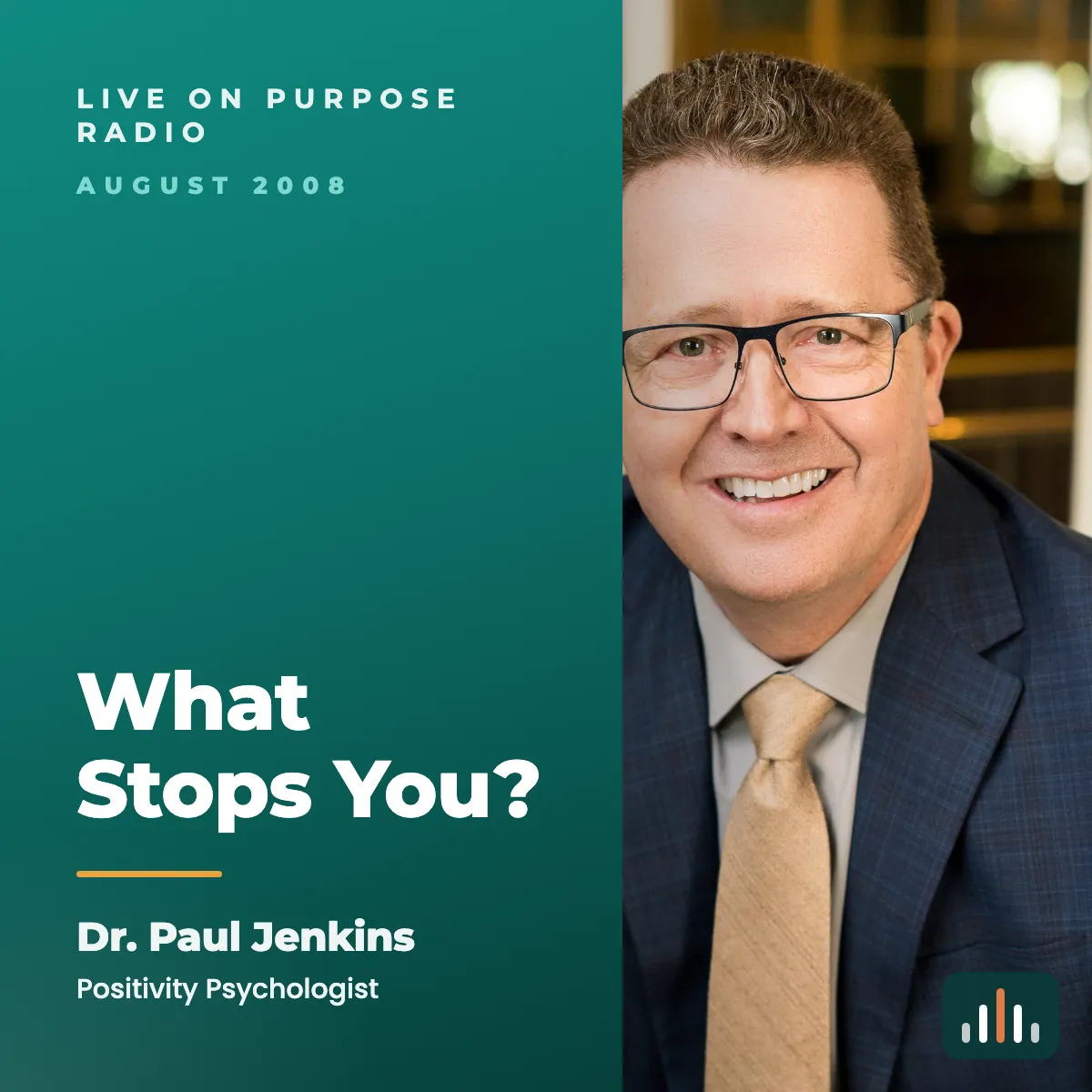
Are you cruising through life not always knowing what direction you were headed? Let Live on Purpose with doctor Paul Jenkins be your guide. Live on Purpose will give you insights into your life and show you how you can become the driver and captain of it. No more aimless wandering. By learning the principles that govern happiness and wealth, you will be able to make personal progress that you have only dreamed possible.
And now, here's your host, the shrink who expands your life, doctor Paul. Hello, everybody. Welcome back to Live on Purpose Radio. This is doctor Paul, the shrink who expands your life and we're coming at you with another episode of Live on Purpose Radio. I'm excited to have another guest with me today.
She is a life coach and someone who is helping people to figure out kind of a tricky issue that I'm gonna get to here in just a minute. Darlene Braden is a best selling author. She has a new book out called, What Stops You? We'll be talking about that a little bit during the program as well. And I I ran into Darlene, oh, about a month, six weeks ago, something like that, on television of all places.
She and I were on the same morning show here in Salt Lake City and, had a little chance to chat for a few minutes and get acquainted with each other. We found out that we're doing some very similar things and just trying to help people to have a higher level of freedom and control in their life. So I wanna welcome my guest, Darlene Braden. Welcome, Darlene. Hey, thank you.
So glad to have you with me today. I appreciate the opportunity and look forward to our conversation. Well, I'm gonna jump right into our topic because this is an area that you have developed some expertise in. And, it's in the area of self sabotage. And you wrote a book called What Stops You.
And this is all about overcoming self sabotage in your personal and professional life. Mhmm. Tell us a little bit about, just who you are and how you started to get excited about this particular topic. Well, you know, long story short, I had an injury. My best friend was killed.
I broke my back and I really went into wanting to heal my body and nothing Western seemed to work. So I really started to focus on the Eastern healing arts and got involved in acupuncture and spinal touch and Tween On, a lot of alternative medicine and herbs. And I really got in touch with my spirit and my soul and found some really great, great healing over the course of what, five, ten years in my body. And so I then really went into NLP, neuro linguistic programming, and became an expert all the while finishing my bachelor's degree, of course, and really found that I was intrigued with the unconscious mind because that's really how I healed my body. Oh, yeah.
Yeah, and so I was so intrigued by the unconscious mind, so really focused on hypnosis as well, And then the unconscious part of our minds that really control us, which is 97% ish of our mind is unconscious and little 3%, you know, is what we can see, hear and feel. And so I was just really intrigued with that angle of healing and started a practice with NLP and coaching and hypnosis and so I just have... And I don't know where it came, the self sabotage branding and the what stops you branding. I don't know. Mhmm.
I don't know where it came from. It just... Well NLP... Sort of evolved in... Yeah.
It evolved in one of the final questions in the NLP well formed outcome. The final question is, well, what stops you? Mhmm. And so that's kind of a jargon in NLP and and use that for my book title. Oh, yeah.
Well, this this whole idea of the the unconscious or the subconscious mind, this this part of the major control center of of you that you're not even aware of. Mhmm. And I I think most of us really underestimate the power of our subconscious mind. Uh-huh. And when you come to understand that a little bit better, you can really make some tremendous strides toward healing or or toward accomplishing the goals that you have in your life.
Yeah. Tremendous strides. In fact, I tell my clients to think of me as the interpreter between their conscious mind and their unconscious mind. Oh, uh-huh. So they're kind of chatting with themselves and fighting with themselves, which is self sabotage, the deeper levels of things that stop us that we're not aware of.
And I read unconscious ease, which, you know, and you know this as well, I mean, when a person moves, for example, in an asymmetrical way where they're moving back and forth or gesturing at both hands in different ways, that means there's a conflict. If a person gestures with both hands symmetrically and sits symmetrically, then they're congruent with their parts. You know, so little things like that, eye movements I noticed through the NLP training and hypnosis. The eye movements whether it's right, left, up or down tells me if they're seeing a picture or feeling a feeling, or hearing a sound. So looking at someone as I chat with them I know what their mode...
I know that internally they're hearing something. Or I'll know based on their eye movements that they're seeing something. Because they're not even aware they're seeing something. Even though they're giving off some some clues or some hints Yeah. To you as an observer, you can kind of tell that there's something going on there.
Mhmm. Yeah. And so so I know, you know, I might say, So what do you hear? And they'll say, Nothing. And I'll say, Hold your eyes right there.
What is it that you're hearing? And then all of a sudden they may break into tears and say, I hear my dad telling me I'm not worth anything. And you know, we just can make... Oh wow. Yeah, it's just quick.
You know, I tell people three to 10 sessions no matter what it is because it's just really quick when you really get the reality, rather than just chatting about a problem. And I do that too, but you know, just chatting about some drama or trauma in your life or something that's not working, chatting is great, yet to really acknowledge these things so quickly is more efficient. Well, coming to a realization of what it is that's driving you, That's a powerful experience for people and they really... They don't often have a full appreciation for for why they do things. Mhmm.
In fact, that's a that's a common lament that I hear from my clients. Why do I do what I do when I know what I know? It is. It's a common lament. I love that.
Why did I do that? Or why can't I do that? And to us it's like, well, because there is a party that doesn't want to. Right. They're like, what?
Well, part of you doesn't want to lose weight. Mhmm. Yes, I do. Okay, so talk to me about the part that doesn't. Oh, it's the part that wants to keep me safe from unwanted advances from men that I hadn't really acknowledged.
Or part of me wants to just feel comfortable or treat myself to a treat and when do I do anything for myself ever ever. I'm always doing things for other people. So I just wanna eat and enjoy. That part does not want to work out. It's the other part that wants to work out.
So this is what you're talking about with the conflict because there Mhmm. There will be desires or or objectives within the same person that are in conflict. Yeah. And then... Oh, yeah.
So let's... I I wanna get into this self sabotage idea a little bit more. I just... I not too long ago read, the Arbogener Institute Leadership and Self Deception. Mhmm.
And, they talk about that quite a bit in this book, in in the context of leadership. But this is something that that'll... I think all of us deal with at some level. We we just kinda go through our lives and we operate in what we would consider to be a natural or a normal way. And part of that includes this almost continual process of self sabotage.
I would love to have you talk just a little bit more about what that is. What what is self sabotage? How does it work? A war inside of me. That would be self sabotage.
It wants... Part of me wants this, part of me wants that. It's a fight inside. And like I've mentioned, sometimes it's conscious and sometimes it's not. Sometimes it's very deep, like an inner child wound or, you know, an adult that's acting out like a midlife crisis really could be the inner child, sabotage, an inner child that wants something that hasn't development, has been stuck in a developmental stage according to Erickson, you know, those stages.
And so if they're stuck in a developmental stage, the body grows up, but that part of the mind is not. That is not a clinical disorder. That is something everyone listening has. Everyone but Jesus, maybe Mother Teresa, you know? Because the fact of the matter is we're human beings.
So it's a daily revision and you need to really assess and say, you know, what's going on. So, so sabotage is a war inside. If you've set a goal before, for those of you listening, if you set a goal before and you haven't reached it, then you set it again and you just didn't reach it again, and the next year, I again, you just didn't quite lose that weight or, you know, clean your office or you just didn't quite do what you wanted. There's probably part of you that doesn't really want to do it. And it can be...
And what I do, Doctor. Paul, is I, with my clients and all listeners, get a piece of paper out. The beginning stages to really find self sabotage is to write down conflicts that you've had today. Like I wanted to wear this but I wanted to wear that. That is a conflict.
It's a very simple one. I wanted to go at 10:00 but maybe I'll go at three. No, maybe I should go at ten because then I could da da da da. But 03:00 would be better. No.
How about... And that's that's a conflict as well. And some of them are very simple like, okay. I'll just decide. Okay.
We're good. Other times, it's like a real war inside over something even simple. And then it could be bigger like I wanna move, sell my house, but I really wanna live here. But I kinda wanna live by the ocean because... And my business opportunities are better somewhere else.
Mhmm. So it's it's that... That's what self sabotage is. So whether it's simple or complex, that doesn't matter. It's the same kind of a process that's going on.
Correct. Yeah. And you're and you're suggesting... Okay. The first step toward identifying that is to start looking at the conflicts that you experience.
Mhmm. That are simple. Even just, Begin with. Kind of a daily a daily experience kind of a conflict that you might have. Such as I wanted to get up, this morning and part of me didn't.
Mhmm. We all have that one. How common is that one? Right? Especially if it's before 9AM.
You know, do I want to get up at six? No. Yeah. No. Yes, I do.
I said to myself, no, I don't. Mhmm. And that's you know, so to recognize those conflicts is really important. And both of those desires actually represent things that you want, but it's it's different parts of you that are wanting it. Exactly.
And and and as you know, there's a lot of people call the part the good and the bad part. Mhmm. And hopefully in this call, people will learn that doesn't work. Because when we have a good part and a bad part, we stuff the bad part down, but its intent is good. So let's say you want to have a midlife crisis.
You want to leave your spouse. Well, okay, part of you wants to be a married man or woman and be a great family person. The other part wants to be free and wants to leave your spouse. Well that's pretty serious and I use that as an example because underneath that, that part of you may want to express yourself, feel alive, feel passion, feel, feel worthwhile, feel in control, feel like you have choice. So there's underneath good positive intents but externally, you're leaving your spouse and that's bad.
And so we ignore the intent underneath it. And and there may be other ways to satisfy that Yeah. That desire or that need that are more adaptive for your life. And that's the key. We'll be right back after this break.
Raising kids is one of the most challenging and rewarding experiences we can have in life. Your children didn't come with an owner's manual, so it's up to you to learn whatever will assist you in your role as a mom or a dad. Join me and my husband, doctor Paul, for a free weekly discussion about all of the hot topics in parenting. Listen to what others are saying about these calls. By applying the things I've learned through the parental power calls, I'm finally becoming the mom I always thought I would be.
I really like to use parental power as kind of like a reference book. So as I have concerns with my parenting, I like to be able to look up on the blog and then listen to whatever podcast seems closely related. I like the variety of of topics, the variety of age groups that are addressed. I'm on the parental power calls as often as I possibly can because I know I'm gonna come away with something I can apply to being a parent that very day. Let us join your parenting team through parental power.
Just send an email to doctorpaul@liveonpurposeradio.com to register for the live calls or just check us out first through the link at doctorpaul.org. All of the previous calls are posted on our blog site where you can also add your own input. Let's team up to start parenting on purpose. Hi. This is Jason Adams, one of the co founders of cashflowparadigm.com.
The created cash flow paradigm is a way to help others look at money differently. What are your beliefs about money? Is it good or bad? Many people have beliefs that limit their control over money and don't even realize it. The thing most people don't realize is that their beliefs about money greatly affect the amount of money and prosperity they have.
It's all about your paradigm. Come play a fun game with us called Cashflow one zero one created by best selling author Robert Kiyosaki. Come meet new people and check your paradigm as we learn principles that govern our personal and financial lives while having fun together. Currently, we are holding monthly game nights in Provo and Saint George, Utah. Go to our website at www.cashflowparadigm.com to register for upcoming events.
That's www.cashflow,paradigm,.com. Okay. So Darlene, I wanna go back to explore something psychologically for now. Okay. This this unconscious mind, this subconscious mind that we all have and it's really the biggest part of our mind.
Mhmm. There's there's so much more going on there than we're aware of. Mhmm. I I have taught a lot of my clients this. Your subconscious operates on the basis of emotion and beliefs and primarily beliefs.
Mhmm. And then it manifests through the emotions that we feel. Mhmm. The beliefs that we have are kinda like a template or a program. It's running in the background.
So you're not even aware of it, but it puts it puts a cast on everything that you experience. And these beliefs are formed often very early in life, in childhood or with powerful experiences that we've had when we were younger. And then it just creates this template and then we use that template to interpret a lot of what's happening in our world. Mhmm. Is this still flowing with the way you see it?
Oh, 100%. I I I add to that that in the subconscious is the id, the lizard brain, the animal brain that just wants to survive and doesn't care how we do it, whether we're angry. So I add that in there, and then you couple it with limiting beliefs and, oh, we're kind of in trouble. We... Well, it kinda sets us up, doesn't it?
Yeah. Yeah. Yeah. Because we're just a lizard. A lizard would go to the bathroom right in front of you.
Yeah. So with a dog, you know, just right over there, and it just wants to survive. And if you, you know, so if we have that inside of us without the superconscious, without, you know, the societal... So I just kind of, you know, societal expectations. So I mix the the animal instinct we have with the limiting belief Mhmm.
And that's why we all need each other's help with this life. So you have you have a word that you use in your book. The word is fables. Mhmm. Tell us about fables.
So fables are once upon a time... Okay. So you're you're at lunch waiting for someone to come and and they don't come to lunch, they're late. And then they're really late, five late, five minutes, then ten and so you just get your piece of paper out and your pad and you write a fable about why they're late. They're late because they don't like me.
And then you think, you know, I'll write another fable that they're dead. They got in an accident. And then you say, well, you know, maybe I'll write a fable about the fact that I am... I'm not very smart and I got the wrong day. I'm not good at time management.
Maybe I'll write this fable that they're bad at time management. Maybe I'll write this fable that I'm on that show. What's it called? Bust, Punk'd. I'm being punk'd.
Oh. You know, candid camera. Uh-huh. And so a fable is just not real. It's something...
It's a story we make up based on our world and the id that wants to survive and be okay. We make fables up and stories that are not true, but we think they're true. And Darlene, haven't you found that you can't you can't not make up fables. Yeah. Yeah.
You're gonna make these stories. But anytime you experience something in life, you have to have some way of interpreting it or understanding it. And so you take all of these templates and all of these core beliefs that you've brought up clear from your childhood sometimes and use those as a format for this fable or this story that you make up. Yeah. Like if you're insecure and your template is that you've been abused or people don't like you, then your template will create that story more towards the I'm not worth going to lunch with and that's why they haven't shown up.
If my template is all people are bad, then my belief at lunch they don't show up is they're so stupid. I can't believe how rude people are. Mhmm. And so the story does come from our from our templates and from our our belief. Mhmm.
And you'll make this up based on as much or as little information as you have. Mhmm. Yeah. And you know, I wanna say, you know, I put in my... I say in my book, humans are meaning making machines.
We almost... It is so hard to not make a meaning. Everyone listening is making a meaning to who Doctor. Paul is and what he's about. They're making a meaning, a meaning, who's Darlene Braden?
They're making a meaning of, okay, how come they're... What is this podcast about? And it might be real positive things. It could be negative. People make meanings if...
All the time, like, oh, why does she have a flowered couch? How come he this? And so we do it and what I use in my book, and I love, love this, is if you model a dog, they don't make meanings. Mhmm. You know, I put my dogs out of my office here, my professional home office for this podcast Mhmm.
And they're both outside kinda screaming but they didn't make it mean I don't like them. They made it mean they're outside. And they'll be happy to forgive you immediately. Well, and they don't even need to forgive. See, they...
We we interpret it as they're forgiving, but they're just purely present. So when I bring them in, they'll go, I'm in now. And this is cool. And they didn't make it mean it's good or bad if I put one out and the other one not out. They don't make it mean I like her better or worse.
It's just that I'm out and she's in. Mhmm. So watch your dogs, people, and they don't make meanings and it's a really great thing to model. To just go into the nothing and really I use a pause button that I... You know, I give people a pretend pause button and just push a pause button when you're at lunch making those meanings and stop it.
Go into the nothing. Go into the dog mode like I'm sitting here by myself. Period. Nothing else. And then when you go home, you can ask why were you late and then find out.
You know, so make those meanings stop and it's like you said, we all do it. It's a little difficult to do because we're humans so let's act like our dog, use the pause button and and stop doing that so much. It's a wonderful thing. And and what I'm hearing you say, it's not a bad thing that we make meanings. In fact, it's what sets us apart Uh-huh.
As human beings and it's part of a very rich experience that we have in this life. But please realize that you're doing it. Yes. Yes. And if you can push that pause button occasionally and then there's some other powerful things to kind of call your attention to these fables or these stories that you make up.
One of my favorite questions is, what else might this mean? Mhmm. Beautiful. Go build another Yeah. Story.
You know? And when you ask that to people, don't they just kinda stop? They look up. They kinda go, what else could it mean? And there's always, always, always, always, always, always five things it could mean.
There's always five things it could mean. Right. If your dad beats you up, there's five things it could mean. Mhmm. It could mean he's...
Well, you know, let's play with it. Dad beats Johnny up. What does that mean? What are five things it could mean? Johnny's evil.
Mhmm. Or dad's ridiculous. Dad's evil. Dad's evil or dad is bumped you. I mean, you know, or help me out here.
Or... You know what? Sometimes I get a little crazy with this. I've had some of my clients where where I'll build a whole elaborate Yeah. Table, you know.
Oh, dad was, you know, the Yeah. The family is under siege by Right. Terrorists. And they have said that, you know, if dad doesn't beat up Johnny, then the whole family gets killed. Right.
You know? Exactly. So dad's actually trying to save Johnny's life. By beating him up. He loves...
And it's ridiculous. Right? So he loves you, so he's beating you up. It's ridiculous, but what other fables are we making that are ridiculous? Just everyday all the time.
Yeah. So if you can call your attention to that, then sometimes you can stop some of the self sabotage that's going on. Yeah. Because you're creating a new story. And the first thing is awareness.
You can't solve a problem unless you know what the problem is. Mhmm. And you know, I use, all of my stuff in business as well. I go into corporations and everyone's in a suit, you know, in the audience. And and I talk to them about the same things when it comes to business in a sales process, for example.
The fear of the phones. Huge. And that's a sabotage piece. It's a piece down deep that doesn't wanna make the call. That's right.
Because they might be rejected. Mhmm. And the character in my book is Anna and her outcome... Anna follows through the book. And you meet her and she's just a wreck, the first of the book.
And by the end, she's kinda figuring stuff out, but she... Her outcome was to make sales calls without throwing up. Oh, wow. And then also on a personal side to, lose 25 pounds. Mhmm.
So it... All of this self sabotage stuff applies in in, business even in terms of I don't feel like I deserve money and my beliefs are money's evil or whatever. Mhmm. So it's a whole... You can take self sabotage and put it in any category.
In religion, how do you sabotage yourself in religion? In physical, you know, weight loss and... And I'm a fitness instructor as well, so I have a whole segment of that that I do as well. Oh, yeah. Well, you know, that's a huge area.
Mhmm. Mhmm. Where I've seen personally in my practice, I've seen self sabotage kick in as as people have these stated goals, you know, they wanna be fit. They wanna they want to lose a certain amount of weight or whatever it is, you know. And then secretly or subconsciously, they are clinging to the status quo.
Mhmm. They wanna keep that going. And if you have a thousand people, you're gonna have a thousand different answers as to what stops them. Mhmm. And that's why private coaching is great.
I have a... My second book out is What Stops You From Having the Body You Want. Oh, Yeah. I was on the home team on the Tuesday fitness day for that. That's the KJazz.
KJazz television morning show in Salt Lake City. Yeah. Mhmm. So, yeah. That's definitely a self sabotage area.
So we're coming up on another break here in just a minute or so, but I'd like to start turning this toward... Okay. So I'm self sabotaging. Alright. Thank you very much.
Now I have that information. I know I've got this subconscious mind. What can we give people as far as practical steps toward overcoming this self sabotage? Okay. Where would you start with that?
Well, I would probably start with what you and I've chatted about with what what are five things it could mean. I I start that out and preface it by saying here's a piece of paper. You're seeing an an eight by 10 or eight by 11 piece of paper and it's white and when you... But I don't see that. I see a line because I'm looking at the side of the piece of paper.
I see a line. And you see a rectangle. And who's right? You or me? I think I'm right and I think you're ridiculous because I know I see a line, a little skinny white line.
And so we could argue forever and so the first thing is to realize there's always another way to look at anything. So after that premise, that's a really good analogy. Then to go into, well what are five other things it could mean? You know, and another thing I do is I question them with... We call it slight of mouth in NLP.
Uh-huh. They'll say, well, I'll tell you about slight of mouth when we come back from the commercial. That sounds like a plan. Okay. We'll be right back.
Thank you for listening to Live On Purpose Radio. Some of you have been asking how you can get more involved with the show and I also appreciate those of you who have offered to support the show. Now you can do both easily by purchasing a top spots listing. For a very small donation to the show, your link will be posted at liveonpurposeradio.com. Just go to the website and look for the top spots widget on the right side panel.
Click at the bottom and follow the simple instructions. You will then be at the top of the list. Thanks for your support. Some people give their 2¢, but this positive island boy shows a dime every time he speaks. Dino Pinder is back with another deposit to your attitude.
Back on The Bahamas, people are always friendly and they greet each other everywhere they go. But I've noticed since coming over here that people just don't wanna talk to each other this much and when they get ready to or they think they're in a situation where they actually need to say something to somebody, they jump on the cell phone. I refer to this as everybody's own cell phone island because that's what they are. Everybody's living on their own island. And I've even noticed since you get on elevators, you walk in a elevator, people don't even wanna talk to you.
They're afraid to even look at your eyeballs, eyeballs that keep staring down on the ground. And until they finally jump on the cell phone and start playing with it, and then they... Door opens up and they go on their way. So cheaper we get back to how things supposed to be and, greet each other and say hello and go back to like our grandparents used to. I think you just need to jump off of that real estate there because that real estate and them cell phone islands are way too expensive.
This has been Dino's Dime. For more island wisdom, visit dino'sdime.wordpress.com. Okay, Darlene. You've just got me just excited to hear what sleight of mouth is. What are we gonna tell?
I was waiting clear through the whole commercial. Yeah. Okay. Talk about that. This is this is one of the techniques or the skill, skills, tools that you use with your clients.
Yeah. Okay. So... Okay. So slight of mouth is, I'm always gonna be fat and you say, for sure?
Or... And that just shifts their... As soon as someone shifts their belief at all at all, it becomes not true. So for sure, you're always, always gonna be fat. And and then as soon as you can find any exception ever, ever, ever, then it's not a true statement anymore.
I'll always be fat. Do you still believe that? Well, no. But I'm really kind of fat. Or...
Okay. So sleight of mouth could be, so always fat? Like, is everyone fat? So... Mhmm.
You know, so you just kind of question the belief that this slight amount like, that's interesting. How long have you thought of that before? Yeah. You know? So it's just kind of a a questioning the belief in an honoring way.
Well, that... That's really the key of a lot of the a lot of the coaching and and therapy and counseling that happens is questioning those beliefs. Yeah. And because if they can find an exception... Let me let me go through a little thing here.
Okay. So let's say... Okay. This is something I would do in coaching. So someone says, well, I'm really...
Okay. So I'm fat because my family is fat and I know, you know, I'm gonna be fat because they are just fat. It's in my genes. Yeah. It's in my genes.
Mhmm. My mom is fat, my dad is fat, my grandpa is fat, and I'll be fat. And then I say, okay, so for sure... And then they go, and I go, so what equations are you making? And in my book it goes all into equations because beliefs are always equations.
So their equation might be I'm fat equals I'm no good and I have no control. Right. And then slight of mouth I say, okay, so you're no good. Okay, so you're no good at anything ever? And of course they're going to find an exception because they may be a good mom or a, you know.
Right. Sure. Then I say, you're good at some things that you focus on. Right? And I go, well, yeah.
And then I say, so what if you focused on being thin? And then they're like, I'm like, woah. And then we talked about, well, so what if fat equals opportunity for change? And then all of these things you've got to sit there for a minute. And then what equals fat equals my body has fat on it.
And I believe that I have choice. And then I say, so what are you going to do about it? And what's the first step? And everything I do, there's three circles like the Olympic rings. It's either an action or a skill or a mental process which is the beliefs and the identity.
So now it's time to take, now that the belief is shifted, it's time to take action and develop skills of whatever skill they're needing. So it's, you know what? Change your beliefs is as easy as eating apple pie with ice cream on it when you know how, right? Right. Isn't that Yeah.
Is that what you find in your practice? Absolutely. You know, it's it's not that hard. Except I say it's impossible if you don't have these little hints. Mhmm.
Little skills. Then seriously, as you know, you've had 50, 60 year old men and women in your office that are struggling with something they formed when they were three years old. Right. So it's really hard to do, it's not impossible. Yet if you know some of these little skills of questioning, sleight of mouth, you know, looking at it differently, then it becomes simple like I cannot believe I believed that at the first of this session.
That's so funny. Mhmm. I like what you said about skills too, Darlene, because, you know, you can take an action, you can kind of know what to do Yeah. And maybe even take some steps in that direction. But a skill is really something that you have practiced.
Mhmm. Something that has become part of what I refer to as your neural pathways. Yeah. Or the, you know, the cruise control, the autopilot of your mind. And it becomes a natural way that you that you and think.
And one of the examples that I use in some of the seminars that I put on is a keyboard. And how easy is it to to just type your name, you know, on a keyboard. Right. But then the keyboard that I bring out in the seminar is one that I've taken a butter knife and popped all the keys off and put them on in different places. Ouch.
And then I challenge people to type their name. Can you imagine? Yeah. It is. Wow.
That's really good metaphor. Good job. Well, and it is so difficult because you can't use your old neural pathways on that new keyboard. Yay. And even if I were to convince you, if I could just convince you without any question that this keyboard that I made is a better keyboard, you still couldn't use it effectively, even if you believe that.
Unless you practice. Right. Oh, that's way good. And what a powerful analogy for what what you're talking about here too. You know, you you identify them.
You get a hold of those mental processes. You gotta understand what beliefs are driving you. What's the template that's creating all of these stories and fables in your life. And then finding the actions that correspond with change, but then having the discipline to put the skill into place. Yeah.
Absolutely. And knowing, see some people focus on the skill before they work on the mental process. And that's where I kind of differentiate and say, okay, what stops you? Is it an action you're taking or not? Okay, let's use golf as an example or losing weight as an example or addiction to alcohol.
Is it an action that you're doing or not that's stopping you? Probably. Is it and or a skill that you've developed or not? I don't know how to say no. I don't know how to drive with my, you know, all the way through and follow through with my putting iron.
Or is it and or? Is it a mental process which is a belief? And so I'm a very structured thinker, so we very structured... I know immediately upon meeting someone kind of where it lies. We discover that an action and or a skill and or a belief and then sometimes we start down at the bottom working through actions and up, other times we just start right at the beliefs and then go down to the actions, depending on the person.
But yeah, the skill and the neural pathway, let me shift a little and say that NLP is all about changing neural pathways in a session. So for example, or three. So let's say you have a new keyboard and you find how to say your name, Paul Jenkins, okay, woah, that was hard. And then through meditation, through things I do, through NLP, then a new neural pathway can be embedded immediately on the new skill on how to type your name fast and efficient. So through some processes that we do.
So changing neural pathways and shifting old pathways is really powerful with neuro linguistic programming, which people, by the way, can go to my website, whatstopsyou.com and look up the tab that says what is NLP and gives information there. Mhmm. And then in addition, just on the website, if you just type in NLP, it's just seriously the the neatest thing ever. Mhmm. I just am so I just am so grateful that I went through years and years of training and experience with NLP.
It's just so powerful about changing narrow pathways Mhmm. And shifting the old memories and the old way of doing things. Well, there's there are some principles that govern all of this. And as you understand what those principles are and then begin to apply them... I mean, even with the with the keyboard analogy, sometimes I'll I'll hand someone that keyboard and I'll say type your name.
And on the average, I've timed a number of my clients Mhmm. On the average, forty eight seconds to type their first and last name and Right. That's just insane. You know, this is something you can do without even thinking about it. Well, because the other neural pathways, it makes it harder.
Right. Because I'm completely expecting to have an s on my left little ring finger, you know. Mhmm. Sure. If you came in anew, you could almost probably type faster if you never had typed before.
If you didn't have the old stuff getting in the way. Yeah. Well, but then I'll have them practice it three or four or 10 times. Uh-huh. And they...
Without exception, even clients who do not type fast anyway can can type their name within two seconds after they practiced it. Isn't that awesome? Well, try try this. Have them type it once and then twice. K?
Then have them sit back and imagine that they're typing it. Mhmm. And have a breath. And even if they don't consciously type it in their head, tell tell them to go through it consciously in their head, then tell them to go through it unconsciously. Just say, okay, you're gonna type it 10 times in your mind's eye in the next ten seconds.
Go 10, nine, eight. So they're consciously like, 'Woah, you're going too fast' Right. For their mind. There's another part that's keeping up. Then, yeah.
The unconscious is doing it and then say, duh. Okay. Now go get a drink of water, come back and type your name. So this... And they will do it for me.
That would be really fun and tell me what you find. You know who Dennis Waitley is? Uh-huh. I I remember him talking about this that that the mental rehearsal Yeah. Is just as powerful.
Mhmm. You know, as you go through the same process in your mind. You think about it, your subconscious or your unconscious mind is in the dark. Mhmm. It doesn't see what's going on anyway.
You have to tell it with your conscious mind Mhmm. What's going on. And so there is very little difference to your subconscious between an event that is real and an event that is perceived. Yeah. Yeah.
It's the same. This is why you get so worked up in an exciting movie. Yeah. And you and you imagine a spider crawling and you bring your feet up. Uh-huh.
Well, and see the the rehearsal... What did you call it? The the what rehearsal? The, the... The mental rehearsal?
Oh, yeah. Mental rehearsal. So... Mhmm. And I take it one step further to okay, we're gonna write you're gonna type your names 50 times in the next ten seconds.
So that takes it beyond mental rehearsal to unconscious mental rehearsal. Doctor. Mhmm. Well, let's... And let's extrapolate that a little bit to other areas of your life.
You know, what if your finances are out of control? What if your health is just in the toilet? Mhmm. You know, what what is going on in your life that you would like to to go from the sluggish type your name, you know, once in forty eight seconds to typing it 50 times in ten seconds. And that's when it would be great to have callers call in and say, okay, what?
Well, this is a habit strategy. Where we're at, we're kind of at an action and a skill level. Cause there's not a belief about typing your name necessarily that we're dealing with. So if someone's mucked up at the action or skill level, then in anything, okay, so what's an example? Putting your car keys away.
You can rehearse that in your mind's eye. You can rehearse getting up. It's called a behavioral generator. It's one of the first NLP processes we learn. So you visualize yourself getting up the way you want to.
You see him or her yourself. And you you see yourself getting up in the morning the way you want to, like, you know, good morning Baltimore. And you wake up and you're all happy. You know? And you see yourself that way when really you're like, oh, crack.
Somehow I smell hairspray. Pink hairspray. My favorite show. Well, that's great. We've got we've got one more segment to to wrap this up.
Come right back. We'll be back with Darlene Braden. If the pile of books you want to read is growing faster than the pile you have read, then abundant reading systems can help you. After taking abundant reading systems course, I dramatically increased my ability to expand my knowledge in a much more efficient way. My fastest test today was in 7,000 words per minute.
I highly recommend this program from what I've seen it do for other people who've been through the entire program and from what I've seen in myself today. I've teamed up with Abundant reading systems to offer a single day intensive speed reading workshop that will at least double your reading speed guaranteed. You know, this belief started to grow inside of me that I thought, you know, I can really do this. I can read, you know, as fast as I let myself read. And, ended up doubling my time, my speed reading time, which was really good.
This is David Hymn, founder of Abundant Reading Systems. I want to personally invite you to join us for our next event. Visit abundantreadingsystems.com now. Abundant Reading Systems, reading at the speed of imagination. This is Kirk Weasler to tell you about morebetterbooks.com.
Morebetterbooks.com is where you can find more better books for a more better life. Not only that, let me tell you about some of the very fun and cool select titles on morebetterbooks.com. You wanna get a copy of The Dog Poop Initiative. This best smelling book could change your life forever. It certainly changed the lives of thousands of Boeing employees as well as school teachers, parents, leaders across The United States and and in Israel, and in Germany.
And you can get your own copy at morebetterbooks.com. Woah. That's not all. What about the cookie thief? This classic tale told in a rhyming format fully illustrated with very fun hit messages.
Pick up a copy now today on morebetterbooks.com. Other great titles there, Finding Your Pathway to Mastery, Beyond Illusions, Make It Great. These titles are only available on morebetterbooks.com. Go to morebetterbooks.com today and begin to have a more better life and live that life on purpose. And when you dream to dream big, as big as Okay.
When you were singing good morning, Baltimore. Yeah. It just triggered some things for me. I've... You know what?
A lot of times, and maybe you have the same experience I do, you know, when clients come into your office and and you start talking about what it is that they want. Yeah. But they immediately launch into what it is they don't want. Mhmm. Yeah.
Yeah. You know what I'm saying? Yep. I have another... I I love visual aids and, you know, just kind of physical lesson material.
Mhmm. And I've got a little bitty pen light that I keep in my my desk drawer. So when when we start talking about what we don't want, you know, here's what's going wrong in my life, here's what I hate, here's what I don't want. I pull out that little light and show them how powerful it is. And it's not very.
Mhmm. You know, you can see a little spot of light, but that's about it. And then I have this other light. It's a 10,000,000 candle power spotlight. And I take it out camping and stuff.
You can light up the side of a mountain with Yeah. This thing, you know. And when I turn it on in my office or in a seminar, it is really, really bright. Mhmm. And I compare that.
Okay? What you don't want and understanding what you don't want is kinda like the little pen light. It gives you some direction. Mhmm. But not much.
If you can identify what you do want, then that's like the big spotlight and it's really gonna turn on turn on the light in your life and show you a direction that you can go. Yeah. Well, the the the... When we know what we want, then the unconscious will project a picture, a sound, and a feeling. So let's say we see ourselves golfing really well, hole in one.
We see ourselves winning a diving contest. We see ourselves thin or fit or whatever. We, you know, we see ourself as a mother with children. And so whatever we project with that bright light of what we do want, then the task is to really see it. It's kind of the secret.
And it goes along the lines of the secret. It's a little more tangible. So you see what you want specifically, hear, feel, and kind of feel it, see it, smell it, etcetera. The unconscious mind will now sort to have that. It'll sort the world.
So let's say it's... Mhmm.... Whatever your outcome is, let's say a fit body, you're gonna sort the world about how people hold their stomachs in. You'll sort... You'll notice and kind of start sorting about how thin people might eat and how you would eat to be that body.
Mhmm. So that's kind of how I take what you're saying and you probably do it too, but I take it, you know, to the unconscious level of really having that vibrantly in front of you and then the body will respond and sort your world to become that. That word sort is interesting because there is evidence Mhmm. Out there for anything that you can imagine. Yeah.
Yeah. And if you if you see yourself and have an emotional conviction of yourself as being this worthless, overweight, whatever, right? Mhmm. Poor, broke, whatever. Your your mind will automatically sort out all of the abundance of evidence that's out there Mhmm.
And select or seek out that which matches your mental image. Yeah. Exactly. Yeah. So if you're picturing yourself fat and sloppy working, you know, at a really low paying job, then we sort the world to make it true.
Right. So watch out what you think, people. And we don't know we're we're thinking what we're thinking. And what I do is I say to to people, what are you seeing in your mind's eye? I'm just seeing you.
No, no, no. Close your eyes. What do you see in your mind's eye that's not in this room? And they go, oh, I see my taxes falling off the table and I see my desk swirling around and I see my ex spouse yelling at me and I hear this voice that's going in this side of my head. And so we call those submodalities in NLP to really find out what's going on really in your head that you didn't know when you walked up my my stairs here.
Mhmm. Well, you know... That's a whole another... That gets us into a whole another fun topic. Alright.
Discussion. Well, I just thought of a little quote from Wayne Dyer that I really like too and he he said, you you gotta be really careful what you think. He says, beware of what you No. How did he say? He said, whatever you really, really, really, really want, you will get.
So be careful. And then he says, but the converse is also important. Whatever you really, really, really, really don't want Yeah. You will also get. Yeah.
Because you're thinking about it and you're sorting for it. That... Wow. That's aggravating. Isn't that...
I know. My dad says you can't get out of this life alive. Nobody gets out of it alive. But, you know, the aggravation, that... It's also the good news because if you really can manifest...
I like that that term. Mhmm. You know, bring into being or create. If you really can create your reality through the the mental blueprints that you're creating. Mhmm.
What that means, and this is the bad side or maybe the downside, it means that whatever you're experiencing right now is exactly what you have created. Yeah. Exactly the way you have created it. I believe that. We've created our lives.
Every single person has created their lives and that is really hard when you're married to an addict to admit. It's really hard when you have a physical ailment that you didn't know that unconsciously there were just some things that you brought that on That's a deep subject right there. And so we do, we create our life. And so back to, back to manifesting what we want, okay, so that's what I want, this is where I'm at that I've created, oh well, they're different. Then what stops you?
Isn't that a good question? Yeah, because then all of a sudden you go, oh that's what stops you. Boing. It's just that, that. Oh, that's what stops me.
It's an action or it's a skill or it's a mental process like a belief or an identity piece. And then you have it in your hand, you go, okay, now that's little enough, I can really address that. And the part that bites is that that you you drive your life. Mhmm. You know, you sort of drove to where it ever is...
Wherever it is that you are right now. Mhmm. But then the bad news is also the good news and that is your hands are on the wheel. Mhmm. You can drive it wherever you choose.
Yeah. Yeah. When you learn how. And so Right. You know, I think it's just so cool that we have so many resources.
Like your your your whole website's amazing and things that you offer for free and your services. I've had a couple clients, by the way. Did you get my email that know you? Yes. Yeah.
I mean Yeah. And talk very, very highly of you. And I think it's so great, you know, and for the price too of the things we charge as experts, like $19.99. My whole life's work is in a book. Right.
You know, how cool is that for people? Well... I think I should charge 5 to 7,000. I was really surprised when they said $19.99. Oh, but you know what?
You put even more than that into it. I would... I had this chat with Leslie Householder. I don't know if you've read her book, The Jackrabbit Rabbit Factor. If if you haven't, do.
I I highly endorse it, but she was saying, you know, she'd spent, I don't know, over a $100,000 in a some period of time to gain the knowledge that she then turns around and sells for, you know, $14.95 or whatever it is. And Yeah. What a beautiful thing though, you know, that we can share knowledge like that. A lot of it's even free. Yeah.
And just get connected with principles that can be life changing. Mhmm. We're talking about about creating life. I wanted to make one distinction too. You create your life.
That is absolutely true. I don't think that we should get too confused about creating circumstances because you can impact some of the circumstances of your life and other things just happen. Right. I think that... Yeah.
I think that's true. And it's not even about you. I hold that belief as well that we don't necessarily create the wind that knocked something over. Right. Exactly.
And and the rain falls on the just and the unjust. Uh-huh. You know, and sometimes it rains. Okay. Well, that's not about me.
It's not raining on me. And I think that there are some things in life that are like that. You know, diagnoses are kind of an interesting animal because you absolutely have an impact on your own immune system. Mhmm. But there are other things that just happen, you know?
Right. And so I I I found some clients get a little stuck on that, you know, thinking, well, what are you saying that I... I'm the one who, you know, caused that car accident that amputated my leg? Right. Right.
Right. I think, you know, and some... And that might even be true. Mhmm. I just don't go that far.
Right. Well, and... But there's a more relevant question beneath all of that. And that is, okay, given the circumstances of my life, what am I gonna make out of all this stuff Mhmm. Of my life?
Right. And that's a more relevant question. Yeah. Yeah. What am I gonna do about it?
I've got a guest coming up on this show, who suffered an accident as a young boy. It was an accident at a scout camp and it left him with some brain damage. And for years, he just... He was in this victim mode. You know, I'm just mad at the organizers of the camp and the sponsors and everybody else for Mhmm.
You know, what had happened to him. And just recently he realized, wait a minute, this is just the stuff of my life. Mhmm. And that doesn't matter as much as, okay, what am I gonna create from the stuff of my life? Yeah.
Yeah. Well, and you need to know how because if you just hear buck up, get in the driver's seat, take control of your life, and live the life you want, that to someone who doesn't know what to do is like, Right. And so within that sentence, it's very true. Then I'm telling, you know, people on the... That are listening to reach out to professionals in the area that you're looking for and experts.
I have someone who does some flower gardens for me. I love flowers Mhmm. But I am a reject when it comes to the ability to do that. Wow. And so I need her to help me.
There's others with Yeah. Expertise that you can tap into. Yeah. And you know They all know everything. As along those lines, Darlene, before we wrap up, we've got about a minute left and I just want to really give people an opportunity to tap into your expertise.
We've mentioned your website, whatstopsyou.com. Whatstopsyou.com. I noticed you've got a bunch of free stuff there too. Ebooks and Yeah. I do.
Little offers. Down kind of on the left, all the way down at the bottom, there's about four or five ebooks that are balanced living assessments, your body assessment. There's there's there's a Wonderful. Quite a few things that are free on my website. And I will put a direct link for purchasing your book right here on Live on Purpose Radio.
Okay. And we'll get some links up there for you. I wanna give you the last word here, Darlene. What is it that you'd like to leave our listeners with today? You have choice and you are important.
You are loved by many. Your life... The world is completely different because you live. No matter who you are, you have your special medicine for the world. And you may not know what that is yet.
And find it if you know, if you do know. Continue on that because you're an important person. Reach out as we all do to gather resources to really live the life that you create and that you want. Well said. Darlene, thank you so much for joining me at Live on Purpose Radio today.
You're welcome. My pleasure. Had a great time. It has been great. I wanna encourage everybody to go out there, take what you've learned today, and live on purpose.
We'll catch you next time. Thanks, Paul. Paul.
Open the transcript on its own page ↗