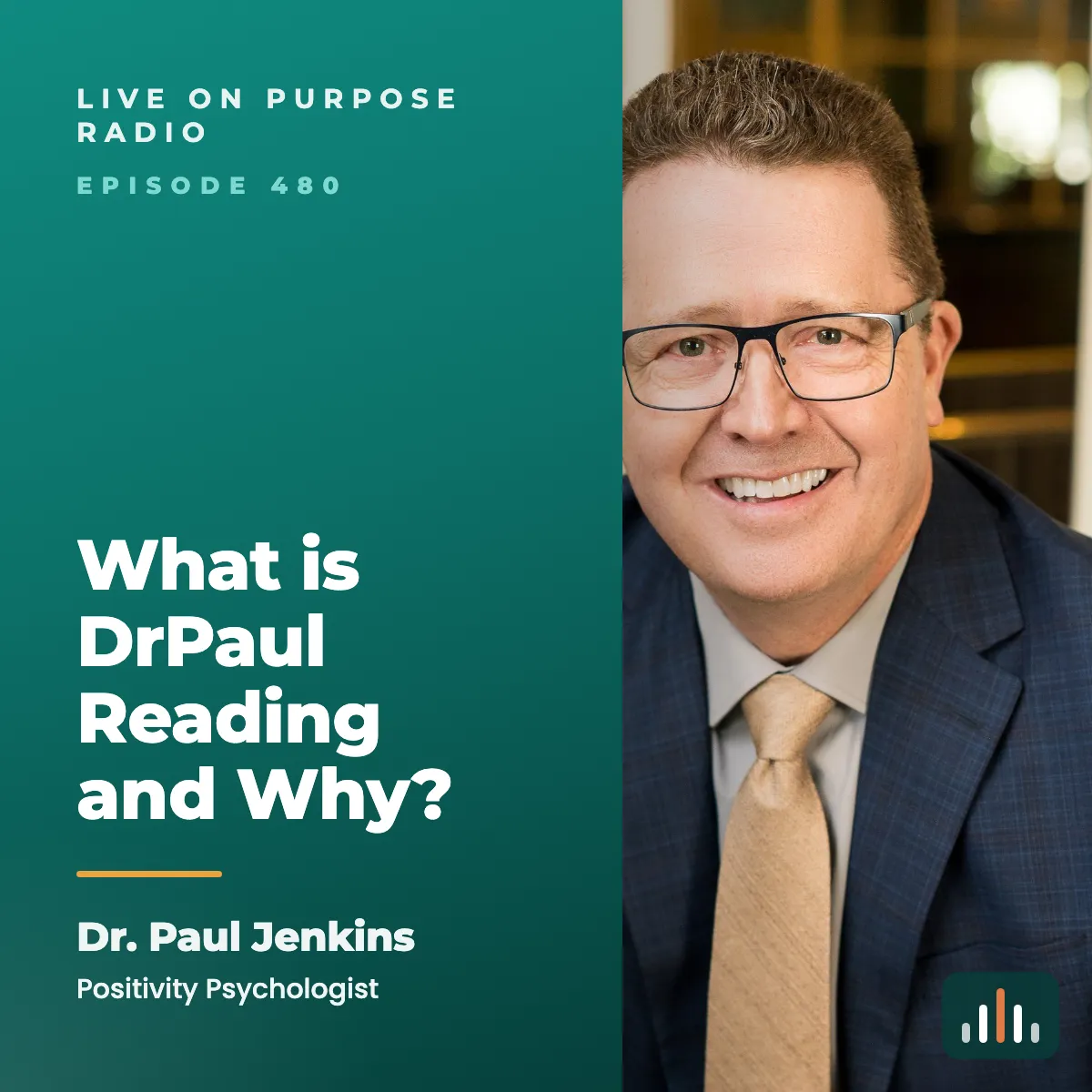
This is Live on Purpose Radio episode 480, what is doctor Paul reading and why? Now is the only time to create and live the life you love. I'm doctor Paul Jenkins, the positivity psychologist. My job is to connect you to powerful positive psychology principles that immediately upgrade your relationships, business, and mental health. Are you ready?
Let's jump in. Hello, everybody. Welcome back to Live On Purpose Radio. This is doctor Paul, the shrink who expands your life with another episode of Live On Purpose Radio. And today, as I was thinking about what to share with you, I've read a lot of books, and I refer to a lot of books.
You can get a list of my current top 10, which I will be discussing today at liveonpurposeradio.com. Do a forward slash best books, and that's all one word, liveonpurposeradio.com/bestbooks. Those are the ones that we'll be talking about here today. I want to share with you why I like each of these books. Some of these folks have been on my podcast.
I'm going to start with exactly what to say by Phil m Jones. Phil is one of my colleagues in the National Speakers Association. I ran into Phil on an elevator a couple of months ago in Las Vegas. We were both having an opportunity to participate in a in a conference there at Caesar's Palace. And Phil got an award actually as a CPAE, which is really cool.
It's the Council of Peers Award of Excellence. It's the speaker's hall of fame. Phil knows what he's doing. He's got this charming British accent, and so it's fun to get the audio version of exactly what to say because Phil will read it to you. I have to tell you, this is one of the books that when I finished it, I immediately restarted it and began to listen to it a second time around because of the power of the message that Phil is presenting.
It's it's a quick read. I think he has, 24 points. I'm speaking just off the top of my memory, but very specific phrases intended for sales conversations. But you'll see as you get into this book that this has a whole lot to do with communication and being clear, and I love it. I've...
I asked my entire team to read it as soon as I finished it. And like I said, I restarted it myself. Exactly what to say by Phil m Jones. Now, again, if you're trying to keep track of all of these, don't worry about it. I've written them all down for you.
Just go to liveonpurposeradio.com/bestbooks. Give me your email address, and I'll send it right to you. I've got the list. It's all made up in a PDF form. And this changes, by the way.
In fact, I already need to do some revisions, but I'm sharing with you the list the way that it stands for now. Here's the next one. Flip the gratitude switch by Kevin Clayson. It... It's fun that I'm having this conversation with you today because I ran into Kevin and his wife on Saturday as I was at the, the pharmacy picking up one of my prescriptions, and there...
There's Kevin and his wife. And we had a little chance to greet each other there in the grocery store. We've known each other for some time, and it's so fun to me that some of my heroes are right in my backyard. Kevin is one of those. Here's why I like flip the gratitude switch by Kevin Clayson.
He gives us a very practical and powerful addition to what we already understand about gratitude. He shared this with me recently on a, a training that I invited him to be one of my guest speakers. And Kevin pointed out if you go to the gym, alright, you say... You've got a goal that you wanna get in better shape. Right?
So you go to the gym, and you're going to do some weight training. And so you you walk into the gym, and maybe you've committed to do it every day. K. So every day, you walk into the gym, and you pick up a pencil off of the front desk, and you do five reps with your right arm, and then you switch the pencil over to your left hand, and you do five reps with your left arm. Now, hopefully, you're seeing how ridiculous this is because to do five reps with a pencil is not gonna do anything significant to change your strength.
True? And yet that's what we do with gratitude. When we do a gratitude list, the error that we make is that we pick up the pencil. We do the light lifting. We do the easy stuff.
Look. Anybody can be grateful for the good stuff, the easy stuff. Health, family, puppies, rainbows, indoor plumbing. That's easy. What's hard is when you flip the switch in your mind to to...
You ask your brain, basically, to look at something that is difficult, painful, frustrating, annoying, kicking your trash, and find what you're grateful for in that. I call it the gratitude power up. Kevin calls it flip the gratitude switch. He did a better job than I have describing why gratitude is so important and how you can actually power it up to strengthen your mind. Powerful.
Flip the gratitude switch by Kevin Glayson. Alright. I'm gonna get through all 10. This is my current top 10 list. Okay?
The next one is portal to genius by Leslie Householder. There's a lot of reasons I love this book. Let me tell you. One of the first personal development books that really started turning the lights on for me from someone who is living and accessible is is the Jackrabbit Factor by Leslie Householder. Now the Jackrabbit Factor didn't make my list until you realize that the jackrabbit factor is included in Leslie's next book, which is called portal to genius.
She coauthored that with another friend of mine, Garrett Gunderson, who is the author of Killing Sacred Cows. And this has to do with understanding the the interface between positive psychology and economics. Now I've got my own take on this called the happynomics. That book is not out yet. I'll let you know when I've finished it.
But it's also module six in the positivity power up for those who are in my coaching programs, and that's accessible at Live on Purpose Central. Portal to genius helps us to see how some of the things that have been taught by gurus and motivational experts throughout time, how that interfaces with our real life. It's inspiring. It's well written, and it combines these principles in a way that I think is powerful. And I just love Leslie.
She's a wonderful human being and a dear friend. Portal to Genius by Leslie Householder. Now there's some bonus here because if you can look through portal to genius and find where doctor Paul makes a cameo appearance, I'll give you some kind of a special price. It's not clear because it's a character that's not named doctor Paul. You won't recognize it by that.
But there was a little conversation I had with Leslie as she was writing this book, that actually showed up as one of the conversations between the characters in the book. And if you can correctly identify it, I'll give you a little bonus. I don't even know what it is, but it'll be cool. Portal to Genius by Leslie Householder. Okay.
The next one, I think, is required reading for all of humanity. This one is Man's Search for Meaning by doctor Viktor Frankl, and that's spelled v I k t o r f r a n k l. Doctor Viktor Frankl was an Austrian neurologist, psychiatrist during World War two. He was also Jewish. Not a good mix, k, at that time in that place in the world.
His entire family was captured by the Nazis and killed. I think he was the only survivor. There's, I think one member of his family that escaped somehow and got got out of town, but everybody was killed. Now he survived it, and he went on to write this book. He shares in man's search for meaning that everything can be taken from a human except what he titled the last of human freedoms, to choose your attitude in any given set of circumstances to choose your own way.
That is powerful doctrine coming out of Auschwitz. K? Now I've gotten nothing on doctor Frankel. My life has been cushy in comparison. But he found in the most dire of circumstances that we still have the ability to choose our attitude.
Attitude meaning position. Folks, this changes everything. And if you can't believe it coming from a man who has interned in a in a concentration camp, a death camp, if you can't believe it coming from him, you know, what is it in your life that is so dire or so extreme that you think you can't choose your attitude? That's why it's so powerful, and I... That's why I listed as one of my top 10 and also required reading for the course that we call Earth.
K? Make sure that you read that one. Man's Search for Meaning by Viktor Frankl. I mentioned this at the beginning, but some of you may have missed it. And if you're trying to take notes, just let me do it for you.
I've got a PDF of all 10 titles and their authors, liveonpurposeradio.com/bestbooks, and I'll just send it over to you. K. Let's go to the next one. I'll give you a little introduction to this too because Scott Wilhite is also a friend of mine and a colleague in in the National Speakers Association. He wrote a book called the seven core skills of everyday happiness.
And you can access, my interview with Scott in the archives that live on Burpstra Radio. Just go look it up. Scott Wilhite, w I l h I t e, and it'll come up. You'll see him there. I think he's been on the show twice actually.
Scott shared with me an idea that I think is a game changer when it comes to positive psychology, and that has to do with one little word in his title, skills. Now notice that. This is profound, but it's easy to miss. The seven core skills of everyday happiness. As I was having a conversation with Scott here on the podcast, we compared it to playing the piano.
And I am a a piano player. I've... I I learned as a child, and I still enjoy playing the piano. You don't find people bumping around looking through the world to try to find their piano skills. Now that sounds ridiculous.
Right? But it's not... You don't talk to someone, while you're at a dinner party about... Well, are you finding your piano skills? No.
It's ridiculous. We don't think about it that way because everybody knows that piano skills are in fact skills. But you see people all the time bumping around through life trying to find their happiness. They're not going to find happiness anywhere. It's not something you find.
It's something you develop. It's a skill set. And Scott nailed it with this book. I haven't seen other personal development books that are so clear about this is a skill set. Get busy working on.
And and if it's like piano, you're going to hire an instructor or a coach. You're going to sign up. You're going to do the reps. K? Put the practice in.
It doesn't just show up on accident. You don't bump into it. It's something that you develop. And I love that because that's my job, teaching those skills. There's two kinds of learning.
K? And think about this for just a minute. You'll probably relate. There is breakthrough learning, and this is the moment. Okay?
This is when you have an experience of, oh, I get it, and the lights go on. K? That's really cool. And we have these when we attend the seminar, we listen to the book or read the book. I say listen to the book because I consume a lot of my, literature in audio format.
I love that because I can be doing a workout, or I can be working a jigsaw puzzle, or I can be working in the yard and still filling my mind with these brilliant ideas. The the skill set that we need is is available. It has to be practiced. And and Scott nailed it with his book. So I think that's a game changer.
The seven core skills of everyday happiness by Scott Wilhite. Go grab that one. Okay. I got five more, and I'm going... For the next one, I'm going back into the history a little bit.
I mentioned earlier, happynomics. K? And this is this is my title. K? One of my upcoming books is titled happynomics, and it has to do with the interchange between economics and happiness.
I think you're going to enjoy that. But one of the people who turned me on to this kind of thinking was Robert Kiyosaki. That's spelled k I y o s a k I. You're going to recognize that name. He's been on the New York Times best selling authors lists for decades now.
And he has been so prolific, especially in the area of personal finance and economics. The flagship book for Robert Kiyosaki is Rich Dad Poor Dad. I would almost put that on the same level as Man's Search for Meaning by Viktor Frankl if we're a different purpose. K? Viktor Frankl, I think, identified what is core to all of humanity.
Robert Kiyosaki is helping us to take a little different look at finance and economics from an abundance standpoint. And there's a lot of the training and education that we get in this area that's more based in scarcity. I think that does a disservice to people. One of the books that I didn't put on the list, by the way, that is right up there with Robert Kiyosaki and influencing the way I think, especially about economics and money, is Ayn Rand, a y n r a n d, Ayn Rand, Atlas Shrugged. Now those of you who know the book are going to have an immediate connection with me because you know why this book is so important to our thinking.
If you haven't read it yet, that's kind of a big undertaking. Again, I didn't put this one on my list because it's kind of a project. It's about 1,500 pages in small print. But it it it is a powerful powerful conversation about producers and consumers. Start with Rich Dad Poor Dad.
Okay? Because Robert Kiyosaki writes this in a way that is so much more accessible and I think user friendly, at least to start with. And then when you're ready for the graduate material, you can move on to Ayn Rand. Okay. This is kind of fun.
I've got four more that I'll I'll share with you today. And then as the list gets up... Updated, I'll I'll renew the podcast too. Here's the next one. Where There's Hope.
Where There's Hope by Elizabeth Smart. You might remember Elizabeth's name from America's most wanted. No. She wasn't wanted, but, she was featured on that show. Her story was featured on that show, which helped to aid in her, rescue.
She was abducted at the age of 14 and severely abused over the the next nine months. It was amazing that she returned alive. It's such an inspiring story, and that's the topic of a different book called my story by Elizabeth Smart. I've had the honor and privilege of doing some work with Elizabeth, and, we collaborated actually on creating a positive psychology course for high school kids. That was a fun project, and I got to know her pretty well through that interaction.
The book where there's hope is her second book, which came out years later after she had an opportunity to talk to and interact with a number of people who had their own story of survival or thriving amidst the most difficult circumstances, she shares these stories in her book and very skillfully ties each of these stories back into, the the connection to principle that allowed her to thrive, despite these difficult situations that she was in. I love that Elizabeth chose to share the stories of many others in the process, Where There's Hope by Elizabeth Smart. And she even honored me with a little cameo appearance in chapter 11, which, was was kind and generous of her, but also just an acknowledgment of the connection between these principles and our circumstances. You see, it... It's not about our circumstances.
This is the number one thing that gets people stuck in their life is thinking that because this happened, now my life has to be this way. It's not true. Elizabeth is a beautiful example of that, and she has shared very skillfully the stories of several other people as an example as well. Where's Where There's Hope by Elizabeth Smart. Now one of the favorite books that I've read in the last year...
So this this one is very current for me. John Acuff, that's spelled a c u f f. John Acuff, a book called Soundtracks. This one really caught my attention. Not only is John fun, he's entertaining, he's humorous, which makes a book far more accessible, but he's also very, very practical about how to get a handle on our thinking.
And it's our thinking that causes how we feel, and then how we feel affects how we show up. John Acuff, in his book Soundtracks, has given us some practical ways to actually take control of our mental real estate. K? And either you drive your thoughts or your thoughts are going to drive you. So if you're ready to to get some practical handles on your own mind, John Acuff soundtracks.
Loved that one. Okay. The next one. The five laws That Determine All of Life's Outcomes by Brett Harward, h a r w a r d. Brett Harward wrote this book before I wrote my first book.
My my first book, Pathological Positivity, was published in 2014. Brett's book came out a little bit before that. I had the chance to to meet Brett at a conference where we were both attending in, Lake Tahoe. And at this conference, I was exposed to some of the ideas that Brett was tossing around, and and many of them felt very familiar to me because he and I think very similarly in a lot of ways. The thing that I like about his bold title, the five laws that determine all of life's outcomes, that is a bold title, but it it ties back to something that I believe very strongly.
The principles determine all of life's outcomes. Brett uses the word laws here. I sometimes use the word use the word principle interchangeably with what I think Brett is referring to as laws. Principles determine all of life's outcomes. It's not magic.
It is not luck. There are principles that when properly understood and applied can change your outcomes, and that's good news. When we are experiencing difficulties or we're not getting the kinds of outcomes that we want, we have to go back to principles. And I happen to like the, specific principles that Brett brings up here. I have to tell you a little inside story as well.
When when I was, working on some of the final revisions of my book, I I shared it with Brett, and I asked him for his input. And he said, Paul, at this point, you're going to feel that you're about 80% done with this book, and you've got about 20% left to go. As your friend, I want you to reverse those two numbers, and then you'll be more accurate. Now this stung a little because I was at a point where I was thinking, yeah. I'm almost done.
Brett lovingly helped me to see that there was still a lot to do, and he has given me that kind of input in several different ways in my life. And I am so grateful for the way he's influenced some of my thinking and has helped me to come to a place where I show up more authentically. So there's a personal connection there too. There is with a lot of these. Brett's been on my podcast as well, so you can go look up my interview with Brett in the archives at Live on Purpose Radio.
Once again, the five laws that determine all of life's outcomes by Brett Harward. Okay. I've got one more to share with you, and then a bonus. K? I'll I'll actually give you the bonus today.
Usually, I save those bonuses just for my behind the scenes family at Live on Purpose Center, but I'm gonna give everybody the bonus today. Here's the last one on the list for today, the dog poop initiative. Do you love that title? You're going to love the book too. It looks like a children's book.
It's, less than a quarter of an inch thick. It's it's large and in color and fully illustrated, and it rhymes. And so it looks like a children's book. The dog poop initiative was written by my friend, Kirk Weisler, w e I s l e r. And, yes, it is kid friendly.
It's got the word poop right in the title. They're going to love it. But this story is a powerful lesson in leadership and taking to what I think is a high level of maturity with the word initiative. Initiative is when you see what needs to be done and you do it. I I would be tempted to share the whole story with you here because I have got it memorized.
I committed it to memory years ago. You're going to love the dog poop initiative by Kirk Weisler. And when you use this with your kids and also with your teams, it's going to make a difference in how people show up. That's my top 10 list, you guys. For now, it changes as I add new books to the list.
This was, revised in 2021 because that's when I read several of the books that are on the list. There's some classics there as well. I hope you enjoy that. Once again, you can get the list. I've put it together for you.
Liveonpurposeradio.com/bestbooks, all one word, and I'll just deliver you a PDF copy of all of these. I promised you a bonus. This one comes from one of my coaches, Jody Moore, spelled m, o o, r e. Jody Moore wrote a book called Better Than Happy. I just finished it a few days ago.
And so that's why it's not on the list, the the preprinted list. Jody's thinking is spot on from a psychological standpoint. She is a life coach. I've actually hired her to coach me on a few things because I love the way that this lady thinks. She helps us to move past some of the shame and guilt that drives our motivations, get into the actual thinking, and do some practical things to have a completely different experience.
Her book is called Better Than Happy. Big shout out to my friend and coach Jody Moore, for creating that wonderful book as well. There you have it, folks. The the top 10 list from doctor Paul personal development books. These, will be revised and updated as other books enter the list.
It's hard to narrow it down sometimes. I hope you find some benefit from that again as the resource for you a free free PDF copy of these books liveonpurposeradio.com/bestbooks. Go grab it. It's time to go apply it and live on purpose. Did you get what you came for?
Give yourself the gift of taking real action on what you realized today. Please share this episode with someone you know would value it, and leave us a rating too. It's time now to live on purpose.
Open the transcript on its own page ↗