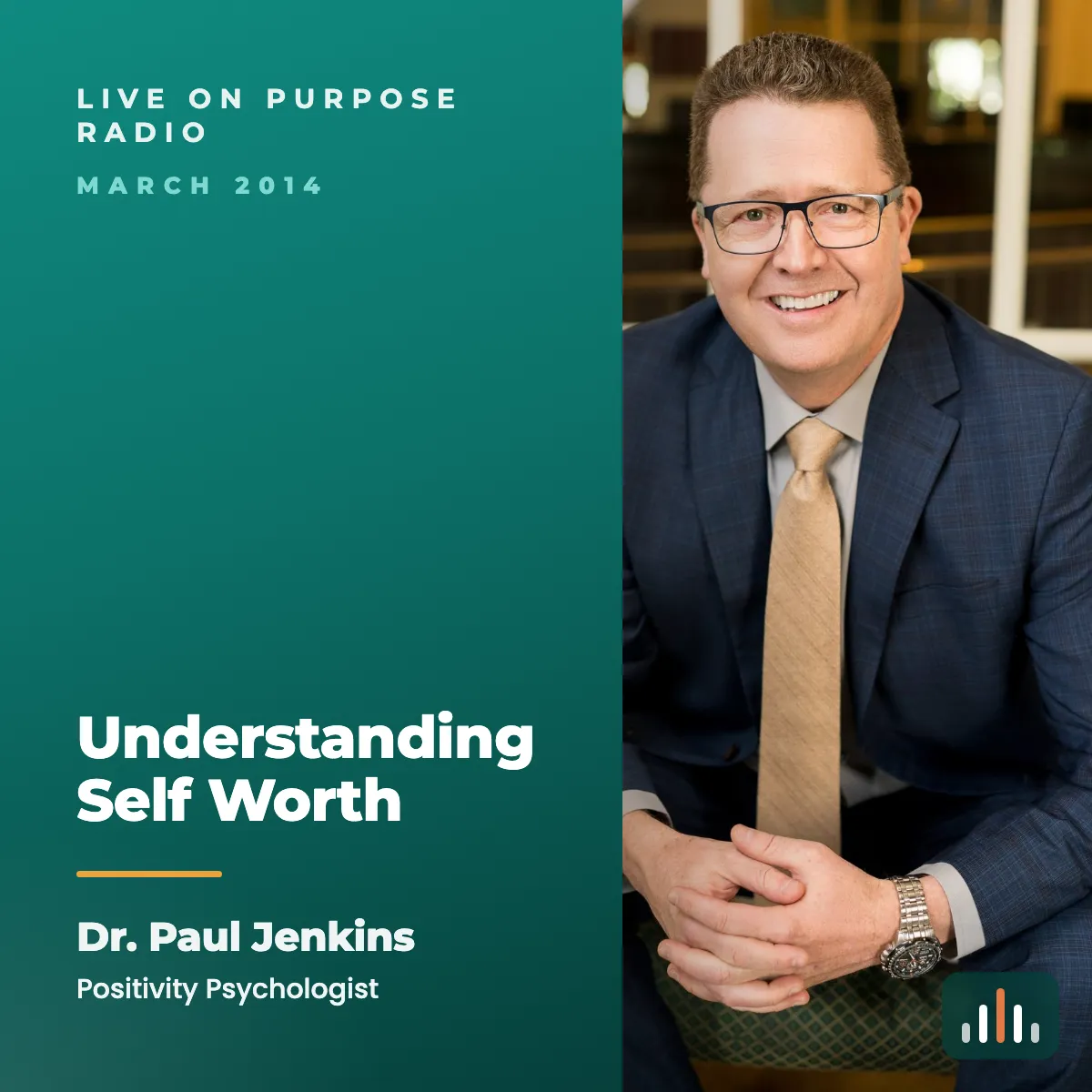
Welcome to Live on Purpose Radio with doctor Paul Jenkins, where you will hear inspiring stories of ordinary people doing extraordinary things. Feed your mind with a regular dose of positive energy and show up for your life every day on purpose. Living on purpose means that you have a purpose and you do it intentionally. And now, here's your host, doctor Paul. Hello, and welcome back to Live On Purpose Radio.
We're Living On Purpose today promoting pathological positivity, self worth, and self esteem. And there's a difference. I've invited a phenomenal guest today. Her name is Karen Eddington. Say hello, Karen.
Hello. Thank you for having me. Thrilled to have you here. Thanks. I've been reading your book, And it's fantastic.
Thank you. I'm enjoying it. And you know what? When I saw this title, I thought I've got to get Karen on my show. And I already know you were associated through the National Speakers Association.
And we have a lot of fun every month at our chapter meetings. And I've seen that you have had some experience that has created an opportunity now for you to teach some things about this topic. So your book is called Understanding... Understanding Self Worth. Self Worth.
Right. Right. Yeah. I basically just spent the past ten years researching with women and teens, and now it's time to share what I've learned. So I'm going to be asking you what you have learned, but I want to start off with something because as I've been reading your book, one of the first things I noticed and I love this Karen because this is something that I teach my clients as well.
There's a difference between self esteem and self worth. Right. Start us off with that. Okay. It's a it's a big thing.
If I were to put it as simply as possible, self worth is constant. It's always there and it does not change. Woah. Woah. Woah.
Hang on. Okay. I don't always feel good about myself though. Right. But...
Do you hear that? Yeah. But that's not self worth. Right. That's the other thing and we'll get to that.
Right. So self worth is constant. Yes. It is. People matter.
People matter so much. And sometimes we forget we're looking at everything outside us, and we're scrambling, and we're competing. And if we can if if we can live in a way that honors self worth instead of self esteem, we can find so much peace in our lives. And I love where you're going with this. So people matter.
What about people who do bad things? They still they still matter. And I've thought about that before because... Of course you have. They still matter.
I think there's... I think our our individual worth and this concept of understanding our identity involves principles of choice and accountability as well. Even though there's choice and being accountable for those things, but people at the root, they still matter. Just because you're a person Mhmm. You automatically have value.
You know what? Not too long ago, you're sitting on a couch right now, Karen, where my clients sit. I'm a shrink. I have a couch. Okay.
And everybody, Karen's on the couch at the moment. So enjoy that. Thank you. Okay. It's comfy.
Right? It is very comfy. I had a client sitting right where you are. And as I had a conversation with her, she she said something along these lines, and I'm not getting her words exactly, but you'll get the feel. I'm I'm just no good.
Okay. Is that true? No. It's not. Not even close.
Now, she's talking about self esteem. She's talking about how she esteems herself. Right. Not about her worth. And this is the point that you're making.
Right? Right. Her worth is fixed. It's constant. It's set.
Right. She can't even change it if she wants to. Exactly. So I had a conversation with her about, oh really? What...
Where would you put yourself on a scale? And I went over to the whiteboard and I drew a vertical scale and at the top I put the word better. And at the bottom I put the word worse. Where would you put yourself on this scale? And guess where she put herself?
Did she go low? She went way low. Yeah. Way low. And so I asked her, okay.
Can you think of anyone who is better than you? Oh, lots of people. Like who? Like my sister Jill. Okay.
So I put Jill's name up above hers. Can you think of anyone worse than you? And guess what happened? I'm sure she listed some people, did she? She didn't.
She didn't. Wow. Actually, you know why? She couldn't think of anyone worse than her. Wow.
That's pretty low and people really are that low. There are people feeling that low. I said, why are you so bad? She said, well because I I do this and I don't do that and I do this and I don't do that and I did... And she gave me this list, right?
I said, oh, so if you do if you do bad things that makes you bad, right? And she said, well that's one of the things. I said, so you're probably... Well, how about Jason? Are you are you better than him?
She's like, Jason? Who the heck is Jason? I said, Let me tell you about Jason. Jason is a kid that I met when I was working in a juvenile correctional facility in Oregon. He was on a murder unit.
A kid. K? Everybody on the unit was 18 and had killed at least one person. Wow. Jason had killed his brother.
Wow. So you're better than him. Right? And still she was uncomfortable saying that she was better than him. Why do you think that is?
It's hard. It's because she's focused on self esteem instead of self worth. When you're focused on self esteem, you rate yourself. And you're always in competition. You're always scrambling.
You're always competing and you're either feeling vain like you're better than someone else or you're bitter that somebody's better than you. And she didn't wanna put this 13 year old boy who had killed his brother and there's a whole story behind that Mhmm. Which I won't share right now. She didn't wanna put him below her because she was focused on his self worth. Interesting.
Yeah. And comparing it to her own self esteem. Interesting. See the problem? Yes.
Very much so. Very much so. Yeah. She could tell that and okay. There's some story.
What was going on with him and and she's willing to give him every consideration in the book, but not for herself. It's hard to do it for ourselves. Yeah. And it's that vertical scale that causes the problem where we're constantly judging ourselves to be better or worse than based on some criterion. Right.
Right. Looks, weight, skills, hobbies, talents. Right. Bank account. Now, if this helps, I can actually break that down into eight things.
We base Mhmm. Yes. Yes. We base our worth off of eight things I'd like to call the pivotal eight. Appearance Mhmm.
Achievements Yep. Intelligence, so how smart we are Mhmm. Ideals, having the perfect life, that kind of Right. Story. Mhmm.
It's also relationships Mhmm. Recognition Right. Money and possessions and addictions. Those are the pivotal eight that we like to use to rate ourselves. Right.
The presence of those or the lack of those or Exactly. How does it compare to the guy down the street or the or the lady next door? Whatever. Right. So these constant comparisons.
You know what really helped her the most? What helped her? To queue into the self worth rather than self esteem. Exactly. Yeah.
We took we took that vertical scale and I added a word to the top and the bottom. Remember how I wrote better at the top? Right. And worse at the bottom? Mhmm.
I added the word off. Better off. Good. Versus worse off. Now, Jason who had killed his brother was in a correctional facility.
Is he worse than me or is he worse off than me? That makes sense. In that way. Does that make sense? Or someone who smokes.
Am I better than someone who smokes because I don't? No. I may be better off. You don't have the lungs. Health wise.
Yeah. Health... Exactly. But that's not an... That's not a statement of worth.
That's that's just a statement of am I better off or worse off when I choose to do these things or not do these things. Yeah. It's such a... It would've helped. It's such a big thing for...
If if we can all get to that point where we live thinking that way, thinking that we matter unconditionally. If you can... No matter what. Yeah. If you wake up every morning and you feel that unconditional worth, it makes such a difference.
Such a difference. What have you found, Karen, that helps people to hone in on that and to really get comfortable with self worth as opposed to self esteem? It starts with our thoughts. Essentially, there's a chapter in the book that says the most important skill and that is what it is. In fact, I just gave you the ending of the book.
But... Spoiler alert. Spoiler alert. There really is... There's actually something called thinking errors that when I was in college...
You're speaking my language, Karen. Keep going. When I was in college, I learned about fallacies in literature. They always told me you can't write words like everyone loves bananas because not everyone loves bananas. It's a false statement.
They taught me that about literature, but they did not teach me that about my own thoughts and my own self. We think things every day that are crazy, distorted, wild, out of control, untrue thoughts, and they are constructed to be true. We believe them and we Yeah. We live crazy thoughts. Because we hear it in our own voice.
We think it's true. Yeah. Yeah. Which is a fallacy. It's it's completely misguided.
Right. You know what? We have a a couple that lives in our neighborhood who just celebrated their 70 wedding anniversary. Which love that. Isn't that awesome?
It is awesome. And we're having a conversation with this sweet older lady about what she has learned. Because, wow, what a wealth treasury of experience that she has. Seventy five years of marriage, Karen. Mhmm.
K. She boiled it down to this. This was her first item of advice. Oh, wait. Okay.
Don't be too quick to believe everything you Think. Think. I love it. That's the twist. That is good.
Is good. We should all write that down actually. Don't be too quick to believe everything you think. And it's profound. You know, we're expecting her to say everything you hear.
You've heard that before. Don't be too quick to believe everything you think. Right. Just because you think it doesn't mean it's true. Right.
In fact, I was gonna say most but maybe a fair portion of what you think is totally misguided. Oh, it is. The other morning I've, I was out and about even and I had that curlers in my hair, and I made eye contact with this lady. And I started doing one which is called mind reading, and I thought, she thinks I'm a dork. Right.
And it's funny. I had to stop in that instant and even correct myself. It is like you can't always trust the things you think. That's one called mind reading where you Right. You base...
You take what someone else's thinking and you just make an assumption. You totally make it up. Yeah. You do. You do.
There's no way we know what she's thinking. And sometimes those things get so out of control. I mean, we we label ourselves. We we... It's all or nothing.
We make predictions about our day. There's so many ways that we do this, and it's hard. It goes back a step even further than that, Karen. People worry all the time about what are other people thinking of me. Mhmm.
Okay. First of all, they're assuming that other people are thinking of them. Or it's more like what we think other people think. Like, it's... It gets pretty deep.
It gets really convoluted Yeah. At that point. Okay. People. First of all, those other people that you're worried about what they're thinking about you, they're not.
They're worried about what you're thinking about them. Exactly. Exactly. They're no different from you. Yeah.
K. People really don't spend a lot of time thinking about or judging other people. They do some. Well, I find the more insecure we are the more judgmental we are too. Or the...
Yeah. I don't I don't know if that makes sense. But the... Usually means we're judging ourselves. Exactly.
Oh, you just hit something on the head. That's so important. That's what it means. So if you're getting all tied up about what other people are thinking about you, let's pay a little more attention to what you're thinking about you Perfect. And get that onto a true a true track.
K. What's true? Your worth is great. Constant. And it's constant, and it's fixed.
Right. I said it was great. I... There's a scripture that I really like that says that in the sight of God, we're all great. K?
That... Maybe that's just God's opinion, was he know. Right? If God says that we're great, who are we to say otherwise? Alright.
Good. Yeah. We got some fun things started here. Hang on. We'll be right back.
This is Kirk Weezler to tell you about morebetterbooks.com. Morebetterbooks.com is where you can find more better books for a more better life. Not only that, let me tell you about some of the very fun and cool select titles on morebetterbooks.com. You'll wanna get a copy of the Dog Poop Initiative. This best smelling book could change your life forever.
It certainly changed the lives of thousands of Boeing employees as well as school teachers, parents, leaders across The United States and in Israel and in Germany. And you can get your own copy at morebetterbooks.com. Woah. That's not all. What about The Cookie Thief?
This classic tale told in a rhyming format fully illustrated with very fun hit messages. Pick up a copy now today on morebetterbooks.com. Other great titles there, finding your pathway to mastery, beyond illusions, make it great. These titles are only available on morebetterbooks.com. Go to morebetterbooks.com today and begin to have a more better life and live that life on purpose.
Thank you for listening to Live On Purpose Radio. We're so glad to have you here. Please come by the website, drpauljenkins.com, spelled with a dr. Drpauljenkins.com. On the website, you'll have an opportunity to receive a free download and while you're there, make sure you click on the social media icons.
Come over to Facebook where we will be posting these episodes as well as our YouTube videos and other content and announcements for you to share. Please like us, comment, subscribe, join the conversation. We're happy to have you with us here at Live On Purpose radio. Let's all support each other to live on purpose. Doctor paul jenkins dot com.
To be what we are and to become what we are capable of becoming is the only end of life. Robert Louis Stevenson. Karen, this topic is one that is so near and dear to my heart. Good. Mine too.
And it's because I think this is one of the key elements that really gets people tipped over. If if they don't really connect to their own worth, they can spend their entire life trying to chase it, trying to find it. Right. Define it, whatever it is. When when you accept that your worth is great and that it's fixed, and I suggested before the break that that maybe God thinks that your worth is great and you don't have the authority to to say otherwise.
In fact our destructive pride sometimes gets in the way and says, well, I don't care what your opinion is. Here's what my opinion is. And did you know Karen that I have an opinion about you? Okay. And you have an opinion about you.
Yeah. Okay. Yeah. And who's right? Well, secretly you know that you're right.
You know? Yeah. That's how our that's how our mind processes this. You know, somebody tells me, oh, Paul, you're awesome. And then in my own mind I'm thinking, whatever I'm thinking.
Well, our pride has us thinking that we're always right. Even if other people give us a different opinion. Mhmm. So here's the opinion folks. The opinion is that you are great.
That your worth is great. It's fixed. It's constant. You can't change it. In fact, you know what Karen back in graduate school they taught us.
That a depressionogenic thought. Have you ever heard that word before? I have not. Depressionogenic means that it creates depression. Okay.
The most common depressionogenic thought is that my worth can change. That it makes so much sense. And if you know that, that can help so many people. Mhmm. Or if people know that, they need to know that.
Right. So changing that belief. Wait, my worth can't change. It's fixed. Then you give up all of these exhausting campaigns to try to elevate it.
That's no longer the job because it's fixed. You know, and this makes me think too when when you have all these thoughts and when you're so focused on the self esteem which is up one minute and it's down one minute. It's really hard. It's really hard to see other people. And I have a favorite new quote that...
About confidence. Confidence is not about being self centered. It's about being emotionally centered so you can better see other people. And I love that. Yeah.
I love it so much. It's in my book if you wanna check it out sometime. But it's... I love it so much because we're... Sometimes you think that there's a difference between confidence and arrogance for one.
Sometimes Absolutely. People are worried about, like, being confident or saying that they matter because they worry that that it's gonna put them above someone else, especially women. I see it a lot. Arrogance is when you start rating yourself. There's nothing wrong with confidence saying, I am great.
I am wonderful. That's a true statement. Yes. But when it's arrogance when you start saying I am better than somebody else. And so often we do that when we're insecure, but that's the difference between confidence and arrogance.
I like that. You know what a similar corollary might be that there's a difference between humility and humiliation. Oh, interesting. Very interesting. Because I think humiliation is when our pride is injured.
Interesting. Humiliation is just an acceptance that, yeah, we've got weaknesses. Have you noticed? Yeah. Yeah.
That's permanent. Welcome to Earth. That's how we roll here. Yeah. Well, there's some...
I think there's some... Also some interesting things about laughter and self acceptance. The way that you laugh Yeah. At yourself, the way that you laugh at others as well. Mhmm.
The way that we feel self conscious, it all kind of ties together. The way you laugh at yourself and other people directly impacts how you feel about yourself as well. Mhmm. That's just another point you can explore. So many ways to go with this.
Oh, a lot of ways. One of the ways that I was thinking of, comes back to vulnerability and our willingness to just to be human and be okay with that. It's really... You know vulnerability. Brene Brown gave an an amazing talk on this ted.com and she's got a book called...
Hang on. Daring Greatly. I knew the title would come back to me. Daring Greatly by Brene Brown. I think Brene took a courageous step to say, hey, yeah.
Being vulnerable is what endears us to other people. And yet we're so afraid of doing that because of what you're talking about, Karen. We're so focused on self esteem. We don't want to show anyone We wanna be perfect. Weakness.
We wanna be perfect. Yeah. What the heck does that mean anyway? Yeah. Well, we think sometimes we have more credibility Mhmm.
If we can show... If we can prove our worth, if we're showing everyone how great we are. But when it's, it's usually the opposite. People will connect to you better in your failures and in your struggles and when you admit some of those struggles. Yep.
Yeah. That's right. It's so hard. It is, isn't it? Because we we want people to like us.
And they will. Now, this is a leap of faith for some folks because you think, well, if they really knew me instead of this fake phony exterior that I try to present. If they really knew me, they wouldn't like me. Interesting. But that's not true, is it?
No. What what do you notice about the people you like the best? They're real. Yeah. And they they tell you things.
I think the reason why is because if if someone shares, like, their soul with you or they share their struggles, if we we connect with them, if they can get through it, we can get through it too. And so it... I think that can encourage us maybe to be willing to open up to people more. You know, admit that your house is a mess instead of always having... Trying to have this perfect put together house.
Admit things. Share things. It's okay to be real and have flaws because we're all people, and we all have flaws. Here you are, Karen, at Live on Purpose Radio having this interview about your new book. You know, this highly successful speaker, presenter, teacher the way over?
Yes. Okay. So, yes. I'm a speaker. And get this, I was a mom.
I have my three kids in the car. We are driving down here to do this radio interview. Little one gets car sick. She throws out a little Yes. Huge.
I know. I know. And so we had to stop at Target, get her some new clothes, and we're running. And I come sitting here. I'm a person.
We are all just people. And sometimes Yeah. Some people sometimes we look at other people's lives and make assumptions about their lives that they're perfect and going well, but we are all just people. Even me, got kids in the car. That's the thing.
So I think I think connecting with what you're saying about self worth, it's fixed. It's constant. It's not gonna change. I can give up all of those crazy things that I do to try to elevate it and just accept that it is what it is. It is.
Yes. And it's great. Here's another place to go. K. It's really important to know that we matter so much, but it's also really important once you know that to understand yourselves a little bit better.
Have you ever heard someone say, I don't know who I am? Or... Oh, yeah. Yeah. Or for example, my parents, whenever I'd leave the house growing up, they'd always say, remember who you are.
Remember who you are, Karen. And I was like, okay, mom. I'm not gonna forget my name. And I was I was just wondering why she'd say that. And we can actually break down what that means.
I know who I am. Because if you know who you are, that will give you so much more of an edge and confidence. And you can do this. You can know this by knowing four three things. Your identity is your complete makeup.
Knowing who you are consists of your heritage. K. Like where you come from. Exactly. Who those people are, the cultures, the traditions, all of that.
Right. So your heritage Mhmm. Your values, so what you believe in Yeah. Yeah. Your traits which can be broken down into a lot of things and your Mhmm.
My favorite. This is my favorite. Are you ready? Choice. What you want to become.
Right. Those four things. I was recently with a couple of young teenage girls and they were they were just saying, I I need to be myself again or they were just going through that big struggle. It doesn't just happen with teenage girls So it happen... It happens with a young mom who just had a baby and she's feeling like she has an identity crisis.
It happens with, you know, 50 year old men who buy sports cars. There are so many times in life, why would somebody say, I know who I am now more than I did later. And it's because of those four things. There's something that I like to call an identity grid. It's being able to Mhmm.
Map it out. You get into this in your book. Yes. You could map it out and write down answers to the four four things. Because if you can articulate who you are, it can help you know that a lot better.
Identity, heritage, values, traits, and choice. Heritage, values, traits, and choice. And take some time to think it through. So so your tool, this identity grid would would provide a structure where where people can actually think through those questions and start to answer them. Right.
Instead of just wondering who am I, start answering it. Yeah. Get to it. And sometimes people feel like they're stuck. I met a girl in the foster care system who came from a really rough background, and she was, about to live on her own at age 16.
And we had a conversation, and it was so neat to see her take strength from her past, her heritage, and exercise that choice. That's part of it as well to determine who she wanted to become. That is with each of us too. With whatever you're at, whatever you're feeling right now, what do you wanna become? Because that is your potential.
And that is also part of our self worth and understanding all of this is who you can become. And that is so exciting. Yeah. It's really thrilling. I'm glad you added that piece, Karen, because your heritage, your traits, you don't get to pick all of those.
No. You're kinda stuck with them. You kinda show up in a family and a country and a circumstance that... But you know what? That gets to be part of your inspiring story as you exercise the fourth one, the choice.
Right. Think about the most inspiring stories that you know. And they all have a hard part in the middle. Yeah. That's part of the context.
Yeah. They all have some context there that gives you a sense of wow. Look where they were and look what they did with that. Right. Right.
So it's cool to think about. This might be off the... So I'm going to the next one. Values. Here's something that's...
If people are feeling lost and confused about their identity, this is one of the places they can go to. Because if you are making choices differently than what you believe in, we feel confused and stuck and and off. For example Yeah. There's a disconnect. Yeah.
When I was in middle school, I remember there was a girl getting teased at the bus stop and I didn't stand up for it and I felt conflicted about that. Mhmm. And so that's values. You gotta know what you believe in and live what you believe and that can help you also with your identity. Right.
Especially as you become clear about what those things are. Yes. So write them down. Take some time. Write it down.
Awesome. That, you know, that's another thing that I I build my whole practice around having conversations with people about these kinds of things. And I mentioned that folks just because sometimes in your own mind you can get stuck in those same traps. So talk to people. Get a coach.
Yeah. That's why they say sometimes talk it out. Sometimes we're stuck in our heads and you need to say things out loud and it helps. Karen, this is amazing stuff. You're doing some good work and you carry a good energy with you around that too.
Oh, thank you. So... I think it's because I love it. I love what I do. I think some of our listeners are really resonating with this too.
How can they get connected with you so that they can get a copy of the book for example or Yes. Follow what it is you're doing? Easiest way is to go to kareneddington.com. E d d I n g t o n. Karen k aria.
Karen with a k. Karen Eddington, e d d I n g t o n. Yes. Dot com. Yes.
It's a snappy website too. I took a look at it earlier today. Thanks. Go visit Karen's website folks. Karen is a speaker, presenter, and author who's promoting this idea of self worth.
And if that resonates with you, if it resonates with a group that you think would benefit from Karen's message, Karen, you're available to, present keynote addresses or show up and talk about your book and Correct. Other topics along this line. Yep. Excellent. Wonderful.
Thank you. Karen, thank you so much for joining me at Live on Purpose Radio today. I'm gonna give you the final word. Great. I would just mention that to know...
Remember... I mean, we've been saying that the whole interview, but remember how much you matter. So forth is constant. Beautiful. Thank you.
Live on purpose, everybody. Thanks, Karen.
Open the transcript on its own page ↗