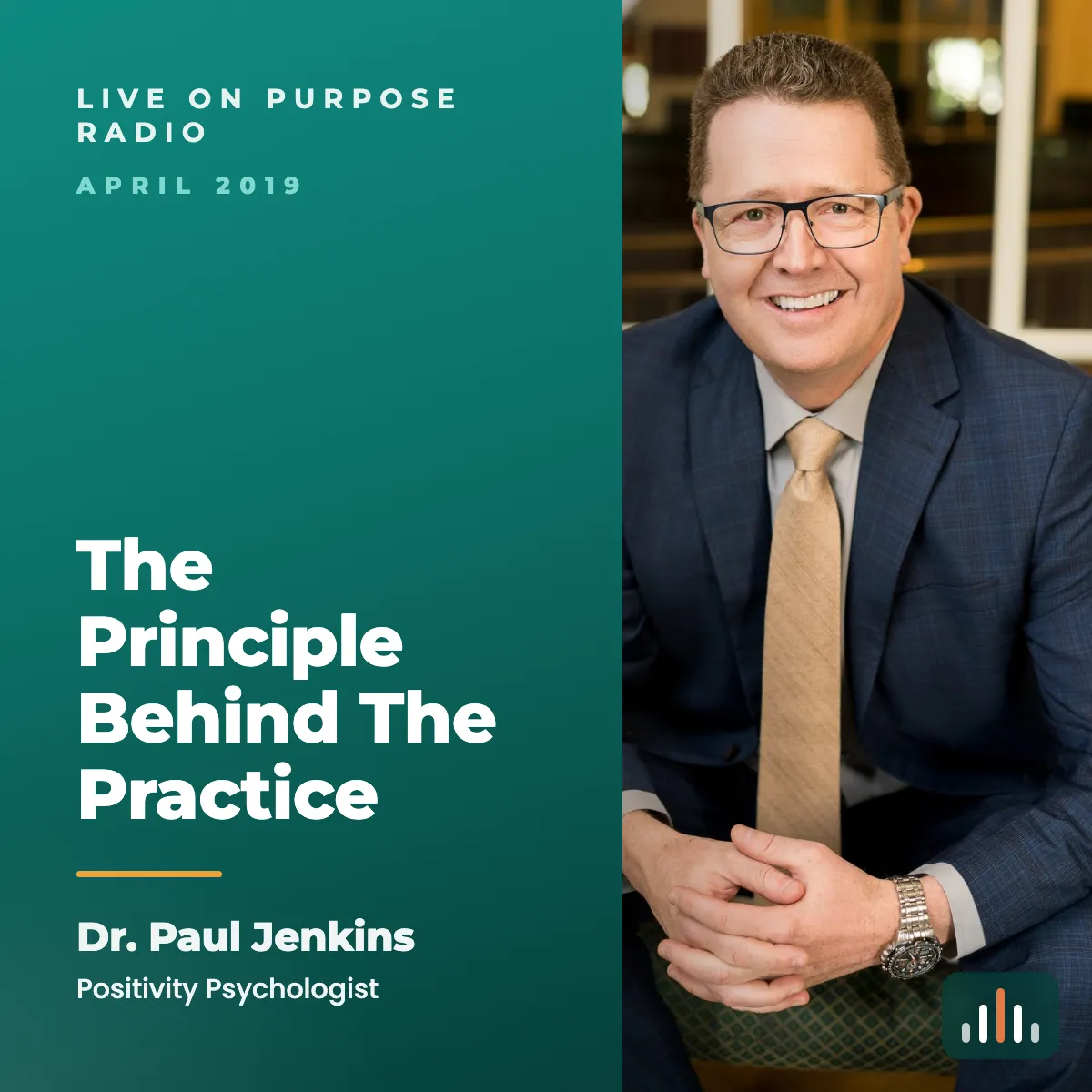
Welcome to Live On Purpose Radio with doctor Paul Jenkins, where you will hear inspiring stories of ordinary people doing extraordinary things. Feed your mind with a regular dose of positive energy and show up for your life every day on purpose. Living on purpose means that you have a purpose and you do it intentionally. And now, here's your host, doctor Paul. Hello, everybody.
Welcome back to Live on Purpose Radio. This is doctor Paul, the shrink who expands your life with another episode of Live on Purpose Radio. My guest today is Bryce Dunford. Bryce is an educator. He loves sharing principles with people.
We've had a fun conversation about that before the show today. He's also a speaker and an author and the kind of person you'd expect to hear at Live On Purpose Radio. Welcome to the show, Bryce. Thank you, Paul. I'm grateful to be here.
I'm so glad to have this conversation with you today. I love this topic. We get into practices all the time. You know, we do this or we do that or we follow that rule or we, adhere to those guidelines. Or even socially acceptable.
We recognize that certain behavior is socially acceptable. Right. And sometimes we don't pause and understand why. What's the reason that's socially acceptable? What's the reason for the behavior?
Yes. That reason gets down to something that you and I talk about called principle. Principles. There's some principle behind it, some reason. And you found, in what you've shared with me earlier, Bryce, you found that your students often don't understand the why Right.
Behind the guideline or the practice. Well, we live in a society that's so behavior governed. This is the right behavior. This is what you're supposed to do in school. This is what you're supposed to do in church.
This is what you're supposed to do in in practice, and no one ever pauses to say, here's why. Yeah. The wonderful thing about our principles is they make clear what to do in different circumstances because you don't always do a. Maybe in situation a, you do a, but what would you do in situation b? Situation b, you wouldn't do action a.
You need to do Right. Action b. And so the principle governs that says, look in this situation you would do this, and in this situation you would do something very different because the circumstances change. That's why understanding the principle behind the practice becomes so critical because you don't always do the same thing in every situation. You know what?
I learned this in a very painful way. Years ago, economically, I was doing some practices in investing, that made a whole lot of sense in situation a, but then the situation changed to b, and I kept doing the a practices and ended up in a bankruptcy. It... That's exactly what you're talking about. I I like to use the analogy of baseball.
There's the skill of bunting. But when do you bunt? Because sometime... I mean, there's an obvious... This is a bunting situation.
There's an obvious bunting situation. But those of those of you who watch baseball recognize that sometimes you bunt in an odd situation because it's the right thing to do. And so when you bunt is a principle, not necessarily a defined practice. Because we've all seen baseball players defy that what's logical and what's... What would I normally do in this situation.
So being principle governed and recognizing what's the principle behind this pay... Behavior, then you can adapt it to the circumstances more correctly. Mhmm. If you always do the same thing, it's gonna be painful in some circumstances. Because as the circumstance changes, you need to be able to adapt and do the right thing.
Right. You shared an example with me earlier about a principle that you talked to many of your students about. Now, you're teaching in a religious context, young people who are enrolled in a seminary program. And in this program, there's something called the word of wisdom, which as I understand it is a a law or a practice related to health. And you shared an example with me about this because we're telling kids all the time, don't smoke.
Stay away from drugs. Right? And I host a program where we teach these same concepts in elementary school, with law enforcement personnel. We have uniformed cops go into the school and teach kids principles that include practices like staying away from drugs or alcohol. And understanding the why behind that makes a huge difference to these kids.
Share some of your insights about that, Bryce, and what you've learned. Our culture has become so ingrained on what we should and shouldn't eat, don't smoke, don't drink. And then when we pause to say, okay, well, why? Why? What's the reason for it?
And the reason for it is that we've all learned that if you don't maintain your car, you're gonna get stranded somewhere. It's gonna it's gonna fail on you. If you don't put oil in your car, if you don't take care of it, then it's not gonna perform the function that you want it to. So we forget that the body that we have, this physical body, is the instrument of our soul, our character, whatever you want. It's a channel to God.
It's a channel to the divine. It's a channel to the cause. However you wanna see it, our body is the instrument. Or the vehicle. It's the vehicle and we forget that the principle is that if you don't take care of that instrument it's gonna fail on you and it's gonna have an impact on the mind.
So years ago your mom told you to eat a good breakfast before you had a big test. But what no one ever taught us was the why. And that is that the health of this body allows the mind to function better. We feel better when the body is taken care of. Right.
So one thing we need to understand is imagine you went into a beautiful building where you were gonna talk about wonderful things and you knew that there would be a feeling there that you would feel. Mhmm. And when you went in the building, the building was in disarray. It was a mess. Would you have that special conversation that you were hoping to have when the building's a mess?
In other words, the body has the same effect. Yep. If you wanna feel good, if you wanna be happy, if you wanna just feel great, and you forget to take care of the instrument or the vehicle, you're gonna fail. There's the principle behind the practice is that the body has an impact on how we feel. It has an impact on our spirituality.
It has an impact on just feeling good. So for example, we always think that alcohol is a major violation of that, but no one really likes to talk about sleep. Oh, yeah. And then all of a sudden it's like, well, I don't feel good. I know why you don't feel good.
It's because you're not taking care of the instrument of your mind. Right. You're not sleeping. For those who practice the word of wisdom, sometimes when we don't talk about the principle behind the practice, we don't realize that sleep is a violation of the word of wisdom. Right.
Not getting enough sleep, giving your body too much food, or not enough food, or the food at the wrong times, or food in wrong amounts. We often talk about, well, don't eat the wrong foods. But what about eating too much food, or not eating enough food? I tell high school students, I love to ask my students, how many of you ate breakfast today? And you would be surprised how few high school students go off to a busy day of school without fueling their body and then they wonder why they struggle in school.
The principle behind the practice is that the condition of your body affects the condition and the workings of your mind and your soul. I know that you teach often in a religious setting, and and that's a good example of a context in which this sometimes takes on a moral character. And I I see this also in in weight loss, exercise, dieting. There's there's almost a morality attached to it where people think, oh, I should do this, and then they start beating themselves up because they're a bad person for eating that particular dessert or or skipping their exercise for that morning, and they feel like, oh, I'm a bad person. What I'm hearing you say is, let's take the morality out of this.
The right and wrong of the situation can be set aside, and just the pure logistics of the principle can say, look, if you eat that, here's the effect it's gonna have on you. Yes. If we take that morality out and say, okay, let's not worry about the right thing and the wrong thing to do, I want to feel better. I want my mind to be more active, and yet I'm not taking I'm not taking care of the instrument of my mind. And then it's not right or wrong.
It's just a matter of, okay, if I choose to eat these foods at this times in these amounts, I'm hampering the health of my mind because I'm interfering with the vehicle that houses that mind. Oh, well then I'm gonna make a choice. I choose my mind. I want my mind to feel better. Okay, then make the choice to take care of the instrument.
And we take the right and the wrong out of the situation. That is so practical. It's just a matter of there is a relationship between the the body and the mind. Yes. There is a relationship.
If you don't take care of the body, then you shouldn't be surprised if the mind has some challenges. If you want the mind to function more healthy, then take care of the instrument of that mind, which is the body. And let's just... Let's abandon the shame and guilt and all of the moral attachments that we put on it, and simply realize that that there are principles at play here. And the...
What you bring up is a great point, Paul, because principles are adapted to the circumstances. What you would do in one circumstance, you may not do, but principles are adapted to each individual as well. What you need to do so that your vehicle runs properly may not be what someone else needs to do for their vehicle to run properly. Maybe you don't need as much sleep as someone else does. You shouldn't feel guilty if you don't do what's right for someone else.
You need to figure out what's right for you. You know, an example I just thought of, Bryce. Every evening, I take a little blood pressure pill. Now, why? Well, because I've determined from genetics and whatever that my blood pressure gets out of whack if I don't manage it with that particular medication.
Now does that mean that everyone should take that medication? Absolutely not. No way. And it... And it's not a moral issue.
It's an an adaptation of a principle. The principles don't change. The techniques or the practices will change drastically based on the circumstances and the context around which we apply that principle. That's right. And you shouldn't feel ashamed that your instrument needs that pill.
Right. For your mind to function appropriately, your body needs that pill. Now someone else who doesn't need that pill shouldn't feel like... And they should... They shouldn't feel shame in not needing that pill.
That's the beauty of principles and being governed by principles is they are unique to every individual circumstance. And what's right for one may not be right for the other. And that's okay because all... In terms of practice. In terms of practice.
The practice. But the principle will govern all of us. And the principle in that case would be if you want your mind to function better and more healthy, then take care of your vehicle, which is your body. Yes. I love the conversation, Bryce.
I'm sure there's some other practical ways that we can apply this. As we come back from this break, let's dig into some of the therefore whats. Does that sound good to you? Great. We'll be right back.
This is Bryce Dunford at Live On Purpose Radio. Do you dream of making a bigger difference more of the time? Have you thought about life coaching as something that you would like to offer? If you are an influencer or a speaker or a leader or a coach, this webinar is for you. In this webinar, I'll share with you seven important clarities that are absolutely essential to setting up a successful life coaching practice.
If you're ready to take some courageous steps to add life coaching to the services you offer your clients, register now at liveonpurpose.coach/webinar. That's liveonpurpose.coach.com/webinar. And we're back. Live on Purpose Radio today with Bryce Dunford. Bryce, we're speaking the same language.
Yep. I think so. And we apply it in different contexts. Right. I'm a psychologist.
You're a teacher. I'm a religious educator, but it's all about principles and application. And we've gotta get beyond right actions, right behaviors. Mhmm. And we've got to see the the principle that governs all of these and the specific circumstances that we're in.
That's the beauty of principles is because Yes. In a different circumstance for a different individual. Let me use a a religious example just to kinda make sure everyone can catch that. You're familiar with those, so let's roll. I think we're all familiar with the command to obey the Sabbath day.
Yeah. But how we do that is different for each individual. Right. And we get into problems when we assume that what's right for me is right for someone else. Mhmm.
I have a sister with some very competitive sons. Mhmm. And they're very competitive, and so for the good of their family, they have outlawed video games on the Sabbath day. And I think anyone listening can understand why a woman, a mother with very competitive sons might do that. For the sake of their family, boy, when you guys start playing video games, you start fighting, and I don't want that on the Sabbath day, so we're not gonna allow that.
Mhmm. In my family, one of the... Our favorite activities on the Sabbath day is to play video games together. Because it's just... It brings us together, we laugh, it's something that just ties us as a family.
Yeah. And we love it. And we play a lot of video games on Sunday because it's exactly what we want to happen in that we're all together, we're laughing, we're having a good time, and we're doing it as a family. Right. And then we go to grandma's house.
Mhmm. And then it's like, okay. Well, my kids will say, why don't we play a video game? And my sister's kids will say, what? We can't play video games on Sabbath day.
That's against the rules. And that's the point that we often make. That's against the rules. That behavior is inappropriate on the Sabbath day. But what we're not having the conversation...
What's not in the conversation is, in our family, because of who we are, Mhmm. My mom has chosen not to play video games on Sunday. That's right for us. Mhmm. But it becomes a tool of judgment, and it becomes a means of Yeah.
You don't know. Oh, you can't. If you play video games on Sunday, you're doing something wrong. Right. And my children would often feel shame, like we were doing something wrong because someone else has chosen to do something else.
The beauty of principles is that we have to say, okay, why is that the right action in our family? And it may not be right for every family, so we ought not to criticize and judge and because of the behavior. We need to have these conversations to say, what's the principle? If my sister's sons were to say, you know what, we get really rambunctious and competitive, and we start fighting, but we're with our cousins, and boy that might be... If they saw the principle behind the behavior, this is a different circumstance.
We're at grandma's house. So maybe the principle would apply differently. We get so caught up on the behavior, and the right and the wrong, and what's right for me, that we don't sometimes pause with the principle. So you're using a a small home based example of something that can take on global significance. As you think about some of the conflicts, for example, that are, constantly around us between countries or nations or cultures.
And our practice in our culture is that we do it this way. Your practice in your culture is that you do it that way, and that's wrong. And we're better than you because we do it and you don't. That's where the moral judgment comes in and starts to separate people instead of unifying them. That's right.
I think there's a principle behind that too. That's right. But how much better would it be if we just simply said, okay, I understand why in your country, in that circumstance you choose to do this. I see it. I see the logic in that environment, in that culture with those people to to choose to do this behavior.
In our culture which is different, we choose to do this behavior, then there's a little there's more understanding. So coming back to our health example, our body and our mind, there's a lot of how to there's a lot of practical it you know, how do you take care of your body? So you've got sleep, you've got food, you've got exercise, you've got you know, hormone balances or or or problems within the body. Mhmm. And so how we incorporate each one of those has to be tailored to the specific circumstances.
Someone who has, you know, exercise, for example. Boy, is that a a club that we pound over each other. And you're not exercising and I'm not exercising enough. But what's enough? Mhmm.
What's too much? That's the challenge of each individual is to say, okay, I want my mind to feel more healthy. Well, I recognize there's a connection between my instrument, my body, and my mind. So I'm gonna... And the funny thing about this body is it functions better when we beat it up a little bit.
Our heart actually functions better when we stress it out. That's an interesting principle. To a certain extent. But... Yeah.
Now, you've gotta find that wonderful balance between too much and not enough. And you've gotta find it for you. What's the right amount of exercise for you? And if your spouse is different, you can't compare to your spouse. You can't compare to your children.
You can't even compare to you five or ten years ago. But I noticed that.... Have the same body you had five or ten years ago. So food and sleep and exercise, knowing the principle Mhmm. And to apply the principle, I need to know each one of those how they affect me.
Right. What foods I I I I get really bad heartburn. Mhmm. And so I have to be smart enough to say, if I eat that food, it's gonna give me heartburn all night, and I won't sleep. And if I don't sleep, I'm gonna be cranky tomorrow.
My mind is not gonna function well tomorrow because I'm lit... I'm... I didn't get enough sleep. Well, the reason I'm cranky is because I chose to eat a food that isn't right for me at that time of day. No matter how much I love it.
And that that doesn't mean anything about whether that food would affect another person the same way. That's right. My wife doesn't get heartburn. And so if she eats it at that time, she's not gonna have a rough night, and it's not gonna have an impact on her. And so this is the challenge of principles and living together as a society, especially as a family, is to say, okay.
I have learned that eating that food has an impact on my mind tomorrow. Right. So I'm gonna make the choice, but my wife doesn't have to make that choice. This is the challenge and the beauty of principles is they adapt to each individual circumstance. I'm gleaning a couple of take homes for this.
And the first first one has to do with our overall topic today. There is a principle behind the practice. And if we will pause to look at the why and get clear about the principles, it makes the practices easier. They make more sense. So focus on the principle rather than the practice.
I think that's one of my take homes Yeah. From this. And to do that requires... I'm going to use the word humility. We could also use the word openness or the willingness to let go of our need to be right about something.
When we were talking about other cultures, for example, even if you can't get to the point of understanding why they practice things the way they do, can you be open to the possibility that they have good reasons even if you don't understand them? Right. So this humility has us giving up our need to be right in exchange for being open. And I think that's gonna have us treating each other a whole lot better. Right.
Imagine the conversations that we'd have if a husband and wife, for example, could say, dear, that's not what what's right for me. I've identified what's right for me, and and there's an openness to say, I understand what's right for you. And that may not be right for me. There's no judgment. We stop beating each other with clubs because you're not doing what I'm doing.
You're doing for you what is right for you and I'm doing for me what is right for me. What if we had those conversations? What if our conversations included more of the why behind what we do? Imagine what would happen politically if Democrats could understand the why of the Republican platform and Republicans could understand the why of a Democratic platform. Why would intelligent, wonderful people want to do it that way?
What's the principle And it's good question, but it's not always a question. It's often a statement disguised as a question. Why would an intelligent person do it that way? That's right. You're an idiot for not doing it the way I'm doing it.
That's a strong statement. It's not a question. But if we put the question mark back on it, why would an intelligent person do it this way? Then that humility allows us to be open to something that could potentially really enhance our own life as we become more open to other ways of seeing things and doing things and the reasons behind it. I love that we're focusing on the principle behind the practice.
Don't get so carried away with the practice that that you miss it. One last thing that I would throw in there is I... I'm... I serve on a board of education, and I supervise a school Mhmm. That the principal, the principal, p a l, of the bill...
The administrator of the school asks each one of her teachers to state on the board what they're gonna learn that day and why. And I have watched that significant... I've watched what happens in that school. When we when we walk into a learning environment already having identified the principle behind today's topic. Mhmm.
And I... What my take home from that is, we need to have that conversation with ourselves and with others more frequently. We need to be humble enough to say, why do I do that? What's the principle? And the more we focus on the why, the more we force our ourselves with every one of our behaviors to say why?
Why do I do that? Why do you do that? And we open up the dialogue and we have these conversations. Mhmm. Man, I wonder what would happen in our society if we were humble enough to to to have that conversation enough, to to focus on principles.
Oh, I think it would it would be a game changer in so many ways. Bryce, thank you for your contributions today. Thank you, Paul. I've loved being here. Fun conversation.
That's right. We'll continue this conversation in so many ways in different context. And now for you, dear listener, it's time to go live on purpose.
Open the transcript on its own page ↗