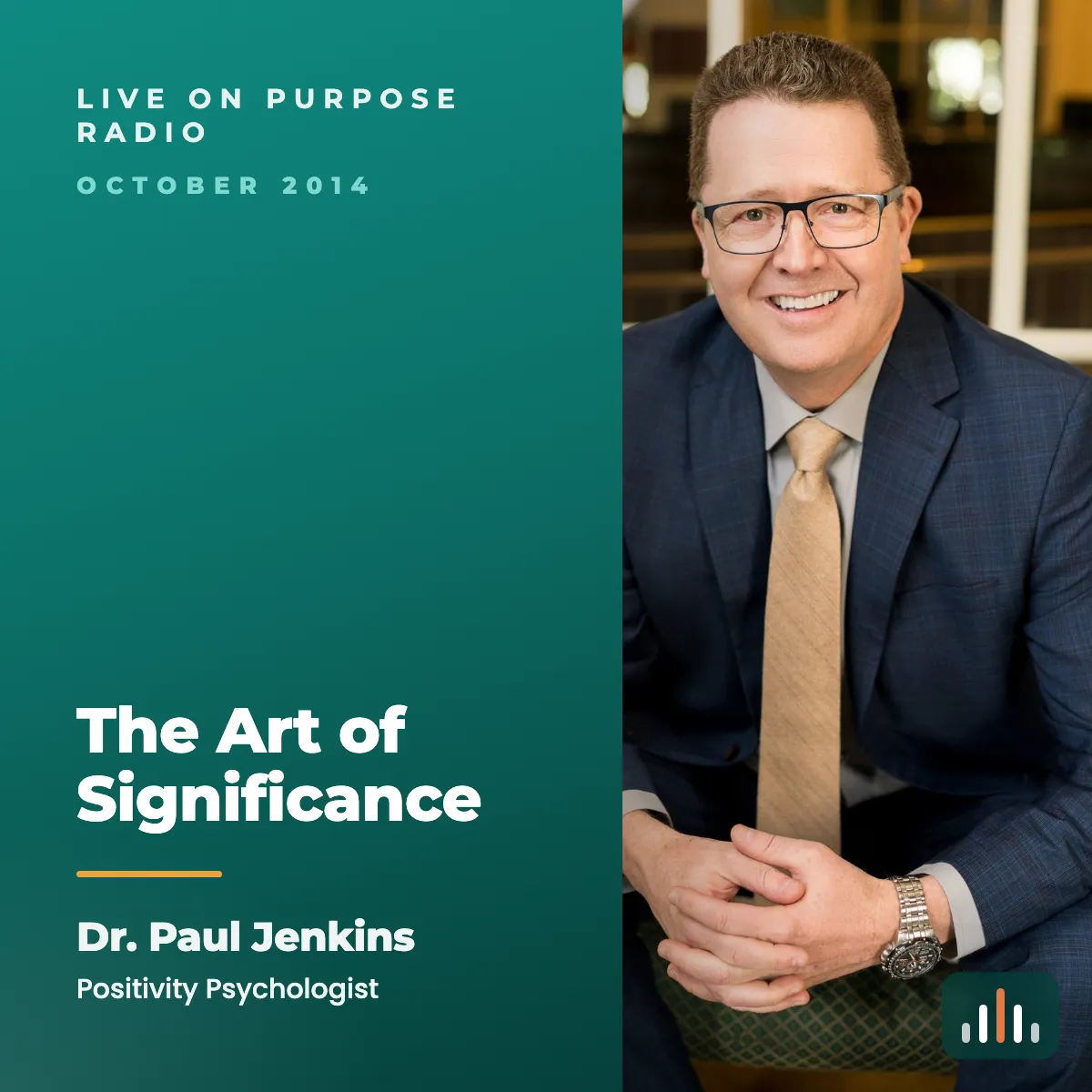
Welcome to Live On Purpose Radio with doctor Paul Jenkins, where you will hear inspiring stories of ordinary people doing extraordinary things. Feed your mind with a regular dose of positive energy and show up for your life every day on purpose. Living on purpose means that you have a purpose and you do it intentionally. And now, here's your host, doctor Paul. Hello, everybody.
Welcome Hello, everybody. Welcome back to Live on Purpose Radio. This is doctor Paul, the shrink who expands your life. Promoting pathological positivity today. Dan, you're already rolling, aren't you?
I love it. I love it already. I got a good friend here with me today. Dan, I told you earlier, you've been on my bucket list for a while. But you're hard to get because you're out inspiring the troops.
You're talking to the world about principles of success and happiness. Significance. Sir. In fact, folks, this is Dan Clark. I I didn't even tell him who you were yet.
Doesn't matter. Figured they figured it out. It's not about who, it's about what. Right? You got it.
And And why? Dan Clark is at... He's a hall of famer. You all know that I am an active member of our local chapter of the National Speakers Association, and Dan in the National Speakers Association, is well known as a hall of fame speaker. He speaks to audiences worldwide.
He has done this for his entire career since his plans changed. You can tell him about that if you want to, Dan. Author of 20 books, 20 plus, I don't know, do you keep track? 21 if you really care. The most recent of which I have in my hand here, it's called The Art of Significance.
The art of significance, which is a level beyond success. Dan, where did that come from? The art of significance? You know what? Maybe three experiences, set the tone.
I played football. One of my teammates, college football teammates, was drafted in the National Football League in the second round. Huge bonus, large salary. After four years in the NFL at the top of his game, he walks out of practice, quits never to play again. Why?
He loved being a football player, but he hated playing football. He got what he wanted, but he hated what he got. He loved the celebrity perks that allowed him, you know, the fame and fortune that went along with being a pro football player that allowed him this level of life that we call success. But because his inner voice and his true purpose and what he did for a living was misaligned with who he really was. He could never enjoy this life of significance and he would actually die with his music still in him.
Yeah. And that woke me up to the fact that most people hate their jobs. They only look forward to Friday instead of Monday. They think they're paid by the hour when in reality we're paid for the value we bring to that hour. That's right.
Most people are getting what they want, but they're trading what matters most for what they think they want at the moment. Mhmm. And so when you start talking about the principles and living on purpose, I've thought an awful lot about the impact you've had on my life as a speaker, as a as a, public shrink, if you will. Standing in front of a group allows me access to feel and to go through the therapeutic process necessary in my own private life without making an appointment. That's why everybody listening needs to hire you as a keynote because it's a safe environment for us to have access to your thinking and your intuitive counsel and your spirituality.
I'm just such a fan of yours. You know you know I love you. But when it ties back into significance in the byline of my book, Achieving the Level Beyond Success, the intrigue from that byline ties specifically into the purpose of your show living on purpose or live on purpose. Mhmm. And living on purpose means that we owe it to ourselves to challenge the status quo.
Right. Because most of the time, what is popular is not always right. Everybody says you gotta think outside the lines. You gotta think outside the box. I'm always the guy in the back of the room that says what if the answers are still in the box?
Most people who come to meetings come in search of the new answers when in reality don't you think we ought to come in search of the right answers and the right answers have always been right or we can't call them right and that's what your show's about. So when you start living on purpose let's just throw out law number two in my book, I have the 12 laws. Right. Everybody wonders how did I come up with these 12 universal laws of high 12 highest universal laws of life changing leadership. Well, what I first did was identify the 12 principles of success that we've all bought into.
And the best place to find those are in the best selling books such as Good to Great by Jim Collins. Now I'm not here to diss anybody, but the reality is I've been on the program many, many times over the years with Jim Collins. But the reality for your listeners on Live on Purpose is this, within nine years after publication, Good to Great came out in 2001. Within nine years, 50% of his examples of great organizations were obsolete. No longer exist.
Yeah. Who is he fooling? Where's where's Circuit City? Where's Nokia? Where's Fannie Mae?
Where's Freddie Mac? All these examples that he used as great organizations prove one thing... Actually, two things all consolidated into one cocoon. Mhmm. Number one, great is not always good enough, and best is only relevant depending on what you compare it against.
What you compare it to. So when we sit around and have best practices, when we talk about best practices, that's a lame approach. So what I've done is I've replaced each of these 12 principles that are still principles. Mhmm. And I've replaced them with the 12 highest universal laws of life changing leadership that never have to be replaced, so my book never has to be updated.
Wait. So highest laws. Let's not gloss over that. I think there's something there that needs to be emphasized. These are irrefutable principles, basically.
But we replace the principle. Yeah. All those things and we're... This could be a matter of semantics. But I chose semantics on purpose because think about it.
Think about law number two. Exercise perseverance instead of patience. We've all been taught patience is a virtue. Right. Yes, but not always.
It's even a biblical scripture, so I hope we don't get struck by lightning. Well, it depends. But think about it. Every every virtue taken to the extreme can become a vice. Patience allows us to never begin.
Patience allows us to to live with a weak mindset that this is my my cross I must bear. This is the hand I've been dealt. Everything is meant to be no no no. Perseverance is patience with a purpose where we don't mindlessly wait our turn. We proactively and intentionally take our turn with the reality that no matter what our past has been, we have a spotless future.
Pain is a signal to grow not to suffer. Once we learn the lesson the pain teaches us, the pain goes away. Right. So in life, there's no mistakes, only lessons. Let's just learn that and get on with it.
Not waiting to take our turn with patience, which is a principle of success. But but replacing that with perseverance, which is the highest law, it's the preparatory law. Let's talk... Well, that infuses the the purpose into it. Absolutely.
And it ties in with law number number 11. Let's just talk about law number 11. Law number 10 is... I've got them all memorized. I know.
But law number 10 is establish commence... Commitments instead of, I can't even remember what my laws. 11, establish covenants. Covenants instead of making commitments. Instead of making commitments.
I know. Oh oh, yeah. Sorry. Law number 10 is... I'm cheating, folks.
I've got his book right now. Law number 10 is love and be... I've love, be loved. Love and... Love and be needed instead of romance and news.
Thank you. I should read my own book. And so in that in that chapter, in that law, I've established commitment as the highest universal law. Mhmm. And then in law number 11, I say establish covenants instead of making commitments.
So now I've relegated it back to a a principle and elevated the highest law to what is called a covenant. Classic example. A commitment is a two way contract born out of suspicion. You make a list of what your responsibilities are. I make a list of my responsibilities.
I hold you accountable to your responsibilities. You hold me accountable to my responsibilities. If either one of us violates any one of those line item responsibilities, the contract is nil and void, and the commitment is is is knit. It's it's it's it's it's it's over. Right.
A covenant is a one way promise born out of love, born out of trust. Sales is just the transference of trust. So a covenant is a one way, promise born out of born out of trust and love. Regardless of what you say to me, regardless for how you treat me, I will still be there for you and be exactly what I'm about, which means I'm gonna live on purpose regardless of what it... What what what is required of me in our relationship to keep it alive.
Because it's who you are. It's how you operate. Exactly. It's why I do what I do. I I remember years ago, Dan, I was running a group of juvenile delinquents.
This is what the state labeled these kids. They're just kids. But they'd gotten into a lot of trouble. And I remember this one kid showing up to group and he has his hat on sideways and he's chewing on a toothpick and he's got a bolt through his nose, you know. And he comes in and we're talking about respect.
And he comes up with this. He says, I respect those who respect me. Exactly. There's a problem with that. I agree.
There's a problem with that. You respect people because you're a respectful person. And you warrant their respect. I agree. You know, I I love to just philosophize about the influences in our lives that actually help us learn about respect.
You put a hard to catch horse in the same field with an easy to catch horse, most of the time you end up with too hard to catch horses. You put a healthy kid in the same room with a sick kid, most of the time you end up with two sick children. Moral of the story to be healthy, disciplined, and significant. You ain't gotta hang around with a healthy discipline is significant. But here's my point.
Yeah. If you hang around with people who respect a specific low level classless attitude towards life and the performance that goes with it, you're basically going to assimilate your attitude and lower yourself down to their level so that you're respected at that level. Mhmm. You know, we often hear, oh, you know, you think you're better than me. No.
I'm just subscribing to a higher set of laws and principles. In the financial world, too many people bring their dreams down to the level of their income when in the level of their income when in the reality is we're trying to bring our income up to the level of our dreams. Of our dreams. To create that on purpose. Yeah.
And because we become the average of the five people we associate with the most, we must be willing to pay any price and travel any distance to associate with extraordinary human beings. So we don't ever have to settle for a lower class of loser. We don't have to settle for a lower expectation of of character and and integrity and service before self and a commitment to excellence in all we do. We can we can live at the level that we choose. Right.
Living on purpose. Well, you speak this live on purpose language. That's why it's so important that you're on this show today, Dan. You're awesome. You know what?
I was thinking about what you were saying about patience versus perseverance and what's the higher line. I was I was talking to a... One of my clients was a very successful, thoracic surgeon and busy. I mean, just in demand for this life saving service that he performs, and his son wanted to go to the Lagoon, it's a local amusement park here. And he's like, I don't wanna go to Lagoon, I hate waiting in lines.
Yeah, yeah, yeah. And so I challenged him on that. It was the same kind of idea. Really? You're gonna spend time waiting when you could be building a relationship with your son?
Yeah. Good point. He's doing the same physical action, but the purpose changes. And as he perseveres in creating a relationship, a meaningful connection with his son, who cares where he's doing that? I agree.
So he's not waiting. See, that's the difference in my mind between patience and just, oh, I'm gonna bear this burden. I love it. Perseverance, patience, and purpose. Put the purpose back in it, and then the perseverance makes sense.
Because now we've got a purpose that's driving and a why. Exactly. You know, I played football for thirteen years. One day in practice, the dream ended. We had a tackling drill coach blew the whistle.
Two of us ran into each other full speed, only parts of our bodies that made contact. His helmets, you know, crashed into my helmet. My shoulder was smashed into the into the sharp cutting edge of my fiberglass pads, and I've... We we slammed to the ground. And when he got off of me, my eye drooped.
I couldn't talk. My right side was numb, paralyzed, and my arm dangled at my side. Things weren't working. I stayed paralyzed for fourteen months, went to 16 of the best doctors in North America. And now that I've recovered, I'm asked the oddest question, what took you so long to recover?
Yeah. And the reason why I stayed paralyzed for fourteen months, I was asking the wrong questions. I was asking doctors how to get better when I should have been asking myself why. And once we answer why and find our purpose, figuring out the how to is pretty simple. From a spiritual perspective I was asking God the wrong questions, I was blaming God and asking him why this happened, and and I was asking the doctors how, excuse me, I was asking I was blaming God asking him how could you let this happen to me Right.
And asking the doctors how to get better, when I should have been asking God why did this happen and what am I supposed to learn from it, and why should I get better? What's the purpose? Exactly. We'll be right back. Thank you for listening to Live On Purpose Radio.
We're so glad to have you here. Please come by the website, doctor pauljenkins dot com, spelled with a d r. Doctorpauljenkins.com. On the website, you'll have an opportunity to receive a free download and while you're there, make sure you click on the social media icons. Come over to Facebook where we will be posting these episodes as well as our YouTube videos and other content and announcements for you to share.
Please like us, comment, subscribe, join the conversation. We're happy to have you with us here at Live On Purpose radio. Let's all support each other to live on purpose, doctorpauljenkins.com. You've heard the question a 100 times. Is the glass half empty or half full?
If we are in negativity mode, we see the glass as half empty. Anyone can see it's half empty. When we are feeling negative, we focus on what is missing and lament the lack of water in the glass. When we are feeling more positive, we see the glass as half full. Of course, it is half full.
Anyone can see that. We focus on what we desire and celebrate the presence of water. Then there are those who see it as completely full all the time. These seemingly crazy people are not just positive, they are pathologically positive. Pathological positivity is an empowering mental super normality that lifts us above the normal perception of reality.
It is a higher level of thinking. We see the glass and our lives as completely full, even in the toughest situations. If you have enjoyed Live On Purpose Radio, then you will love Doctor. Paul Jenkins' book on pathological positivity. Pathological Positivity.
Available now to order, visit pathologicalpositivity.com to get your copy today. That's pathologicalpositivity.com. No pessimist ever discovered the secrets of the stars or sailed to an uncharted land or opened a new doorway for the human spirit. Helen Keller. Okay, Dan.
You're kind of a weird guy. Enjoy it. It's weird. You gotta shrink telling you. I love it.
Dude, you're a weird guy. You you know what? Earlier you're saying, some things that I really appreciated because we have had an opportunity to inspire each other Mhmm. From behind the mic. Mhmm.
And you said some things to me that turned some things on in my brain that allowed me to show up a little later and say some things that turned some things on in your brain. That's just a neat thing Yeah. When we when we share those associations. And I was thinking as you said that, psychotherapy sounds a little like therapy for psychos. People aren't really excited to sign up for that sometimes.
But we all need some changes to happen in our mind. Mhmm. We get stuck behind ourself. Have you noticed this? Oh, yeah.
In your own life and the people that you've worked with, we get stuck in there somewhere. And I don't know if it's our pride or if it's, well, it probably is pride. I mean, we know that we're right. Have you noticed that? Yeah.
It's not that we think that we're right. We know we are. Yeah. We don't see And then we're not open. Yeah.
We don't see things as they are. We see things as we are. If you and I are looking out the same window Yeah. And it starts to rain and you say what a horrible day and I say no, it's wonderful, the weather did not change. But when we get around someone whom we respect, who brings a higher level of consciousness, a higher level of understanding, that's when we flip the switch and say wait a minute, You have illuminated my understanding to the next level, and that becomes the new norm.
Right. So that's why it's important for us to seek wisdom, seek counsel, seek those who know more, who've experienced more than we have. And truth, one of your truths here, one of the laws, the 12 laws of significance, is to know the whole truth instead of believing what you think. Some things are true whether you believe them or not. Everybody's entitled to their own opinion, but nobody's entitled the wrong fact facts and we should never believe everything that we think.
Case in point, 09/11/2001. We all know what happened that day. We all remember where we were. For thirty days after that horrific day, our youngest children ages 12 and under, elementary school children sixth grade and under were caught in this constant state of trepidation. The loud noises frightened them.
They were scared to death, paranoid. And the American School Counselors Association decided to spearhead a one question survey to get to the bottom of this so that they could figure out how to best counsel our children. And they asked one question, explain to us what happened on September 11 and to a t students from all 50 states said evil men stole jets, crashed them into buildings, killing thousands of people, and they kept doing it. What we as adults failed to understand is that our youngest most impressionable children could not differentiate between a video replay and real time news on TV. So bless their hearts.
Because every television set and every store and every home was just locked and loaded on the news coverage of September 11. They actually saw the replay of the planes crashing into the World Trade Center eight to 10 times every day for thirty days in a row. We shouldn't believe everything that we think. It's tough enough for us to deal with reality a little or misconceptions. And how often does that happen in our everyday life?
Right. Exactly. Circle back around. We trust these business gurus who say this is this technique. This is what's...
What matters most. This is the solution to success. Nine years later, we realize they've let us down. The whole motivation between behind search... In search of excellence with Tom Peters and his coauthor Mhmm.
Is a complete joke. It was not based on fact or science. They just said, hey. What companies right now are doing some pretty cool things who are run by some pretty cool cool guys? Mhmm.
And yet that became our behavioral bible and business excellence. Are you kidding me? And that continually happens time and time again. Yeah. So at some point we got to look over the wall and find the whole truth.
In in in the media we call it confirmation bias. Right. And every single person who's a producer or director of a show has complete control over the opinion they promulgate to us as listeners based on who they decide to interview on the side of politics that they choose to, affiliate with. Right. Shouldn't believe everything you think.
This is ridiculous. Well, when you say confirmation bias, this is a psychological term as well. Yes, sir. Confirmation bias, just so that we're all clear about what that is. It's the mind's ability...
Well, it's an ability, but it's a it's a tendency. It's a it's the way we're wired. When we have a belief about something, our mind tends to see only the evidence that supports that belief. That's true. And then we ask our mind to find that evidence and to, to solidify that belief in our mind.
It doesn't mean that we're right. It just means that we're more convinced because we found all this evidence. That's absolutely true. You find that in religion. You find that in in politics.
Oh, yeah. You find it in in sports. You find it in life. Absolutely. So knowing the whole truth, let's just tie it into to law number, law number nine, accept others instead of judging them.
Discipline is to teach not to punish. You can't increase a person's performance by making him feel worse. Humiliation immobilizes our behavior. So who are we fooling that we're supposed to put somebody else down to make ourselves feel better about who who they are or who we are? At some point we've got to understand and accept the fact that there's a difference between acceptance and tolerance.
And that coincides with our acceptance and understanding of these so called principles that need to be replaced by higher laws, case in point. Work life balance is an either or proposition that creates guilt and screws up our relationships. You gotta give more time at family, so you gotta give less time at work or vice versa.... Zero sum. Exactly.
And it's an either or proposition. No. Harmony, my law number 10... I mean, my law my law number eight, experience harmony instead of forcing balance. Harmony is an either and proposition.
Too many folks in my audience when I say how many of you are multitaskers, they raise their hands and proudly admit that they're lousy at a lot of things. What would happen if we started looking at ourselves and thinking with the mindset, living life with the mindset that we're jugglers? A juggler only controls the ball in his hand. Once we've let go of the ball, we've relinquished control. So why worry about it until we actually catch the ball again and can control it for those few seconds or minutes or hours or days based on what what the task requires.
At some point, we've got to change our entire mindset and understand that harmony means we can do it all, and we can be it all. Because we only live one life. You can't leave your work at home, and you can't leave your home at work. You've got amalgamate all of them into one life and make sure all things work. Then you're......
Means the things... If you... If the things you think about are different than the things you do, you'll never be happy. Right. I I was going to comment also, you're a musician.
I am. So this word harmony Mhmm. Has a lot of meaning for you. Yeah. Every song.
You can't do it with one note. No. Well, look what Johnny Cash did with two. You know, not bad. He had a few few records sold.
Yeah. But every song written was written with the same 12 notes. Right. Doesn't matter the genre. And so the question is what's the difference between a hit song or a loudy lousy songwriter?
They have access to the same 12 notes. The only difference between one song and another song is the order in which those 12 notes fall and the timing and spacing in between the notes. I talk about this in-depth in in law number eight in harmony. In the harmony chapter. So the difference between a hit songwriter, lousy songwriter's passion, creativity, and imagination, the answers are inside of us.
We just have to hang around with the right people, the five people we associate with the most who can trigger more passion, creativity, and imagination. That's how we start to live on purpose. What's the difference imagination. That's how we start to live on purpose. What's the difference between a great a great banker and a lousy banker?
They have access to the same interest rates in the same economy. I drive forty five minutes one way one way to bank. Never once have ever asked what the interest rates are on my loans. If money becomes a topic of conversation it means the presentation is weak and the relationship is non existent. I want relationships.
I want harmony. I want everything to matter so I can be hit songwriter every day realizing each morning when I wake up no matter how many hits I've had, no matter how many wonderful experiences I've had Mhmm. Today's a brand new day to take those same 12 basic boring naked notes and arrange them with passion, creativity, and imagination to win another hit song. And the cool thing is most hit songs are co written or it's a three way and they are rewritten, which means harmony is a journey, it's not a destination. Right.
Everybody thinks happiness is some destination that that that's impressive when achieving significance is a journey that's important. It all ties in with your radio show and the purpose that you even have your Live on Purpose show. Yeah. A journey. You know, life gets a lot easier once you finally realize that.
I'm not on my way to something. I'm on my way. It's Yeah. It's not that we're trying to to reach the horizon. That's not even doable.
The horizon's not a real place. But so often, we push happiness out there beyond the horizon. Once I accomplish this or once I have that, then I'll be happy. I love the words of a friend, whose last name is Uchtdorf. He said, we're more than just mere mortal beings living on a small planet for a short season.
Mhmm. And there's a theological, you know, understanding there's gonna be some great final judgment and everybody thinks we're gonna be judged for what we've accomplished and I believe that we're gonna be accomplished for who we've who we've become. That nothing has happened to us, everything's happened for us. Right. That validates the ideal that that it's a it's a journey.
That no matter what your past has been, you have a spotless future. I'm liking this idea of what if what if... Just put this question in your mind, listeners. What if all of this is for me? It's Yeah.
Perfect for me. To give us experience. Dan, you got hit in the head Yeah. And paralyzed. We're talking before the show about how Adam broke his leg Yeah.
As the top returning senior in the four a division in cross country. Mhmm. What is all this about? My injury is clearly one of the best things that ever happened to me. I would have never met you had I not been paralyzed all those years ago.
And my injury is not the best thing that happened to me happened to me, but because adversity introduces us to ourselves, who I am as a man and what I've learned about perspective and about priorities is clearly one of the best that makes it one of the best things that's ever happened to me. Right. Which means you can turn every stumbling block into a stepping stone. And if you're willing to do what others... If you're willing to do today, what others won't, you can accomplish what others...
Tomorrow, you can accomplish what others can't. Pretty cool that I screwed up. That's okay. You've practiced... Yeah.
Brain damage. Drain damage. Drain damage. Yeah. I'm still numb from the neck up.
And it was a it was a bad... Yeah. But you're on the couch today, Dan. You kept a little check up with a little window. When I finally sit up, I can't...
You know, I'm choking to death, and you're like, no. Lay there. I'm a therapist. Stay there. Just tell me about your mother.
I know. Yeah. I'm glad I don't have that kind of a practice. Can you imagine, doc? I can actually.
I can imagine it and that's why I'm so grateful for what I have. That's why I love it. I was an ecclesiastical leader in one of our faiths and I just always struck my struck me funny and I scratched my head when someone would come in and say, I hate my dad, young girl. I hate my dad. He's the cause of all my pain.
He's the cause of all my sorrow. And I'm like, let me get this straight. Your dad caused your pain. Your dad caused your misery. Your dad caused your sorrow.
Yeah. Okay. Call him. I wanna I wanna counsel with him because if what you're saying is true, if I treat your dad, you're gonna get better. And they would shake their head going, yeah.
Yeah. Yeah. You're an idiot. I get it and I understand that. Yeah.
We're always trying to blame somebody else. No. Yeah. And we're always taught, you know, is your class half empty or half full? Well, the idea is to look at it half full, but then the reality is it could be half full of the wrong thing.
So you still need to understand that beginning with the end in mind is not good enough. Right. It could be the wrong end. At some at some point, we've gotta strive for significance. More important to do the right thing.
And you're cracking me up, Dan, because the back of my book starts with the glass. Oh, yeah. Is the glass half empty or half full? Yeah. Well, let me just...
It's actually completely full. Give me a permanent magic marker. Yeah. I can... Full of what?
Yeah. Exactly. That's funny. Dan, we're signing off, but we have to give our listeners a way to get a hold of you. My website is danclarkspeak.com, danclarkspeak.com.
And, you can go to my music page. You can download my books. Whatever. I'd love to speak for you. My my, my, that's good enough.
I don't need to give out a phone number. The website's the best place to find. Yeah. And folks, Dan Clark, an amazing human being. Hire him to speak for your group and go out there and live on purpose.
Open the transcript on its own page ↗