Welcome to Live on Purpose Radio with doctor Paul Jenkins, where you will hear inspiring stories of ordinary people doing And now, here's your host, doctor Paul. And now here's your host, doctor Paul. Hello, everybody. Welcome back to Live on Purpose Radio. This is doctor Paul, the shrink who expands your life with another episode of Live on Purpose Radio.
Joining me today is Jamie Mo Crazy, and, yes, that is the name that she is officially known by. At least since the time when you were doing Mo Crazy things every day as an extreme sports athlete. Jamie showed up in the X Games and was one of the premier female skiers on the planet. Forget about female. They're they're one of the premier skiers on the planet.
And then, well, we'll get into the story about how everything changed for you during one of those competitions. Jamie, welcome to Live On Purpose Radio. Hi, everyone. Thank you so much for having me. This is exciting.
I've been wanting to talk to you for a while. We got to know each other through the National Speakers Association. Jamie, I have to tell you before we get into your story specifically. Your handle, your nickname that is becoming actually the way people know you, Moe Crazy, this came from your experience in extreme sports. But I love that because my book is pathological positivity.
Now the word pathological from a psychological standpoint means crazy. And I am encouraging people to be more crazy all the time Yeah. When it comes to their positivity and and their mindset. So I just really appreciate where you're coming from on that. And, I think we're gonna have a fun conversation.
Would you share with our listeners a little bit about your story so they get a little feel for where we're going? I didn't spoil that in the introduction. Mhmm. I want you to be able to share, some of the context around what we're going to be talking about today. Yeah.
Well, to start out with my story and, well, crazy, I was always crazy my whole childhood. I was climbing on everything, doing lots of different sports. If you asked me, I actually... It's in the newspaper. When I was six years old, I was interviewed competing for, a gymnastics competition, and I said, I wanna do gymnastics on snow.
And then I learned how to do... I started doing freestyle when I was older, and I did gymnastics on snow, and that's where I went professional in that career. And then what happened was I was traveling around the world, competing in x games, all the world tour, and it was a pretty exciting life to be living, and especially when you're in your young twenties. And then on 04/11/2015, I was competing at World Tour finals in Whistler, Canada. On my first run, I ended up in fourth place, and I am a very competitive ambitious little girl.
And fourth place is not on the podium, does not cut it. You know, so... It's not gonna do it. No. It's not gonna do it.
So I had to... I I chose to upgrade and change my off axis back flip to an off axis double back flip on the second run. And on the second run, on landing, I caught an edge and I whiplash my head onto the snow in such a way my brain started bleeding in eight spots. Oh. Yeah.
And I hurt my right brain stem, which completely paralyzed my right side instantly. Oh, good. I started convulsing and I went into a coma. And speaking of this, my sister was actually at the top of the course. And so imagine being my sister, giving me a hug, watching me take off, not seeing my land because you couldn't from the top, not seeing me hit the next jump, and then hearing on the radio, we need all hands on deck and a helicopter on standby.
Oh, okay.... Down and seeing me spewing blood, my eyes were rolled back, and I was convulsing. We lose people this way, Jamie. Yeah. My fatality report was actually written when they took me away in the helicopter because they did not think I was gonna make it to the hospital.
Oh, I haven't. Wow. And as you went into a coma, you didn't even open your eyes again for some time. Correct. I was I was in a coma for ten days, and then I had serious amnesia, so absolutely no memory at that time.
Like, I I still have no memory of that time for six weeks. None for six weeks. And then it started to come back, and I remember a little bit for the next couple months. I remember things that were really important to me, and, you know, when you, like, think back at your childhood and you remember some incidents in your childhood that, like, meant a lot to you, that's kind of how I remember the next couple months. And then my mind kept coming back and it, with a lot more to it than just...
My mom actually has a master's in psychology and a master's in childhood education, so she did a lot beyond what my outpatient therapy of doing childhood preschool kindergarten activities for me to do, and I had to re... I had to relearn how to read, and then I was reading all the time, I was writing all the time, I was doing those little puzzle things and those little drawings Yeah. In the black felt and things like that. So anyways, my mind came back, and stuck around, and then a year later actually went back to college with no disabilities. Wow.
And so the paralysis, that part healed as well. Yes. One of the things that we're getting to scientifically, have experiments that prove this, and it was something that, my mom believed in and she was in in charge of making all the decisions in my recovery. But, with neuroplasticity, that means that you can create new synaptic connections in your brain, so new nerve pathways at any time in your life. You can also open up new nerve pathways after they've been damaged.
And with the right side brain stem damage, a lot of why people did... The success rate is still very low, for regaining mobility after brain stem damage. But a lot of that is because people are trying to comfort you but really cuddling you, and they don't push you to do those exercises. Like, I I did so much work on my right hand. I'm on the right side of my body to make it move again.
And doing all that work allows it to open up and heal again and be able to get your mobility back. You have to work it to get there. And that seems so appropriate for you, Jamie. Because it's like, you know, the doctors come to you and say, I'm sorry. You're gonna be in fourth place here.
And you're like, I don't think so. Start to push through the hard things that are required to do that kind of recovery. Yeah. And I would say it is hard things, and you have to do a lot of steps and a lot of pushing, but you've gotta make sure you turn it into being fun. So you figure out how to still enjoy those activities and those things that push you.
You know what? It sounds a little like, a new game. And and maybe it's not the game you thought you signed up for or the one that you were hoping to compete in, but this is the one that was handed to you that day in April five years ago. Yeah. And act...
Very true. I I do a lot of talking about climbing an alternative peak, which is the same idea. I was climbing up life's mountain, and I got caught in a metaphorical avalanche that slid me down to the base, which actually a lot of people are experiencing with the COVID right now. A lot of the things you took for granted all of a sudden disappear. And then all of a sudden when you're at the bottom, you can decide if you want to climb up an alternative peak or not.
Or just stay crumpled up at the bottom. Yeah. And that has a lot to do, I'm I'm sure, about positive... Well, I know about positivity and and mindset. Absolutely.
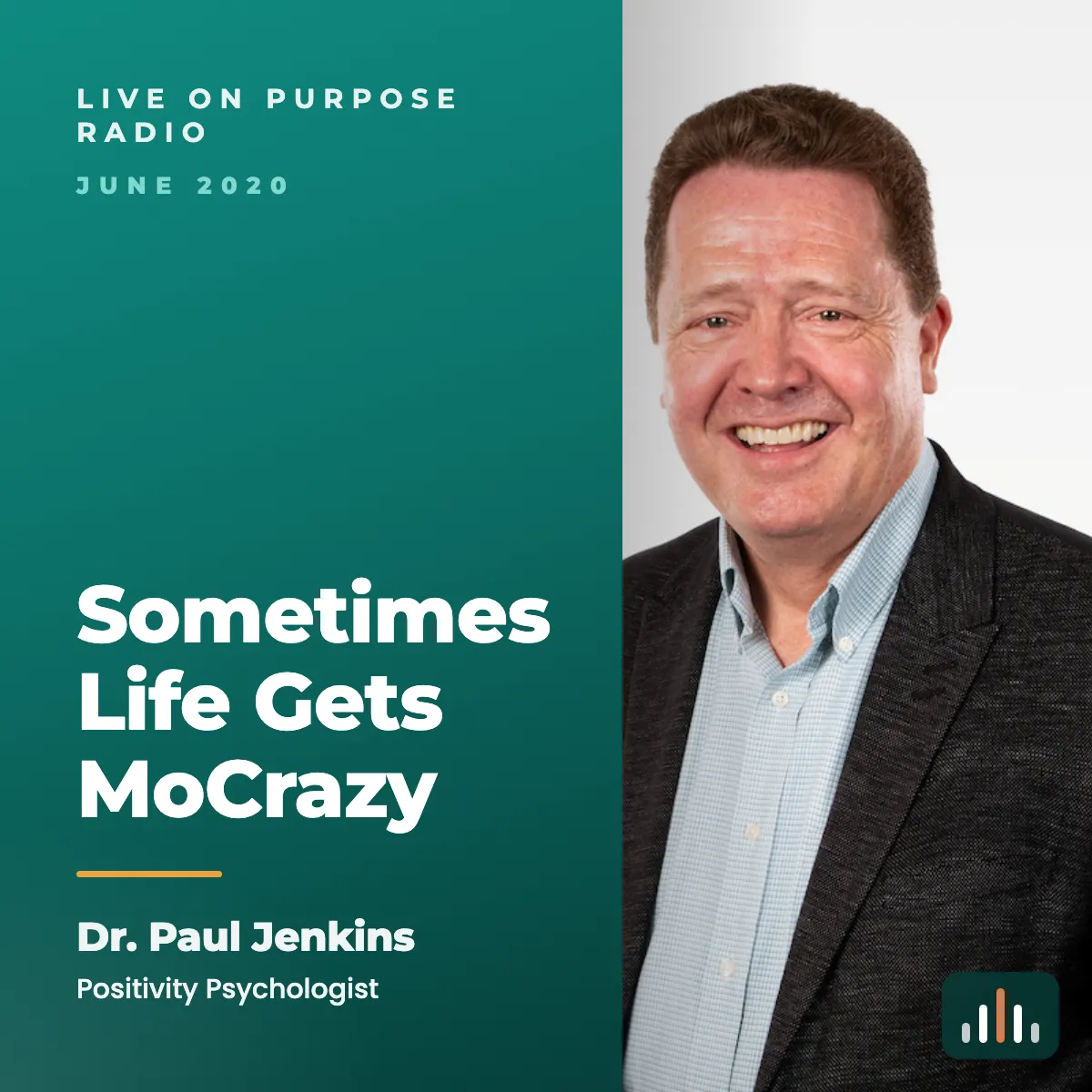
And this is such a great analogy for what we encounter in life. In fact, the title of this particular episode is Sometimes Life Gets Mo Crazy. It was crazy enough to start with, but then it goes up a notch or two. Yeah. And your story is such a beautiful example of that.
As you're competing in extreme sports, well, that's crazy. And then you get slammed into a coma. Well, that's Moe crazy. And then you recover from that and put your life back together from the pieces. And now you're doing things like like speaking and inspiring audiences and appearing on podcasts and, using your story.
I love... One of the things that you said on your website is something that I've heard from some of my friends who work in the addictions area about how your mess becomes your message. And that, I think, is the value of the avalanche when it hits you, of the accident when it occurs, of the pandemic when it takes over. It's easy to see the downsides, but there's all of these amazing opportunities that open up as a result. Yeah.
And that's why I'm so passionate about speaking and sharing this message is because the outcomes that you experience when you encounter trauma, struggles, I mean, everybody encounters struggles, and every company encounters struggles. And the ones who can overcome them and capitalize on the opportunities that develop are the ones that stay successful. Mhmm. And being able to do that... And I I...
My experience, it was years of... I had first hand experience, and then I've been so interested in it. I've been doing lots of research and more education on it. Mhmm. And neuroscience, I've started studying neuroscience at Harvard, and I have a bachelor's in communication from Westminster in Salt Lake City, and I'm using all that to to communicate and share my stories and tie them into life lessons so you can remember the stories and feel inspired.
Jamie, in some respects, you shouldn't have even survived that accident at fault. In other respects or other ways of looking at this, you shouldn't have recovered from a traumatic brain injury the way that you have with no obvious disabilities. The... You're beating the odds. But I love what you're doing with this because as you educate yourself about what's possible, we don't know everything yet.
Do we? No. And when something like this occurs and you beat the odds, it opens up possibilities for us to look at new approaches to old problems. Mhmm. Traumatic brain injury is an example of that.
But also how you how you choose another peak when the one that you were climbing is no longer available to you. How do you shift gears and and go a different direction? I think there's so many inspiring things about that. Jamie, as we come back from this break, let's dig into some of the things that you've learned from this experience that you are now sharing in such a powerful inspiring way. Are you down for that?
Totally down. Hey, folks. This is Jamie Mo Crazy at Live On Purpose Radio and we will be right back. Are you ready to take your positivity to a whole new level? I've been enjoying these conversations with my guests at Live On Purpose Radio.
My own story about becoming more positive is something that I've shared in my book, Pathological positivity. And right now, I'm giving the book away. You just pay for the shipping. Go to doctor paul jenkins dot com, spelled with a d r, and click on the big orange button right there that will get you a free copy of my book. You pay the shipping.
I'll pay for the book. Sound like a good deal? Power up your positivity and get ready to see phenomenal changes in your happiness, your relationships, your business, every aspect of life. Enjoy this free gift from me, doctorpauljenkins.com. And we're back.
Jamie Mo Crazy. Mo Crazy. Not just crazy. Here at Live on Purpose Radio. Wow.
You know, life does get mo crazy sometimes. There are principles that you have learned through this process, things that you've now brought into a a format that you can share them with other people. So not only has this improved and enhanced your life, but your experiences now are being used to serve and uplift the lives of other people, and I love that. I just I just wanna thank you for doing that with your story. Thank you for thanking me.
Well, you know what? You don't make a good victim. No. And by that, I mean, you... Yes.
Stuff's gonna happen to you just like anybody else. But rather than staying crumpled up in a heap down there at the bottom of the avalanche that life threw at you, You're like, okay. What am I gonna do with this now? And I'm sure that you had your times when it was discouraging and hard and just demoralizing. Because that's a normal part of dealing with, when life gets more crazy.
Yeah. Where does that lead you, Jamie? When I when I invite you to consider what you've learned from this, what are some of the principles that you feel most passionate about sharing from this story? The principles I started focusing on the most were actually some principles that I had been raised with by my mom, which was so lucky that she raised me with these principles because it definitely affected my outcome. And so now I share it to people who aren't lucky enough to have a mama fruit tell them this stuff.
Yes. She's called mama fruit. So I'm called Jamie Mo Crazy, and she's fruit. And not many people are lucky enough to be crazed... Mo Crazy and have a fruit, so that...
So I share it. But so what I learned was to look at everything with a growth mindset, not a fixed mindset, which means that with a growth mindset, with hard work, fun, time, everything can be changed and molded. And so with a growth mindset, the... At certain stages of my recovery, who I was and my detriments, instead of thinking that they were permanent, I found way is to fix them and overcome them. And then another thing was after you make the mindset that you're gonna overcome them, that you're gonna start climbing up your alternative peak, so the growth mindset you you decide that you're gonna heal.
And then how do you heal? Well, then the next thing to do is to set attainable goals, and attainable goals means goals you know you can accomplish. So one day, an attainable goal for me was to do a double flip, even though no girl had done it in a competition before, that was attainable for me to do, which I did, which was cool. But then another time, an attainable goal for me was to walk up a flight of stairs, because I couldn't do that by myself yet, but I was going to be able to do it. So it's setting attainable goals was climbing up the stairs.
Or another day, setting attainable goal was swallowing a glass of water, because when when your food... When you are on the tubes and stuff eating, and then they get taken off, they cannot get take... Like, you have more stuff in your nose and that will not get fully taken away until you can, swallow water. And water is actually harder to swallow than liquids that are more solid. So more solid liquids I could swallow, but that was a big goal for me, was a day when I could swallow water.
And those are very different goals, but they all matter, which is why a quote from my mom that I grew up with was, be your own personal best. And I thought of that throughout my whole recovery, what is my best today and be that best. And then during the whole process of all these things in your life journey, love your current self. So it's easy to think about who you want to be or who you used to be in the past, but really every day wake up, love who you are that day, and then love your journey, love the choices that you've made in your life every day. And if you don't love something, then start to change it so that every day you can wake up loving yourself, loving your journey, so then you can climb your alternative peak.
And make sure you write the ending that you wanna live. You are the author of this story. Yeah, you are the author, and I actually have a really, funny story about that. When I was in the hospital, when they would ask me, after my cognition came back a little bit, they would ask me where I was, to find out if I knew where I was, and I would tell them, well, you know, I'm in a movie about a hospital. Because you see, I'm not old, I'm not sick, I have a hammock in my room, and when you poke me in me...
With needles, it doesn't hurt. So it has to be a movie about a hospital. There's no way I'm I'm in a hospital. And I firmly believe, like dead serious, like now looking back on it, I know it's silly, but, like, I I really firmly believed at that point in my recovery that I was not in a hospital because I associated that with being sick and ill and bad. Like, in a movie about a hospital, and it was hard for the nurses to be like the reason why it doesn't hurt when we we poke you on the right side is because you're paralyzed, honey, not because you're in a movie.
But that same concept, once my mind came back more and I began to realize I had had an accident and I was not in a hospital, I I really had had an accident. I still believed I would be okay and I believed I could write that ending that I wanted to be living, And so by that pot... Super positive belief the whole time that I could create... It wasn't just gonna happen, but it was possible. That was huge for me.
That word possible is a real key. When you talk about the growth mindset Mhmm. I... It's not like positive thinking magically cures traumatic brain injury or paralysis or any other kind of bodily injury that... Or or disease process that you might have.
But here's the thing. Your mind has the power to create possibilities for you. And at a very simple level, for you to say, oh, I can't. Alright. Well, what's the next step after I can't?
Mhmm. There isn't one. Right? Maybe fetal position in the corner, I guess. But when you say with a growth mindset that you talked about in that that positive attitude, when you say I can, then the next step is obvious, and that is to figure out how.
It brings that question to mind, how can I? Because maybe you are paralyzed in a hospital and you can't feel your right side. But if you start with I can, that opens up possibilities. And when I said you're the author of your story, this story is not over yet. No.
And you don't get to pick everything that happens to you, but that's the material with which you're going to craft the rest of your story or the next part of it. Mhmm. I think you've done that nicely. Thank you. And it's fun, Yeah.
It is fun. And that's a big big thing to remember because sometimes people think they wanna change things and they have to go on diets and workout and it's all, like, tough and hard to do. Yeah. If you want to lose... My advice is if you wanna lose weight, instead of thinking you have to cut things out of your life, think of adding things into your life that are better and more nutritious and healthier for you.
So the same thing with my recovering from my TBI, instead of feeling like I had to work hard and... I did have to work hard, but instead of thinking of it negatively, like I had to do all these things that I didn't want to do, we found ways to to bring everything I wanted to do the way I wanted to do it. So, like, learning that had lots of value in a way that I would enjoy. And again, thanks to my mom, because when I was recovering, the other thing that's important important to me to share is that at the time when I was in a coma and beginning to recover, I could not make any of these decisions. So all of this stuff that I was doing, and then what I now talk about and share with people, I didn't make those decisions for myself at the beginning, but I recognized how valuable that they were, that that's why I wanna share them to people who haven't received them at the beginning.
But I received so much support and it went all the way from... People knew worldwide about my accident, and my family would do little things like when I was in the hospital, they'd have all my international friends and acquaintances send videos supporting me and wishing me a speedy recovery. So then I got to watch them in the hospital because I didn't know who any of my friends were. So then I'd watch a video about them and I'd find out how I was associated with them and that they were my friend again. And there's just so much support.
I guess to sum it up, accept the support in your life and and reach out. Support is is so important. You're not in anything by yourself, and you can find support for everything. That is so true. So true.
And then we... It will come in in sometimes surprising ways too. Mhmm. That support, something you didn't expect. There's always upsides and downsides to everything.
Right. And part of the message I'm hearing from you loud and clear today, Jamie, is to embrace the upsides, accept the downsides. Yeah. Embrace the upsides and then go build something fantastic from whatever life has just dumped on you. Yeah.
Because sometimes... I definitely had downsides. I still do. There... There'll be days, when...
Especially with this COVID, like, a lot of people in the world right now, I'm I'm just at home on self isolation, and some days I feel like I'm making so much progress and connections and doing so many fabulous things, and some days I feel so stuck. And that happens, but the way I like to think about it is instead of dwelling on your depression and dwelling on situations that don't work, just accept, okay, this sucks, this is happening, and then go do something to get it off your mind. Like go watch, I like to watch Friends. It's like light hearted, I don't don't think of anything, it makes me laugh. So like watch an episode of Friends, or listen to music, or watch a funny show, something to take a hot bubble bath.
Something to get you out of that, but recognize it and and admit it because it happens to everybody. Okay. This is happening, but remember, it's not permanent. Yes. Jamie, you've got me excited about taking on whatever's next in my life, and I hope that you listeners are feeling that as well.
Jamie, we're putting a a link in the description of the show to jamiemocrazy.com. Yeah. That... And it's spelled jamie,mo,mo,crazy, just the way you would spell it. Jamiemocrazy.com.
Tell us just a little bit about, how people can connect you and what kinds of things you're offering. Definitely. So that's my website, and you can send an email to jamiemocrazy@gmail.com, or my management is mocrazystrong@gmail.com. If you have questions or you'd like to book me, and I I I speak at motivational events, and I also speak at youth events and educational events and business events. So I tie...
I tell my story. I tell lots of different stories, and I tie it into life lessons. So like what we talked about, what I learned, I tie in stories to share how that happened. So you can get entertained and educated to decide that you wanna take another step towards your growth goals and what you wanna do and live a life that you love. Beautiful.
And there are ways to do that. You've created some hope for us here today. I hope that as you're listening to this conversation between me and Jamie today, that you've identified some ways that you can take what you've learned on today's program and go live on purpose because it's time to do just that. We'll catch you on the next episode.
Open the transcript on its own page ↗