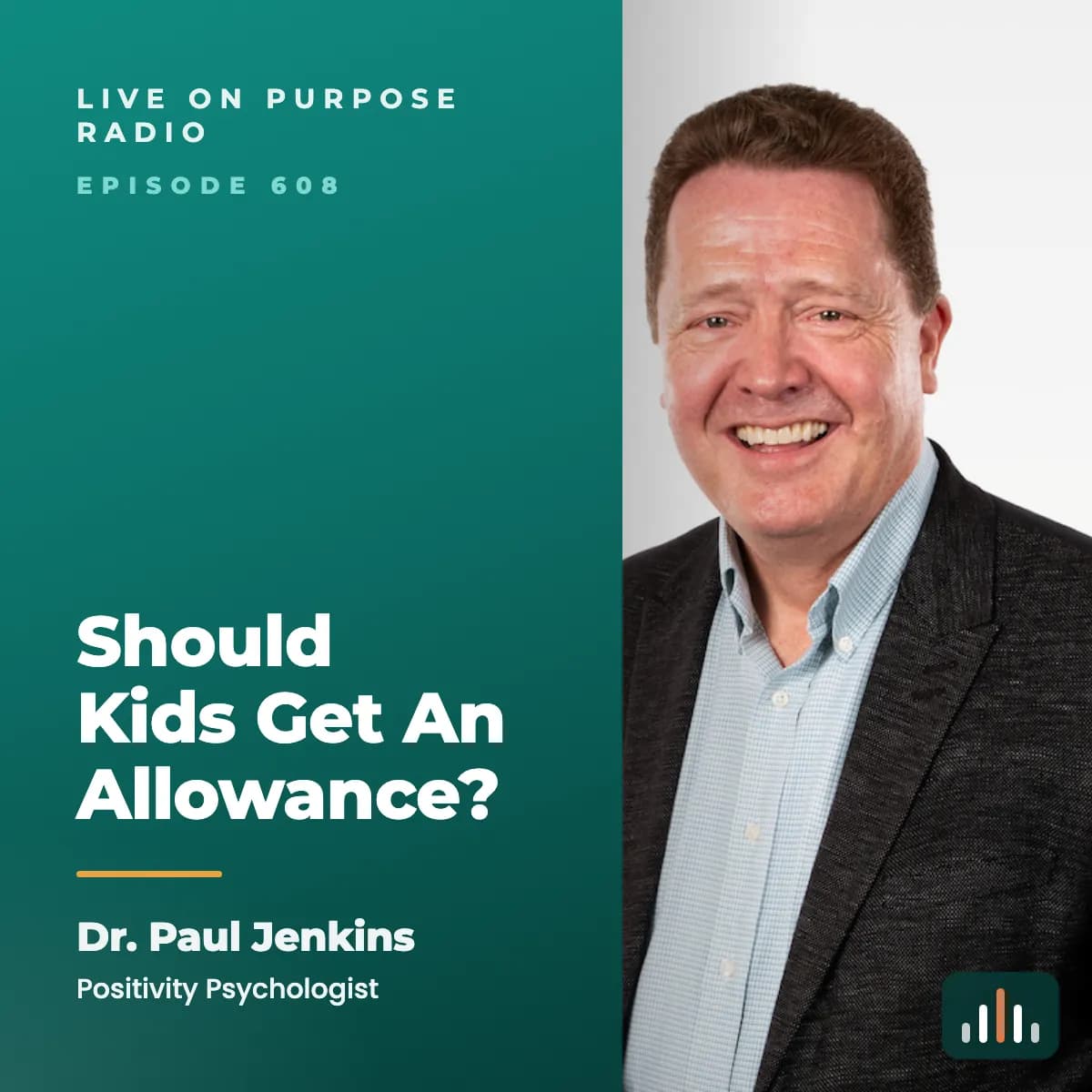
This is Live On Purpose Radio episode 608. Should kids get an allowance? Now is the only time to create and live the life you love. I'm doctor Paul Jenkins, the positivity psychologist. My job is to connect you to powerful positive psychology principles that immediately upgrade your relationships, business, and mental health.
Are you ready? Let's jump in. Hello, everybody. Welcome back to Live on Purpose Radio. This is doctor Paul the shrink who expands your life with another episode.
This one is for parents. Many of you know that much of my career was spent doing clinical work with parents, children, families. And one of the questions that came up quite a bit, should kids get an allowance? So I'm drawing on thirty years of clinical experience here. And Vicky and I had a chance to raise four kids of our own, so we got to practice some of this, within the walls of our own homes.
And I want to acknowledge right up front that allowance can be your best friend as a parent or a quick path to entitlement that will ruin your kids. So the first question I have for you, as a parent who's concerned about this, why? Why are you even considering an allowance for your kids? Spend some time thinking about this. Now if the answer is to teach responsibility, then let's move forward.
If your answer is because of social pressure, expectation, entitlement, then put the brakes on this and rethink it. Because like I said, it can be your best friend, or it can be a quick pass to entitlement, which kind of spoils kids in a lot of ways. So if we're doing this in order to teach responsibility, let's go next to the distinction between needs and wants. There's a difference. This is important for us as adults to understand, and it's something that our kids are still learning.
They really think that they need something when actually they just want it. Now I say just. Maybe I shouldn't diminish it with the word just. They want it, and they may want it very strongly, and they may be convinced in their mind that this is a need that is absolutely essential to their very survival. It might be just as important for the parent to make this distinction as it is for the child.
I had a conversation with a family just very recently. I was doing some coaching... Family coaching with them, and the issue had to do with a cell phone, which is interesting. Okay? We call...
We still call it a phone. It's not. Really, most of the time, it's not even used for that. It is a digital device that has an active Internet connection. So it's a social media device.
It's a gaming device. It's a connection device. It's a texting device. Rarely is it used as a phone. Have you noticed this?
So the definitions have changed. And, in this particular family, the daughter is 13 years old, and she needs a phone. After all, all of her friends have one. It's it's sort of an expectation now. Right?
So I would ask you, does she need a phone? And the answer is no. How do we know this? Because millions of teenagers survived. I know.
This this sounds like the parent answer. Right? People survived for centuries without a phone. This this is true. But it helps us to distinguish that this is a want, not a need.
What do they need? Let's be very clear about this. Your kids have five basic needs that you as a parent are obliged, both legally and morally, to provide to them. I call these the five freebies. So make a little list if you need to.
I find that most people kind of remember them. Number one, love. Because your job as a parent is to love them no matter what and even if. That's the first freebie. Second freebie, air.
You know, this one surprises some people. Okay? But it is a need. It is a desperate need, and you realize that if you hold your head underwater for a little while, you need air and so do your kids. Now you don't provide air to your kids, but you have no business depriving them of it.
And it's sad that I have to even mention this, but I testified in a court hearing. It was actually a trial for a mom whose daughter died as she was deprived of air, and the mother was being tried for the death of that child. Now that's tragic, and it's extreme, but I I include air on the list because I just really wanna make a point here that there are some actual needs. Let's go to the next one. Water.
You can survive just a little longer without water than you can without air. Alright? But it's still pretty essential to your life, to your survival. Water. Next, food.
Now food does not mean preferred food. It means sustenance. It means keep the belly button away from the backbone. It means nutrition. And I make that distinction too because, when we get to the point of allowance, you'll see where they can have much of what they want if they're willing to pay for it.
But you have to provide all of the freebies, and food is on that list. Okay. So how many do we have so far? We've got love, air, water, food. The next one is shelter.
And shelter... I get in trouble for this. Shelter does not necessarily mean a private bedroom. And, again, you look at all of the thousands and millions of people who have survived without a private bedroom in the past. Is it a need?
No. Is shelter a need? Yes. And it's more important in certain climates than it is in others. But what we're talking about here is protection from the elements.
Now shelter also includes in most societies appropriate clothing, And that also doesn't mean preferred clothing. K? It means appropriate cover the bare essentials kind of a thing. Now I'm I'm sharing this because we're going to overemphasize that these are free. Your kids don't have to qualify for them.
They don't have to pay for them themselves. As long as they are minors, they are entitled to receiving these freebies from their parents. And in most societies, parents can be in legal trouble if they neglect their responsibility to provide these basic freebies to their kids. K. You with me?
So five freebies. Now using an allowance with your kids in order to teach them responsibility can look something like this. Everything else that's not on the freebie list comes from a budget that they make from their allowance. This potentially teaches them responsibility, delay of gratification, how to manage money and other resources. Without the need for them to buy what they want from their own resources, then they will find other ways to get what they want.
And usually, the easiest way to get what they want is to manipulate their parents into simply providing it for them. And sometimes they do that by convincing you that they need that thing that they actually want. You can start small with ways to work for an increase. I remember one of the families that I worked with was a very affluent family, and they were providing as an allowance for their preteen. A $100 a week.
And I'm thinking to myself, what on earth could a 12 year old need a $100 a week for? And and the answer is they don't. They they get everything that they need from their parents. And the parents were still buying preferred clothing for them, preferred foods for them, entertainment activities with their friends. So what if we peel all of that away and they get to budget for that out of their allowance?
When I said start small, I'm not here to tell you how much. You can tell from what I've shared that I think a $100 a week is probably too much, and it it doesn't provide the same opportunity for your child to practice budgeting and to practice delay of gratification. Because at a $100 a week, they can probably still go get anything that they want through no effort on their own part. So when I say start small with ways to work for an increase, you can give them a path toward earning more. You notice I use the word earning more.
So taking on special tasks or projects at the home, doing work outside of their regularly expected chores and household contributions. And I wouldn't necessarily tie the allowance to those things. That's just part of living in the house. You get to do those things. The allowance is simply there as a learning opportunity, and it only works as a learning opportunity if they can't obtain those things that they want in other easier ways.
I hope this gets you thinking. When I said allowance can be your best friend as a parent, Notice once that's in place, then you have more opportunities for appropriate consequences when needed. Having fines, for example. If they have to pay a fine out of their allowance, which, by the way, can be deducted prior to giving it to them, then that gives you another consequence that you can use when needed. If your kids are on a stage of development where where the transactional consequences are appropriate.
And when I mentioned the stages, you know, people have asked me a lot too, what age should kids get an allowance? And for me, it's really more about stage than it is about age. Go to, Live On Purpose Radio. Remember the name of of our podcast here. Liveonpurposeradio.com.
Do a little forward slash stages, and I will give you a free PDF copy of the model that I share with all parents that helps them to understand the... What I just shared with you, the the importance of stage, not age. This can drive our decisions as parents and gives us an opportunity to interact with our kids in ways that are really most likely to help them progress to higher stages of moral development. So go check it out. Well, you live on purposeradio.com/stages.
And I'll put that right in your inbox. Hope you got something useful for this. Share it with other parents. I know you know some. Share the episode with them, and let's go live on purpose.
Did you get what you came for? Give yourself the gift of taking real action on what you realized today. Please share this episode with someone you know would value it, and leave us a rating too. It's time now to live on purpose.
Open the transcript on its own page ↗