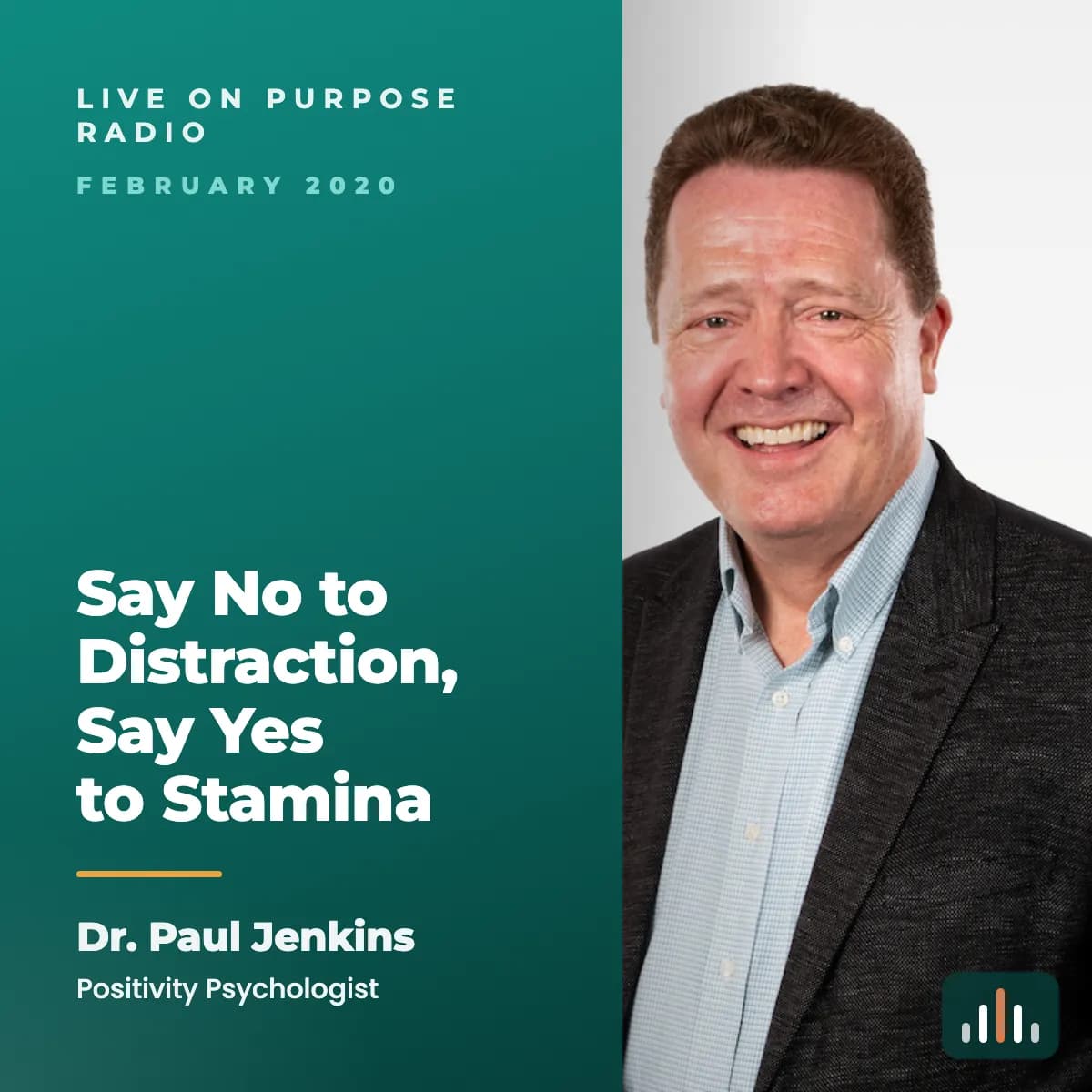
Welcome to Live On Purpose Radio with doctor Paul Jenkins, where you will hear inspiring stories of ordinary people doing extraordinary things. Feed your mind with a regular dose of positive energy and show up for your life every day on purpose. Living on purpose means that you have a purpose and you do it intentionally. And now here's your host, doctor Paul. Hello, everybody.
Welcome back to Live on Purpose Radio. This is doctor Paul, the shrink who expands your life with another episode of Live on Purpose Radio. Joining me today is Sabrina Runbeck. Sabrina is an expert on helping people to love their life, and that's why I'm getting excited about this. Sabrina has found a passion in helping professionals in high demanding careers to have the kind of lifestyle that they deserve so they can enjoy their success.
It's kind of like living on purpose. Sabrina, welcome to Live on Purpose Radio. Thank you, doctor Paul, for having me. This is fascinating to me, and I would love to have you share a little bit of your story about why why you're doing this and how you got here. Can you Yeah.
Introduce yourself a little that way for us? Sure. Of course. So it was about four years ago. Thirty in the morning, there I was actually having a 100 o one fever while operating heart surgery.
And my nurse keep passing day cool and cough drop under my mask to keep me going. I thought to myself, how could my childhood passion working in medicine and living the American dream turn into such an unhealthy reality. And top that off, when I called in sick the next morning, my manager made me think that I was inconveniencing him. A few weeks later, I treat a young man who's only in his early thirties who required fourth open heart surgery because he didn't share his new symptoms, thinking they were small and insignificant. And that is why I realized I have these small and insignificant things in my life that I have to address.
Otherwise, I'll become a patient myself. Mhmm. I used to say yes to so many things thinking I got this. Right? You just keep going.
Yeah. Then I know that it's when we say too many yeses, that's what hurts us. Because even though society taught us to be polite, to do favors for others, just to be a nice person, but if we say yes to the things that do not align with our own core value, like that side project that we pick up, then we might feel resentful and unable to deliver the high quality result that we know we can as a person. And sometimes, we might even break our promises. That's why I started to say, I would not do any work that really drains me.
I will do things that will pick me up and lift me in life. And while on this journey of researching, analyzing all my, other studying from other high performance research, of course psychology neuroscience is, such a core part of it. And then, coming up with the system and that I can turn my life around. And what I call that, say no to distractions and say yes to stamina. You've discovered some principles through the course of all this that help people not to stay stuck in this place where there are so many demands and the pressure and the expectations to achieve.
And I've seen so many people, it sounds like you have too, who who get into that thinking, okay. This is what's gonna fulfill me and make me happy, and I'll be a productive citizen. And then they end up feeling trapped. Right. Exactly.
I feel like it's a sims... Similar struggle for people. Doesn't matter you just begin your career or you're already working in the area of your passion. Mhmm. Because you have follow a path.
Right? There's the end goals and the end goals. Right? And most of us are just simply taught to say, well, my family has brought me up. I respect them and I see things I like, I dislike, by wanting to be respectful.
So, I picked this pass and supposedly to be secure, to be something I want to do. But once you get into the round of just laboring yourself, constantly adding more things on top of your to do list, and you don't even know how to allow yourself just to take a break, to say no, to putting yourself care last. Because if we don't put ourselves first, then we're giving others not the best of us, it's really what's left of us. The leftovers. Yes.
Which is is not fun for us personally, but it's really short changing everybody else that we're working with too. Right. Right. I noticed something about how you just presented that, Sabrina. It...
And it has to do with being able to say no at the right times, which allows you to say yes at the right times. Yes. I think that's the most difficult part. Right? It's when to say yes and when to say no.
And then one thing I think is a key component that tie into saying no to putting yourself here last is that clarity. What is the purpose of who you are as a person? How you want to show up? And now, how do you want it to contribute? Right?
The type of experiences you want, that, that you actually... Your core interest as a person and then how are you serving as a person in society. So if we're not super clear on those, it's also easy to get sidetracked, because we don't have that, you know, bright and northern star that guides us. We're just in the motion of doing, by doing what we really good at. Right?
It's not to say, like, we work so hard to get to that point. We didn't do it to hate it, but at the same time, we did it because now we know how to do, and you get comfortable at it. And to question yourself of your own intention, that's not something that we typically do. You've discovered some of this, I I wanted to say, by accident, but I I don't know that it was an accident that you discovered these things. You were working, what, eighty plus hours a week in in health care.
You're a a surgical medical expert. And in the course of doing all of that, you started to discover some principles that are really more about life than what you might have anticipated when you first started into your training as a as a medical surgical expert. Yeah. Exactly. I think, while I was younger, I'm very, my personality just very type a, very outgoing, very much questioning.
Right? If we define, using the four tendencies by Gretchen Rubin, I'm the questionnaires. I pretty sure what I want because I research that, I question it, and then I also challenges the bigger external expectations, to say is what we're doing really the right way? Can we improve on it? It's not to say change everything, but can we be a better person or better delivery system?
So in that sense, it helps me to keep going. Once that goes for myself, I'm I'm I'm on it. I don't really need too much of external accountability, but it's still nice to have. But in medicine per se is... There's a misconception of asking help is a sign of weakness instead of it's a sign of courage.
And when we go into school, it's crazy how half of my class... Yes, it's intense. Right? You're you're you're like drinking from a fire hose how much information you're getting. Right.
How you expect to deliver because your patience is right there. Once you graduate, you better know your stuff. Right. Right? And then because...
And then I just always thought, like, with, you know, internships, shadowing, all this experience, I love surgery. And it's... Human body is crazily puzzling, but we can recover it by fixing things. Yeah. And I pick heart and lung surgery.
And while I was going to school, I even before, people will say, oh, you're a girl. Why do you pick the field that's like one of the most intense? You know, like, because, you know, heart surgery, it's life and death all the time. Things can go really quickly bad, but you also see the good things. When you have someone who's seen severe heart failure and you do your surgery, you fix their valves, fix their coronary disease, and gradually, they become completely different.
Right? And so it's... That is what drives me. However, when we're just going into the routine of just doing it because I'm I'm not good at it, and you start getting better at each day, but then you start waiting on you, it's like it's never ending. It feels like once I get to my goal, what is the next step in life?
Mhmm. And there's always something more. Right. Which is where some people get trapped, I think. Right.
Right. They feel like they have to reach the pinnacle of their career or their success in order to be happy. You know what? I've found... In my own experience, I've found that it's probably just the opposite, that you're more likely to reach the pinnacle of success if you're happy.
Yeah. I I think that's the key thing is I didn't learn until later on. It's not just allowing yourself to enjoy the little wins in life, but it's living into those wins. It's to say, like, what did I actually do that I'm happy of? Okay.
Great. Let me do more of that. Like, it's just like, it's changing the way of thinking for sure. Well, Sabrina, as we come back from this break, I would love to get into your mind a little bit about the practical application of some of what you've learned. I think that you've probably got some experience you could share along those lines.
Yeah. Of course. Folks, this is today Sabrina Runbeck at Live On Purpose Radio, and we'll be right back. Are you ready to take your positivity to a whole new level? I've been enjoying these conversations with my guests at Live On Purpose Radio.
My own story about becoming more positive is something that I've shared in my book, Pathological positivity. And right now, I'm giving the book away. You just pay for the shipping. Go to doctorpauljenkins.com, spelled with a d r, and click on the big orange button right there that will get you a free copy of my book. You pay the shipping, I'll pay for the book.
Sound like a good deal? Power up your positivity and get ready to see phenomenal changes in your happiness, your relationships, your business, every aspect of life. Enjoy this free gift from me, doctorpauljenkins.com. And we're back. Sabrina Ronbeck at Live On Purpose Radio today.
Sabrina, you've got such an interesting experience. I'm talking to you about positivity and about making life meaningful, enjoying your success, and you're coming from from a background of surgery, heart and lung surgery. I mean, this is not the field I'm typically involved with or or interviewing people from, but it's interesting that you can learn the principles that you need to... In whatever field you're in, and you happen to be in this medical field. You've learned some very practical applications for the principles that we've been talking about here today, and I'm hoping that we can get into that now in the second half of the show.
What would you advise people to start with? I mean, where do you start with people when when you're advising or consulting with them about this area? Yeah. So my system are five simple steps. And then, of course, well, I think something you said before is simple doesn't always means easy.
That's true. And things that are logical doesn't mean it's always practiced. So my first step... We'll go over three of them. So the first step is say no to vagueness, so you can dream big and achieve more.
Because people couldn't react their minds. If we're unable to express our true purpose and ideas and that become a guessing game and your expectation and other people's expectation are not matching, that's when conflict starts. So before we do any project, write a one sentence purpose statement. Mhmm. And then it become very defined.
Say no to vagueness. Oh, boy. You know what? That triggers a lot of things for me because I talk to people all the time who just want to have a better life. What does that mean?...
Be any more vague? Right. Yes. Or or people, say, I want to be more successful or I wanted to be happier. Happy become just a state of mind.
And I think Yeah. One big thing about, like, unable to accomplish goals, is because we have such a vague idea of what we want. And it's not something clear enough we can visualize or attach it emotional to that final product. So if you don't feel it's it's even achievable, now how much effort are you gonna put in to make that happen? Right.
And confusion paralyzes. If we're confused about our own goals or objectives or what we want to accomplish, then we'll we'll end up in a state of paralysis. We can't even move as a result. Yes. Exactly.
And that lead to my second point is to say no to negative thoughts so you can say yes to reclaiming your mental power. Because every mission has roadblocks, we can't prevent that, but the I'm positive I can mindset generates the power, the skills need for us to do. So every morning, this is what I suggest and that's what I do as well myself. Uh-huh. We have all these great qualities.
Just say one thing positive about yourself in front of mirror or say out loud. And so, of course, you can begin your day on a positive note. Oh, but that's so awkward. Right? Because you don't like to be proud of yourself or just to simply say it out loud?
Maybe. Isn't it weird though that that's hard for us to do? Yes. You said earlier, something that we both shared at at different times, and that is simple and easy are not the same thing. Mhmm.
This is a simple thing, and I reacted with the awkward statement because it's going to feel a little unnatural, perhaps, if you're not used to this. Right. If you're not used to looking at yourself in the mirror and saying something positive, it's gonna feel a little awkward, uncomfortable. Do it anyway. Yes.
And to be a smaller step, you can even just write it on a piece of sticky note. Right? If if you feel awkward about self expression, that's what I feel like is a form of self expression, a self love. If you couldn't say it, then write it down. Because anything that's written or speaking out loud, it become more, like, affirmative.
It's it's confirmed. It become more real. And you know what, Sabrina? I'm not a big fan of comfort. I mean, I am for myself.
I like to be comfortable. So... But for my clients, I'm always trying to nudge them a little out of that comfort zone. And here's here's the thing, people. Better is always different.
Yeah. Yes. And it it doesn't mean that difference is always better. That's where we get into trouble sometimes. But better is always different by definition.
And so if you feel that this is different from what you're used to, great. That's probably good news. So I'm throwing my support behind what you just suggested, Sabrina. I think let's push out of our comfort zone a little bit and try it. Exactly.
Create that energy that allows you to say yes to some important other things. Right. And that's that's how we... If we can say more positive, then of course, that message will deposit into our head and it bumps away all the negativities. That's how I think.
Oh, I think you're right. And this... You said you said something about you're going to say no to negativity so that you can reclaim your mental power, was it? Yes. Yes.
It it just that if you think about anything, our brain capacity is not a 100%. Right? Like, for... I don't think we can ever get to that point. However, if we say there is a box per se, if our brain capacity is a box, then are you allowing yourself to deposit all the positivity or negativity into that box?
And if we can deposit more positivity, of course the negativity will shrink because there's no room to go. But on the flip side, if we're allowing other people to add in negativity, the naysayers, or our self negative talk, then of course, there's also no room for the positive energy in your life. Right. Simple physics. Right?
Awesome. And then the last one is what I mentioned earlier. I think I'll I'll... Self care is to say no to putting yourself last. So you can give the best of you, not what's left of you.
Because without appropriate energy, productivity really couldn't go far. So when we can build in these stamina reboot session, what I call, like, these smaller moments of whether it's a briefing, meditation, or things that I help other people to set up. Mhmm. And even just do that a couple minutes will make your mind and physical body reboot itself. So the things that you thought you can just push through because...
Let me just... If I can just finish seeing these patients or finish responding to this email, I can go home. But what if you just allow yourself to take that tiny little break, you become more alert, your eyes become brighter, you feel lighter, and then probably, you can get things done in thirty minutes instead of just push through for the next two hours. Yes. It's true.
You know what? There's research, there's clinical experience that backs this up. Yep. You called it a stamina reboot? Yes.
That's kinda cool. What if we could reboot our stamina? Yeah. It's... I I mean, there's so many research as you're saying.
Right? Like, the productivity, coaches will say that we wanted to set timers intentionally. Right? Like, anywhere between half hour to fifty minutes. So when you sit down, you're not just, like work work work and forgot about drinking water, like allowing yourself to even go to bathroom sometimes.
And that's... Funny thing is that's what I hear most of the time. I hear people who are having these demanding jobs, who are in medicine, who are counselors, producers, and this... They will tell me, like, oh, I'm running between meeting to meetings. I don't even remember to eat or drink because the bathroom is too far away.
What it, if I eat or drink, then I have to take the time to even go to the bathroom. I'm like, how crazy is that? Like... Right. It'd be like driving your car somewhere and you see that you're running low on gas.
Yes. But I can't stop for gas. I don't have the time. Well, how much time do you get to spend broke down on the freeway now? Exactly.
Yes. It's true. And this is brain friendly practice that you're talking about. We're taking better care of the equipment, and then the equipment will take better care of us. Exactly.
Yeah. I mean, I truly believe in productivity, but if we don't allow ourselves to rejuvenate, restore, then no matter how productive we think we are, where we have all these other strategies, we are physically not in a state, we're mentally not in a state to carry out anything. Right. That is so help. So you've given us three very practical things.
Say no to vagueness, say no to negative thoughts, and say no to putting yourself last. Mhmm. And there's more, obviously, that we could do, but I appreciate you're sharing those three with us. Thank you. Sabrina, if if our listeners are interested in getting to know you better, where's the best place for them to do that?
Oh, and when we talked earlier, you said that you have a little assessment that people can take to discover some of their hidden roadblocks. Can you tell us about that as well? Yeah. So I believe that we all have the inner ability to achieve our dreams and do, able to gain the knowledge about who we are, find satisfaction in our personal life and in our career as a individual. But to achieve this heck yeah life, it does require conscious intentions to do, as we discussed.
And we all begin by knowing your strength and weaknesses. To do that, I develop a three minutes quiz called discover your hidden roadblock. And people can go to sabrinarumbach.com/assessment to take that quiz. Wonderful. Let let me make sure we got that.
Sabrina, s a b r I n a, runbeck, r u n b e c k. Did I get that right? Yeah. Dotcom and then /assessment. That's where they can get this three minute quiz.
Yes. Beautiful. And then knowing those hidden roadblocks, that puts you in a position of power to start doing something about it. Right. And, typically, I, talk to people on my initial, consultation.
I also identify those roadblocks for them. And then discuss what are the common reasons that you have these roadblocks, and then talk about couple strategies to move forward in life. And for most people, I'm very active on, Instagram and LinkedIn, and my Instagram handle, just my full name at sabrina rumbach. Wonderful. Sabrina, thank you so much for joining us at Live on Purpose Radio today.
Thank you so much for having me, doctor Paul. -You guys you've heard it now from the queen of productivity. Sabrina Runbeck, go out there and apply what you've learned today at least in part. Do what you can, start where you can, and create that life that you love. It's now time to go live on purpose.
Open the transcript on its own page ↗