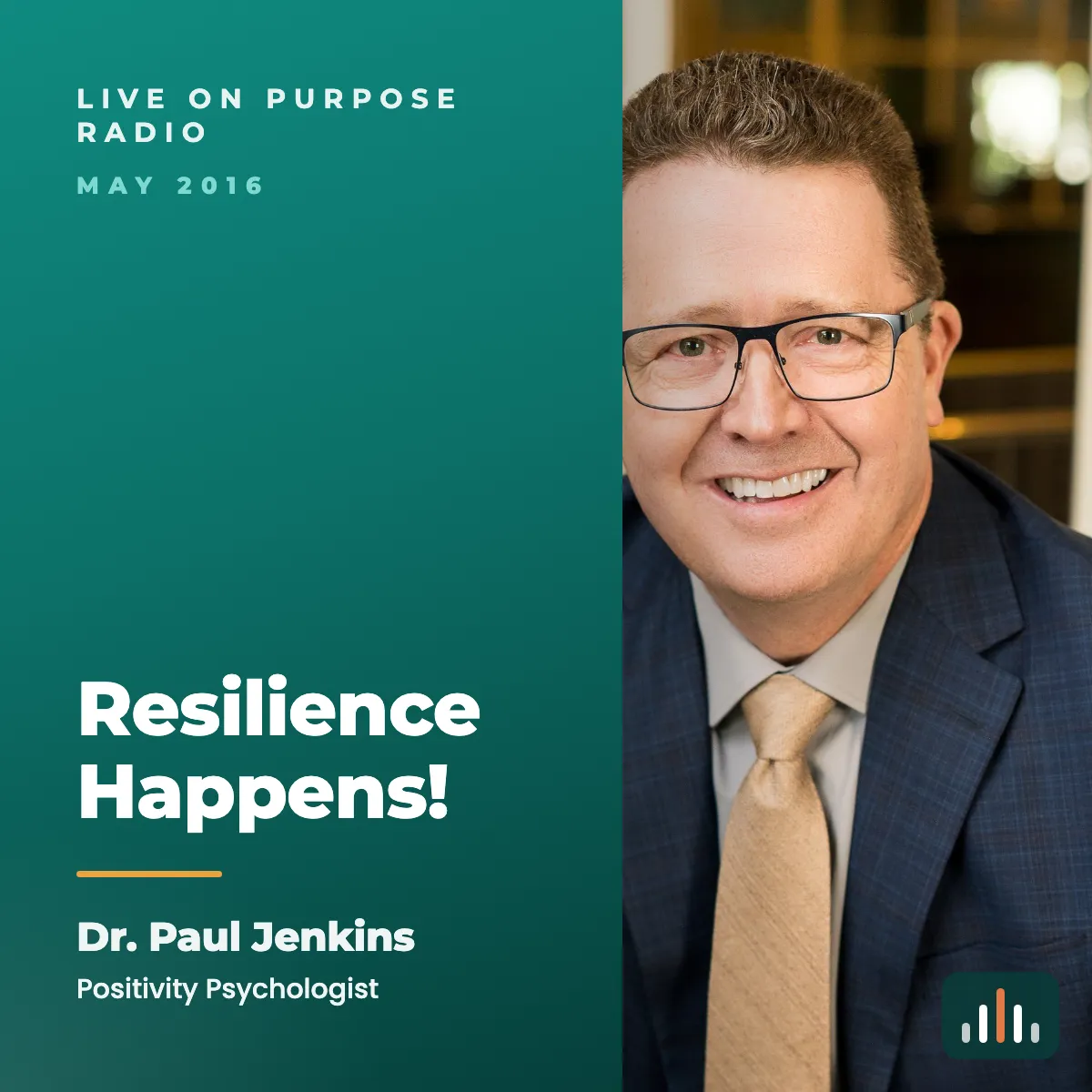
Welcome to Live On Purpose Radio with doctor Paul Jenkins, where you will hear inspiring stories of ordinary people doing extraordinary things. Feed your mind with a regular dose of positive energy and show up for your life every day on purpose. Living on purpose means that you have a purpose and you do it intentionally. And now, here's your host, doctor Paul. Hello, everybody.
Welcome back to Live On Purpose Radio. This is doctor Paul, the shrink, who expands your life with another episode of Live On Purpose Radio. Joining me today is my friend and associate, Danny Heinsohn. Say hello, Danny. How's it going everyone?
I'm... I've got Danny on video as well, folks. So we've done this with a couple of episodes where you can go over to youtube.com/liveonpurposetv, all one word, liveonpurposetv, and you can see the episode that we're recording here today. So that you can see the charming face of Danny right there in front of you. So, I just wanted to make that acknowledgement upfront.
Danny and I met in Washington DC at the National Speakers Association. We are both speakers, and Danny has an inspiring message. And so I appreciate you being on my show here today, Danny. And I appreciate the opportunity. Tell us a little bit about your story.
You know what I mean when I say your story. Sure. Absolutely. Well, I'll I'll just get to the chase and go take you right back to the to the very beginning. It was back in, 1999.
I was 23 years old, just about to graduate college. I had plans to go to Europe for two and a half months with my best friends, come back to The United States. I'm from Reno, Nevada, so I was actually gonna try to move to Colorado or Arizona to begin my, my life as an eligible bachelor and to Yeah. Be the ultimate weekend warrior and just mountain bike every every weekend. And, about a week before I graduated, I woke up with an intense headache.
It was a Sunday morning and, you know, just being 23 years old and feeling indestructible like a lot of us do in our in our, early twenties, I just thought, you know, this thing is gonna blow over. I'll feel fine the next day. The next day was actually the last final of my undergraduate career in a course called digital control systems. Mhmm. So if that doesn't give you a headache, I don't know what will.
But anyway, I tried to do the irritation, and I wasn't sure if the final was just extremely difficult or if the headache was really, you know, obstructing my my clarity of my thoughts. Mhmm. So Tuesday evening, I'm running the base pass in a softball game, and with each impounding stride, it feels as if a river rock is sinking deeper into my skull, and the excruciating, nearly brings me down to my knees. So, Wednesday and Thursday, I called a couple doctors, get a couple of opinions, and I'm told, oh, you know, it's a stress of funnels. You're you're anxious to graduate, and you're excited to go to Europe and yada yada yada.
And, you know, still I'm thinking this isn't a big deal. Mhmm. So I got couple prescriptions, calls back, you know, the routine. Saturday was the best I felt all week. Sunday was the day I graduated.
I'm an only child, so we had a family in in town, and it was a very, you know, momentous occasion for us. And, you know, I was supposed to leave for Europe on Tuesday, but, Monday morning, the the headaches were worse than ever. So my dad takes me down to the ER at Saint Mary's, and after two and a half hours of testing, blood test, CAT scan, MRI, instructed to be... To sit on a gurney. And, so I get wheeled on down to the the waiting room, and my dad stands up, and he says, doesnit look like youire going to Europe.
The doctors think you have a tumor. Oh, boy. And, had a chance to look at the scan. I had this big white mass in my head, you know, as as you as you know from from from CAT scans, it's typically black and white or gray scale, and, anything that's white is is bad news. So I had a massive racket ball on the left side of my my skull that was, the brain tumor.
Which explains the headaches but changes everything. Yeah. Yeah. You know, it was, it it was times like this where everything pretty much aligns itself into into perspective. Mhmm.
Because I called a couple friends and, you know, without hesitation, they were at the hospital. Student student government. I was a senator for the College of Engineering. So I got a lot of unbelievable support from from my community, in in college and just all my friends for being there. And, you know, you really...
When something like this happens, you really put into perspective what's important in life. Oh, yeah. Really nice.... Of being there, you you know Sure. Can mean the world.
Yeah. You know what? As you're sharing this story, Danny, I'm thinking, wow. First of all, huge that something like this would happen in your life. And then I'm also thinking, typical.
I mean, not typical to get this kind of a diagnosis or to to have that show up on a CAT scan, but typical that we plan our life and we move along as if everything's going to go according to plan and then boom, something happens. It's kind of like surprise. I titled one of the chapters in my book Surprise Mhmm. Because it it just hits you out of the blue. It's not what you had in mind.
Mhmm. You've done something with this story since. I know from my experience with you and in in our conversations, Danny, that you speak on resilience. And how, you know, the human spirit or the or the human mechanism is so resilient, amazingly so. And you've got a comeback story too.
Walk us into that. Lead us through. Well, I mean, that that... It's kinda kind of a long lead in to to getting there because I had to go through all kinds of, cognitive, reparation and so on and so forth because after the initial operation... So I went in the hospital on Monday, craniotomy took place on Thursday.
Kinda remember a couple episodes. One was... The first one I remember, I just woke woke up terrified. Could not control my breath. Next episode I remember is my buddy Paul worked at the hospital and he's got this...
These big old teeth and this big old grin. I remember him, like, smiling and my my parents were there. But then the next episode I remember was actually the reality that that I woke up to, and that was in a... An intensive care unit. You know, the lights were off.
I could just hear like the haunting, you know, beep of a, you know, the heart rate monitor. The machinery. And hearing people, you know, walking up and down the hall... Hallway. And I thought, god, am I just waking up for...
From a coma? Not that I know what it what it feel like to get hit by a bus, but my body was just drained and senseless. I had a massive seizure that blew a pupil in my left eyeball. I couldn't see straight. Oh, wow.
I was throwing my words when I spoke. You know, after days in the hospital, come come to find out that I lost a lot of my my motor functions. I... Because of the seizure, I was unable to wipe with my hands. You know, I was in the hospital for two weeks, and when I got home, you know, I really started to notice the damage done.
You know, I could no longer play the guitar or the piano. So... And on top of that, they actually removed a chunk of my skull about the size of a baseball card because of the intense cranial pressure. It was, you know, after the first operation, I woke up in intensive care, I don't remember, and I guess I was smiling and cracking jokes and everything and I passed out and, I had a massive seizure and, doctor John Davis here at Saint Mary's said it pretty much cleared the room and when I woke up I didn't have any protection to my brain, other than the extent of the flesh that covered it. And I had to do that because of the intense cranial pressure.
Right. So, kinda make a long story short, my case is forwarded to UCLA to the brain tumor board where I'd have a conclusive, operation to fix the cranial defect and to, you know, to conclusively diagnose what was going on. So I actually came out of this operation feeling the best that I'd felt, you know, since I got admitted to the hospital in the first place. Mhmm. And I always, you know, testify that to the to the nurse who took care of me in intensive care because she was pretty hot.
So, she has something to do with it.... Memory when, you know, looking back. So I was just actually feeling really good and, you know, the standard protocol for, brain surgery. You know, you want to give the patient two or three weeks before you, you know, kind of start any physical therapy or if you're... If it is malignant, you know, you mean the the brain needs some time to heal before you start any intensive treatment.
And I actually thought that I was ready to move on with my life. Okay, you know, so I diagnosed in May, another year I will be able to go to Europe like I had originally planned. Well, come to find out that what I had was primary central nervous system lymphoma, a type of cancer that originates in the brain with the median survival rate of five years. So that was, that was, woah. Okay.
Now it's normalcy. This is real. This is real. You know, there was all this hope. You know, 23 years old, it's like...
It's like, wait. We're not done yet. Yeah. So this is the beginning. So, you know, going to OHSU in Portland, Oregon, the team down in UCLA was following my case pretty closely and because I was 23 and I was pretty strong and healthy so I could withstand higher dose of chemotherapy, you know, experimental therapies.
But this had been around for over twenty years. So, it, it it was one of the saving races of this whole experience because it was chemotherapy that didn't involve radiation to the brain in the long run. So it would last for an entire year where it's a traditional form of chemotherapy, you know, being mixed with radiation, it only lasts for four months, but you're just getting, you know, you're getting hammered every time you go into the hospital. So, you know, go through my year of chemotherapy and I lost my hair and you know, all the all the good stuff that happens when you when you get cancer and you go through chemotherapy and, you know, they put you... Every every patient is is different.
Everybody's, you know, treatment, is is is customized based on the, you know, I guess the tolerance of the patient. And, so I ended up going through it, but what they really donit teach you when youire done with chemotherapy is like how to reintegrate it back into life. So here I'm on amped up on steroids and then coming down from steroids, you know, it's like a downward spiral, so steroids are a stimulant and then when you taper off of it, you know, I just went into this like deep depression. You know, this is back in 2000. You know, I just graduated college and there was no, you know, I hadn't even had a chance to begin my my life as far as, like, a career making a living.
Right. Obviously, they say that every every day you go through chemotherapy or cancer takes just as long to recover. So I kinda took that to heart. And, yeah, okay, I'm gonna take a year off and let myself recover. But, you really need to be involved with your community or have a community that kinda takes you out of it.
And that's something that they don't teach you, when you're going through everything. So, yeah, it was a really tough time. I I would say that the year following chemotherapy was more difficult to lead than probably everything that happened before it, just trying to to trying to navigate that. And then plus the fact that, you know, you have brain trauma. Yeah.
Add that to the mix. Add that to the mix. Yeah. Exactly. But really my my saving grace was, I was...
I became an honored patient for the Leukemia Lymphoma Society, at a fundraising initiative called team and training where people from all over The United States, they they train for century bike rides, train for marathons and triathlons. Oh, yes. I was an honored patient, you know, going through my ordeal. And really the the, the impetus moment for me happened on my eleventh month when I was invited to go to the kickoff party when everybody, you know, they were training for their marathon, they were training for the 100 mile bike ride, and, the cycling coach said, hey, man. You can come on down to my shop.
We'll get you a bike. You can come out and ride with us. You know, we'd... You know, make... We'll make it your day.
And, so, you know, are you familiar with with Lake Tahoe? Yes. Okay. So, yeah. I'm I'm in Reno, Nevada, so it's a twenty minute drive to Tahoe.
Right up the mountain. Yeah. It's, you know, it's beautiful country out here. So, yeah. I get on this bike and had really no no expectations for the day other than the fact that, I was in in this repetitive, vicious cycle.
How do I get out of this every day? And, get on this bike and you start at South Shore in Tahoe and you ride around the lake clockwise, and the perimeter around Lake Tahoe was 72 miles. I mountain biked in college, but never never Not like that. Thought I was gonna ride a 100 miles or 72 miles around Lake Tahoe. So I thought, you know, okay.
I think what's gonna happen is I'll probably just get out there and stop at Emerald Bay and then get on to the next stop and maybe just come back. Well, I remember the first stop at Emerald Bay, the sun was starting to rise, and it was the most beautiful thing I'd ever seen in my life. Oh, yeah. And I knew that the day had something special in store for me. So I'm like, okay.
So I'm gonna get down to Homewood, which is 25 miles into the ride. Well, if I get to Homewood, that's 25 miles. Well, if I gotta go back to downtown, I'm riding 50 miles anyway, and if I go back to the hotel, then it just ends up being an ordinary day for me. So I'm like, okay, well, I'm just gonna go another 16. I'll be half way around the lake and I gotta ride 72 miles anyway.
So, Dan Brown, the cycling coach, he said, you know what, Iim gonna hang with you. This is gonna be your day. And, you know, long story short, we get around to the, you know, to the end... Towards the end of the ride, and there's, I just remember growing up in this area as like a kid when we first got our license to drive. We would drive to Tahoe, in South Shore and go to the arcade and play video games.
And I'd always remember the, the tennis courts on the right hand side before you actually get to downtown. And I was like, wow. I just did it. Wow. And it just...
For me, it was like my moment of rapture, and I knew that I had defined my mission at that time because I've read Lance Armstrong's book, Not About the Bike. It came out in January 2000 right when the... I was in the middle of chemotherapy. And having him winning the Tour de France in in 1999 after I was released from UCLA, he was a huge, huge inspiration for me. So, of course, I read his book.
So when he finishes the Tour de France, or France, however you wanna say it, you know, he's being interviewed by the media and he says, if you ever have a second chance in life to do anything, you have to go all the way. So I made it my mission to do the team in training as a fundraiser and as an active participant, I was gonna raise all the money, and, I was gonna do the entire 100 miles, and I was gonna go all the way. So that was really the cornerstone of my mission and, my my springboard to to livelihood. This ordinary day turned into something extraordinary that launched you in a whole different direction. You've queued that up really nicely for us, Danny.
As we come back from this break, we'll dig into those principles that you learned in this process that you're now sharing with others. Folks, this is Danny Heinso at Live On Purpose Radio. We'll be right back. Hi. I'm Bridget Cook, New York Times best selling author and transformational speaker.
Thank you for listening to Live on Purpose Radio. Because you're listening, I know you're in touch with your purpose. So are you ready now to put your story on paper? I invite you to come to my inspired writer's retreat where you learn to write a story so juicy that your readers can't put your book down, but with quality that leaves a legacy of your lifetime. Go to inspiredlegacyretreats.com and sign up today.
When you hold your finished book in your hand, you'll be glad you did. Thank you for listening to Live On Purpose Radio. We're so glad to have you here. Please come by the website, doctorpauljenkins.com, spelled with a d r. Doctorpauljenkins.com.
On the website, you'll have an opportunity to receive a free download and while you're there, make sure you click on the social media icons. Come over to Facebook where we will be posting these episodes as well as our YouTube videos and other content and announcements for you to share. Please like us, comment, subscribe, join the conversation. We're happy to have you with us here at Live On Purpose radio. Let's all support each other to live on purpose.
Doctor paul jenkins dot com. And we're back with Danny Heinz at Live On Purpose Radio. Danny, you had quite an experience as a young man, just finishing up your college experience. You had the world in front of you. You had great plans.
You're going to Europe for Pete's sake. And then boom, something happens. You get this diagnosis. It turns out to be worse than you thought as you entered a a long and grueling period of recovery. But you've demonstrated, I think, through your own life and your own experience that that we are, as a race, as human beings, we are very resilient.
There are principles that can bring that resilience to the surface and help us to heal from or recover from whatever it is that happens to us. Whether it's a diagnosis like you had, it it could be anything though. I think where these principles apply. And you've come up with three pillars of this resilience that you share with your audiences. First one is to adapt.
Tell us about adapt. Well, adapt is, adapt to the process of change because in these days, especially with the... I mean, technology is moving so fast and everybody's going to technology to become more efficient. Yeah. If you don't adapt, it's basically adapt or die.
And... It's like everything passes you by if you don't. Exactly. So Mhmm. You know, of of course when I was going through my whole medical ordeal, I was I was adapting to, you know, taking taking various medications, you know, I was sleeping three hours a night, you know, what do you do with that time that you have, when you're awake and you're amped up on steroids and it's like, well, you make the best of that time that you have.
And, you know, I ended up reading 20 books that year when I was going through through chemotherapy. Oh, wow. So that was that was really instrumental in, you know, helping kind of rebuild my cognitive mind, getting everything back into alignment and my neurons firing again. So, yeah, definitely having the ability to accept your reality and to accept change is is I think... Acceptance is the first step to to adapting.
You know, you have to accept your reality and you deal with your problems. And as a friend of mine used to always talk about, in our little sessions during that time, it's like, you know, you deal with your problems or they deal with you is is basically what happens. So... Yeah. I like that.
Yeah. So, you know, the the first pillar is, you know, adapt to the process of change. And, you know, it's kind of the sequence of of my story when I'm on when I'm on stage doing a keynote. Yeah. And then the second principle is, you know, once you learn to adapt, then you can create opportunities.
And how do you create opportunities? Well, you tap into your community because thatis where your opportunities are going to reside and you start networking. Sometimes we feel that there is nothing out there, but I think it is a two way street as well. If you need help, people generally, people in general want to help other people who are in need. And you just have to get out there, you know, it's...
I think it's a fifty fifty proposition to be honest with you because if people don't know what you're struggling with, then how can they help you? Well, you told this story like, about the the bike race at Lake Tahoe. And because you were willing to show up and accept what you had. So your first pillar is to adapt, accept that this is what it is and start making some adjustments in your life, but then that puts you in position to create. And you said go to your community.
Go to the people who are there already willing to offer something and to provide support, but they don't even know to help you unless you show up there. So this creation process, you show up. You show up the way you are. Yeah. Gotta be present to win.
There you go. Love that concept, Danny. And that that puts us in position then to to create something even better. Because regardless of where we are in our life, there's always an improvement available to us. Do you agree with that?
Oh, absolutely. Absolutely. Yep. I I know, you know, when I went to NSA back in DC this year, I mean, there's... The speakers there are freaking amazing.
I mean, these are, like, the best of the best, and, you know, I'm aspiring to to to get on that stage, you know, at at that and perform at at that level. And, you know, I'm, you know, I'm at I'm at this level right now, but this is, you know, these people are... These people in this community are inspiring me or inspiring me. You know? It's like, this is what they're doing that's that's rocking the house.
You know? Can I comment about that too, Danny? Because I was sitting behind you in one of these sessions and we had a conversation there. Part of the reason that we're having this conversation today at Live on Purpose Radio is because you showed up at NSA, and I did too. You know, we're both showing up there engaging in a process, creating some possibilities, but you showed up with a scar on your head.
I was sitting behind you. I saw the scar. I'm gonna say that. Okay. You're not trying to hide it.
You're not trying to, oh, you know, I don't want people to know about this. It's just part of who you are. You've accepted it. You show up with that, and it led to a conversation where where I realized, wow, Danny's got some things going on. Let's create some things together.
Absolutely. And I don't know who's gonna hear this episode who will think, oh, maybe there's some hope for me. You know? Something hard has happened to me in my life. Here's Danny and he's somehow making it happen now.
And really a lot of things have changed for you since you accepted your situation and just started to move forward and create. That's the second pillar. Right? To create. That's awesome.
I just wanted to acknowledge that because I I want our listeners to know that you're practicing this. It's not just a theory or a philosophy for you. Yeah. It's what you're doing. There's a third pillar.
What's that one? So the third pillar is, you you adapt, you create, and the third pillar is you activate. Activate. K. Now that you have...
You know, you've overcome this this setback, you know, I, I often like to say that your your greatest... Your biggest setback could be your greatest opportunity. And this is my biggest opportunity because my tenth year remission, I decided I was gonna do an Ironman triathlon, 2.4 mile swim, 112 mile bike ride, 26.2 mile run, and that was gonna be, boom, my my statement for celebrating ten years of brain cancer remission. So, I decided to get a couple of my friends together and said, okay, well, we want to raise $10,000 What are we gonna raise $10,000 for? So we go out to lunch and, my my buddy says, well, why don't you start a scholarship fund?
I'm like, okay, let's do it. We're gonna start a scholarship fund. And I already knew what I was gonna be called. It was gonna be called my hometown heroes because the people that were there for me in the hospital when I was diagnosed, they were my heroes. So I was like, it just made sense.
So since, you know, I finished the Ironman under twelve hours, it's still daylight outside. It was the most amazing day ever. And, You just rattled that off like it was nothing. Yeah. Yeah.
Right? Right? And then, yeah. Since 2011, we've awarded 26 scholarships to young adult survivors attending, community college or university from across the country. And, now that I'm a full blown entrepreneur, my goal is to...
Or our goal with my hometown heroes is to award $1,000,000 in scholarships to the young adult survivor population and, just to just to run some crazy numbers by you. Every year, there's over 70,000 young adults between the ages of 15 and 39 diagnosed with every year. About sixty five percent of those kids will go to college. The average student debt, based on the kids who apply for our scholarship, you know, is between 40 and $50,000. So when you compound all those numbers, between 2016 and 2020, on a very conservative note, that's $5,000,000,000 in student debt just among this population.
Wow. And you're talking about these young adults who are diagnosed with something similar to what you had. And by similar, I mean some grave diagnosis that, is life changing. Wow. So this activate pillar, it has a feeling to me, Danny, of of giving back and of taking what it is that you've learned and using that as a powerful platform ashes.
Yeah. You know what? I had an experience just last week with a building here locally. It was a it was a house of worship that it was a century old. The original settlers of this valley had built it, and it was destroyed by fire about five years ago.
Well, the church that owns that structure has taken it literally from the ashes and built this magnificent building with the old structure in place, but a whole new interior and a whole new purpose for this building. It is better and more beautiful than it ever was. Mhmm. So when you use that analogy, I'm I'm thinking about, this building that's right here in in my community. That's an example of that and this is what people do with their lives When something like this happens, maybe maybe that fire that caused the ashes is a necessary step toward the eventual upgrade to the new thing, you know, whatever it is.
I'm thinking about you. Yeah. You quit your corporate job. Right? Yeah.
To go out there and change the world? Would you have ever done that without that diagnosis? You know, I... You know, we're all we're all dealt, you know, a set of cards. It's Yeah.
It's how we play them, you know. And then, you know, you know, it's it's the people that we come across in our lives that are really gonna help determine where we wanna go or where where we should be or where we shouldn't be. Right. You know, just life is just ever changing. Boy, it sure is.
Oh, thank you, Danny. What an inspiring story. And I... I'm so supportive of what it is you're doing to create these scholarships and to spread a message of hope and and possibilities and resilience. That's your main message, isn't it?
Resilience. Exactly. Yeah. I actually just I did... Actually just trademarked resilience happens because, you know, crap happens.
Mhmm. But And so does. We we can all become resilient as well. So, I am actually planning to launch my own podcast on that very theme later this summer. Yeah.
It's gonna be awesome. Well, we'll title this episode Resilience Happens, and then you can put it up on your podcast later on as well. Awesome. I love it. That's...
That is neat. Danny, how can people get a hold of you if they want you to speak to their organization or they wanna follow a little bit what you're doing with these scholarships? What's the best way? The the best way is gonna be through my website. It's resiliencehappens.com.
It'll be Okay. Be the it'll be the the the master brand that kinda oversees everything. But, yeah, you can definitely reach out to me on there and, we have some great content coming out. And I'm actually I published my first book in 2014. I'm actually publishing my second book this summer.
It is a, a book on sales, sales resilience. Oh. That's that's kind of where my professional background is, working with the New York Yankees, the Ravens, biggest names in professional sports and corporate sponsorship. So I teach people the principles. The principles behind it.
Right. Of of, doing sales. Perfect. Yeah. So...
Well, Danny, we will put a link to your website in the blog section of our podcast so that people can get to you. Folks, this has been Danny Heinsohn at Live on Purpose Radio, a resilience expert and a man with an inspiring message. Thank you, Danny for joining us today on this show. Thank you. It's time, everybody.
Go live on purpose.
Open the transcript on its own page ↗