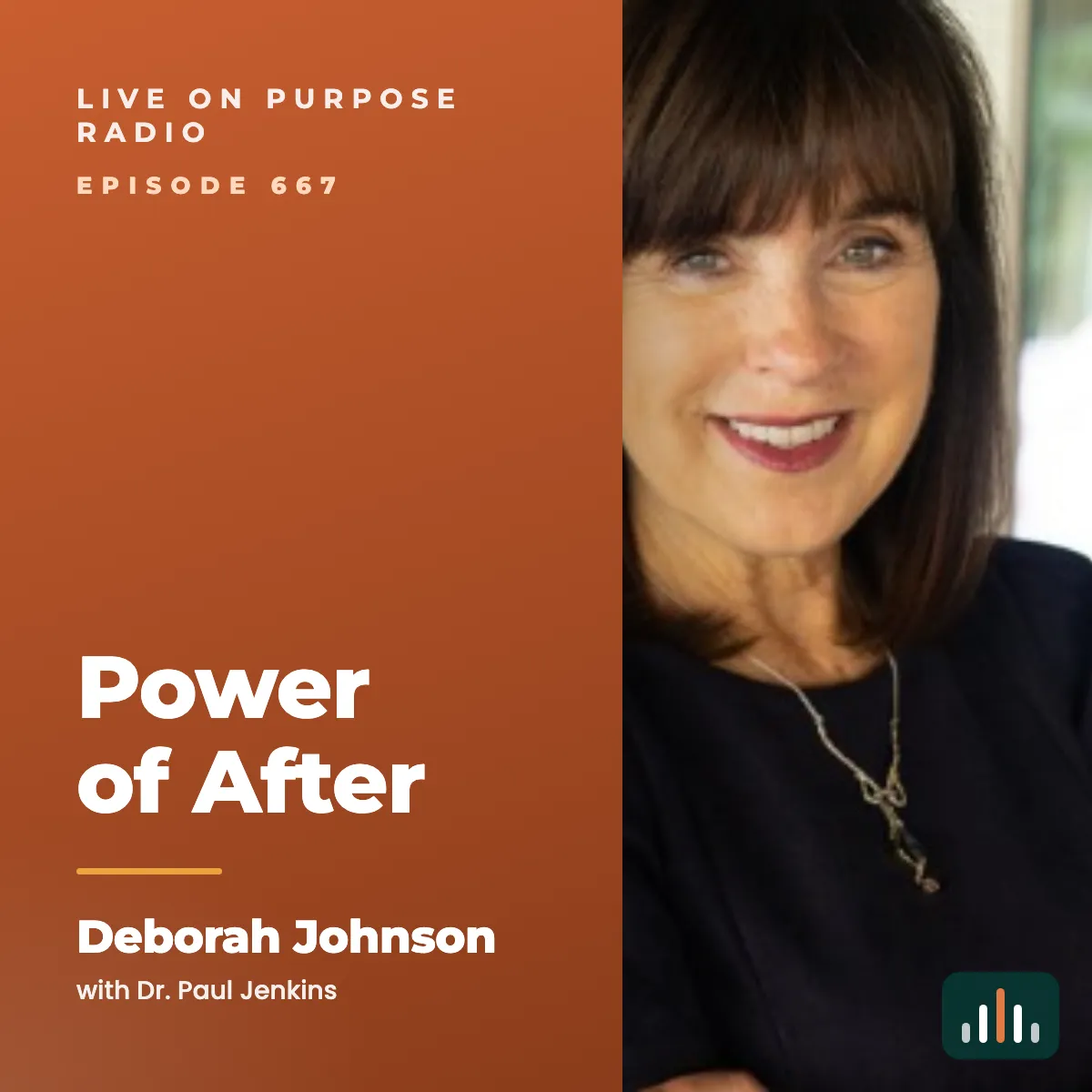
This is Live On Purpose Radio episode 667, Power of After with Deborah Johnson. Now is the only time to create and live the life you love. I'm doctor Paul Jenkins, the positivity psychologist. My job is to connect you to powerful positive psychology principles that immediately upgrade your relationships, business, and mental health. Are you ready?
Let's jump in. Hello, everybody. Welcome back to Live on Purpose Radio. This is doctor Paul the shrink who expands your life with another episode of Live on Purpose Radio. Joining me today is a friend and colleague in the speaking industry.
She is an author. She's a composer. She's a performer. She's almost everything. And A mom.
That's my my mom. That's my Well biggest jobs ever. Some of these titles just go without saying, but let's acknowledge that too. And, someone I've known through the National Speakers Association now for many years, who is a past president of her local chapter as I am of mine. And so we share a lot of common ground.
And, I would love to just welcome you, Deborah Johnson, to the show today. Welcome. Thank you so much. Thank you for having me. This is always so much fun and, really appreciate that.
I know how much work it is to produce these podcasts. And so... But it's so much fun. It's just so fun. Yeah.
There's nothing like it. You heard me mention this is episode 667, and that's about how many weeks we've been doing this. So Amazing. We launched this show in 2007 Wow. Which is before podcasting was even a thing.
Yes. And what a great opportunity to have conversations. And I have to tell you, Deborah, one of the things that got me excited about our conversation today, obviously, we're talking about your new book, Power of After. Yes. And I believe you have a podcast by the same name.
But here's what caught my attention. I had just finished reading Arthur Brooks, From Strength to Strength. Mhmm. And in this book, he talks about how we have all of these skills and attributes and strengths as as young people. Mhmm.
And you're perpetually young, but some of us get older as we go through life. And Brooks points out that this isn't necessarily bad news. Mhmm. And this is something I got from your book as well, that there are some unique strengths that we can bring to the table if we approach it in a way that maybe is a little different from the traditional midlife crisis. Yeah.
That is such a worn out idea. But, Deborah, just take a minute to share with us, if you would, why you're so passionate about this subject, and, we'll take it from there. Whatever you'd like to share about that. Well, you know, this is really the best time of life. You know, you get launched kids.
Oh my gosh. Not everybody has launched kids. You know, people start late and all of that and or people may not have kids. So it's just, you know, there's everybody's different, but this is a great time of life because you've built up your skills. You've built up your experience.
You've got all of this going. And what I found was I still remember the morning. My husband and I have coffee together, cappuccino, I should say. I call it my foo foo drink, in the mornings. And, I remember telling them, man, all of these people, they're just sitting on their skills.
They're sitting on their experience. They're sitting on all those resources. They're not doing anything, and we need common sense voices, and we need all of that experience right now, especially, like, mentoring or whatever we're doing, and we need those. And he looked at me and he said, well, that's like your mission. That's your purpose.
I mean, he had defined it for me after I wrote books. So, but it was really what was driving me because the podcast that I run, it is called now, power of after, but it's been called women at halftime. And it wasn't just for women. It was also for men, and I felt like the power of after was a stronger statement. You know, I'm kind of 360 or 70 episodes in as well.
So it's Mhmm. You know, it's it's evolved through that year... Through the years, but it but it has a a bigger, broader audience. And so it was just such a powerful statement of being able to know that there's so much power in these years. And, I think we have a society that just celebrates all this youth and all of it, but I tell you, there's a lot of issues with mindsets.
I mean, you talk so much about mindsets and that positivity. We have a lot of, people that are depending on that self worth worth, which is so fragile, you know, on their devices. And that's just... I mean, you're talking like emptiness. So just building that, personal...
All of that and and understanding there's a lot of encouragement to move on at this point in life, and our and our world needs you. That's exactly right. In fact, what a tragic loss Yeah. For those who just keep it inside of themselves. Yes.
Yes. It's There's so much to give. Yeah. Well... And there's a richness there, especially...
I've noticed when I have these interviews that the the depth of experience and knowledge... In fact, as I was reading your book, Deborah, I was thinking, okay. These are some really time honored proven principles that you're sharing. And you've made it very relevant and current with, okay, how do we live in this new technological world with AI and everything else that comes in? But then tying it back into, it's not magic.
It's not luck. There are some basic principles that allow us to create and live a life that we love. Yeah. I mean, I be... I share what works, what I use.
It's very basic, but I emphasize for readers of anything, whether it's my book, anything else, that you're gonna develop your own system. You're gonna develop what works for you, but take it and launch off of it and be encouraged of the possibilities. And, technically, I mean, people can work around me, like, you know, and they'll hire teams. They'll do everything. I do what works for me.
And I do... Because I do... You know, I'm doing travel and then... But I automate stay... I...
I've automated for years. And as part of what, you know, technically, you know, and it gets frustrating. I agree. I understand. I get stuck on the...
You know, it doesn't matter what level you are at, by the way. Technology is still gonna be challenging. It does not matter. I've been in this field for a long time. It does not matter.
But, you've gotta overcome it. Just be patient with it and say, okay. If that doesn't work, well, I'll find something else. And, and usually, if you develop your team or your, your network, you can figure out, you know, some of the answers as well. So...
But great point Right. That you said, doctor Paul. Yeah. You know, as I was, reading, that first part of your book introduces this idea of AI and how does this tie in. You've also challenged the idea that change means starting over.
Instead, you're framing it more as building on what's already there. Right. And and it... We don't have to be intimidated by the tech. That's just a new tool that is available to...
And they're they're developing new ones all the time. Right? So the last Every minute. Every second. Yes.
Tomorrow is gonna look a lot different from today. Yeah. What's something that you would say to a person in maybe in our generation Mhmm. Who feels a little intimidated by all the tech, maybe feels like their best years are behind them, where would you encourage them to start? With tech?
Well, I I first would start with some mindset, that I did not pay her to say that, by the way, people. No. But it's very true. I usually ask people, how are you doing? Not just how's your business doing?
How are you doing first? Because the process of journaling and of, you know, working through some of those things is very, very important. But I I encourage anyone, especially in tech, take very, very small steps, and don't spend too much time wasting too much time. You're gonna end up feeling like you're wasting time. I hate to waste time.
I absolutely hate to waste time. I like everything to run smooth. You know? But, I do I do agree that's... There's parts of this that you've gotta be willing to say, okay.
That didn't try... That didn't work, but I'm gonna come back to it. And I'm gonna come back to it. And then after a certain amount of time, and I use that illustration, actually, in the book toward the end, I I kinda give an illustration of, some software that I had come back to it and come decided what I was gonna keep. Because a lot of your...
If you're gonna do some sort of new software, especially if it's from a start up, I buy some of those just to try them out. And if they work well enough, I know that they're gonna keep working and keep getting better, and I can get on the ground ground floor. Some of those that I have bought have worked out really, really well. Some of the... There's a couple of little risks that I took that didn't as well.
But if it takes too much time, if it's a time sucker, and after a certain amount of time, I get a refund and and and say no because it's not worth it. But if you find little things and you take tiny steps, it's like... And I love some of the books on habits. It's very much with tiny habits. You know?
Get your workout clothes the night before, and I do that. I work out every morning very early. My clothes are laid out the night before. And every... You know, because then...
Okay. It's easy to get on. Right. And, otherwise, you're putting roadblocks in your way. So little tiny steps.
Get somebody that can help you out a little bit. And, you know, little time... I had a guy come today. I'm putting a new air conditioner in my office, and and he's a handyman too kinda, but he's mostly electrician. And he got here and he says, you know what?
This is out of my... I... I'm not gonna put this in. I'm gonna call a friend. So sometimes we need to call a friend.
Okay? We're gonna go, this is a little out of my league. Let me call a friend. I appreciated his honesty. So, actually, I wish it was in right now, but it's not gonna be until later today.
So... But but I appreciated that, and it's a good principle for us. Now that's way beyond. But I did say take tiny steps. Don't be afraid to ask questions.
Don't be afraid to journal and write down your thoughts and say, okay. I'm struggling with this. How... You know? And move on.
Right. I remember one of my guests on this show said it's the start that stops us. Yes. You're right. It does.
That's... Yeah. And that's what you're saying is take some steps. Just move... Get yourself moving.
You can steer a moving car. You can't steer a parked one. Yeah. You put those clothes out the night before, they're facing you in the morning, and you go, oh, k. I'm doing it.
That's that's that's starting. That is starting. It's not just walking or moving your butt. It's starting because you've got your... You've already started the night before.
So I think that's a really... And I got that principle kinda... I realized what the principle was from my father. He would he would lay his tools out the night before. And he would...
If he was on a building project, he was also a fire captain. They always have second jobs, but what... He would lay his tools out the night before to not forget anything, because if he had workers show up and the tools weren't there, he's wasting a day of time and have to pay them. You is not gonna do that. So lay your tools out the night before, be ready, and it's pro...
It's a proactive, action. Right. It... And like you said, you know, if your workout clothes are laying out... And whatever the equivalent is.
Whatever it is. Are you trying to get yourself to write a book? What's the equivalent of laying out your wake... Workout closure tools so that you face it? You've gotta do something with it.
And either you're gonna move it out of the way or you're just gonna put it on. I remember our colleague, Jim Cathcart Yes. Was was here on the show years ago. And and he talked about just lacing on his his shoes and tagging the curb. Yep.
Yep. Couldn't get himself to maybe go for a run, but he could get his shoes on and tag the curb. And then Yeah. But once you get to the curb, you're like, okay. I can do a walk.
I can do a mile. Whatever. Right? Right. So this this movement, getting yourself going.
Yeah. Talk for just a minute if you would. Deborah, I'm guessing that, you've had some personal experiences that have have launched you in this direction that... And there's some personal connection to this. What is it?
In the direction... Okay. So kinda define which direction you're you're talking about, speaking, writing. What what sort of launching You are a creator. That is I know.
So I have to just know which lane you're talking about. I'm talking mostly about this second half. This Okay. The... Like, when you go to a play, you got the first act, you got the second act.
Right? Yeah. And everything culminates in the second act. You don't wanna miss that one. And I know I know, like, myself, you know, I'm realizing I'm not the 20 year old young psychologist fresh out of out of the university.
Mhmm. I've got a few years and a few miles. Mhmm. And I'm just, like, I didn't know more about your personal journey there. You know, I think that part of this is figuring out...
For me, it was figuring out where the market was going because... And I didn't especially wanna do more, a lot of touring for music groups because I was doing some touring there. And and I just saw what the market was telling me, though. Things were starting to, you know, not book as much when I was doing these large shows. So that was kind of a little, you know, writing on the wall a little bit.
And then I, really came to the point of what I wanted my lifestyle to look like, what didn't I wanna do, and what did I wanna do? So I wanted to keep creating, and, and I knew I had responsibilities and and wanted to be around... You know, we've raised three sons, so I... I've always wanted to kinda be around enough. Someone has to raise them.
So, you know, doing that. So... And and I think there was that little bit of the uh-huh, and I sorta just started falling into it. I worked on the relationships that I had and some agents that I already had and kind of to see where the market was going and, what my skills were and, you know, validating those, because we discount some of our skills a lot of times. And especially in the in the world of AI, there's a lot of soft skills that are very important, and they're gonna become more and more important in the coming years because those skills can't be taken over by just a bot or a computer or an AI tool.
There's... I mean, you are in a field of soft skills. You need that relationship. So I think those moments for me, seeing where the market... I was I was basically stuck not knowing where my next work was.
I had, you know, not wanted to teach full time in a college, and so I've, you know, I've figured out what I really wanted to do at this point. And and I think then just more things started opening up. The technology started open... More of it started tech... Opening up, and had already been in, like, a recording field.
But, you know, recording it, it crosses over. I mean, as I was working on my power of after book, I've recorded the last... This is my fourth audiobook I've recorded in my studio. Mhmm. But I have that background.
So you can use... Okay. What background do I have? And I tell you, technology has changed. I had a couple of things in my studio kind of, you know, as the...
Those change, I had to use some different technology. That's strange. So it was... Oh, there's always something to learn. Oh my gosh.
So... But I think some of those things, you know, it wasn't this big thing. I haven't gone through this life and death experience, all of this. Some people just have those huge things or or a startup that just they're gonna lose everything on. I didn't have that, but I had I had some things in my career wise wondering what I wanted to do next and what type of lifestyle, you know, because part of my travel now is visiting kids and and also travel with my husband as well as work.
But I didn't want it taken over by just... You know, I wanted to be able to do more of virtual and producing and all of that, which I am doing exactly what I wanna do right now. That's not accidental. No. No.
And this is what I love about... Thank you, Deborah, for sharing that because there are times when I'm interviewing a guest and it's like, well, I was struck by lightning. Yeah. Right? And and this is a big transformational event.
But for many of us, it's a lot more like what you're describing here. You hit a point where you're like, you said, I saw the writing on the wall. It's like, okay. This career that I had Mhmm. Isn't gonna look like this in the future.
Yeah. Totally. So therefore, what? Yeah. And and you know, Paul leaving it to default, you took that on purpose.
And I love that. I love it that you mentioned that because I used to think, oh, I don't have a big enough story. I mean, there's a lot of that. Oh, I wasn't in a car crash that I almost died or it wasn't like in a skiing accident that I lost legs. I I wasn't in...
I mean, it's... I feel with those people, but I felt like, okay, do I have a big enough story that... And you don't know. You have life experience. You have who you are.
You have you have common sense, which we need. And those people that have had to go through going, well, yeah, I had to tell two year olds not what to do, and now you have to... Like, now I have adult kids. How do I... So, you know, this whole progression through this life that you've you've lived.
So I think there's so much to that, Paul. Thank you for bringing that up. Yes. You don't you don't have their story. You have yours.
Your story. Yes. Yeah. And that's the only one you need. Oh, it...
It's enough. I remember we've got another colleague another colleague in the National Speakers Association, Brad Barton. He happens to be a world record holder, and so he's got that. But I remember him commenting, you know what? I got all my limbs.
I haven't lost, you know, everything in some natural... I got nothing. You got everything. You got everything. You've got your story.
And what occurred to me as you were sharing as you were sharing that, Deborah, is that there is only one place where you can start from for what's after this, and that's exactly where you are. Yeah. Yeah. And and that was that validating your skills. People are sitting on their skills and their experience and their resources because they're not validating who they are and what...
Their uniqueness. I mean Right. I mean, we... We've been around long enough to where you look people around here and you're gonna go, there's a lot of uniqueness in this world. There's a lot of a lot of different people.
You know? Another thing I've noticed about that too, Deborah, is that we become so accustomed to our own personality, our our skillset. It... Maybe it comes very naturally to us. Yeah.
And we don't fully connect with the value Mhmm. Of that because it comes so naturally to us. It's like, well, it's not a big deal. Maybe it's a huge deal to other people. Mhmm.
I'm even looking at... Okay. So you come from a background of performance and composition and give you a piano, and you can keep us entertained for Hours. Days. Days.
Yeah. Maybe. No. It's... I don't know.
Yeah. A long time. And there are people on this planet who would look at you, Deborah, and they'd be like, oh, that's amazing. Right? When you might look at it and say, it's just me.
It's just what I do. Yeah. Right? And look at the years that I spent preparing to get there. Yes.
You know? It's the preparation, and I think that's something that's discounted because, there's so much of this easy instant, you know, you can be an influencer. You can do, you know, all of this. And, and I think, I realized also as an artist, which was a little bit uniqueness, but, I realized that one of my assets is persistence and tenacity. And and I remember I was doing my first album.
I was in the studio, and this was some years ago. And and, the the main engineer, he said, man, you are tenacious. I did not know what the word meant. I went home and and I thought he called me a name. You have to tell me what that word means.
Oh, gosh. So here... But I realized later later that I validated even more. But there is a certain amount of that. That's where...
When you're meeting AI and you're meeting some of the new technology, you have to decide to be a bit tenacious and to be a bit persistent. Take those little tiny steps. We quit too soon. And you gotta know when to quit, first of all, but the only way you know when to quit is when you've tried enough. Okay?
So you didn't... Made enough mistakes. Right? Yeah. But, you know, not to quit on it because it's a little frustrating.
You know? And, yeah. So I think that's a really, really important point, and I think you had made that point. I was just launching off of it, giving you the credit. Can I call back to something else that you said earlier?
And you just kinda glossed over it like it's... You said you said the phrase soft skills. Yes. Which I don't think are fluffy or dry. I mean, we call them soft skills because they differ from the hard technical or tactical skills that people learn in their jobs.
Mhmm. But they usually refer to interpersonal, communication, the ability to connect with and work with other people. And you mentioned that as something that is not going away No. And something that cannot be replicated in AI. Mhmm.
And I just wanna come back to that because I think you and I both agree that these... Calling them soft skills is a little misleading. Yeah. It is. Right?
It sounds like that's That's the tricky question. Sounds like fluffy. It sounds like, oh, these are not so important. Right. They are core.
Right? Yes. You're right. What kind of soft skills were were you thinking of when you said that? I've mentioned a few, but drill down to some specifics for us.
Well, I think, and and the terminology, you're right. People don't really know. I I, you know, I have some friends that I hang around with here and there, different groups actually. And when I mentioned, one of my conversations, I mentioned soft skills and very educated people. They had no idea what I was talking about, which is interesting to me.
They've not heard that term. And for us in our field, we've heard it quite a bit. I'm not a psychologist, but I've been in this field for quite, you know, quite a while and working with some of the, you know, HRs out of that. Anyway, but soft skills, I think, listening, being able to, mirror what people are saying to be able to work through things. A big deal right now are some of these, businesses and legacy build...
Businesses that have been generational businesses through the years and, being able to negotiate, like, either... I I have a friend right now that's working in one, and they don't know... You know? He'd like to sell it. But how how do you negotiate, if there's family members involved and can they do a good job with this or how...
So you kinda only... Almost need that outside negotiator with those soft skills to say, let me listen to this side. Let me listen to this side. Different generations to be able to do that. Leadership on leadership teams in businesses, how to be able to negotiate.
Maybe you have different generations. You have an older generation that's now in leadership, and you have a younger generation that's coming up and they're saying, oh, they're so not relevant. They're not. How do you negotiate through that? Those are negotiating skills that through the years you've learned.
You've learned that not only in business, you've learned it as an entrepreneur, you've learned it as a parent. So all of those big deal as a parent, I tell you what. So, but you've learned a lot of those skills, and those are those soft skills of... They're not the hard, okay, I'm gonna practice technique with... When I'm talking about piano.
It's it's the emotion that comes through that. That's how I can relate it to some sort of musical term. It would be, you know, that naturalness that comes through that from knowing the technique. You bring the technique. The technique gets you a certain place, and then you expand on the technique.
And that's what being able to communicate with a team, communicate and negotiate with things back and forth. Your technique, you... It's given you the book knowledge to be able now to actually have the personality and the the ability to talk and to mirror what people are saying to say, you understand this. Can we work this out? Can we negotiate?
And, you know, you're not an attorney, but there's a lot of that that if you can have some of those sort of skills... I mean, it's like I use illustration in my book about calling an airline. I was booking two internet... I was booking in one international flight, and I was working with two different airlines, could not get the form to go through. So I called the airline.
He wasn't gonna give me the same price as it was online. I said, you're kidding. I had two airlines. The prices were were the same. The other one, I was able to book right away, and that's the one we're flying on.
Because the, when I contacted the the the person... There was an actual person. I was able to book it right away. Those are the people on the... When you call or you're not just on some sort of bot that says, no.
We can't do this. No. No. No. No.
You have a person on that other line that's hugely valuable with a lot of businesses, especially for higher higher ticket prices. So Right. Those are, those are very, very important skills. Do not discount those. Those are gonna be in demand.
Things like... You mentioned listening. I I was also thinking empathy. Yes. The ability to connect with...
Care about how other people feel, understanding care. Right. Right. And that caring. This is a uniquely human trait.
Mhmm. And so... Yeah. And you're you're obviously thinking Yeah. You don't have to be high on the empathy list.
Actually, my husband would tell you I'm kind of low on that because I have I kinda like... I told our boys, well, just get over it. You know? You know? I don't have that.
But, but still, the empathy is being able to to listen and understand. That helps a lot. You don't have to be just this. Oh, oh, oh, you know, because those people just drive you crazy if it's always that way. But, yeah, but at least you can understand, and you're listening.
So you're not just, you know, blurting like I am. Like, although I get excited. Well, Deborah, thank you so much for contributing here on our our show today and having this conversation with me. Folks, the the book is called Power of After by Deborah Johnson. Yeah.
And you can also learn more about Deborah at her website, goalsforyourlife, if you can remember that. Goalsforyourlife.com. That's all one word. Mhmm. And, Deborah, is there some some parting thought that you'd like to leave our listeners with today?
Oh, I just think, have the mindset that, you are worth it. You know? Don't don't say that you don't have anything to offer. I think that, you know, that's one of the biggest encouragement things, and and I like what you said too about taking one step. You are worth enough, and you've got something that I have taught music too for years.
I always looked for the it quality. No. There's a lot of people came to me that wanted to be these star singers. But there's some Need more than passion. Yeah.
It quality. There was a stage presence. There was a communication. There was a ability to interpret. There's a little something that you have and that's so unique.
So don't discount that. You are worth it. You were created as a worthwhile person on this earth. Don't give up. So that's that's my one thing.
I think that that would be Love it. Encouragement. So with your message. That's that's the message. And we've heard it now.
It's time to apply it. Let's go live on purpose. Did you get what you came for? Give yourself the gift of taking real action on what you realized today. Please share this episode with someone you know would value it, and leave us a rating too.
It's time now to live on purpose.
Open the transcript on its own page ↗