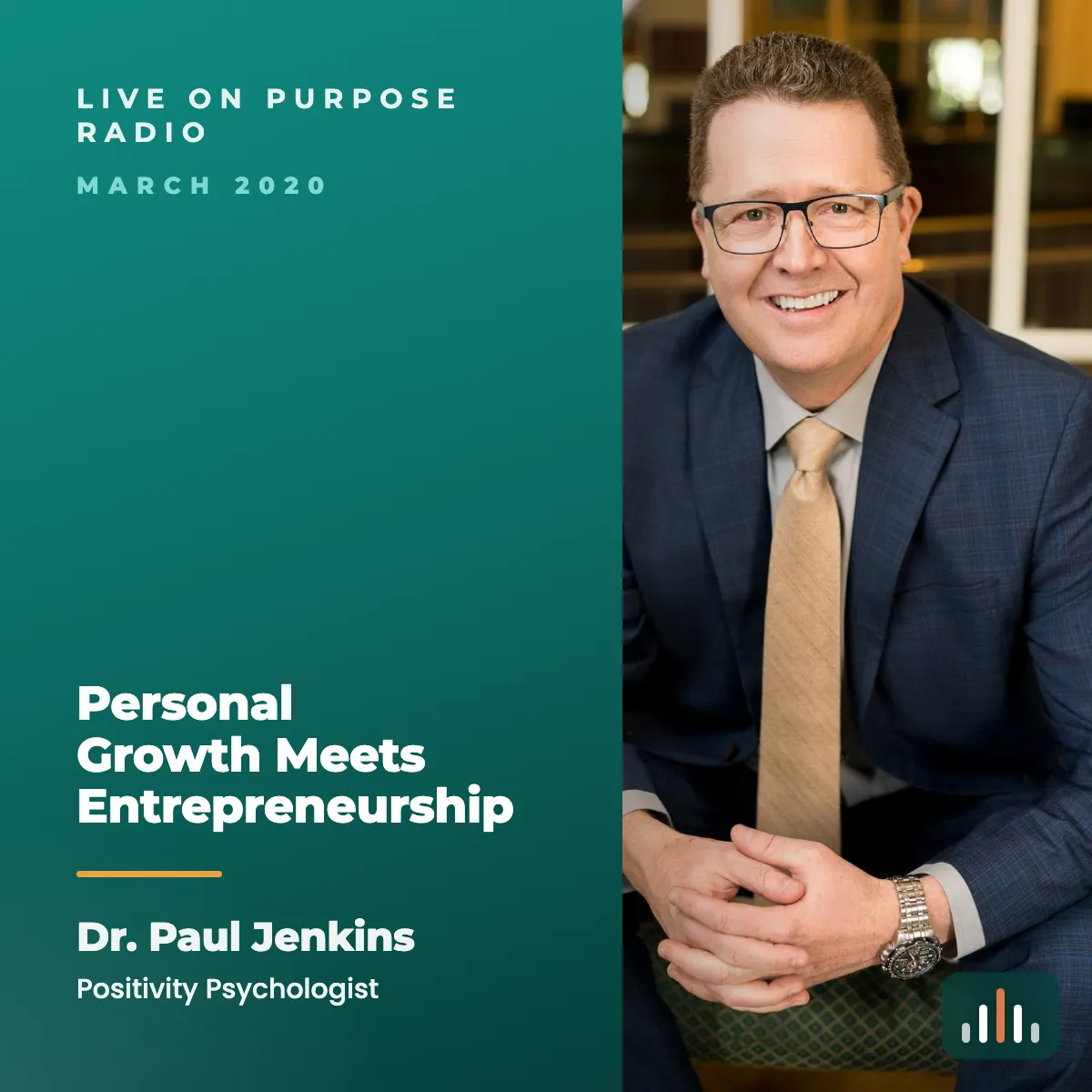
Welcome to Live On Purpose Radio with doctor Paul Jenkins, where you will hear inspiring stories of ordinary people doing extraordinary things. Feed your mind with a regular dose of positive energy and show up for your life every day on purpose. Living on purpose means that you have a purpose and you do it intentionally. And now here's your host, doctor Paul. Hello, everybody.
Welcome back to Live on Purpose Radio. This is doctor Paul, the shrink who expands your life with another episode of Live on Purpose Radio. Joining me today is Dane Maxwell. You have jumped into some things in your life that some people would be terrified to take on. Starting businesses, you've done this, what, 14, 15 times.
That I can remember. And that you can remember. The ones that stuck with you. Yeah. And I noticed as I was, looking at your bio before we started the show that at least 11 of those were crash and burn failures.
Mhmm. Which I love. They're actually slow burn failures. Like, the knife goes in slow. Oh, those are even more fun.
Yeah. They're very fun. I mean, you've learned some things from your experience that fits so well. With what we're talking about here on the show, how to live on purpose. Can you share with us, just as as kind of an opening here, share with us a little bit of your story, the the path or the journey that you've taken to get to where you are.
Because right now, you're seen as a a leader in the field, but you didn't just poof there. You've had a journey to get there. Tell us a little bit about that journey and and how you got to where you are. Well, I wonder if leaders are just the folks that... Let me turn on my Slack off.
Let... I think I think, leaders are, probably the guys that make... Gals that make the most mistakes. So I just make a lot of mistakes. You know, I wonder, you know, people listening, and I'll pose a question as I kinda give context for myself is what would happen if you really knew in your bones it was okay to make hundreds and hundreds of mistakes?
What might you start doing? Because it's it's in my bones to create, and I just... I almost create out of an impulse now. Just this this... Just like, let's create.
Let's create. Didn't work. Okay. Let's create. Didn't work.
Okay. Let's create. Didn't work. And that started from... I think my mother was so instrumental in this.
And, and if you need help learning that it's okay to make a mistake, head on over to Google and, you know, say, like... Or look up books that could help encourage you on making mistakes and stuff. But Mhmm. That... It's not something you're fixed with.
It's something you can build, as doctor Paul would probably attest. But I was homeschooled, and I just made mistakes through my whole life, and it just kind of became a way of life. Okay. That didn't work. Not...
I'm not gonna do this, but... Oh, okay. That didn't work. So, you know, I had this profound epiphany when I was, like, 20 years old, and I realized that I wasn't the center of the universe. What?
It sounds so stupid when I say it, but, like, if you think about it, like, I... When I realized that Google searches, like, if you were to start a business, would you start a guitar lesson business or a piano lesson business? And you could do the same amount of work for each one, but one of them would make four times as much money than the other because there's that much more demand for guitar than there is piano. And when you... Like, so, like, you know, you...
In the terms of, like, oh, follow your passion. I'm like, hold up. No. No. I would say it's it's it's very easy to be passionate about something that works very well.
When something works, it's very enjoyable. So my my thought process on this, and it could evolve, and it feels risky to say because it's something I'm not totally certain of, but it's what I did and what I recommend, is to, since we don't get to decide what works like we don't get to decide guitar is more popular than piano. Right. We don't we don't get to... And we don't we don't get to decide what people will want.
We don't get to decide what people will buy. We don't get to decide what people search for. We don't get to decide what people think about. That means that we just live in a state of allowance. Okay.
This is what human behavior is showing us. Okay. This is what people are saying they really want. Okay. Let's go out and listen to the pulse of what works and then provide that in the marketplace.
And so I have a approach to business that's really very much where I listen. I just really, really deeply listen. And, it can be very vulnerable to... Because, you know, you have this idea you wanna lead with. I got this idea for a business.
Most people don't have an idea. Some have, like, five. They don't know which one to pick. I don't try to do any of those. I just go out and listen to folks.
So if we don't get to decide what works, what that means is we need to listen. And that's what I learned through the 11 failures, really. Those 11 failures were all my ideas. All of them. You know?
And then the five that succeeded, they weren't my ideas. And they were pretty big successes? Oh, sure. Yeah. I mean, the the success was a minimum of 50,000 in sales.
My my current business has a CEO in place. It's a self managed company I built, started, and exited. It's a multi... Low low multimillion dollar, software company. And then the principles from that software company, are very transferable to build any kind of business.
I've got a book coming out that I wrote, and I wrote that book following much the same process that I did to build a software business I had. I made $3 on the book before it was ever released because, I sold 30 people spots for a $100 to watch me write the book from scratch. So, you know, people... And, you know, like like, when I did the software, I also try to get people to pay for the software upfront. I try to get people to buy...
Because since I don't know if it works or not, I don't wanna invest my time in something unless I know it works. Mhmm. So it's a very different approach. You know, you think about... Well, I think I'll stop there.
I'd say I'd say just what if you... What would happen if you knew in your bones it was okay to make a mistake? It was okay. Yeah. Now you mentioned something else, Dane, that I'm really feeding into here because I'm a psychologist.
Great. Yeah. And I know that we get in our own way all the time, and we become very fond of our own ideas. And you suggested here early in our conversation that one of the things you've learned through all the tuition you've paid Yes, sir. Is that you listen.
You connect with other people. Get out of your own head so that you can connect with others. And and business, I believe, maybe you'd agree with this, the only valid business out there is something that solves problems for other people. Yeah. Yeah.
If it solves your problem, it's not a business. Unless it solves someone else's too. Yeah. Well, and that's that's what it has to do in order for it to be a viable business. What...
Well, so what I wanna say is, like, I'm very passionate about giving people a voice in the business world. You know, imagine imagine you sitting here listening right now, getting a chance to animate your voice, share it in the business world, and become rich from it. Like, just imagine that for yourself as a reality. You're here. You're sharing your voice.
You've got a product or service that solves a problem, and you're sharing that voice in the world, and you're really helping people and you're getting rich. Like, the idea of someone animating their voice in the marketplace is such a strong passion of mine. And I think, I just really like to help people not become intimidated by a business because a business... The... When you see the business, you're like, oh, good lord.
But I've often joked that I could start a business in the time it takes someone to fill out a job application. Mhmm. Because a business is in existence the second you have a paying customer. Not as soon as you get a domain, not as soon as you register an LLC, not when you get a business card, not when you make your own website, not when you buy your office furniture. Your business exists as soon as you have a paying customer.
And Peter Drucker is like the godfather of business consulting. He's like one of the first big business consulting coaches. And Peter Drucker is... He's a dope dude. And he said a business exists for one purpose, and that's to create a customer.
And so he echoes the same sentiment. But... So a business doesn't exist to have a website, business card, doesn't exist to go to networking events. So I wanted to just, like, as briefly as I can, because I know these are shorter interviews, just demystify and unintimidate. Like, remove intimidation around a business by giving, like, just a very short example.
K. So so let's say you're going to target, what kind of a shrink are you, doctor Paul? I'm the shrink to expand your life, Dane. Positive psychology? Positive psychology, exclusively.
Yeah. Right. So there's a niche of positive psychologists. And, for example, doctor Paul, would you be interested in... This is not technically how I would do it, but, sort of like how I do it.
Would you be interested in knowing whatever... What other, positive psychology shrinks are doing to get rapid results with their clients? Sure. And why would you be interested in knowing how other positive psychologists are are doing that? It would make sense to me that if they're getting results with their clients, they've found something that's working.
Right. And it's like you were saying earlier about, oh, that didn't work. That didn't work. What if I didn't have to try all of these things that have already been shown to not work, but I could hone in on something that is working? Great.
So... K. So now we have a product idea. The product idea is based on helping you discover what works with positive psychology to get more rapid results with your clients. In business, if you're gonna be in business, it's really not important what the product is nearly as much as how important it is that you're getting someone a result.
See, so doctor Paul doctor Paul would be interested in what I'm providing because he's interested in getting his client results. He's also interested, as he said, in saving time for making mistakes and, like, testing things out when he could just do what works instead. Mhmm. So that time that time savings, you know, if if you're saving, you know, ten hours because you get one good thing, that's ten hours of your time now, doctor Paul, that you can save because you can spend one hour doing what works. Right.
So, if I were to put, like, a network together of positive psychologists and I were to interview them, record them, transcribe them, organize their ideas, put it into an online, report, and then a community where positive psychologists could discuss all their own different strategies, and I'm just the facilitator sharing what works. Would that be worth paying for? That's... And... You don't have to say yes.
If it's not worth paying for, you don't have to say yes. Because... Well, what what I was going to say about that, Dane, is if it answers my problem, it's worth paying for. Because I don't want my money. I want what my money can get for me that answers a problem or solves a a pain point for me.
Yeah. So what what would make what would make that an irresistible purchase? What could what could the product be or do where you're like, oh, definitely, I wanna pay for that? Like, how would how would it look or what would it do? Well, I think you've hit on many of the main things.
If it saves me time and energy and I see that it accomplishes the goal that I want to to accomplish, then it's a no brainer. Right. What would you what would you pay for that? I would I would pay whatever it cost. Now...
And I say that, Dane, with an acknowledgment that I'm already paying for the problem in so many ways. What do you mean? If you offer me a solution to a problem that's costing me time and money and effort and mental stress and agony, I'm already paying for it. And to put a number on that, I've asked some of my clients this. What's it costing you right now to not have the solution?
And it's an interesting mental exercise to to start looking at that because it's not fair to just say, well, it's worth so many dollars. We have to compare it to what we're already spending on the problem Right. Without having the solution that's being offered. So what I also wanna track... And like I said, I'm very passionate about personal development and and, like, honoring body, things like this.
So I just wanna, like, rep... Demonstrate that I feel a lot of fear right now. And I feel my eyes getting kinda wet, and I just wanna say that I'm scared because what I'm doing is I'm opening my heart right now to doctor Paul to listen to listen to him and then to, like, you know, to maybe even ask, you know, what would you pay for this? And that feels like such a risk for me to do. And I just and I just wanna name that I'm afraid.
And... Well, not not so much now. I mean, literally in ten seconds just by sharing it. Mhmm. I feel, safe, sharing that.
And because I wanna represent, you know, a man who feels, and I wanna let other men know that if they're afraid talking to another man or whatever, this is okay. And this is this is the kind of fear that if you face... Doctor Paul and I are having a conversation that's been under thirteen minutes so far. And in under thirteen minutes, I have a product that he's willing to pay for, that I could go and find other positive psychologists to say, hey. I know you're a positive psychologist that cares about your clients getting rapid results with your work.
Would you like to join a network of positive psychologists all sharing their best ideas of what's working right now to get their best results? And this is an idea that's transferable to any field. It's also it's also an idea that a good a good first time entrepreneur can just apply a lot of curiosity towards and become a facilitator, to build... And it's a great first business for someone to get their feet wet and confident with. Because if you start a business like this and you're just a humble facilitator sharing information about what works and your whole...
My whole purpose with doctor Paul is to help his clients get great results. And so, like, it's not about the product. It's not about the facilitation. It's not even about the tactics Right. So much as it is about, okay.
Is this getting your clients a result, doctor Paul? So that's where I'm aligned. So now that I've got a a client... So if... The the way to build a business at light speed and, you know, I've done a lot of emotional work.
This is the first time I've ever been on a podcast where I've been safe... Felt safe enough to share that I feel afraid, but I... I'm so happy I did. That's a new experience for me. You mentioned personal development.
You're you're pushing my buttons at that point because we all get in our own way from time to time, and you just demonstrated a level of vulnerability that I think a lot of us aren't quite willing to take. As we come back from this break, let's explore that just a little bit farther and see where we can take it in terms of creating and living a life that we love. Are you down for that? Absolutely. Folks, this is Dane Maxwell at Live On Purpose Radio.
We will be right back. Are you ready to take your positivity to a whole new level? I've been enjoying these conversations with my guests at Live On Purpose Radio. My own story about becoming more positive is something that I've shared in my book, pathological positivity. And right now, I'm giving the book away.
You just pay for the shipping. Go to doctorpauljenkins.com, spelled with a d r, and click on the big orange button right there that will get you a free copy of my book. You pay the shipping, I'll pay for the book. Sound like a good deal? Power up your positivity and get ready to see phenomenal changes in your happiness, your relationships, your business, every aspect of life.
Enjoy this free gift from me, doctorpauljenkins.com. And we're back. Dane Maxwell, Live On Purpose Radio today, who is a serial entrepreneur. That sounds like something you get charged with, doesn't it? It's a it's a it's a honor, really.
Hey, Dane. You know what? In the in the opening segment, you were giving an example about how how you listen to people. What is it that they're looking for? What what would be valuable to them?
And as you became vulnerable and acknowledged a feeling that you were having, I don't think you were doing this just for the show, Dane. I think you were feeling it in the moment as you said, hey, I'm feeling some fear, Harold. I'll put a label on that. That's a lot of times where we turn and run. Yes, sir.
And to be able to push through that feels to me like an essential part of accomplishing this big, hairy, audacious goal that you have to to start a business or... You know what? It could apply in a relationship. It could apply any level of personal development. We reach that...
One of my colleagues called it the terror barrier, where we really don't want to ask the question that we know we need to ask or put ourselves out there in a way that we could be rejected. Can you just comment about that and and what you've noticed about the essential nature of of going to that place of vulnerability? Yeah. So vulnerability is really, to me, about vulnerability with self. You think about it's like being vulnerable in front of another person.
But, generally, the the most important thing in the world to me is is if I'm not careful what other people think about me. But if I look at that closely, it's it's usually what I'm thinking about myself. Mhmm. So I think... So the most important thing that you would probably wanna reflect on is what you're thinking about yourself.
And Yeah. What I think about myself is, into this... In this moment as a as a beautiful human being. And with that thought of... And it's only as...
And and I'm actually more than that. That doesn't make me a beautiful human being so much because, like, I'm I'm I'm way beyond that. But that's that's a thought. Right? So as a thought of a beautiful human being, that makes it okay to share a feeling.
If I have the thought, I'm a piece of crap, I'm a piece of garbage, nobody loves me, these kind of things, and I might be very scared to share. So, rule... The the general sense is ask yourself, what are you thinking about yourself? What do you think about yourself? And the vulnerability is generally with yourself, not so much with, first and then vulnerable with another after that.
You know, I'm so glad that you get this, Dane. Yeah. Sometimes when we think about business... Okay. Business is the hard hitting, you know, go get them kind of an environment.
Business is people Yep. Interacting with other people. Yeah. And the way you show up is determined by how you think about yourself. Yeah.
I'm so glad that you mentioned that because you've got some you've got some reasons to know this, not only from a personal standpoint, but in all of the businesses that you've been able to create. Mhmm. This is what it's coming down to. Yeah. And I've wrestled and wrestle with a personal sense of inadequacy quite greatly.
It's quite unconscious. And and, I can actually even feel it now. It's like, Wait. The great Dane Maxwell? Oh, sure.
Yeah. I'm very I'm very familiar with the feeling of inadequacy. Like, felt... Who's that? I mean, we see people...
You hear the podcast. K? And there... There's these experts talking about stuff that they rock. Yeah.
And they're just people. They're just peep... It's you and me, Dane. We're having this conversation on this podcast, and we're just two human beings who struggle with our own feelings of inadequacy. Yep.
And and we don't always publish that part. You don't get to see that on the website. Yeah. Right? But behind it is a real life human being, and and I think if we can be more authentic about that, it puts us in a position where we're actually able to help other human beings even better.
Well, when you're... When I'm honest about my experience and I don't have to exert any unconscious energy to protect myself, So I have a tremendous more amount of energy to get my work done with. And I'm so relaxed right now to... For the most part. Mhmm.
I feel still feel nervous and also excited, and I'm just so honored to get to share my voice here on this podcast. But when I say, you know, I struggle with personal sense of inadequacy. It... It's it's... I don't have to protect myself.
Like, I'm not Right. Not posturing. Posturing takes energy. If you're honest with yourself, vulnerable with yourself, and reflect with yourself... Or, sorry.
Honest, vulnerable, and reflect on what you think of yourself. Mhmm. And you're honest about what you think of yourself. You know, I watched a TED talk with a gorgeous man. He's gorgeous looking, and he...
And I do like women. He's gorgeous look... He's gorgeous looking. And he said... Stands on stage.
He said, you know, I struggle with body dysmorphia. You know? And then he just sits there congruent. He knows what he thinks of himself. He thinks he struggles with his body's worth, and he's just relaxed because he's like, you know what?
I think I'm a piece of crap. You know what? I think I'm a piece of blank. You know? I think I think I'm ugly.
I think... Like, if you're honest with what you think about yourself and you just, like, own it, it's a it's a pretty it's a pretty... Like, you you unlock a lot of energy to do stuff with. No. There's some power in that too, Dane, because in in naming it or acknowledging it, it brings it out of that dark subconscious place to where we can actually take a look at it and say, really?
Yeah. We can start to question it at that point. Yeah. Because we are not our thoughts. We are not our feelings.
We are not our body. We are not our mind. We are not our heart. We're not even what we do. You are not your business offering.
No. We're not our business offering, although parts of you that feel worthless or have been trained to think you are might think that you are your business. And that's just more of your work to do. If you identify with your body, I am my body. Like, a lot of women that struggle...
Like, women are told all the time that they're their body. You know, like, you get the Victoria's Secret, and those women get more attention. So like, all this with women and, like, you're not your body. And for men, you know, you're not your money. Like, that's the one I'm like...
I'm I'm very embarrassed still to talk to men about what they do with their money because I feel inadequate with how to invest my finances. I can produce cash and generate cash and create cash producing businesses. But when it comes to investing, I feel inadequate. So talking to other people about money is difficult when I think I am, but I'm learning and doing that. So if you look at this, we're not our mind, we're not our body, we're not our heart, we're not our thoughts, or we're not what we do.
Mhmm. If you think you are your... If you think, oh, you know, I am what I do, to me, that is a form of suffering. It's a form of identification. It's it's it's a form of attachment that, will not...
It's not very good. It does... It doesn't work. Because there's a part of you that has an intuition that you're way more than all that. There's a part of us inside all of us that has an intuition that we're made way more than our thoughts, deeds, actions.
And, you know, it's... We've been conditioned that we are what we do. If you do something wrong, you go to prison. But even, you know, I don't identify with traditional Christian, but I do love Jesus, and I love Jesus' message. And there are some people that have said that with...
Like, Jesus comes on the planet, and then people add Christianity years later to what he said. Mhmm. But when Jesus was on the planet, he came and he said, love your enemy. And people are like, what? What?
That's crazy. What the heck? That's that's some pretty powerful, stuff. And, like, and what he's, some people that, like, channel him, there's a guy named Paul Ferraney who wrote a book called Love Without Conditions. Mhmm.
And, he said that, like, he channels Jesus or something like this, and he said, you know, if you punish a man for his wrongdoings, you will reinforce his sin his sin. And it's just it's just like... So, you know, if you do something wrong, you get punished for it, you start to get taught that you are what you do. But then you hear these then you hear these stories of, like, someone doing something wrong and having love given to them, and it's just this huge healing, random thing? Because there's a part of us that knows we're not we do, we're not we think.
So once you once you realize this, then you're, now free to follow your soul's calling, your soul's natural inclination, your soul's natural urge. And for me, with my latest business that I'm starting in this this book that I wrote, it definitely feels given to me through the cosmos as a gift to give to the world. And I don't even... I didn't even come up with a name for the book because the, the title felt like it came through me, and it was my idea to steward the world. So I don't have a lot of identification with the book.
Like, if someone else wrote the book, I'd be like, oh, good. It exists. But it is... The idea happens to be coming through me, and I'm... It came through you.
Yeah. But in order in order to do that, I've gotta be pretty clear. Yeah. Alright. As you mentioned, the book, Dane, that that draws me back to how how we can help each other just by showing up and getting out of our own way.
We can become that conduit, you know, that that you have become for this book and for all of the ideas about business and how to start a business, whether you have ideas or resources or not. There are so many possibilities available, and and and I think connecting with each other is what makes that ultimately possible. In that light, Dane, I want to give our listeners before we sign off a way that they can connect with you, your book, your website. What... Where would you send people to, to connect with Dane Maxwell?
So I've got a podcast that's free that I mentor people, and I teach them how to make a lot of money without compromising who they are. I love it. And so people come on the show, and they say, here's my goal and here's my background, that podcast will probably be very helpful for people. I have one guy listened to it. He said he got more out of listening to that in one day than in five years of listening to other podcasts.
It's it's it's a really damn good podcast. I mean, it it... It's, it's got so much value. It's edited down to be so compact. It's, you know, it's me with fifteen years of failure and entrepreneurial experience disseminating that down into action steps over and over and over again for different people.
So I'd say the podcast is a great way to keep in the relationship. Where do we connect with that podcast? What's the name of it? So if you, I've got a special link set up for your listeners with some with some free stuff just for them. Oh, wonderful.
Yeah. So it's startfromzero.com, startfromzero.com, which was the idea given to me for the book, that name. Startfromzero. That's the word zero, not the number zero. Yep.
Yeah. Spelled out startfromzero..com..com/purpose. Purpose. And so when you go there... So I've got a book coming out, and I think the book is probably...
Looks to me like one of the most comprehensive books to... On how to start a business from zero when you have no idea, no money, no experience, no credibility. It includes 15 different examples of businesses that people started specific things. It includes personality assessments, so you can see what the personality makeup is of each entrepreneur. It's got data in there, research in there.
It's like a... It's very grounded base level knowledge, that'll be relevant, like, a hundred years from now. It's just really good, a really good book. It was... It was a really labor...
A labor of love, and I, but I don't want you to buy that book unless you're gonna unless you're gonna read it. Because, you know, a lot of times you buy books, you don't read them. So I don't want the most sales for the book. I want the most readers for it. So I don't ask that you buy it.
What I ask is that you go to startfrom0.com/purpose. K. And on there, you'll see a link to the podcast, but you'll also see a link to click to get the book... A book excerpt. And it it happens to be one of the most relevant book excerpts for people that are starting because it's got a seven day challenge on how to find seven business ideas in seven days and then pick your favorite one to build a business from.
And that book excerpt is right there on startfrom0.com/purpose. And and there's no email capture, required for that. But there is an email capture if you do want accountability to implement the guide. Otherwise, the guide's free. If you read the excerpt, you like the excerpt, then please do support me, and support us and purchase the book.
And try out a couple of minutes of a podcast and see, if you like. I got an 80 year old on that podcast. It's an 80 year old. He's like, selling filters. That is awesome.
As he's like, how do I make money? I was like, well, do it do it like this. But, I also I also wanna close the loop on, so this facilitation based business. So there's seven skills that... There's more, but there's seven really important skills that I list in the book to starting from zero.
One of the skills is actually become the newbie. Like, you think you need to be the expert, but actually become the newbie. And so if you become the newbie and then you learn the skills of facilitation... I taught monks how to make money, doing this at a monastery because they wanted to raise money. I was like, let me just show you how to make it.
And that story is in that book. But what happened is, so if you wanna contact any business in any category, whether it's yoga, positive psychologists, and you ask them, listen, what is the most important result in your business that you're always thinking about, that you always care about, that you're always wanting more of? You ask a business that. They'll tell you an answer. You can create a whole idea exchange around that result, and you can really get your feet wet with starting your first business.
But I recommend getting more training. I recommend the book. If you like reading the excerpt, I recommend the podcast. And that's all at startfromzero.com/purpose. Oh, wonderful.
Thank you, Dean. Startfromzero.com/purpose. Yep. And you can connect to all of that, including the podcast. Dean, thank you so much for your contributions here today at Live On Purpose Radio.
You're welcome, doctor Paul. Thanks for having me. You guys have heard it. It's time now to go Live On Purpose.
Open the transcript on its own page ↗