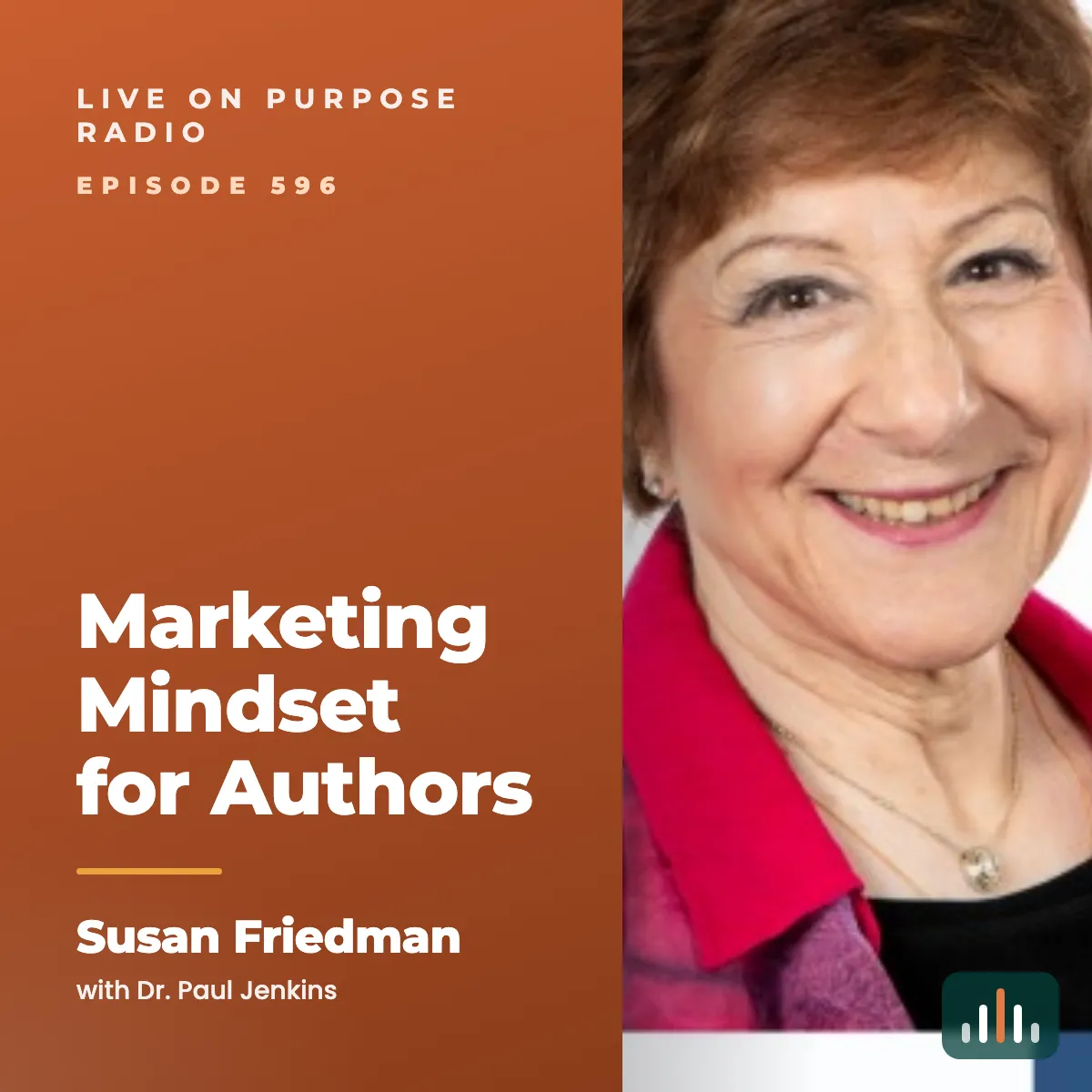
This is Live on Purpose Radio episode 596, marketing mindset for authors with Susan Friedman. Now is the only time to create and live the life you love. I'm doctor Paul Jenkins, the positivity psychologist. My job is to connect you to powerful positive psychology principles that immediately upgrade your relationships, business, and mental health. Are you ready?
Let's jump in. Hello, everybody. Welcome back to Live On Purpose Radio. This is doctor Paul, the shrink, who expands your life with another episode of Live on Purpose Radio. Joining me today is my friend and colleague Susan Friedman, who is a member of the National Speakers Association, and I've known her there for a while.
But I've gotten to know her much better lately through an association we both have through Michelle Villalobos, who is our coach and someone who has curated an experience for some of us as influencers to come together and collaborate and share brilliance. And and I'm just excited that you're going to share your brilliance today, Susan, on this podcast. Welcome to Live on Purpose Radio. Thank you. This is such a treat.
And, you know, we had the mic's, reversed where I interviewed you a few weeks ago, and that episode will be live shortly. We have a... We had a blast. So you're doing the same to me. So I...
I'm hoping that it's going to be just as good. Yeah. I fully expect it to be. You have dialed in on some principles that have been powerful in the lives of your clients and the people that you work with, primarily speakers and authors who are publishing their book. And I've noticed as a psychologist and also as a speaker and author that we get in our own way.
Oh, don't tell me about it. And so you have some unique perspectives on the mindset that supports the successful launch and marketing of a book. That's your area of of specialty. I want to use that as an introduction and just invite you to share with us first, if you would, why you're so passionate about this. What has brought you to the table to do this particular kind of work?
It's so interesting that you start with that, Paul, because I was in a niche market, in fact, the exhibiting industry for over twenty five years, and I lost my passion for it. However, behind the scenes, I had had a publishing company, Aviva Publishing, which is my publishing company. But I had had that, you know, just to publish my own work. Because when you're in the trade show, the exhibiting industry, not too many, you know, publishers are out there, you know, vying to want to publish your books. So I started my own.
That's the way I did it. You know? Why not? So that's what I did. I started my own publishing company.
And along the way, I met up with some book coaches who said, hey, Susan. Could you publish, you know, some of my client... Our clients' work? And I was like, I'd never even thought about that. What a concept.
And I was like, I don't see why not. And so what are we now? It's, like, over thirty five years that I've been running this company, and I published over 500 titles, working with primarily nonfiction authors. We've got a few fiction, but nonfiction is my my genre that I prefer to specialize in because I feel I can help people more in the nonfiction realm than I can in the fiction realm. Mhmm.
And because that's, you know, more my background. I like nonfiction. And, when I lost my passion for the industry, for the trade show industry, in fact, it was my daughter who said, you've got this, you know, Aviva publishing that's there in the background. Why not put your heart and soul into that? And I was like, well, that's really interesting that you say that.
And I did. I did. I was like, I love my authors, and I'm looking... I'm constantly looking for ways in which I can help them guide them. I don't do it for them.
I guide them in terms of book marketing, and especially when they can hone in on a niche market, Paul. That is really, you know, the nucleus of everything that I do is being in a niche market because that's where I was, and I managed to sell over 500,000 copies of my first book to one company. Wow. Well, obviously, you know a thing or two about Just a little. About the publishing industry, especially in in the nonfiction space, which is where a lot of my colleagues hang out too because, you know, in personal development, self help, the kinds of books that people read to improve their lives based on principles, that's my genre.
That's where I write. That's what I read. And I I know from talking to you before that there are some mindset issues that are almost predictable. Maybe they are predictable because we're all human. Right?
What have you run into as you've worked with these authors that comes to mind about what's important in that mindset space? What have you learned, Susan? So thank you for that question because it is key. What I found, Paul, is that when authors write and publish their book, They think that that is the end of the journey. And in fact, that really is just the beginning.
You know? They Right. They don't like the idea of marketing and selling. There's sort of this, it's... It sounds dirty.
It's like a four letter word. They conjure up these visions of used car salespeople, and and they think they just don't want to be in that space. And, of course, you know, there is... We're all selling all the time, except we don't say we're selling or marketing. I mean, what are we doing on here?
You know? We're selling our ideas. We're marketing our our ideas. Maybe not necessarily for money, but we're sharing our wisdom, which is really what it's about. And it's the mindset of understanding that sales and marketing is really just sharing their expertise, you know, from taking it from the written form now and sharing it on podcasts and, you know, speaking engagements, webinars, workshops, seminars, whatever you want to call it.
I mean, you're just sharing your wisdom. Right. That is, you know, the crux of of this sales and marketing that you're getting people interested and exciting excited about what you do. Yeah. You're bringing it to life.
I mean, the book is an intangible. But you, the author, can stand in front of the book and say, hey. Yes. This is my expertise in a package. You know?
Mhmm. But now let me really share what it's about. So it's that, if that makes sense, that idea that writing the book is the beginning of the journey, and the marketing is what keeps the engine going. I just had a kind of a funny image pop into my mind. Do you remember there was a movie that that came out years ago, called The Grinch.
Oh, yes. And this is, I remember a scene in the movie where, where the Grinch character was making his to do list. Do you remember this? And he's... One of them was solve world hunger.
Tell no one. Right? And that's the image that came to my mind. Exactly. Exactly.
As these brilliant authors, they put their life's work and their heart and their soul into this book. I'm thinking about that for my own book where it's... I I I dumped literally twenty years of clinical experience into a concise package that that shares what I've learned as a professional psychologist in a way that's accessible to people. And that is a treasure. But if we tell no one Exactly.
It's the cringe. Right? Then this life isn't going to improve. But there's a fear. Have you noticed this?
There's a fear that people have about stepping into that marketing and sales area. What's the fear? Oh, the fear is the imposter syndrome. Well, what's been... You know, has the label of the imposter syndrome.
It's like, I've done this, but, yes, I'm fearful for putting it out there because people are going to judge it. They're going to criticize it. You know? And maybe, you know, I'm... I sort of second guess, well, have I put everything in there?
And is it the right way? Is it... And all this nonsense, all this head trash goes on. And I think that's part of the fear. I know, to be honest, I've had that myself.
It's like, you know, I've done this. I've put this out there, but one of the things that I've forgotten to do is to tell people that I've done it. That I've written a book. Tell no one. 18 books.
And, yes, you you forget that it's like, well, people are not going to find out about you unless you tell them about you and your own expertise. So it's blowing... You know, tooting your own horn, but doing it in a way that is not obnoxious. Well, let's go back for a minute to this tell no one idea. I mean, obviously, the Grinch was doing it because he's the Grinch.
Yeah. But I think often we as authors do it because of the imposter syndrome, like you said, the fear of criticism. And let's just put that baby to bed right now. You will be criticized. Of course.
You're gonna be judged. You're gonna be criticized. You will be hated. Yes. There's an old joke about how do you start a controversy on social media.
You post something. Yes. It doesn't even matter what it is because there are so many different opinions. You will not please everybody. And nor should you even try.
So let's just... Well, there... There's a misguided notion, I think, that whatever we put out there needs to have that ability to please everyone. It's not even possible, and it sounds ridiculous when I say it because you know that it's not possible, but yet we hold ourselves to that standard sometimes. People will hate your work.
That's just part of it. And that's okay.... Too many people. You don't want too many people doing that. Here's the other side of that.
Other people will love your work. Mhmm. Other people will be liberated and sometimes even saved. Yes. I know lives that were saved because I put my book out there.
Mhmm. I also know people who have sent me scathing, critical reviews. These are people I don't even know, Susan. Yeah. Who thought it would be a really great use of their time to compose Of course.
What what they said to me. And Makes them feel better. Makes them feel better because Well they could have done a much better job. You know that, don't you? And I think they should.
Yes. You can write your book. That's another question. You can do better. You please go write your book.
Right? I remember when I received that letter. Two things really helped me with that. I had I had just heard Wayne Dyer speaking about this because he got a lot of hate mail, and this is back in the day when they actually sent mail. And so he would get these letters in the mail of people who had chosen to give him critical reviews of his work.
And and so he had mimeographed. Do you remember the old mimeograph machines where you you roll it off...... Aging us.... Purple. You're aging us.
Well, he had mimeographed a response. K? For those of you who don't know what a mimeograph is, go look it up. It's just... It's an old fashioned photocopy.
K? He had mimeographed this response, and it said simply this. And it said, dear and then blank. He could write in the name if he wanted. Dear blank, I am sitting here in the smallest room of my house.
Now you know what room that is. With your letter before me. It will soon be behind me. Regards, Wayne. Oh, that's brilliant.
I love it. Kick out of that because it's an acknowledgment. Yeah. Just like you're saying, Susan, it's an acknowledgment. Yes.
You're gonna put it out there, and you will expose yourself to criticism. Yes. Yes. I love it when I get, you know, I've put out a blog, let's say, and somebody comes back and said, you know, you should have put a comma after that, or you should have put an exclamation mark, or you should not have done this. And I was like, you know what?
I love it when I have eagle eyes who can, you know, see work because you don't see your own mistakes. So I go back readers, you help me make them. Yeah. It's like, what am I going to do? You don't see your own errors.
You just don't. That's why editors are good. You know, the other thing that helped me with this particular issue, I just watched Pirates of the Caribbean as well. You remember the first one, the good one? Mhmm.
And there was a point in the movie where captain Jack Sparrow is being confronted by two British officers who are about... He's about to commandeer their ship. Okay? And they're they're confronting him, and they... One of them says to him, you are the worst pirate I have ever heard of.
And his response was beautiful in his wobbly way. He's like, so you've heard of me. Right? And I felt that way when this guy skim... Sent me this scathing review of my life's work.
He's ripping it up one side and down the other. And I'm like... And he's... He even finished it with something like that. You are the worst psychologist I have ever heard of.
And I'm like Thank you. Flattered. And I think that was my response. I said, I'm flattered. Thank you.
You've heard of me. Awesome. Because that means I'm not hiding under a rock. Correct. And it's interesting because, you know, having spent many years in the, public, relations arena, they say there's no such thing as bad publicity.
There's just publicity. Because often, people don't remember, but they remember your name, but not necessarily whether it was good publicity or bad publicity or whatever kind of publicity it was. It just is. And, yes, at least you've put your work out there. And as you say, you've been able to save people's lives with the information, and those are the most important ones.
Like, you know, with my work, I mean, it... It's like giving people information that they didn't necessarily have before or helping them see things from a different angle. I love doing that. When you talked about, you know, not pleasing everyone, what came to mind, Paul, was that I often get authors who come to me and I... I ask them two questions.
One, what do you want the book to do for you? And secondly, who's your target market? Yes. And the the second one is the one that people say to me, well, I've written... What I've written is universal.
My book is for everyone. So I'm like, that's great. And, yes, it might be. How do you plan to market to everyone? Because not even Procter and Gamble tried doing that.
Right. So that's why I believe in, you know, really niching down and knowing exactly who your audience is. Because if you can get your arms around your audience, and this isn't just women or men or women between the ages of 30 to 60. I'm like, there's a big difference between a woman who's at 30 year old and a woman who's at 60 years old. You know?
So maybe we need to condense that, you know, age Right. Age gap a little bit. So I really work with authors to find a niche that they can really get their arms around because then you can mark... Start marketing to these people. Because you look at where they're trying out.
You know, where are they going to see your message? You know? Is it is it going to be on Facebook, or is it going to be on Instagram, or is it going to be on LinkedIn? You know? Mhmm.
It it it all depends. A lot depends on the age group. A lot depends on the interests. And who it is that your target who it is, who it is. You're exactly We spent a little time earlier talking about the the fears and, how people will criticize and hate you.
Remember, they're just self identifying as not being in your audience, which is a blessing and a gift for you because you don't have to spend marketing dollars on them. Exactly. Exactly.... Helps you to clarify more. You know?
And you said there's no such thing as bad publicity. It's kinda like breath. Bad breath is better than no breath at all. I like that one. So let's let's put it out there.
The the lives that I have been able to touch and even save through my work, and I'm not saying it's me. I'm saying it's me stepping up that has facilitated that for them. The... Would I trade all of that to avoid the pain of the criticism? And at this point in my career, that I to save people if you did that.
Yeah. Right. And when I put those on a scale, which one is more important? Yeah. So when when you talk about the the marketing mindset for authors, it's it's really about getting...
It's not about us. Right? Let's get out of our own way and realize that this message is perfect for our target audience, not for everybody, but for our target audience. And as we hone in on that, we will be able to reach others that are peripheral to them. And you're being selfish if you don't share that with your audience.
Right. If you're keeping that to yourself, it's like, why? Mhmm. You know, which lives are... Whose lives are you not saving?
You know, why keep this information from them? I get... I... I've gotten questions when people say to me, Susan, how long do I keep marketing my book? And I'm like, how long do you want your book to be sold?
You know? It... If if you're not marketing it, it's not going to do it on its own. And this is, this is a big mistake, Paul, that authors make is that they think, for instance, they're gonna post their book on Amazon. And that they can just sit back and forget about it because somebody's going to discover them, and they're going to become rich and famous.
Well, I've got news for you. Maybe. Maybe yes and maybe no. Probably no. Right?
Well, I I used to be under this same misconception, honestly. I thought, well, should I self publish, or should I go through a publisher? Mhmm. And my thought was if I go through a publisher, then they will market it and sell it. Not true.
Not anymore. Not anymore. That's not the way the world works. And even if you go through a publisher, they'll do an initial push. They'll include it in some of the materials, and then it goes on a shelf somewhere.
And whether that book sells or not is totally up to you. Absolutely. It's all about what you do. And in fact, these days, if a traditional publisher is interested in you, they want to know what your marketing plan is to sell... Market and sell the book because they don't want you to be reliant on them.
Now, you know, historically, it has been you get published by a traditional publisher, and you can sit back and hope for sales to come in. You know, the royalties, that isn't the case anymore. No. Not with self publishing, not with... Aviva publishing happens to be what's known as a hybrid publisher that's halfway between self publishing and traditional publishing.
So, yeah, you still have to sell the book. And if you live on Amazon... I mean, Amazon is just a digital, you know, bookstore. You've gotta bring people to the bookstore. Right.
Give them a reason to go to the bookstore. Exactly. Exactly. Yeah. You said earlier, the...
One of the first things you mentioned is that you don't do this for people. You guide them. Because, really, Susan, you can't do it for them. I don't even know what the price tag would be to have you do it for them. And there's no value then because, again, you sit back and you get fat and lazy that you think that, you know, I'm gonna do it for you, and you don't have to be part of that game.
Well, no. You've gotta be invested because there's no one like the author who can market and sell their book. I will never have the same feelings, the same emotion about your work as I do about my own work. However great your work is, I might recommend it to other people, but I don't have that emotional attachment to it the way you as the author has it. Yeah.
Right. Would you say that that's the main hurdle that authors get to overcome as they look at marketing their book? Yeah. Because they're looking for ways to get around doing it themselves. Mhmm.
You know? So it... It's like shirking that responsibility because of their own fears of putting it out there. So if I do it for you, therefore, you know, the fear is on me, but I don't have that emotional connection. I don't have those fears.
You know, I'm very, you know, objective about it. Whereas, you know, you hold the fears. So if you put it out there, you're fearful. But if I put it out there, you know, I'm taking that fear away. No.
No. I'm not doing you any service. In fact, I'm doing you a disservice by saying, oh, I can get you all these sales because, yeah, maybe I could. And what happens when you stop paying me? You know?
Right. Your motivation is different. I'd rather teach you to fish so that you you know, what... What's that saying? You know, I Yeah.
I love it. If I give you a fish, you you know, you'll eat one meal. If I if I teach you how to fish, you'll fish for a life... That you'll be able to eat for a lifetime. Right.
So, that's what I'm... That's my sort of, I don't know. I don't say cruel, but it... It's the reality is that I'm... I want you to learn to do it so that you can sell it.
You Which is not cruel at all. It's the kindest thing you could do. I I like to think so. I like to think that. Susan, I know that there's a number of of listeners, to our podcast who have expressed to me personally that they are interested in in getting their book out there, writing their book, at whatever stage of development they're in.
How can people connect to you in a way that they can get a piece of all this brilliance? I always say they should start with doing just a brainstorming session with me. And I've got a link that is brainstormwithsusan.com. And if they... That will take them to get a twenty minute session with me.
And it... This is not a sales spiel. I'm not going... I'm just gonna look at what information do you need at the stage you're at with your book. Now, you know, so whether, you know, it...
Does it need... Have you finished the manuscript? You know, does it need editing? Does it need a cover design? Does it need layout?
I mean, go through the motions. And, also, as I said in the beginning, what do you want the book to do for you? Once it's out there, what do you want from it? You know? Do you...
It's usually a big fat business card that gets your foot in the door as a credibility builder, you know, to go out and do speaking engagements. These days, you're a speaker, you need a book. It's an expected part of the tools that you offer is you have a book. That's why all these famous people who want to get on the speaking circuit have got books. Even though those might be ghostwritten, you know, they've got those books because they wanna be out there.
You're gonna make more money speaking than you are selling books. And you're gonna sell more books speaking. Exactly. You got it. You're a fast learner.
You're a fast learner. That is incredibly generous. You guys, I don't know if you understand the value of what Susan just offered you. Brainstormwithsusan.com is going to get you some time with her. Go use it.
And even if you choose not to use her services after that, I know this lady well enough to know that her heart is in this. She's here to serve you, and she will be compensated well for that. I'm confident. Well, thank you. Thank you.
I appreciate that. Yes. I just want people to go on the right path. Yes. There there are a lot of scam agents in this business, unfortunately, and they're there to take your money because there's sort of something...
You know, there's ego involved with writing book. Sure. And there are people who are taking advantage of that. And, you know, if I can sort of put you on the right path, whether or not you do business with me or not, then, you know, I I feel as if I've done my job. Wonderful.
Okay. You guys, you've heard it. It's time to take action on it. Let's go live on purpose. Did you get what you came for?
Give yourself the gift of taking real action on what you realized today. Please share this episode with someone you know would value it, and leave us a rating too. It's time now to live on purpose.
Open the transcript on its own page ↗