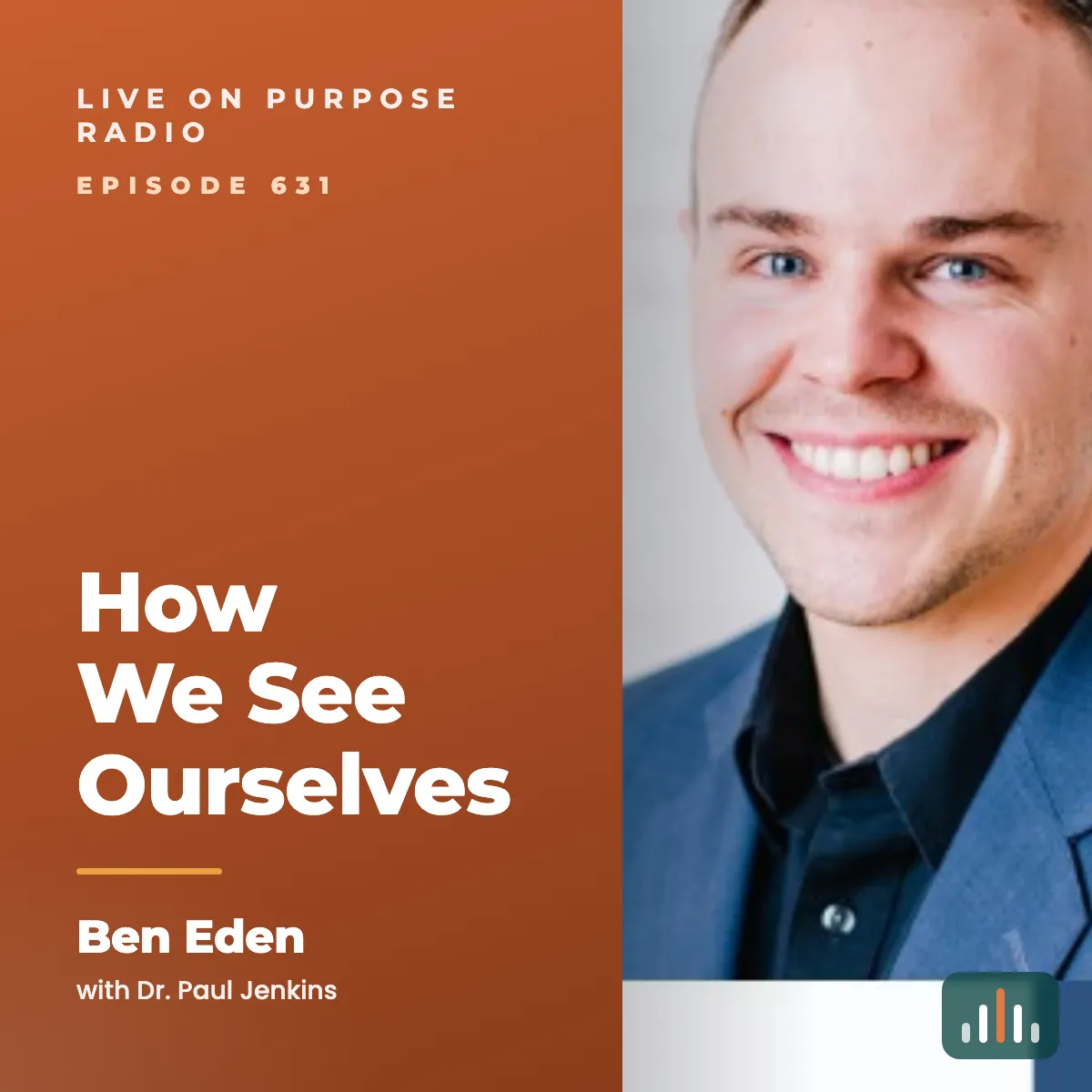
This is Live On Purpose Radio episode 631, how we see ourselves with Ben Eden. Now is the only time to create and live the life you love. I'm doctor Paul Jenkins, the positivity psychologist. My job is to connect you to powerful positive psychology principles that immediately upgrade your relationships, business, and mental health. Are you ready?
Let's jump in. Hello, everybody. Welcome back to Live on Purpose Radio. This is doctor Paul, the shrink who expands your life with another episode of Live on Purpose Radio. Joining me on the mic today is an author and a speaker who comes from the world of human resource.
His name is Ben Eden, and I got to know Ben at the National Speakers Association in our local chapter, which, in my unbiased opinion, is probably one of the best chapters on the planet. And I believe that because I get to meet cool people like Ben every time I attend. Ben, welcome to the Live on Purpose microphone. Thank you so much for having me, doctor Paul. I've been looking forward to this.
The... So your background is in human resource. Correct. And you've kind of caught fire as a speaker and an author about principles that are not necessarily traditionally associated with human resources, but that I really identified as I was reading your book as being the principles that make up what what I call positive psychology. And you nailed dozens of these principles in your book, how we see ourselves.
So it was a fun read for me because as I got your perspective on things that I have thought about, worked with my clients around, I've written about and spoken about now for three decades. And that may be a little longer than you've been doing it. Kinda guessing it is. But it was fun for me to see that. Would you just share with our audience a little bit about why you're so passionate about the topics that you've taken on in this book and maybe a little bit about your journey to get there.
Absolutely. Thank you for the opportunity. So what it comes down to is this. For example, we are trained in life to chase results, aren't we? When we go to school, what are we expected to get?
As. And if you get as, then how do we describe ourselves? And we say, oh, great. I'm an a student, and I'm succeeding. But if we don't get as, especially if we get an f, then how do we describe ourselves?
Not, hey, I got an f. No. We describe ourselves as I am a failure. So if we get the results we chase, we feel great about ourselves and we see ourselves as, hey, I'm successful. If we don't get the results, we see ourselves as, I'm not good enough.
This will never work out. Now this follows us through our entire lives, not just school. Because you get into college, same thing happens. And then you get into your job, your first job, or you've been successful in in your work for a number of years, but you're still expected to get what? Results.
And if you get them, you get the promotion. You get the pay increase. You get the accolades. Cool. And then you think, yes.
I'm succeeding as this VP of something. But if you don't get the results, then it skips everything in my model called the Eden model, and it goes straight down to that identity. All of a sudden, because I don't have the results, I'm a nobody. Or the the question is, who am I actually? Mhmm.
And I've seen this in a lot of people, but, of course, first, it started with me. My story was I started as an HR intern at a company, and I helped grow that company from less than 50 employees to become almost 2,000 employees all across the world. Wow. So that was cool. And I did this in my twenties.
So I started as the intern. I came to become an executive in in the HR world on that team in my twenties. So everybody looking at me thinking, wow, this guy's made it. He has the quote, unquote picture perfect life, executive, traveling the world, has a nice car, the nice house, and, okay, he's made it. And, yeah, there might have been a moment where I thought, this is pretty cool.
You know, I'm checking the boxes of results. Sure. But then, after a few years of doing this, you know, things started to change. For example, I had been traveling the world, but then because of the size of our company, it didn't make sense for the HR executive to travel as much. So, you know, we delegated that to some other employees.
So that changed a lot about my world. And I thought, oh, well, there goes my variety and that... And my fun, and things started to get a little boring, let's say. So I had to focus on some other things. And long story short, to get to the most important part of this part of the story is I started to realize that even though I had the bachelor's, the master's in HR and was a senior certified professional, you know, coming with the accolades of HR, the value I thought I brought wasn't seen as valuable in that company.
And here's how I know. My boss, the CEO, said to me one day, Ben, we have nothing against you. We just hate HR. Oh, which you had come to identify with a bit, perhaps. That's exactly right.
Because my brain immediately say, well, hold on here. I am HR. So if you hate HR, I mean, you hate me. It's just... It's a full package right there.
So that was a huge identity, challenge right there. Right. I think I had thought I had created my life up to this point and it was all quote unquote working. That's a big phrase in my mind. And in the mind of many high achievers, is it working?
Right? Right. Right. So, yes, to to me that was, and that gave me my identity as the HR executive, the successful professional, the it's working in life guy. Right?
When he said that, that started me thinking, well, hold on here. Who am I? And then I started to look at the rest of my life and I started to focus on other things that may not have been working as much or as well. Mhmm. For example, dating for me.
I tried. Now I dated lots. In fact, people are like, okay. Who are you dating now? Right?
Uh-huh. So I tried, but it came to a point where I was in my late twenties, and I started to say to myself, I am successful in everything that I do except for dating. And then the brain quickly switches to the question of, well, what's wrong with me? And there must be something wrong with me because everybody else is figuring it out, but I can't. You know?
So I had some of that going on. And then it comes to this where I thought I was successful. I had been hiding my suffering in silence because, look, I'm an HR executive. People go to HR when they have issues. If you're HR, who do you go to?
You're you're you're on the executive table. You're not supposed to have issues. You're supposed to have everything figured out. Right? And then not to sound prideful, but, you know, at my age, I just didn't have very many friends that were at the same level as I was.
So I didn't feel like I could relate, And I didn't know where to go. So, yes, I started suffering in silence because I didn't know where to go or who to talk to. Right. And when chasing more success and more results stopped working and hiding behind that shield of success to make me think... Or make others think everything was great and to make me feel good, when that stopped working too, I turned to a coping mechanism of addiction.
And even me, Ben. Ben, the picture perfect guy, as people said, the guy who was raised in the church, who has good values, who has been taught the right things, turned to addiction. And so this suffering in silence turned into loathing in silence. K? Mhmm.
Because, yes, the addiction that I was turning to is pornography. It's like, hello. You know you're not supposed to do that. And so that against everything that you were trained, taught, and educated through your conservative religious upbringing Yes. And and just social expectations and norms.
And I noticed in your book, Ben, you're very authentic and vulnerable about that to show that here's here's what happens when we turn it upside down. In fact, I appreciated that your Eden model in the book takes these these traditional steps of, you know, results, for example, is if we focus on results first, then you turn that all upside down to show... Look. The world's got it upside down. Mhmm.
And in the Eden model, as you get it turned back around, it it changes everything. And so as you're sharing your story again here... I I say again because I've read your book. Dear listener, you may not have had that that opportunity yet, but, of course, you can go read Ben's book. I'm I'm noticing here that we get it into our head, maybe because we're trained, taught, and educated to do that, that it's all about results.
And you look out there in the business world, and what do you get paid for? You get paid for results. Right? I mean, you don't get paid unless you create results out there in the business world, but we get it backward. We think that if we get results, then we'll be successful.
But it's really more accurate to say when we're successful, then we'll get results. There you go. So... And I cut you off a little bit as you were just sharing that story. But as you got trapped in this world of chasing more results, it actually led to some experiences or outcomes for you that were much less than what you might describe as a joyful existence.
Is that fair? Yes. Yeah. So even though I was still living in the world of having results, most of them, you know, people could have looked at me and said, well, his life's great. They wouldn't have known otherwise.
Because of where where I had gone inside, I had that suffering in silence and I turned to that addiction. So it came again to that point where many listening might be relating. This is what I've learned. K? Many listening might be relating, which means you're suffering in silence too.
You've chased the results. You've believed those are so important that if you don't have them, who are you? So you need them, you need them, you need them. But if they're not coming, then we all have our favorite coping mechanism, whether it's a known addiction or it's just the Netflix and the food and the whatever. Right?
We all have them, and that can turn into shame. And when you have shame, then you start to see to yourself as not good enough. And that does affect your results, but most importantly, it affects your relationships and your quality of life. So, yeah, what I learned is, wow, this made all the difference for me because number one, with the addiction, I had started to believe with certainty that there was something wrong with me because I, who knew better, couldn't figure out how to change it. And I couldn't believe that I had gone to this result or this behavior in the first place.
Mhmm. But as I went to a recovery group, one of the first things that I learned as I walked into this room of other men, I realized that they were just like me. They were successful. They looked like good people, and we were just dealing with something in common. And I started to first realize that, wow, this behavior is not me.
I don't have to define myself by the behavior anymore, nor do I have to define myself by how I feel. And that was a huge weight lifted off of my shoulders that started to make all the difference. Because... And can I bring up god for a second? Well, you just did.
Well, you can tell me now. Absolutely. Okay. So, you know, I had been taught all these things. I had gone to the seminars.
I had gone to church. I'd been told, hey. This is how God sees you and everything else. But because of what was going on internally, because I had been chasing those results as a high achiever and coming to my own conclusions, I started to think that doesn't apply to me. Yeah.
Christ did that thing. Cool. That's for other people. God says that, but, nah. It obviously doesn't apply because I still feel this way, and I still do these things.
So I had that huge barrier because I thought it doesn't apply to me. But when I saw this difference that it wasn't me, the behavior, the emotions, the temptations, whatever, but, hey. It was the devil. All of a sudden, I started to think, wait a minute. I'm not the enemy here.
Uh-huh. And God does want to help me. I can have God on my team. And I'm telling you, that was a shift I needed because I changed how I saw myself. And when I changed how I saw myself, the world I saw changed.
You know, there's something here that is so profound, Ben. And and this is something I've worked with my clients on through my whole career. It's an understanding of who am I? And sometimes it has to start with who am I not? And we are not our thoughts.
And you even point this out in your book, and you use an analogy that I've used sometimes with my clients too, how we're we're more like the casting director. You know, we're auditioning these thoughts that show up in our head, and they're not us. The quickest example I can think of there, you know, I've I've asked my clients before. Do you control your thoughts? You know?
Not only are you are you identifying with them, do you even control them? So if I ask you to not think about grapefruit, what are you doing? Well, do you control your thoughts or not? And where did that one come from? Well, it came from me.
Right? Yeah. That... You're driving down the highway, and suddenly you're thinking about home mortgage rates. Why?
You just saw the billboard. Right? This this is how advertisers get our attention. We're we're not thinking about it. They bring it to our mind.
And I don't wanna get into all the conspiracy theories about thought control and things like that as much as recognizing that that this noise in your head is not you. And you point that out in your book, and I think that is so powerful to acknowledge I am not my thoughts. And then it brings up a question, well, then who am I? What if you're the observer of those thoughts? What if you're the one who is experiencing those thoughts?
What if you're the one auditioning these thoughts that might have a source outside of you? I mean, you mentioned God and the devil, and there's a lot of people who hold beliefs about entities in our world who are not us but have influence on us. And that is worth considering. It sounds like that was part of the key to your recovery and discovering what you have here with the Eden model. And that's exactly right.
Understanding that I can observe those thoughts. And here's what's crazy. I had already read the seven habits for highly effective people by Stephen R Covey, who teaches that. But, again, at the time, it's like, ah, whatever. That doesn't apply to me.
I'm a special case somehow. I mean, it starts to sound like destructive pride when I put it in those terms. Yeah. No. That's exactly right.
But I talk about that in my book too. The the the... This is what caught me up, and and I share my experience with a bankruptcy, and it was a very similar thing. This is such a shameful thing. I shouldn't be going through this.
I'm a good person. I'm a... Mhmm. And and yet here I am. Right?
And it gave me a lot more empathy. You know, you talk about going into that recovery group and you see, surprise, other humans who are actually good people. It it gives you more empathy for people who are going through an addiction or a bankruptcy or a divorce or whatever it is when you realize, oh, this is just part of our experience. This is our experience with my details. There you go.
Yeah. And I love what you brought up because everyone has that feeling of, oh, I must be the only one. Right? Well, guess what? That's certainly a thought that comes from the devil because he doesn't want you to get help.
So he can have to do, oh, it must be just you. I mean, how how dumb are you to have gotten a break... Bankruptcy or to, turn to this addiction. Right? And he starts to have that conversation.
And because we... Or if, let's say, we don't have the knowledge that we can observe that thought, we think, yeah. You know what? That does make sense, and here's why. And we start to rationalize it, and then we start to believe it, and then we start to say, yeah.
I mean, this is this is why my life is defined this way. Right. And once you buy it, you... I I teach my clients all the time. Your brain has two main jobs, to keep you safe and to prove you right.
There you go. And both of those get in our way all the time. So once we buy it, then our brain is looking for and even creating or fabricating evidence that that is true. Mhmm. And when you look at results, when you base everything on results, it's easy to prove this theory is true.
Right? After all, look at my results, forgetting about the fact that you just created these results. I mean, what's interesting... Now I love what you thought about the second one where it's proving that you're right. Right?
In other words, we are meaning creating beings. We always have to create meaning. Right? So everything... If you go through the model, our brain always subconsciously adds and that means.
So if you look at results, hey. These results exist and that means. I did this and that means. I feel this and that means. I think this and that means.
So we always associate a meaning. But the knowledge that I try to teach people is you get to decide that meaning. It's not x was y and guess what y is my life. It's like, oh, no. X happens to be y, but I can change the equation.
Right. We've known forever in psychology. There's research to back this up that there's a high correlation with success and happiness, but we got it wrong. We thought that meant, well, therefore, if we're successful, meaning as measured by our results, right, or maybe even our thoughts or our feelings, then we'll be happy. Right.
Right? And and we got it backwards. Because, really, when you're happy, then there is a much higher likelihood that you will achieve all of those measurements of success, including results. I I think that's part of what I get from your book too. Yeah.
Please. That's exactly right. I'm sure you totally understand this, but that's exactly what I teach where, for example, somebody might say, well, I'm supposed to do a SMART goal. Okay. So they say, well, I wanna lose 30 pounds.
Okay. And if that's just their goal, I wanna lose 30 pounds by the end of the year, then what happens at the end of the year? If they lost 30 pounds, then they might be happy. But it's still not a guarantee that they're gonna be happy if they lost those 30 pounds. Why?
Because they didn't focus on the emotion that they wanted in the first place. And here's here's more detail to that. Because you could lose 30 pounds, but it could be unhealthy 30 pounds. Well, you just destroyed yourself and you have a sore shoulder because you just went crazy in the gym to try to lose those 30 pounds. And now how is your emotional well-being compared to what it was at the first?
Well, now you can't move because your shoulder's aching. Right? Or to the other example, what if you work hard, you do all the right things, and you have never felt better, but you only lost 29 pounds. What does that mean? Did you fail?
Oh, I didn't meet my new year's resolution. Right? And that does come because of the way we're trained to define success. But what I do is I help them establish how they wanna feel and how they want to see themselves from the beginning. So instead of saying, I wanna lose 30 pounds, for example, then because...
And let me say this to be extra clear. Every behavior we do is based on an emotional need. Mhmm. If we wanna feel good, we chase the behavior. No.
We do the behavior. If we don't wanna feel a certain way, we say I'm not going to do that. Right? Right. So everything we do is based on an emotional need.
So if we understand that emotional need from the beginning, then instead, we can say, hey. At the end of twenty twenty five now, right, one year away, here's how I see myself. I see myself as the most energetic person I have ever been in my entire life. I love the way that I look. I show up with confidence.
People can sense my energy. They love being in my presence, and I treat my body the way that I should. Guess what? That type of person is probably gonna lose some weight if they need to. Or because we don't just talk pounds, I'm not a weight loss coach necessarily.
I'm just giving you this example. Right? Yeah. Sure. But you can shift poundage.
Right? Muscle weighs different than fat. So if you're shifting it, you may not lose hardly anything, but boy, does your body look and feel a whole lot better. So doing it the right way and putting yourself in that emotion from the first place, not only more guarantees for your success, but it's more lasting success because it's changing who you are and how you see yourself and not just chasing, oh, well, I weigh thirty pounds less than I did. I'm remembering an experience that I had that ties right into your model, Ben.
And I was I was a young new psychologist. I just finished my internship in Portland, Oregon. We were moving back here to Utah where we currently live. And, a friend of mine approached me about running a five k. Now I had an identity.
The way I saw myself was I don't enjoy exercise. Now I wasn't overweight or unhealthy, particularly, but I had this... And I don't even know where it came from then, but I had this idea. I don't enjoy exercise. Right?
I was kind of identifying with them. And then... But I went and ran with him because it was a social exercise. And I was really sore afterwards and... For a couple of days.
Right? And I finished, like, four hundred twenty third or something. Anyway, that was my experience, and and I kept that in my head. And then another friend approached me several weeks later and said, hey. Do you wanna come play basketball?
Well, the word play caught my attention, and I hadn't really excelled in basketball before then, but it sounded like fun. It sounded... We're gonna go play. Yeah. I'll come and play.
Right? Yeah. And I really enjoyed it. And I was sore, and I was sucking air, you know, trying to keep up. And I was learning things, and I was having fun with it.
And I was showing up three times a week to play with my friends. Right? Well, year later, that same friend from earlier came to me and said, do you wanna run that five k again? And I'm like, sure. Why not?
Ben, I finished third Wow. In that five k. I didn't realize that I had become an athlete. There you go. And I had never thought of myself as an athlete.
I... It was like, well, I don't enjoy exercise. Well, maybe that's true, but I really enjoy athletic activity. Mhmm. And I had to engage at that level just playing basketball and the effects on my body, the results that I got to observe was that...
The result was I finished third. I got a medal Yeah. In the same race a year later. And and I just see that as an example of what you're sharing with us here. It was my...
What changed? My identity, how I saw myself changed, and the results just kind of happened. In fact, I noticed this at the end of your book because you do a little separate chapter on each level of the the model. Right? Mhmm.
And you concluded it very abruptly. I said, well, you don't have to spend much time in this chapter because, well, the results are gonna take care of themselves if you... You know? I think it was only one page, wasn't it? Which was longer than chapter one, by the way.
And I won't I won't spoil that for them if they wanna jump in chapter one. It's it's worth reading. I just say. Well, Ben, I, I really appreciate your coming and having this conversation with me today. I'm wondering, is there is there something else that you're really hoping to share before we wrap up with our our podcast today?
Yeah. Can I ask a follow-up question to your example? Yeah. Sure. So where you said, hey.
A year later, I ran and got third. But tell me what else happened to your life. Right? That was a one running experience, but I'm sure it translated into some other areas of your life. Can you tell me a little bit about that?
It was kind of... And thank you for asking the question. It was kind of a moment of realization for me that I had been doing it because how we see ourselves is often something that we're not consciously aware of. But I could see that that had changed when I observed that result, and I wasn't doing it for the result. It was just like, oh, And after that race, instead of being sore for three days, I went home, took a shower, and felt completely normal the rest of the day.
Right? And the days following it, I had more energy. There was more of a a feeling of well-being that was just permeating my life in every aspect of it. And and this is the time when I was first getting started in my career. And there were a lot of hard things that I got to do to establish my practice as a new psychologist.
And and yet I was I was vibrant and alive and just joyful, I guess, is how I would experience it. That's that's great because a correlation that you just shared is because you had success in changing the way you saw yourself in one area of your life, it affected another, which was your profession, for example. Yeah. So a lot of the people who resonate with what I talk about are entrepreneurs. They're in this place being a high achiever.
I wanna make an impact. I have my personal story. I wanna make a difference in the world. Awesome. But then we all go through this because it's a stare in the face of, wow.
Who am I? And now I'm vulnerable to everybody. And if we don't learn to change the way we see ourselves, here's what... Here's the truth. Where you are now or the results you have now are because of how you see yourself.
So if you want different results, yeah, I'm okay to still talk results, but do it in a different way. Not what should I do differently because that just drives you nuts. You can change how you see yourself and boom, the the results start to change. And I'll just give one follow-up story that relates exactly to yours. One of the first people who read my books or my book came to me very soon after and said, oh my goodness, Ben.
I have been trying to exercise for years. I was an athlete back in high school. See how she said it. I was an athlete. But until I read your book, I had done all the diets.
I had done all the plans. I had done every behavior possible to try to exercise, but I hadn't been able to do it. When I read your book and started to see myself again as an athlete, I have been going to the gym consistently for the last thirteen weeks. I can attest to exactly the same thing. I don't try to exercise.
I I I simply exercise because that's what athletic people do. Exactly. So it... When we focus on the behaviors and the results, it's like white knuckling our way through life. Mhmm.
And I'm guessing that a lot of you listeners can relate to this too because it it takes so much effort to do something that is against your nature. Mhmm. But if it's your nature, there's no effort. There you go. It's simply how you show up in the world.
So... I love it. Can can I share one last thing? Yes, please. So again, relating, just using you as an example, because, hey, that's what I do as a coach.
I try to go right in the room. What are we gonna do? Yeah. So you... Somebody could be saying, alright.
Well, I wanna be a successful speaker and podcaster like doctor Paul here. But then their thoughts immediately go, well, I'm not like doctor Paul. I... I'm not on 631 episodes of my podcast. I haven't been doing this for thirty years.
You know, all these things that that convince ourselves and prove ourselves right that, yeah, I'm not doctor Paul, and therefore, I can't do that. Right? But, again, if you were to say, well, the secret to success is to do 631 episodes on a podcast, then you'd stress yourself out trying to get to six thirty one episodes of podcasts, and that's no guarantee of success. No. If instead you start to realize, if I wanted to be like doctor Paul, what is it that he does?
What is it that he thinks? What is it that he feels? What is it that he believes? What is it he's... How he sees himself?
Oh, okay. I could mirror some of that. And if you start there, because guess what? You probably had the same journey. Back on episode three, you probably saw yourself differently than you do now on episode six thirty one.
Is this true? Of course. Yeah. Because life has changed and you've changed. And the same thing happens for all of us in our entrepreneurial journey or whatever journey we're on.
Yeah. We will see ourselves differently in the future, and we get to influence that. Don't leave it up to the results that you do or do not get. Choose how you see yourself now in the future, and then become that person today. That's so true in so many elements of life.
I'm just thinking about when I wrote my book. Ben, you probably experienced this when you wrote yours. At what point do you call yourself an author? Right? Is it after you've published a book?
Well, if it's after you published a book, we wouldn't have any books. That's exactly right. Because we need authors to write them. Uh-huh. So and what if you have an idea for a book?
And the same thing for a speaker. I coach a lot of speakers. I coach a lot of coaches, and and I provide mentoring and certification for the... For those coaches. And I'm constantly asking them at what point do you call yourself a master coach?
Mhmm. Is it after, you know, 30 of of a career like where I am? Or do you get to be that now? Because that master coach or that professional speaker or that author is already in there. I I remember consulting with Leslie Householder about this.
She's the author of a book called The Jackrabbit Factor and another brilliant book called Portal to Genius. And and she said when she was writing her first book... And the Jackrabbit Factor is a New York Times best selling book. That's huge. Right?
And she was working with a riding coach, and her her coach was having a similar conversation just like what you and I are talking about here, Ben. And the coach said to her, what if you were to tell the truth in advance? Because she had been telling herself, well, I'm I'm not really an author yet. Well, what it... Are you a best selling author or not?
Because that's about your identity. Mhmm. And the the book and the accolades come because you are. That's not what makes you that. And so her coach invited her to tell the truth in advance.
And the truth is she is a New York Times best selling author, and she told that in advance. It... It's like owning it first, becoming, and identifying with it. And that's what came to mind as you were sharing that, Ben. No.
It's great. No. I remember I coauthored my first book. I was the first chapter in an anthology, and I went through that journey. I'm like, can I call myself an author?
And now my conversation's right. I kinda am. I mean, I coauthored. I go around about. But that experience prepared me for this book to say, yes.
I'm an author, and this is my solo book, and I'm proud of it. And when I was writing my first book, I had to decide that I was an author because authors write. Uh-huh. And once I decided I'm an author, I set a writing appointment every Saturday morning at 05:30. And nobody's bothering me at 05:30 in the morning.
I mean, nobody wants my time then somehow. And and I... That was my writing appointment. What do authors do? Authors write.
Be... I don't know what you do if you're becoming an author. I mean, what do you do? A lot of dreams. Right?
I mean, you dream and you wish and you say someday. But if you're an author, you write. And once I made that shift in my mind, I am an author. I wrote. Yeah.
And I've published three books now. I've got two more in the opera. Three, actually. Nice. So I'm on a similar drink.
Here's something cool that I learned. Author is short for authority. And let me tell you, I still have that negative voice saying, do people really care what you wrote? Or, you know, if I look at the numbers of the, the number of books that have sold, I might start to say, oh, shoot. I'm not where I hoped I would be.
And I could get discouraged. Nobody wants to care. And I'll just put it on the shelf. But no. Right.
But remember that because I'm the author of this book, I am the authority on this subject of how we see ourselves. Then boy, do not only people want to hear it, but they need to hear it. And that changes how you show up. Yes. Ben, I'm so glad you showed up here on this microphone today Thank you.
For being here at Live On Purpose Radio. Folks, time to check out Ben Eden. His website, reachyourultimatepotential.com. That's all one word. Reach your ultimate potential.
That's where you can learn more about Ben. You can get connected to the things that he's doing and his book, how we see ourselves. I think they can even get a free chapter over there on your website. Is that right, Ben? Yeah.
They can. Yes. Awesome. But you don't want a chapter. You want the book.
K. So go grab that, and and enjoy the experience of learning to see yourself a little differently. It's gonna change everything. Ben, thank you for being here today. Folks, you've heard it.
It's time to apply it. Let's go live on purpose. Did you get what you came for? Give yourself the gift of taking real action on what you realized today. Please share this episode with someone you know would value it, and leave us a rating too.
It's time now to live on purpose.
Open the transcript on its own page ↗