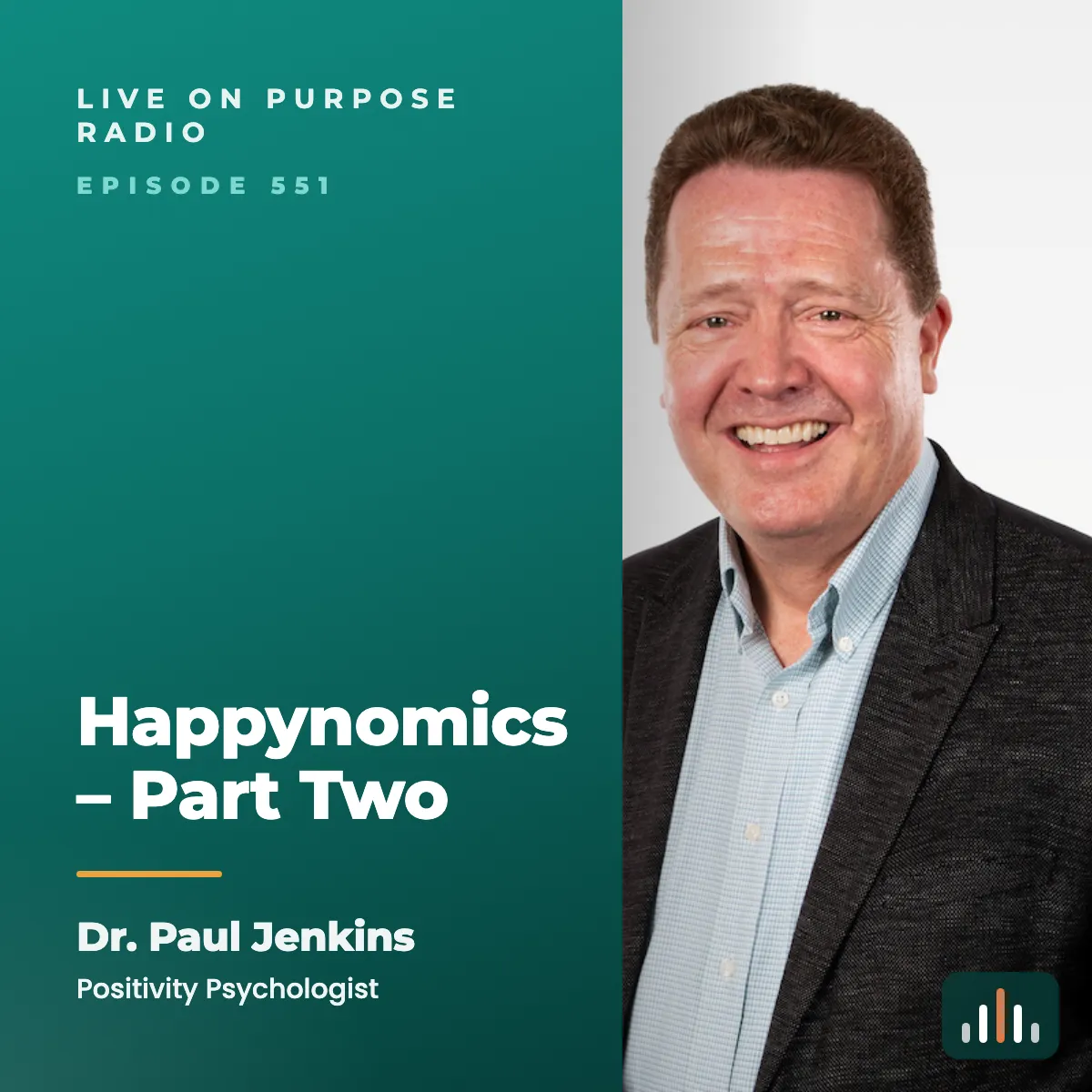
This is Live On Purpose Radio, episode 551, Happynomics part two. Now is the only time to create and live the life you love. I'm doctor Paul Jenkins, the positivity psychologist. My job is to connect you to powerful positive psychology principles that immediately upgrade your relationships, business, and mental health. Are you ready?
Let's jump in. Hello, everybody. Welcome back to Live On Purpose Radio. This is doctor Paul the shrink who expands your life coming at you today with part two of two on our happynomics conversation. If you didn't listen in to part one, please grab episode 550, happynomics part one, because that will set you up for where we're going next.
Now we left off talking about the balance sheet of human life value. Remember, human life value is different from property value. Human life value is more important. Human life value is more fundamental. Human life value is the source and creator of all property value.
Now I'm I'm gonna go on a little rant here for just a minute because people put way too much value on money. And as we get into the income statement about human life value, I'll give you some insights about money that are going to make perfect sense to you as you understand this happynomics model. K? So remind me if I forget because I wanna make sure I give you that. Now let's go to the income statement.
What I'd like you to do is think about some basic human activities that I will share with you. Basic human activities can be categorized as either income or expense, And it's important to understand which is which. Remember I told you a story in the last episode about sitting at dinner with doctor Jeff McGee, and he said, Paul, you suck. Meaning, I suck resources. I consume more than I produce.
At the time, it was true. It was evidenced by my financials. I was in negative cash flow. I was going downhill fast, which eventually ended up in a bankruptcy for me. Now I'm not proud of that, but you know what?
I'm profoundly grateful for it because of what it taught me, including what I'm about to share with you. It's important to understand what is expense and what represents income. So as I share these basic human activities with you, just think through, is this income or expense? K. Let's start with one of my favorites.
Learning. Learning. I love learning. Don't you? Income or expense.
Now as you're thinking about this, remember, assets give rise to income. Liabilities create expenses. This is true in human life value as well. So learning income or expense, it is expense. Wait.
Wait, doctor Paul. I enjoy learning. I gained so much from it. Yes. But what gives you the need to learn?
Is it your knowledge, an asset, or is it your ignorance, a liability? It's your ignorance. That's why you have to learn. So think of this. Learning is the expense you pay for the liability of ignorance in paying your expense.
Just like when you pay your mortgage, you get to control an asset. What's the asset? Knowledge. What do you get to do with the knowledge? Teach.
You get to teach. Teaching is income. Okay. Let's try another one. How about serving others?
Serving others. Income or expense? Serving others is income. Okay. Was that confusing too?
Being served being served by others, that is expense. Now why? Because of the assets and liabilities. What allows you to serve others? Your strength, your knowledge, your ability, your strong body?
Yes. It's income because it comes from your assets. Being served. Well, you're served because of your weakness or your deficits or the things that you need from others to do for you. Now notice I am not saying that it's bad.
I'm saying that it's expense. Just like I wouldn't say that your mortgage is bad. It's simply the expense you pay. If you don't pay your expenses, your liabilities will overwhelm you, and you'll lose your assets. Do you remember this?
So don't confuse expense with bad. Just realize that's what we do with our liabilities so that we can manage and control assets. It's our assets that give us the ability to serve others or to teach. What about consuming? As opposed to producing, which one is income, which one is expense?
Consuming is receiving or taking. Producing is giving, creating value. Producing is income. Consuming is expense. Now does this feel backwards?
Wait. How could giving be the income and receiving be the expense? Remember, I told you... I promised you that I'd tie this into money. A misunderstanding of money is what leads to the confusion.
Think about it. These terms that I'm sharing with you, income and expense, We are used to thinking about those in terms of property value. Right? Having to do with money or property. And, of course, that's what...
We even call it income. Right? It comes into me. I receive it. What do you receive?
You receive money when when we're talking property value. Why would money ever come in to you? Why would you ever receive money? What happened just before the money came in? You created or produced value.
You served someone. You taught. You showed up and produced, and the money came in as a receipt for the value that you created. Now look at the expenses. Money leaves you.
Right? Why would money ever leave you? What happened just before the money left? You received something. Someone else served you or provided you with a product, and then the money leaves you as a receipt for the value that you received.
The human life value income is what allows the property value income to come in. It's the human life value expenses that cause the money to leave you because you're receiving all kinds of values. Think of the money as a receipt and then it makes sense. This is why I said a misunderstanding of money is what makes all of this confusing. We have to get back to where the real value is, and the real value is in human life value.
So why is this so important? Understanding what is income and what is expense allows us to go back to the same goals that we had to start with. Let's start with the balance sheet, for example. K? Do you remember in property value, the goal is to make sure that your assets are greater than your liabilities.
Well, what if your liabilities overwhelm your assets? That's a debt position in human life value. We call that captivity. And check it out. In property value, you have to go purchase your assets and you acquire liabilities in the process.
In human life value, they're built in. You already have the assets. They are God given gifts. And, yes, you can improve them and develop them, but you're going to have both assets and liabilities. So what makes one or the other more prominent?
It's our focus. What we focus on, we feel. What we think about, we bring about. If we focus more on our liabilities than our assets, more on what we can't do than what we can do, we create a state of captivity, stuckness. I invite you as you're listening to my voice today to consider where it is in your life that you feel stuck.
And I bet you dollars to donuts, you're focusing on what the limitations are, what the liabilities are more than what the strengths and skills and abilities are that you could address that same problem with. That's what creates stuckness. Now what if we focus more on our gifts and our abilities and our skills than we do on our disabilities or our weaknesses. When our assets are greater than our liabilities, we call that equity and property value. I call that liberty in human life value.
Liberty equates to freedom and possibilities. This is what opens up the the chance for you to transform your circumstances. Now what we do on the balance sheet matters because it creates either captivity or liberty. Either you're going to be stuck in what I call a victim paradigm, or you're going to turn on your brain to the possibilities of what you can now do to show up and create some income. Okay.
Now I was in negative cash flow when I went into that bankruptcy. What's negative human life flow? When our expenses outpace our income, when more is going out than is coming in on the money side, we call that a loss in human life value when we consume more than we produce, when we are being served more than we're serving, when when we are learning all the time but never teaching or applying that knowledge, it creates a negative flow. All of those expenses create a negative flow that we call misery. What if we produce more than we consume?
What if we serve more than we're being served? What if we show up and and create value at a rate that exceeds what we're consuming? That's the positive flow of human life. We call that happiness. That's why I call this model happiness.
We have to understand where is the income. Where is the expense? You know, I have to tell you a quick story about a client that I had who experienced the death of her husband at a time that was very challenging and difficult for her. She had four children. She was expecting her fifth.
And and suddenly, her husband is bummed. And as you can imagine, her friends and neighbors rallied around her and family members to serve her. Now being served by others is expense. K. I'm not saying it's bad.
You need to be served from time to time, don't you? And she was receiving a lot of service, receiving and and being served, and people taking care of her. Now she went through a grieving process as we would expect, and then she became depressed. There's a difference between grief and depression. Okay?
Grief is one of the the common human experiences we get to have if we choose to love. Because news flash, nobody gets out of this alive. But when it transferred to depression for her, I had this conversation with her, this one that I'm having with you about happiness and how how she realized that she was constantly receiving service, but she wasn't giving service. She went to her assets, to her strength, her knowledge, her abilities, and she asked herself, how can I use this to go serve someone else? She started serving, which is income, and that depression resolved within days.
It... It's almost miraculous when you see how this impacts our psyche. We have to be creating more than we're destroying. We have to be producing more than we're consuming. You know what?
I I think this is why a lot of our young people, including teenagers, are in such a funk nowadays. If they're constantly consuming without producing, it creates a negative flow in their human life, and that equates to misery. And it's almost epidemic in our society. This is so important. So let's just look at a typical day.
K? You wake up in the morning. Your eyes pop open. Where are you physically? In bed.
You've been sleeping. Income or expense. And let me give you a little shortcut. K? Because anything you do to take care of number one, of yourself is expense.
I am not saying it's bad. In fact, please take care of yourself. Okay? Sleeping is expense. Anything you do to take care of other people, that's income.
But let's be clear, sleeping is expense. Then what do you do? Get up, have a little breakfast, maybe go to the bathroom, take care of yourself a little bit, get yourself ready for the day. Expense. Expense.
Expense. Maybe you go exercise. Expense. Come home, take a shower. Expense.
It's been an expensive morning. But if you make breakfast for the family, income. Except the part that you made for you. That's expense. Because eating is an expense.
Right? But serving others is income. Now I don't care if you get paid for it or not, but oftentimes, you will get paid for income, and you will have to pay for the expenses. But from a human life value perspective, that's not important. It's just...
Does it come from my assets or from my liabilities? Am I taking care of me, or am I taking care of other people? That's how you can tell. Where's the offsetting income? Now here is a tricky one.
Going to work. Now work, let me be very clear about this. Work is income because it comes from your assets, your abilities, and your skills. But I said going to work. K.
And I don't mean the commute process. I mean, why are you showing up? And if you are going to take care of number one, if you are there for your own needs because you need the paycheck and you're there to receive something, it's expense. And I'm not saying you shouldn't do it. I'm saying correctly identify it.
If you're going for you, it's expense. K? What if you are going... What if you are showing up to bless and serve and lift and elevate and edify the people that you serve in your work? What if that is your purpose for showing up?
It suddenly became income. Why is this important? Because if we have more expense than income, we suck. Meaning, we have a negative flow. Right?
We're consuming more than we produce. You can transform your work into income. Human life value income by simply changing the purpose for which you show up. It's the same thing about attending your church or synagogue. Income or expense.
It depends on why you're showing up and who you're serving in the process. Look. If you're showing up to fill your own spiritual buckets, expense. And it's a good expense. K?
Because you've gotta take care of your spirituality. But what if you're showing up to serve other people? I served in a volunteer clergy position in my church. For nine years, I was leading a congregation. I was serving people every Sunday.
And and so church for me was income every week. But there's a problem because if you don't pay your expenses, your liabilities will overwhelm you and you lose your assets. You gotta find a way to take care of you. And I did. I started attending temple every week for selfish reasons.
Selfish reasons. I'm there to fill my own buckets. Right? That was an expense, and you've gotta pay your expenses. Think about how there are times when you get so stuck, captivity, k, because you're focusing on your weaknesses, you might need some coaching to to identify it first of all, but but to get into a different form of thinking that allows you to focus more on your assets and go create some income.
If you're getting stuck in your own stinking thinking, then for heaven's sakes, hire a coach. Pay your expenses. If you don't pay your expenses, your liabilities will overwhelm you and you'll lose your assets. We lose far too many people to suicide, which is the ultimate destruction of the best asset on the planet. We have to take better care of ourselves.
We have to pay our expenses. And then with the assets that that helps us to leverage, we show up and serve. And that way, we create the income. I've gone through this fairly quickly even though this was two separate episodes. And listen to both.
Okay? If if you just are catching this episode, go back and listen to episode 550 because that's where I introduced it, and we did part one of two. This is huge, you guys, and I I introduced it originally as graduate level positive psychology. There is a book called Happynomics. At the time of this recording, it's not available because it's still on my laptop, and I'm about 95 pages in.
K? This is a a forthcoming book where we'll break it out for you. I'll give you some graphs and and charts that help you to see how this works. Because when you get this, you get the other kind of value too. Human life value is the source and creator of all property value.
And when you get this, you get that. And that's good news. Hope you got something fun out of this. It's been fun for me to share something with you that I've been developing and working on, and, would love to have further conversations with you about it if you find that engaging. It's time to go use this somewhere.
Let's all go live on purpose. Did you get what you came for? Give yourself the gift of taking real action on what you realized today. Please share this episode with someone you know would value it, and leave us a rating too. It's time now to live on purpose.
Open the transcript on its own page ↗