
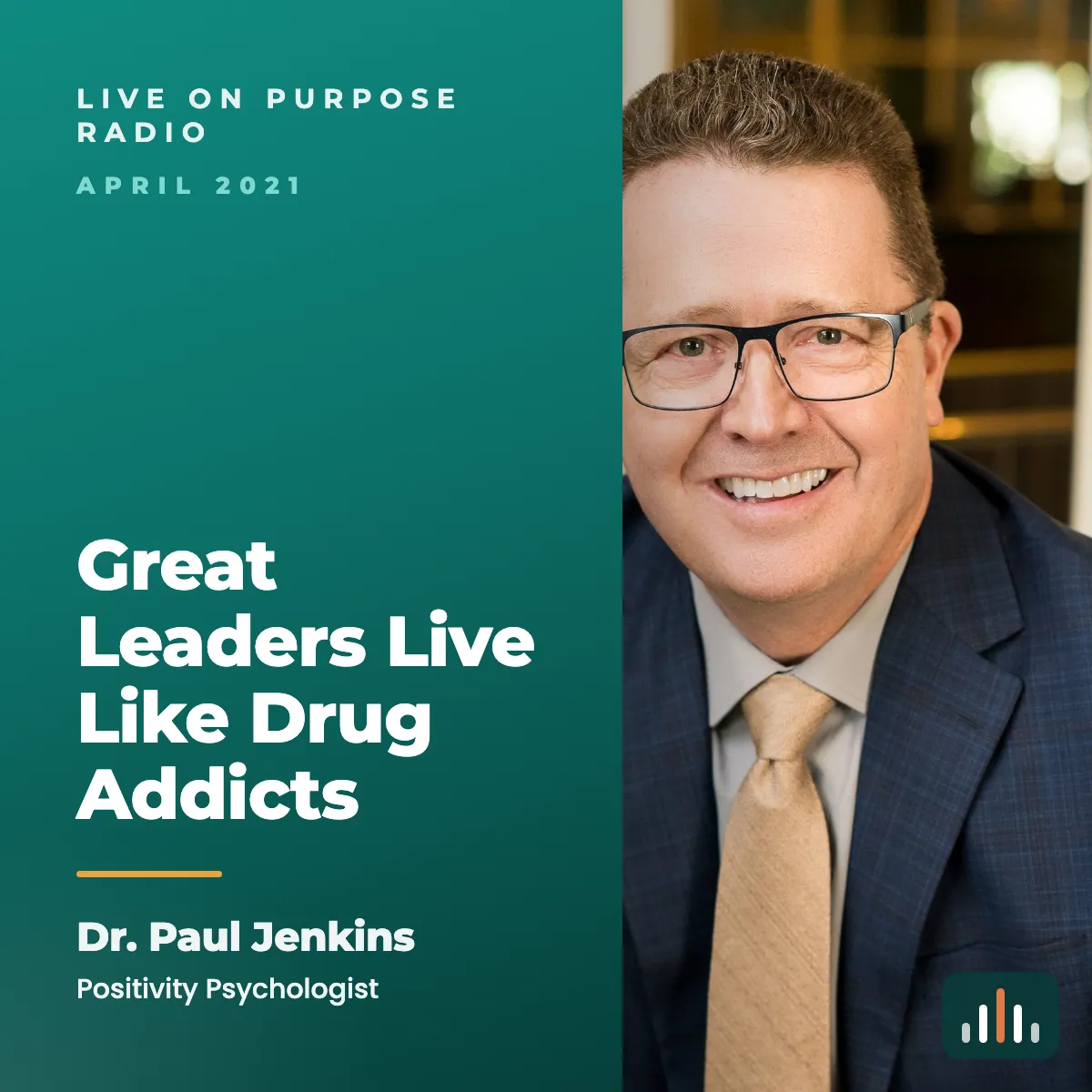
Episode 438
Great Leaders Live Like Drug Addicts
April 8, 2021 · 30 min
29:35
Listen on
Show notes
About this episode
In this episode
Michael Brody Waite joins Dr. Paul to explore what great leaders and people in recovery from drug addiction have in common. He shares three principles: practice rigorous authenticity, surrender the outcome, and do uncomfortable work. Listeners see how these principles can shape them as leaders, parents, and citizens.
Read the full transcript
Welcome to Live On Purpose Radio with doctor Paul Jenkins, where you will hear inspiring stories of ordinary people doing extraordinary things. Feed your mind with a regular dose of positive energy and show up for your life every day on purpose. Living on purpose means that you have a purpose and you do it intentionally. And now, here's your host, doctor Paul. Hello, everybody.
Welcome back to Live on Purpose Radio. This is doctor Paul, the shrink who expands your life with another episode of Live on Purpose Radio. Joining me today is Michael Brodie Wait. He is the author of a little book called Great Leaders Live Like Drug Addicts. And you don't have to, you know, get all nervous about, oh, is this gonna be an appropriate episode?
Yes. It's gonna be an appropriate episode. There's some things that Michael has discovered from his own adventures that will help us to learn how to do our own life better and what this show implies, to live on purpose. Michael, welcome to Live on Purpose Radio. Thanks for having me, dude.
I gotta hear a little more about the backstory because you've got reasons for knowing what you know. Yeah. So great leaders look like drug addicts. So first, let's talk about the drug addict part. So, for me, at the age of 23, I had been kicked out of college.
I've been fired from my job. I've been kicked out of my house. My car had been repossessed. I was throwing up blood. Even though this is really sad, it's kinda funny.
My doctor said the only thing higher than my liver enzymes was me. And... Yeah. Funny joke. But at the end, the only way I could fund my habit was by stealing from my friends.
And the only thing keeping me from living on the street was me overstaying my welcome on a buddy's couch. And when I looked at myself in the mirror, I hated who I saw, and I was so terribly uncomfortable to be in my own skin. And so every day from the minute I woke up to the minute I passed out at night, I was drinking and I was doing drugs, and I was doing anything to get out of my body and out of my life and out of my skin, and I knew that I would not live to see my thirtieth birthday. So that's that's what it was like for me at the end, and we can dig in wherever you want. But, like, on the other side, great leaders are like drug addicts.
So what do I wanna talk about when I talk about leadership? I know a thing or two about leadership. My clean date is 09/01/2002. I spent eight years working my way up the corporate ladder at a Fortune 50 company where... With a drug addict with no college degree, I had 19 direct reports and a $250,000,000 p and l in my twenties.
I left that company at the height of the recession here in The US to cofound a startup whose mission was to reinvent access to health care. We made it so you could schedule a doctor's appointment from a digital device in thirty seconds or less rather than have to make a phone call. Oh. And we grew that company, and it became an Inc 500 company, grew to a 20000% less than six years, and we sold it to a publicly traded company. I left that job or that company, and I took over a nonprofit that helped 2,000 entrepreneurs a year start to grow a business, and I did that for three years.
And during my stay there, I tried to take everything that I had learned about leadership, and I did a TED talk called great leaders do what drug addicts do. And about a year after I did, it went viral. It's got over 2,000,000 views in about 25 countries. And that inspired me to leave the nonprofit, my work there had been done, and write my book because I'm on a mission to revolutionize the rules of leadership. Because when I say great leaders of, like, drug addicts, I mean two different things.
I mean, when I look at the great leaders of our past, I see the general on the battlefield, the CEO in the boardroom. I see people that are fixing and managing and controlling perception just like a drug addict does. Yeah. They're doing it to chase the next success, promotion, high. The endgame's different, but the behavior is the same.
And when I look at the great leaders that are emerging in our present and our future, I think they will lead with true vulnerability and authenticity. The only type of authenticity that is real when you say I'm Mike and I'm a drug addict, and the only people in this earth that are systematically trained in how to live that way are addicts in recovery. Interesting. That's my intro. That's so so fascinating.
You... This is the same guy. You just told us two very, very different stories. Yeah. This guy that's climbing the corporate ladder and knocking it out of the park in terms of building businesses and leaders and and this guy who was mooching off of his friend.
Yep. Same guy. Same guy. At the beginning of my TED talk, I put a little picture of me when I was, high. And you can just see that that person doesn't even wanna be alive, and it's hopeless.
And I've got, like, bushy beard. I mean, I I didn't get... I was so poor. I couldn't even afford a belt to keep my pants up. I had to use a piece of rope.
And for me to be able to go from that guy to what I've had the great honor and privilege of the life that I get to lead, the only thing that I know that is the difference is I I entered recovery. And there's more than one way to recover that I respect, but I entered a 12 step program. And the thing I love about a 12 step program is they gave me a step by step idiot proof method to be able to systematically change who I was. And so now what I'm doing is essentially, I took that system. I applied it to not only my life, but my leadership.
I taught my employees how to live that way. And so now I go around the world teaching leaders how to do what drug addicts do in recovery because it actually makes you a much better leader. And I learned it not because it was expensive. It was just the, you know, the price of my life on the line. Mhmm.
Oh, there's so many different directions we could go with this. When people think that there's no hope... And you were at a point where you probably felt that way. I mean... Oh, I was trying to kill myself.
I was just too scared to do it the fast way. Right. Oh, and how tragic. I mean, so many people are in that position and they don't see that possibly the very characteristics that are driving that addiction could be steered in a direction that could become enormously productive for them and for other people. Yeah.
But you don't see it when you're stuck, do you? No. I... The only reason that I went to rehab was because my buddy... So, like, one of the things that would happen is every...
About every month, my dad would take me to breakfast. And he would say he wanted to buy me a meal, but I knew he just wanted to make sure that his son was still alive. Right. Like, I... Every time I say that, I still feel bad for what I put him through.
And he would offer to send me to rehab, and I'd be like, I don't have a problem. I don't have a problem. And and one of the big challenges was I lit... Just to see what you said, I literally could not see how life could be different. And the only reason I went to rehab...
There... We have a saying, come for the wrong reasons, stay for the right ones. The only reason I went was because I came back to my buddy's apartment that I've been crashing on his couch, and I told him. And he was, like, aggressively supporting me in going to rehab, but I could tell it was, like, he was tired of me stealing from him, wrecking his place. He wanted me out of his house, but he loved me so much he wasn't willing to put me on the street.
And so when I when I saw that, I'm like, okay. I'm gonna have to move. So I might as well go somewhere for twenty eight days where I know I'm gonna have a roof over my head and three meals a day, and then I'll figure it out after those twenty eight days. But when I got there and I was surrounded by a bunch of people that were sharing my story, it became almost impossible to ignore that I had a serious problem. But then when other addicts in recovery would come and share their story, I would see myself in them, but they would have a year clean, five years clean, ten years clean, thirty years clean.
I remember there were these two dudes that were, like... When they walked in, I was scared of them. They were, like, these hardcore biker gang. You know? Like, I'm like, oh my god.
These guys are gonna kill us. They must be high on whatever. And they started talk... They're like, hey. You know?
I'm Tim, and I've got fifteen years clean. And let me tell you about how recovery's changed my life. And I'm like, woah. Maybe it is possible. And I...
We have a saying. It it was the last house on the block. I was gonna kill myself if I couldn't figure a way to get clean. Wow. And even when I was in rehab, I didn't think I would stay clean, but I, at least, at some point, started to understand that there was the potential, the possibility because I could see myself in the people that came and shared the message.
And that's one of the reasons I go around the world trying to share my message today. It's a powerful message, and so many people need it. But you know what? I think our world needs it too. I...
I'm just thinking, Michael, what if you would have stayed in that place? And and, honestly, we lose a lot of people in that place. They don't, like, stay there. They exit at some point. Yep.
And, had you done that, We wouldn't have your book. I know. The lives that you've touched would not have been touched, at least not by you. No. I built a company, that had a game changing culture.
I have a daughter. I have a son. I have sponsees. The truth is is that, like, the book, I have to surrender what it does, but I already have fulfilled my objective with it because one... At least one person has read it instead of change their life, and that's all I really needed to accomplish.
Everything else is gravy. And and I'm 42 years old. I expect to be dead by 30, so I'm playing with house money. That's the way I look at my life. But when I look at the things around me...
And and and the thing is I'm not special. I'm just an addict that has a way of communicating a story that people, you know, respond to. But I got, like, a million addicts behind me that are doing the exact same stuff that I did. And our job collectively is to let the addict that's still suffering know that this is possible. Right.
I was, I was sharing my message last night. I actually did... I did a public speaking engagement for a a a university, So for a bunch of students, like a paid... You know, I do paid speaking. And then I went to carry my message to just another, to a twelve step home group where a buddy of mine was celebrating twelve years clean.
And one of the things that I was just struck by was I know that there had to be a student that was struggling with drug with drug addiction or some sort of addiction in that other in that other audience. And I know in my Tolstet meeting, there's someone that has a solution. And and our job is to understand and be able to communicate this very simple message. If you are out there and you're struggling with addiction, this is what I'm gonna tell you. This is what I said last night to the students.
They didn't get it. This is what I said to the addicts, and they did get it. The very best thing about me is my addiction. The best thing about me is my addiction because it gives me an excuse to live a principled life in a way where I walk around with a gun pointed at my head. I have unique motivation to practice these principles in all my affairs.
And secondly, I have a community of people that do the same because their life is on the line too. And so what I try to tell an addict is don't think about getting clean or sober as a surrender, as a bad thing. I consider it my superpower. Right. Imagine the worst thing about you being the best thing about you.
That's what happens when a drug addict gets clean. It's like you're succeeding because of this, not despite it. That's that's my personal message. A lot of addicts, stay behind their anonymity, and that's fine. But no one ever told me...
They always told me, hey. You can you can let addiction stop impacting your life. No one said that you can be uber successful in all the dimensions of life because you're an addict that gets clean and you have recovery. And so what I wanna tell anyone out there who's struggling is if you're an addict, do you like to get stuff that makes you feel good? Well, get you some recovery because it's gonna give you a superpower, and it's gonna give you a competitive advantage over the average person if you commit to that program.
That's the message I wanna carry. I'm guessing, Michael, that you feel better now than you ever did when you were high. We have a saying, my worst day in recovery is better than my best day using. Yeah. And you know the truth of that now.
I do. Oh, I love the story. I know that there are principles that have been revealed to you as you've gone through this journey. When we get into the second half, Michael, I'd love to have you highlight a few of those principles for us so we know how this has something to do with leadership too. Yep.
Yep. Guys, this is Michael Brodie Wade at Live On Purpose Radio. We'll be right back. Are you ready to take your positivity to a whole new level? I've been enjoying these conversations with my guests at Live On Purpose Radio.
My own story about becoming more positive is something that I've shared in my book, pathological positivity. And right now, I'm giving the book away. You just pay for the shipping. Go to doctor paul jenkins dot com, spelled with a d r, and click on the big orange button right there that will get you a free copy of my book. You pay the shipping, I'll pay for the book.
Sound like a good deal? Power up your positivity and get ready to see phenomenal changes in your happiness, your relationships, your business, every aspect of life. Enjoy this free gift from me, doctorpauljenkins.com. And we're back. Michael Brody, wait at Live On Purpose Radio today.
There's something about this story, Michael, that is so powerful. And thank you for bringing this message to our audience today. I know you've learned some some principles through all of that that you've you've linked up, you know, your experiences in in, the workplace, your experiences as an addict. You're not even separating those. Those are all part of the same grand experience for you, but help us to see what you've discovered in terms of these principles.
So I think, you know, in in today's world, authenticity is a very buzzy term. A lot of people are like, oh, I should be authentic. I should be authentic. I should be authentic. And they aren't, you know, like, I'm a Brene Brown fan just like a lot of other people.
But what I learned in recovery was a very practical step by step system that allowed me to lead myself, my true self, and stop hiding. And that's really why I did all the drugs to hide. Right? Right. And so I've done a lot of work.
I've worked with companies like Google, Dell, two... I've surveyed 2,000 leaders. I've trained a bunch of people, and I've been able to distill down why recovery from addiction and a step by... And a 12 step program is able to transform a regular leader that may not be an addict. And so there are three principles that form this system.
So the first one is practice rigorous authenticity. Not authenticity. Anybody can do selective authenticity. Anybody can keep it real in front of grandma and their best friend. I'm talking about when your job is on the line, when the relationship is on the line, when something is on the line, are you rigorously authentic?
Very big difference. That's what we aim for in recovery because we can't... Once we start hiding, we have addictive personalities. We start hiding all the time. Right.
So we have to be rigorous. We can't just be authentic on Instagram on Thursday and then post something that looks really great on Friday. So that's the first principle. And and that's the recognition that most people, 90% of people, admittedly, are not rigorously authentic. Mhmm.
Right. And that that includes leaders. So how do you actually become rigorously authentic besides being inspired? It's all about the second principle, which is surrender the outcome. This is what most people don't know how to do.
We just had an election in this country regardless of what side you're on. On election day, the only thing you had control over was casting your vote. But how much time and energy did we waste looking at the news, looking at cnn.com, trying to control something that we couldn't control? And so what addicts learn is that they can't control their addiction, so they have to surrender the outcome. And the way that we learn how to surrender the outcome...
So, like, practically speaking, if you are in a business negotiation with a customer Mhmm. You're worried that if you ask for the price that you want, they will go away. That's the outcome you're worried about. If you're in a relationship with your partner and you guys have a disagreement and you wanna ask for something that you need, but you're scared that it will make them go away, you're scared of surrendering the outcome. And so we focus on things that we can't control at the expense of the things that we can.
And that's what I wanna kinda teach the audience. I'm gonna give you guys a really simple tool on on what to do. But before I do that, here's here's the goal. It is extremely uncomfortable to admit that you are an addict. But once you are able to do that, you become good at doing what's called uncomfortable work.
And that's not smart work or hard work. That's intellectual or physical. We've all seen someone doing eight hours of hard work avoiding ten minutes of uncomfortable work. Uncomfortable work is emotional. It's a physical sensation that stops us from taking actions that are good for us.
If any of us here have ever avoided a difficult conversation that they knew they needed to have, you know what it's like to let uncomfortable work stop you from being the best you. Addicts, we don't have that chance because we can't hide. We have to be real all the time. If you're rigorously authentic all the time or else we'll go back to the drugs. So the linchpin in all of this is that's the middle principle, surrender the outcome.
I'll stop. I have a little I have a little tool that people can use to learn how to surrender the outcome, but I'll stop there and see if you have any questions. I am taking notes, Michael. What you've just said, I'm I'm doing a little later today. I'm doing a big parenting web class.
We've got a lot of parents on our YouTube channel who like to follow that, and you're almost point for point talking about what it takes to be an effective parent. Yeah. I'm learning that right now. And what's the difference between leadership and parenthood? I mean, honestly, there's so much overlap.
But being rigorously authentic, love it. It... It's not something that you just do out of convenience or when it's practical or might get you the sale. Right. It...
It's gotta be it's gotta be real. Well, otherwise, it's not authentic. Right? Right. Right.
And then you talk about surrendering the outcome. The wording that I use for that is detach from the outcome. And and it's the same concept. If you're so tied up in the outcomes, your anxieties go up, you actually start to do things that are counterproductive. And that's true in parenting, that's true in leadership.
It's absolutely true in the context of the addiction that you've that you've shared with us. So I don't know that I have questions as much as men. I'm loving this because everything that you're talking to us about as a professional psychologist, I'm thinking, man, that is sound. That is solid. That is based on everything we know about psychology and human relationships.
Well... And so thank you for that. And so here's the thing is... This is what I love about being a recovering addict is, there's a lot of self help and inspirational stuff out there, TED Talks, podcasts, books, where, you know, people get inspired by a concept of, hey. Practice rigorous authenticity, surrender the outcome, and do uncomfortable work.
But the question is, how do you actually practically execute that? How do you actually do it? So let's, like, let's use an example. Mhmm. So when I got out of treatment, I had to get a job or I was gonna get kicked out of my halfway house.
And I went and I laid down my application a bunch of places. I had all these gaps in my resume. I got one interview at a record store. And I knew that if I talked about my gap in my resume, I wouldn't get the job. So the outcome I was worried about was I wasn't gonna get the job if I showed who I truly was.
Right. And in that instance, if I didn't get the job, I couldn't stay at the halfway house, so I'd be on the street. So extra urgency for me. The way a recovering addict... The way my sponsor taught me to approach that is he said you have to surrender the outcome.
And then you have to tell them the truth, tell them that you are a drug addict that was using. That's why you have gaps in your resume that you went to rehab and you're in a halfway house now. That's true. I'm like, dude, I can't do that. Yeah.
But that's the rigorous authenticity, no matter what, but that dude, that is scary. Like, for anyone listening right now, you might not be a drug addict, but everybody can relate to being in a job interview and be... And not wanting to share the worst thing about them. Right. So how do you actually reliably and consistently walk through that fear and go do something that most people can't do.
And so it all comes down to a really simple tool, and this is what I teach my people. And I'm... Actually, I wouldn't I wouldn't doubt that you teach something almost very similar. So I tell people to take out a piece of paper and write can't control on the top left and can control on the top right. Draw a line down the middle.
And so when they think about the outcome, so in this instance, I'm worried about the job... Not getting the job. I tell them to write three specific things about the situation that you can't control on the can't control column. Mhmm. So for me, I couldn't control that I was an addict.
I couldn't control that, the manager was gonna ask me about my work history, and I couldn't control how he would respond when I told him my answer. Right. Those are three specific can't controls on the left hand column. On the right hand column under the can't control, think of three things that you can control about the situation. Well, I could control how I told him.
Mhmm. I could control when in the interview I told him. Mhmm. And I could control whether or not I was gonna start my professional career as a recovering addict under a lie. Those were the things I could control.
Right. And so right at this point, a lot of people start nodding their heads, and they go, yeah. I get it. I need to let go of things I can't control. I'm like, yeah.
But most people still don't. So what is the missing piece? Knowledge is not power. Action is. And so then what I have them do is I have them go look at the first thing in the can't control column and read it and then put an x through it.
And then read the second one, put an x through it. Read the third one, put an x through it, all in the can control column. And as you do that, you're engaging your body and your mind in physically releasing the outcome that you are scared of. And then you go to the can control column, and you circle the first one. You read it.
I can control this. I can control this. You circle all three. And by the time you are done, you're not thinking about the outcome. You're not thinking about what you can't control.
You're aware of at least three things that you can, and that is where you would then identify what your uncomfortable work is. And for me, my uncomfortable work was simply to tell the manager that I was a drug addict and why I had a gap in my resume. Mhmm. And I did, and I still got the job. And that's why I'm convinced that people hide themselves out of fear of the outcome unnecessarily.
And that's why I'm on a mission to show people how to do it in a practical way. You put yourself in the position of the person who's hiring you in this circumstance, and what do they truly value? As you're talking about this rigorous authenticity, k, do you want someone working for you who's truthful and authentic, or someone who's fake and phony and lying? Okay. That's huge.
Right? I mean, yeah. And from from a business perspective, a lot of the people I talk to are either... They either are coming back from, like, you know, prison time or something bad or they're brand new to the workforce. Yeah.
And you know what your value to someone who's hiring you is your ability to be coachable? Well, guess what? If you demonstrate that you can be rigorously authentic, you're coachable. And if you demonstrate that you hide yourself, you're not. And so by hiding yourself to look good, you're actually showing the person that you don't have what it takes to be a successful employee.
Nobody wants an employee that lies. Nobody wants an employee that says, I know how to do this when they don't. Nobody wants that. I also want employees who are going to focus on what they can control, not what they can't. Yes.
These are life hacks. Yes. They're also really sound advice for success in leadership, in parenting, in business and, and big surprise. Who is it that's engaging in those activities? It's a human.
It's a person. Yes. So as we identify these these life hacks that allow us to live on purpose, that's the theme of our whole show here, it changes everything. It's a transformation. And I'm going back to something you said earlier, Michael, because I don't think I don't think you became a different person.
I think you figured out how to drive the one that you are. Yeah. Is that fair? Yeah. I cover...
I I took all of the things that were covering up my true self Mhmm. And I was able to systematically remove them. And then I was also able to see who I truly was and then use this process to become the person I wanted to be and and grow in the areas I needed to grow. I didn't start off being a good father. I I had to learn how to, you know, be...
Or we'll we'll ask my daughter if I'm actually a good father. But we'll...... Working on that. Right? Yes.
Still work in progress. But, like, people... You know, when I'm going around, I'm talking to people, they'll say, okay. So how do I know who my true self is? And I'll tell them, I don't know, and I don't know who my true self is either.
The way you identify your true self is you systematically identify all the moments in when you're not being your true self. I know when I'm not being true to me. I know that if I was to tell that person to Sam Goody at the record store that I'm that I'm not an addict, I know I'm not being true. And by catching myself where I'm hiding myself time and time again, you start to really uncover who you truly are. Right.
And you can tell by how it feels inside of your skin. Literally in your body. Yeah. Like, it's it's a sense of tingling sensation in the middle of my gut when it's a knowing. And when it's...
When I'm hiding myself, it is a, like, rapid heartbeat or breathing in that high high part of my chest. My body literally is an indicator that lets me know if I'm pretending to be someone I'm not. So the book is great leaders live like drug addicts. And you've got a little insight to that, folks, as we've talked to Michael Brodie Waite today here at Live On Purpose Radio. I know from my experience, Michael, that there are people who are hearing this who will feel to reach out to you, to connect to your book.
Where's the best place for them to go so that they can do that? Sure. If you want the book, just go to greatleaderbook.com. Greatleaderbook.com. Great leader book.
You can... We're on, you know, Amazon and Barnes and Noble and all this other kind of stuff, and there's some information. And you can get... Actually, if you go to greatleaderbook.com, you can get a thirty minute intro to the book. I read...
I'm the narrator, for free if you just give us your email. And then if you just wanna learn more about my story and how these three principles are changing the lives of others and how it could potentially change a life for you, you can also just go to michaelbrodywait.com. That's b r o d y w a I t e. So michaelbrodywait.com. You can also Google me.
No one else has that jacked up last name. So if you put it in Google, it'll come to me. That's the one benefit of having that name. They'll fight you. Yeah.
Michael doesn't help you so much, but then the Brody Wait part. The Brody Wait. Yes. The Michael did not. I grew up in the era of Michael Jordan, Michael Jackson.
Yeah. No. Michael Mann. You name it. But, the Brody Wait Alps.
Awesome. The website once again, Michael Brody, b r o d y wait, w a I t e. There's a.com after that. The book is great leaders live Like Drug Addicts. Michael, thank you so much for contributing today here at Live Unburger Radio.
Thank you for having me, man. It's time for all of us. I know you've been inspired like I have. Let's act on that inspiration. It's time for us to go live on purpose.
Open the transcript on its own page ↗Practice this every morning
Positives is Dr. Paul's daily practice membership: short morning audio messages that anchor your focus before the day derails you.
See PositivesNew here? Start free
The Positivity Power Pack turns the ideas from the show into a seven-day practice.
Get the free Power PackKeep listening
Related episodes


New to Leadership & Success?
Start here in Leadership & Success



Free for listeners
Take the show home with the Positivity Power Pack
The fastest way to put Dr. Paul’s model to work. Everything below lands in your inbox, free.
- The Portable Positivity minibook and companion workbook
- The Unique Abilities video lesson
- Seven guided audio messages, one for each morning of the week
Send me the Power Pack
The full pack, straight to your inbox.
Get the free Power PackFree. Takes one email address.