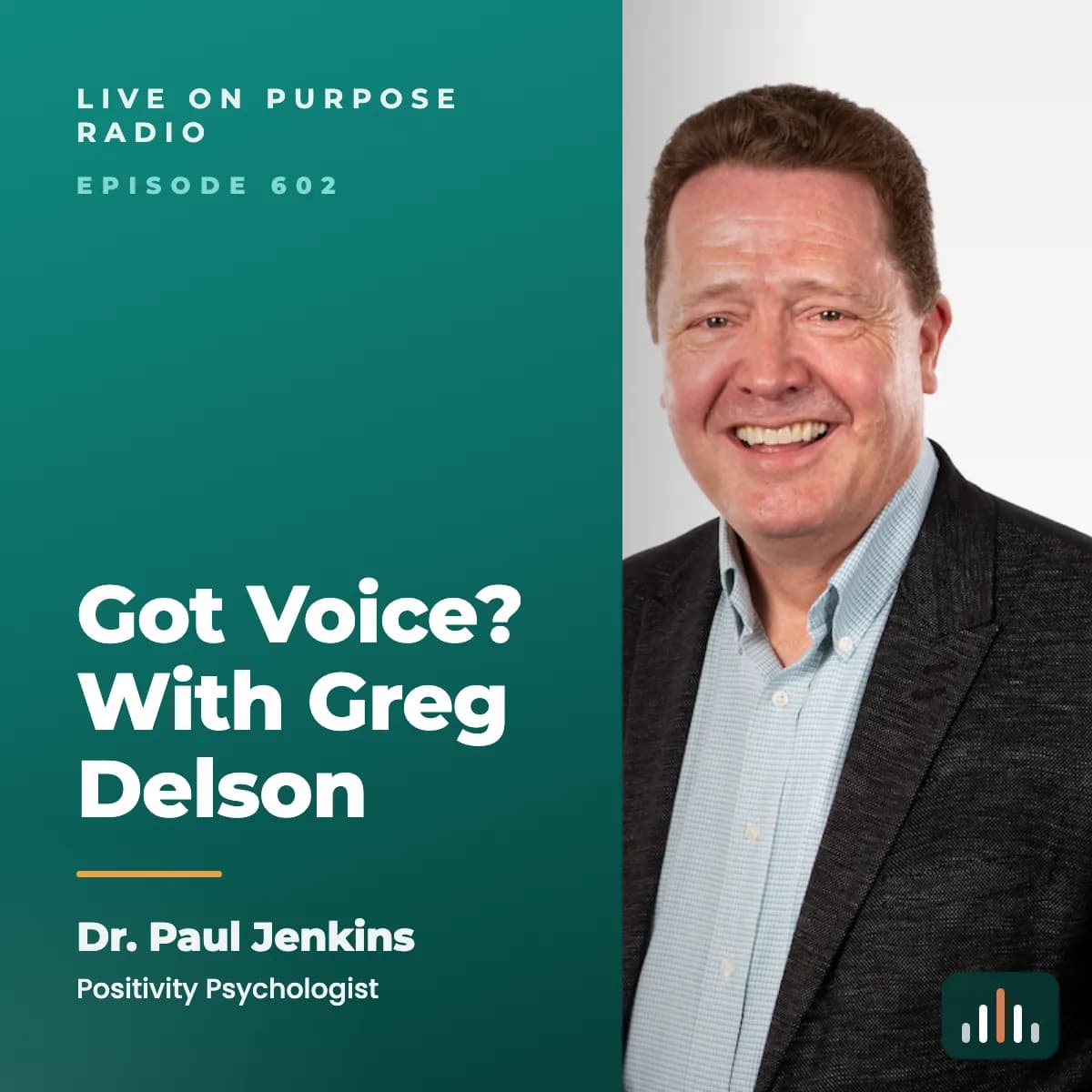
This is Live On Purpose Radio episode 602 dot voice with Greg Delson. Now is the only time to create and live the life you love. I'm doctor Paul Jenkins, the positivity psychologist. My job is to connect you to powerful positive psychology principles that immediately upgrade your relationships, business, and mental health. Are you ready?
Let's jump in. Hello, everybody. Welcome back to Live on Purpose Radio. This is doctor Paul, the shrink, who expands your life with another episode of Live on Purpose Radio. Joining me today is one of my heroes and a new friend.
This is Greg Delson. Now let me tell you just a little bit about Greg, and then you get to hear from him. He is an expert. Now I've I've said before you don't have to be the expert. You just need to be an expert.
And Greg is an expert in the area of voice. This caught my attention for some reasons that we will discuss as we get into this episode. And, his expertise goes back to a master's degree that he completed in music education, but then he went on to complete a three year diploma in vocal science and pedagogy from the Complete Vocal Institute in Copenhagen, Denmark. Greg knows your voice, and now he heads up the Landlight Center for Voice in Los Angeles. Greg, welcome to Live On Purpose Radio.
Thank you. It's so nice to be here. I'm glad you're here. I've been anticipating this conversation for a little while, and I've already shared a little bit about this with our podcast friends. Folks, you might remember two episodes ago.
Episode 600 was about retire the diagnosis. And if you haven't listened to that episode, go listen, and I'll give you a little more context there. But the short version is I have carried with me, for the last twenty two years, a diagnosis called spasmodic dysphonia. I even wrote about it in my book, pathological positivity. It has been a big deal in my life.
Now spasmodic dysphonia is a neurological voice disorder similar to Parkinson's disease, but affecting only the voice. It originates in the basal ganglia of the brain. It affects the innervation to the vocal folds and causes spasms. That's the quick version. And in March 2024, when I met Greg Delson, I retired that diagnosis, and that's what episode 600 is all about.
So now I get to interview the man, Greg Delson, voice educator extraordinaire here on, on my podcast. Greg, I know I tell my version of this story, and I did back in episode two... Episode 600. I... I'm curious what your version of this story is.
Yeah. So first of all, it was so much fun meeting you because you just have the most infectious personality, and I was just so glad to meet you. But I was working with a lot of people in that... On that day. So Right.
A lot. We had been talking about voice. I gave my presentation. I put everyone into workshops, and we did a lot of fun things around the voice. And everyone had an opportunity to come talk to me.
So I had a lot of conversations, and you were one of them. And here you come up to me, this friendly, outgoing, talkative guy who then launched into this whole conversation about this diagnosis you had and what you did to treat it and how it's caused you all this trouble and, you know, hardly about the years. And I'm listening to you thinking, okay. You're... You just told me you're, like, at around 600 podcasts.
You public speak for a living. You have YouTube videos. And I and I just asked you. I said, well, do you speak? And you said, yes.
And I said, so tell me, because I'm not a medical doctor, just how does that diagnosis serve you? How does it... How is it helping you? He said, it's it's not. I said, is there anything that carrying that around and telling me that story is going to change anything?
Like, is there something you can do about it? And you said, no. The treatment actually was terrible, and you... It causes one to lose their voice. And I said, okay.
So I'm seeing a man who is speaking to me, speaks for a living. And I said, you speak. So, I was very fortunate to study in Denmark for years, and they're very straightforward. And Yes. They would just...
I I had that kind of coursing through me because they would just say, okay. And what what does that mean? You know? Like Uh-huh. What's the purpose?
And I just asked you that one clarifying question. How is it serving you? And you said it's not. Then I just watched the wheels turn in your head, and then the next thing, I knew you had retired your own diagnosis. And Right.
This brings up something that I work with everyone with. Obviously, you have a very particular case, but everyone I work with has been given some type of diagnosis by their parents, their loved ones, a teacher, a choir instructor when they were younger. And most people were told, including this person right here who is a professional voice educator and vocalist, at one life that you're not a good singer. You weren't meant to sing. You don't have a good voice.
Does any of this sound familiar? So let the professionals do this. Yeah. Who sings that song? Let's stick with that person.
So our culture, there's a lot of misdiagnosing of, ability or talent declarations when it comes to our voices. So Right. I've learned through research, and this is what I spend all my time doing, is that everyone can sing. If you can speak, you can sing. We have one voice.
It's the same mechanism. The reason that you don't sound as good as some professional singer is because you've never been taught how. The voice is part of our body, And to do singing in a very sophisticated way that sounds pleasing, some people naturally kind of just intuit that and come to it. But most of the rest of us have to learn. And I have so many analogies.
We can dive in if we want, but my favorite one is the sports teams. When kids are six years old and you put them on the soccer field, and there's that one little kid who can dribble up and score a goal, and then they dribble up and they score another goal. And, yes, that kid is naturally, quote, unquote, talented when it comes to soccer. But the other kids who aren't doing that, should we tell all those six year olds that they shouldn't play soccer? No.
Of course not. We teach them. We coach them. We give them drills. We teach them how to kick.
We give them practice, scrimmages, and that's a normal thing. But for some reason with singing, we've been fed this lie that you either can or can't. And Right. That's another misdiagnosis. It's more...
Essentially, you've learned or you haven't learned for the vast majority of people. And there is not a single person that has come to me who I... Even people who are completely beginner singers who cannot learn, I have taught people who come to me and they cannot even match pitch. And then I have them performing on stages for hundreds of people because they put in the work. There's still work and learning that has to be done, but I just want everyone here to know it is 100% possible to become a great singer no matter what you at some point of your life to the contrary.
You know, Greg, my twin sister... At the time of this recording, my twin sister is going to have a birthday on Monday. And I remember when she turned 50, I signed up for guitar lessons. Now this just popped into my head as you were sharing this, and I've heard you talk about this before. Our voice is an instrument.
The guitar is an instrument. Now should I say, well, I'm just not a guitarist. Or do I choose to play the guitar and then I do... See, the choice is essential, but not sufficient. So then I get to hire an instructor, and I get to put in some reps and and get my hands on that instrument.
And at first, it it was very unskilled, but that skill grew as I practice. So it it just occurred to me that you're talking about an instrument. I'm talking about an instrument, and language is another wonderful analogy. Were all of us born to speak the language we're speaking? No.
We acquired that language. And after a certain age, we do need to cognitively learn languages. But could I not learn Japanese right now? Of course I could learn Japanese. Will it be challenging?
Yes. Absolutely. So the real... What it comes down to for any of these skills, and singing is one of them, is two things. Well, it's really three.
First is the inclination. Do you want to? Right? I... People listening right now may not believe me when I say, yes.
You could be a great singer. But if you don't really want to and to go on that journey of learning, then you never will be... Just like any skill. But if you want to, then we have two things. The first is coaching.
You need to find someone or some program or some school that can give you the information and the exercises that you need to develop that skill. The third thing is practice. You can learn all of the information in the world, but if you don't apply it and practice and used focused learning and iterative practice to grow that skill, then you also won't improve. It's just as simple as that. And I will say with singing in particular, the coaching thing is a little bit of a roll of the dice.
There are people... Coaches out there, all incredibly well intentioned, who may not have the education or teaching type that best suits you to improve. So just because you lessons with... This is... This has come up a lot.
There are people, well, I took I took lessons for six months, and I didn't improve. That is not a condemnation of you or your ability to learn to sing. It is a a clear demonstration of the fact that that teacher was not the right teacher for you. So please do not give up with any skill. If you find that you're not improving after a certain amount of time and you are practicing, then the variable is the coach.
And I say this with love because coaches are wonderful people. Teachers are wonderful people, but not everyone is going to be the right teacher for you. So I don't want anyone here to ever give up because they're not growing. They should take that as a sign to make a change, find a new coach that maybe has a different philosophy or pedagogy, and try that. And with with all due respect and grace for the instructors who are out there offering these services, they too have been programmed.
Yes. And so... And whatever they've been taught is what they're going to share with you. It's just like when we're talking about language earlier. Right?
We don't choose to speak our native language. We are programmed, and we are programmed by people who didn't give us a choice. And that's not a bad thing. Let's just acknowledge that's what it is. And, Greg, the thing that I love about your philosophy, because it's it's so much resonates with me that we can retire old worn out inaccurate thinking just like we can retire a diagnosis, and we can latch on to something that is not only more useful, but also, I think, more true to the resilience and and just magnificent nature of the human body, including the vocal mechanism.
And you're you're setting aside some of those old tired traditions because you've had the courage to ask more pointed questions and to actually find out, is this really true? And it all comes down to growth mindset. So when we have a fixed mindset, we think, well, this is just the way it is. But when we have a growth mindset, you're right. We ask those questions.
Am am I missing something? Could I improve? Could I learn something new? And I already had a bachelor's degree in music and voice, and my voice was not working for me the way I wanted. I felt very limited.
This was when I was younger, much younger. Here I have all this education and training, and I was still losing my voice when I performed in shows. I didn't feel like I had a consistent instrument. And rather than just thinking, well, maybe I've hit my ceiling on how good I can be, which, by the way, I was told by someone. Somebody had that opinion for you.
Yes. I thought there must be more. And so I researched, and I found this institute in Denmark that was doing things totally differently. The Complete Health Institute in Denmark is a science based research institute. So rather than just taking dogma and passed down learning from hundreds of years ago, they use science.
They put cameras, which, ear, nose, and throat doctors have these cameras that can look down people's throats. And they looked with the cameras while test singers sang for years, and they saw all of these patterns, and they saw things that became peer reviewed published science. And from that learning, we now have such a new modern understanding of our voice that is so much more freeing and, empowering and limitless than what has been passed down for hundreds of years. And, again, if that works for you, great. I'm not knocking it.
But as the Danish would say, well, if it's not working for you, then why are you still doing it? So... And I have people... You know, I don't... I'm afraid to try something new because I was told this is way it is.
And I say, well, is it working for you? And a lot of times, singers will say, no. I lose my voice or I go hoarse or I I... My voice cracks in the middle of concerts. I say, okay.
So what you're doing right now is not working for you. You can stick with that, which is kind of a fear based thing. Right. If you feel like there might be something else out there, take the chance. And there's no worse that can happen.
You know? It's like, just learn. See what a new way of thinking might lead you to. I did it, and it changed my life. This was many years ago, and I was so blown away by how powerful this system, this methodology of understanding and teaching the voice was that it ignited in me a mission to share it with the world.
So that is what I am doing. Yes. I coach a lot of people one on one, but I... You know, you know, I give workshops. I give talks, lectures.
I I turn people into choirs, and my whole philosophy is let's sing. Let's learn how to use our voice in a healthy way that is enjoyable and empowering rather than something that makes us feel self conscious and insecure. And the difference there is just learning. Learning and... Is so empowering.
I know that, as you're listening, dear listener, you might be thinking, oh, if only Greg could coach me. And your wish is granted. In fact, I'm just gonna take a little pause here from a... For a word from our sponsor, who is Greg Delson today. Greg, you've got a course that you put together.
It's called the life changing singing course, and you have graciously made that available to us. There's a link in the description, you guys. Basically, you're you're going to go to singing.easiestcourses.com, and then use the discount code doctor Paul because as a listener to this show, and thank you for this, Greg, you get a discount on something that's already on sale. At least at the time of this recording, it's on sale. So act fast while supplies last.
And now back to our show. Oh my gosh. I love it. And, yeah, that course is, just a year's worth of work, and and my whole mission for it was to get this information out to as many people in an economical way that they can learn. And there's over a 100 videos on there that are all explained to multiple learning types.
You get to watch me teach someone else. You get to hear me explain it and demonstrate. There's practice videos. I put so much love into it because my goal really is for the whole world to gain the self efficacy and the joy of singing and not feel like it's something for someone else. It can be for you.
You need the inclination. You need the coaching. In this case, it's the course if you want it, but you also need the practice. Right? And then, of course, you could your goals.
And this thing that maybe you thought was never possible to you is possible. K. I have to chime in about the inclination part. Yeah. Because, dear listener, as you're listening to this, you might think, no.
That's not for me. I am not a singer. Well, that's okay. Greg's not looking for singers. He's looking for humans who have a voice.
And one of the things you can do with that voice is sing. Now why would you wanna do that? I know a lot of people express intimidation. Greg, last last week when you, visited our inner circle meeting, we talked a little bit about intimidation because, unfortunately, our culture has morphed singing into performance. And performance implies judgment because everybody's scrutinizing and judging.
Are you a good singer or are you a bad singer? Well, you suggested that we just retire the idea of singer and just look at singing as an activity. And you might recall, Greg, that I mentioned, a visit that I made last year to Kenya with my daughter. And as we interacted with the beautiful Maasai people there in Kenya, They greeted us with song, and everyone was singing. It's not a judgment kind of a thing.
It's a community, energetic kind of an experience. And there are very compelling psychological reasons to consider adding this, especially if you're afraid of it. Now I'm saying that as a psychologist. If this could stretch you a little bit and open up new possibilities for you to experience a joyful life, then I think you should consider it for that reason. Now I just thought I better address the inclination part of this formula.
I don't know. Is there something you wanna comment about related to that, Greg? There is so much there. There is... So in my in my master's at Boston University, this is the research I did.
There are so many studies that show the psychological and physiological benefits of singing and especially group singing. It really does lower stress. It makes us feel... You know, there's an epidemic of loneliness in this country right now. It's one of the...
Group singing is one of the things that gives us the feeling of community quicker than almost anything else. You're right. There are cultures all over this world that don't think of singing as a performative or industrial type of thing, music industry. Mhmm. They think of it as a way to bond and share community and to feel good.
And when you talked about the not assigning ourselves identities, this is something I talk about all the time. Don't tell yourself that you are a singer, a good singer, or a bad singer, or this person's a bad singer, this person's a good singer. You hit the nail right on the head. It's all about getting rid of the noun and just doing the verb. Sing.
Right. You may, be beginning your journey of singing. You may be on your journey of learning how to sing. These are all verbs. You may be more advanced and more experienced in your experience of singing.
But you see how this puts us on a continuum of learning a skill rather than a valid judgment of good or bad. Good or bad is fixed mindset. A skill and a verb is growth mindset, and that's where all the richness and growth in life comes. Right. Everything that you want that you don't currently have is outside of your comfort zone.
Yes. And if it feels a little bit of a stretch to go there, then that, for me, becomes the reason to do it. It expands our experience. And I'm with you, Greg, because I have I have participated in the activity of singing my whole life. In fact, I remember telling you in March, it doesn't affect my singing voice so much, this voice disorder that I carried for so many years, just my speaking voice.
And do you remember how you responded to that? I don't. I remember how I would respond now, but you tell me. Do you remember? Well, what I remember is you told me I only have one voice.
That's right. Yeah. That's the biggest thing. We only have one voice. When we look inside with a camera and we're speaking or singing, it looks identical.
Same mechanism. The difference is holding vowels longer enables us to hold notes. Right? When we speak, it's very staccato is what the musical terms would be. It's very, broken up into little bits.
When we sing, amazing grace. Right? We have that. You hear I'm holding the vowels? Yeah.
Vowels is what singing is, but I'm still saying amazing great. Right? I could say amazing grace, but I could sing amaze. What's the difference? What was singing?
What was speaking? Well, the other thing different with singing is we put things on a melody and to a rhythm, whereas when we speak, it's a little more random. That's it. There's no change. So my number one tip that I give people for when they're starting to explore singing is just speak the song in melody.
Don't think singing because your brain's probably gonna have you do something very different than that normal voice that you're using throughout the day. Right. That's a great place for beginners to start is just to speak it. Amazing grace, how sweet the sound. Then you extend it.
Amazing grace, How sweet the sound. Then you put it on a melody. Amazing grace. How sweet the sound. I'm already halfway there, and I haven't, quote, unquote, sung anything yet.
Right? Where do we draw that line between speaking and singing? And I think what I'm hearing from you is there doesn't have to be a line. There doesn't have to be a line, and you can get more musical, more stylistic. But if the tone is starting from a place of the voice that you use every day, it's gonna automatically be more comfortable.
It's gonna feel more you to start. Right. Of course, we can play, and we can get all sorts of sounds that we don't use in our everyday speech. But I always usually find a way to get people there. You know?
But then maybe you were yelling at your dog a little bit, and you get that that no becomes the thing that gets you into that louder voice or a really surprised and happy, oh my gosh. What a beautiful day. If that gets you into the higher part of your voice without thinking, I have to sing higher now Yeah. That's gonna be a freer way to get there. And, of course, there's so much more to it, but I love little easy ways in for people to just experiment and play.
When it comes down to it, let's play. It doesn't... It's just singing. It doesn't have to be so serious. I love that.
Folks, are you ready to play? Are you ready to play? Because Greg is ready to educate, coach, teach, and, yes, you can have Greg Delson himself help you through this. Remember the life changing singing course that I mentioned earlier. So did they get the website right, Greg?
It's singing.easiestcourses.com. And then just type in the discount code doctor Paul, and you'll get a nice little discount on something that is already so reasonably priced for a life changing product. Yes. And they can also go to my Instagram, just my name at greg delson. On my Linktree there, there's an easy...
Just link straight to it if they don't wanna type it through. Yeah. That's beautiful. And then your your other main website is landlights.com. And, that tells more about the other work that you're doing with, groups and and choirs.
In fact, you run a choir in Los Angeles that doesn't even require an audition. Yes. We are the largest... No audition choir in Los Angeles now. We actually have a waiting list.
So, I'm opening more of them. That's the plan because I want everyone to be able to sing. So it's a... Just a joyful... I call it...
It's a social group that sings rather than this choir. And there's no... No one has to have any experience. I I created it with the whole purpose of getting anyone who wants to to join. So there's no auditions.
No one read... Has to read music. No one even has to know how to sing. They just have to wanna come, have fun, make some music, make some friends, and it's really become one of the most joyful things that I do. It's twice a year in the spring and the fall.
And right now, it's in the Los Angeles area, but it's coming more to come. Yeah. Stand by, folks, because we haven't heard the last of Greg Delson. Thank you so much for your contributions here, Greg. It's always joyful experience to visit with you and to share your gifts and talents with our people here at Live on Purpose.
Thank you. Thank you so much for having me, doctor Paul. I'm such a fan of everything you do. You are a bright light in this world, and that's what we need. So kind.
And if you're ready to apply what Greg has shared with us today, it's time for us to do just that. Let's go live on purpose. Did you get what you came for? Give yourself the gift of taking real action on what you realized today. Please share this episode with someone you know would value it, and leave us a rating too.
It's time now to live on purpose.
Open the transcript on its own page ↗