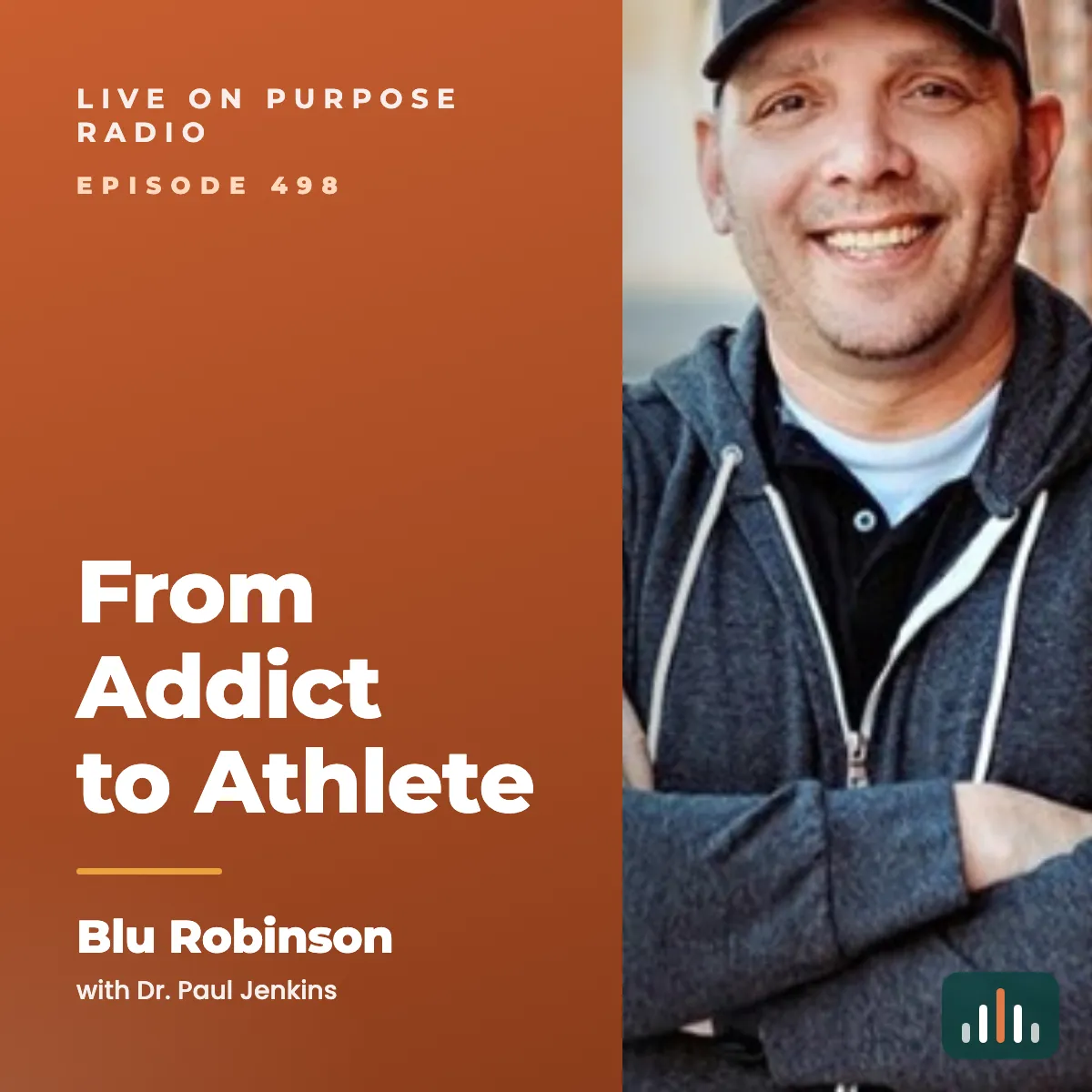
This is Live On Purpose Radio episode four ninety eight from addict to athlete with coach Blue Robinson. Now is the only time to create and live the life you love. I'm doctor Paul Jenkins, the positivity psychologist. My job is to connect you to powerful positive psychology principles that immediately upgrade your relationships, business, and mental health. Are you ready?
Let's jump in. Hello, everybody. Welcome back to Live On Purpose Radio. This is doctor Paul, the shrink who expands your life with another episode of Live On Purpose Radio. Joining me today is my friend and someone I've known for a long time since he started his enterprise.
This is Blue Robinson. He is the founder and head coach for Addict to Athlete. Blue, welcome back to Live On Purpose Radio as a returning guest. Man, what a privilege and honor, doctor Paul. Thank you so much.
And, yeah, we go way back. In fact, Addict to Athlete just turned 11 last week. So we've been doing this for eleven years. It seems amazing. But eleven years.
You've been there since the beginning. Eleven years. I've been I've been there since the inception of act... Addict to athlete, and I've become a corporate sponsor for your group, Blue, because I love the philosophy of erase and replace and how your mess becomes your message. Yes.
Those things really resonate with me because I don't think that having an addiction or going through a recovery process means that your life has to suck now Yeah. Or that you you don't have an opportunity for some kind of greatness or inspiration. In fact, it's just the opposite in my experience. When you apply the principles that you teach in your program, addict to athlete Mhmm. This can become the starting point for something amazing.
And I know you've got a lot of stories about that. Yeah. Yeah. Tell us, Blue, why you're so passionate about this and what it is that that has you believing, in this different form of addiction recovery. That's a great question, Doctor.
Paul. And from personal experience, having struggled with addiction myself in my younger years, I found that when, when life started kind of hitting me hard, I started realizing and feeling less than, I bumped into a crowd of folks that said, hey, we've got something that will that will kind of let you know, sidestep some of those feelings. And I took advantage of it. And through the process of really kind of getting in connection of a cycle of addiction that my family in and of itself kind of processed through, I took a step out and said, this isn't where I wanna go. I could tell real early that if I didn't change my my trajectory, that I wasn't going to hit any kind of target that would be meaningful meaningful for me.
And so by doing that, I stepped away from the addictive cycle from my family system, which caused a lot of turbulence. And and, you know, that's a crab in the bucket kind of mentality where the crabs try to get out of the bucket... The the basket. And right before they're ready to reach freedom, one boat reaches up and grabs it not so fast because it's trying to get out. I got out of the system of the dysfunction and started really working on myself to find out where this is coming from and realized that this is kind of an amazing process.
This isn't as easy as as I think the naive parts of me thought it would be, but it was so meaningful. And I took what I went through, applied it to situations that I felt I could benefit my clients in as I went through and and, you know, from a high school dropout, getting back into high school, finishing my degrees, did things I never thought possible. And I thought, this is kind of an interesting thing. If I can do it, why can't they? I wanted to change the way that society viewed people with addiction.
I didn't want them to call them addicts anymore because, you know, you're not an addict. It's a part of you, not who you are. And I really wanted them to stop, stop needing to hide the anonymity factor. And I get why those traditional meetings, you'll work with anonymity. But now I think in 2022, anonymity has a cloud of darkness to it.
Why not share the tools and the resources that you have by being very open about it? And it takes a lot of courage to do that. But once people realize that you have a powerful story and that you're not afraid to share it, they share their stories. And then, accumulatively, the healing process begins. And so really to step out of the darkness into the light, I found that people with addictions have amazing stories if they'll just get out of their way and show it.
I love that. The, the power of the story. Mhmm. I think that's because all of us can relate Yeah. To the strong feelings that we have about this or that.
Many of the the addictions that we get into, Blue, are based on, you know, some form of avoidance of those feelings. We want to change our mood and stop feeling some of the pain or the difficulty Right. That we feel. But we all feel pain. Yes.
But it's who we are as humans. Yes. Right? Yeah. Absolutely.
Love about what you just shared, Blue, is that, there's there's a shroud of shame and guilt that is associated with you mentioned anonymity. When really, as we as we authentically share our human experience with other humans and we can relate, that's another way to to process or handle the pain that is sure to happen as part of, you know, living here on the planet. Yeah. It is. And you've tapped into that through through your unique approach.
Erase and replace, for example. This is one of your mantras Yes. At, addict to athlete, and the name implies it. Yes. Let's take the addiction thing and let's do something else to manage the feelings that we have, and athletics or physical activity is one way to do that.
There's other ways too. Yeah. But talk about that for just a minute if you would, Blu. What? For sure.
The the power of, shifting that energy from something that is destructive or maladaptive Mhmm. To something that is more productive but still helps us to manage those feelings and emotions? Absolutely. Thank you for asking because that's actually a a big foundation of what we do. And it it even goes right down to that symbolism of our name.
And it's interesting because people read that and they're not quite sure what it is. But the cool part about it is there's a lot of meaning behind the choice of the name that we that we adopted moving from addict to athlete. And the Roman numeral specifically is a big part of this because in the Roman numeral system, they do not identify with zero, which means you can never have less than one. And I love that concept because so many times we feel like we're nothing and sometimes we feel like we're less than nothing. Well, the Roman numeral system doesn't allow that.
So once you realize that there's one, which is either you, your higher power, whatever it is, once you realize that there's one and you add something to it, maybe it's yourself, maybe it's the adaptation of that higher power, maybe it's a trusted friend or family, once that establishes two, that becomes the foundation to build on. You can build off the Roman numeral two because it's a pillar system, which means that there's a foundation now. Right? You move out those those two numbers apart and you put something on top of it. You now have structure.
You now have something to build on. So the name in and of itself reflects that. And what it shows is that you don't have to just be labeled an addict. I think labels, Doctor. Paul, you and I have the same philosophy with this, both having, you know, the ability to diagnose people with with with mental disabilities, you know, addictions, all this stuff.
If we label people, they have a... They... They're kinda prone to become that. So I wanted to change the perception of, hello. I'm blue.
I'm an addict because I'm not. Hello. I'm blue, and I've had an addiction. But I'm also an athlete, and I'm a father, and I'm a son, and I'm a brother, and I'm a scholar, and I'm an artist. If we typecast ourselves into that one paradigm of addict, we're going to always kind of perceive ourselves in that dark light.
So I wanted to leave it behind symbolically by now building on that. I don't call my my clients or my athletes. I don't call them addicts. I call them champions because that's what they are. They're overcoming something through being victorious in sobriety, and it comes with challenges.
You win some and you lose some. But that's just that's life. What we call something matters. Exactly. Because it determines how we show up for that thing.
Mhmm. So you consider, for example, we... Our pets, for example, we give them names. We interact with them. There are cultures that would call my dog lunch.
Exactly. Yeah. And not to, you know, disparage or demean those cultures. It's just part of their culture. Yeah.
But notice what you call something determines how you interact with it. Exactly. We call ourselves an addict, this... Blue, this is something that really resonated with me and why I became a corporate sponsor of your organization Mhmm. Because I had been to the meetings.
Yeah. As a professional psychologist and for a couple of, personal connections that I've had, I've I've attended several 12 step meetings. And the tradition there is to introduce yourself as an addict. Yeah. And and the labeling always bothered me.
I think the principles are sound. I love For sure. What they're doing in those 12 step programs. Yes. But I think the labeling is what caused the resistance in my mind.
Yeah. If you declare it and you own it, it determines your behavior. And I think I think it came from a desire to, you know, let's stop being in denial Yeah. Of of a real problem that we get to deal with. Mhmm.
But we can take it too far, and we can take it on as our identity, which is a problem. Mhmm. Whatever... It's like giving the marching orders to our brain. Yeah.
It's like telling our brain, here's how I want you to interact with this. And if it's me, I'm an addict. Okay, brain. Go find all the evidence that that's true and treat me that way. Yeah.
Yeah. And then allow it... Allow yourself to be treated that way. And that's... Doctor Paul, again, that's...
I... We're not bad mouthing the 12 steps. They're guaranteed to work if you authentically work them. They are guaranteed. But there's also some, like you said, some terms and some language that that I don't jive with.
The first being that we're powerless over this. I do not believe that we're powerless over this. So first, that's the first line. And the first step is that we're powerless over our addiction. And yes, your life has become unmanageable, but powerlessness also reflects that.
What can you do about it then? You have zero power. Kind of a victim mentality. It is. And I don't want to ever teach that because I want to say, you know what?
You even showing up, you wrapping your fingers around that doorknob to turn the knob to open the door is the essence of power. And I really wanna capitalize on that because even asking for help, that's the epitome of power. Them sitting in that chair is the definition of power. You're taking it back. I don't wanna convince people that they're less than or weaker than than what they authentically are because look at what they're doing.
You You follow me? I love that. You know what, Blue? There's a false tradition out there that if I am truly powerful, then I can do this myself. Yeah.
Yeah. That is so misguided. Exactly. I had a guy in my office. I was...
I still remember this from years ago, and he said, well, you know, I'm so embarrassed to be here. And I'm like, why? Yeah. Well, because I've... I feel like I've failed.
I should have been able to handle this myself. He's talking about depression and some addictive tendencies that he had and whatnot. I said, really? Like, yourself? Like, do you do anything yourself?
Like, get dressed in the morning. Do you do that yourself? He rolled his eyes. He's like, of course I did. Really?
Really. Really. Using what? Clothing that you made from fabrics that you put together from fibers that you harvested? Yeah.
Wait a second. He's like... You know, he still didn't get it quite. But the point was that there were hundreds of people who helped him get dressed. So true.
So true. I asked him, can you can you sign your name by yourself? He picks up a pencil and I'm like, wait. Where did that come from? Yeah.
How many people collaborated to put that pencil in his hands? Exactly. That morning. See, we don't do anything ourselves. It's a myth.
I love it. Your power doesn't have to do with doing it yourself. Let's just get that out of our head. Exactly. Your power has to do with...
I love the image that you created for us just now, Blue. You turn the doorknob. You enter the room. You get your feet moving in the direction that puts you in the company of people who already have stories and experience. Yes.
And it's your power that puts you in that room. Yep. Powerless? Yeah. I'm with you on this one.
Not even close. Not even close. And that's that's the fantasy. And I get it. And I understand the humility and the aspects of why it's so important to understand that because you want to be, I guess, to a certain point, meek, you know, when it comes to approaching this.
But I'm thinking that was, it's a it's a gone era. If we're not fortified, if we're not conscious, if we're not aware, we'll get sucker punched and it'll it'll get us. So, I mean, right now, doctor Paul, so so intensely. Like, right now, the CDC released information yesterday saying that we have a new record of people being lost to addiction. Last year, we we we approached a hundred thousand people last year that died.
From 2021 to 2022 of this year, We've now estimated because final numbers haven't come in yet, but already exceeding one hundred and seven thousand people died last year from an overdose from substances. That means there's one person passing away every five minutes. It's like a seven forty seven falling from the sky every day, and we're not noticing. And so my goal is to help people understand that there's a life worth living, that that these aren't throwaway people, and that we have to do our best to give them power and to show them that that there's more out there than just hiding because we're losing this battle. We were kind of getting pushed around out here.
We're the underdog on the field here. And this big bully addiction is trying to take us, but we can out, we can outplay it. If we tune in, if we start playing and putting our heads in the game. The power is in the choice. Mhmm.
And until we see it as a choice, it's not. So true. Which is one of the things that is so difficult about addiction because there are some chemical properties of some substances that actually create dependence. Yes. And that robs us of some of our power to choose.
Mhmm. Having said that, there's also always the next choice. There is. And you can empower yourself. Blue, I love what you're doing with with addict to athlete and how you're enriching and even saving lives through the work that you're doing, and I I compliment you for that.
Before we wrap up today, I would love to give people a little sense of how they can connect to you and to the powerful programs that are actually sponsored and powered by Live on Purpose Yes. Which I'm proud to say. I've been a I've been a a very proud corporate sponsor of Addicta Athlete since you started and, just love what you're doing. But could you tell our listeners a little bit about how they can connect to that? If they or someone that they love in their family or in their friend group is struggling with an addiction of any kind, how how do they connect to this this magic?
Absolutely. The best way to do it is to jump on our website because it has links to everything and everywhere we go and do. And that is addict, t o athlete dot org. And you can find all of our resources on there from the events we're holding. We have a proxy run coming up in September, right down to our sober sobriety coaching, meaning we'd love to train people to become independent coaches of Team Additive athlete through our recovery coach program, and that's connected right through Live on Purpose as well.
Because as you probably heard doctor Paul talks about listeners, the troops aren't coming. We are the troops, and it's gonna be us that kind of turn that mess into a message. So jump on Addicts TO athlete dot org. Check out all of our socials. Our emails are on there, phone numbers, all that stuff, backlog content.
It's all free for your for your choosing. Jump on and check it out, but that's where you'll find us. It occurred to me as you were sharing that, Blue. And, again, that's addicttwo,to,athlete.org. It's a nonprofit organization that is doing a lot of great in this world sponsored and powered by Live On Purpose.
And, Blue, you've also got a podcast. Yeah. I don't think you mentioned that in the in the string of things that you said they can connect to, but That's right. The Addict to Athlete Podcast Yep. Where I have recently been a guest.
You have. And that's the beautiful thing about Addict to Athlete Podcast is we have we have quite a few episodes of with professional athletes right down to the athletes I coach. I host one that doctor Paul, you've been on a guest show to, Savannah, my daughter. She's host the minor league podcast, which is a teen's perspective on on, you know, just all things teenagers. And it's kind of fun being able to cope with life through the perspective of a teenager.
And then we have, the agents of recovery podcast, and that is with myself, NFL football player, and BYU quarterback, Max Hall, and a former law enforcement officer who was injured in the line of duty, Brock Bevel. And all of those can be linked on our website as well. Wonderful. Thank you for the good that you're doing, Blue. My pleasure.
You've heard it, folks. You may have someone in mind that you know would benefit from this conversation and from the work that is being done by the good folks at Addict to Athlete. I would encourage you to act on whatever you're feeling inspired to do. As we wrap this up, it's time to go live on purpose. Did you get what you came for?
Give yourself the gift of taking real action on what you realized today. Please share this episode with someone you know would value it, and leave us a rating too. It's time now to live on purpose.
Open the transcript on its own page ↗