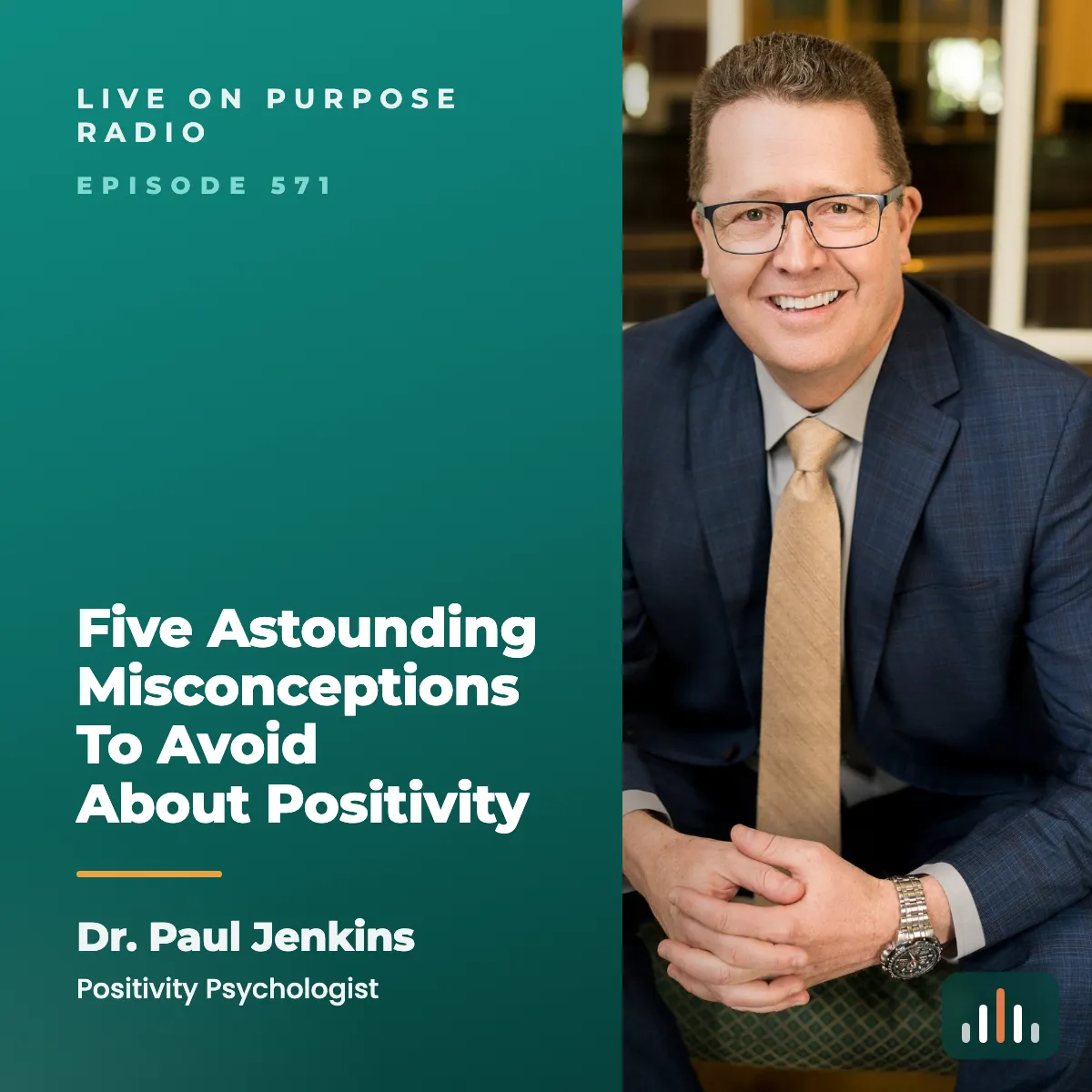
This is Live on Purpose Radio episode 571, five astounding misconceptions to avoid about positivity. Now is the only time to create and live the life you love. I'm doctor Paul Jenkins, the positivity psychologist. My job is to connect you to powerful positive psychology principles that immediately upgrade your relationships, business, and mental health. Are you ready?
Let's jump in. Hello, everybody. Welcome back to Live on Purpose Radio. This is doctor Paul, the shrink, who expands your life with another episode of Live on Purpose Radio. As we get into today's topic, let me start by saying I am a black belt in positivity.
And you've heard it everywhere. Right? Just think positive, but that can be so dismissive and trite and fluffy unless you understand what positivity actually is and what it is not. As a professional psychologist, I have committed the last half of my practice so far to positivity, defining it, creating models about it. For me, it's all about understanding how to operate the equipment of your own mind, and there are a lot of misconceptions out there about positivity.
So I'm going to share five of those that I've identified in today's episode along with the truth about each one of these misconceptions. You know, several years ago, before I wrote my first book, pathological positivity, I was consulting with a number of colleagues and with several people that I trusted who had made a name for themselves in the industry. And, one of these colleagues, I won't even say who it is because I proved him wrong, But he's a brilliant psychologist. He is a consultant to many, big companies and top clients. And he said to me, you know, I think positivity is kind of a flash in the pan.
I wouldn't go down that route if I were you, Paul. You might wanna find a different topic that's more sustainable and less saturated. Well, I took his advice and then ignored it. Because I think the word positivity gets thrown around in ways that create some of the misconceptions around it, and he was referring to some of that as he was giving me the feedback. It was important to me to get past the tripe, fluffy version of what positivity is all about and actually get into the science.
What's going on in our brain and in our mind when we talk about positivity? And that's where my model was born. So let's go through these misconceptions, and then I'll try to clear each one up as we go too. Here's misconception number one. Positivity is ignoring or denying the pain.
Okay. This misconception has actually given rise to a lot of talk out there in the media and in social media about toxic positivity. Now the title of my book is pathological positivity. That's a different concept. But this idea of toxic positivity is what fuels the misconception that positivity is ignoring or denying the pain.
Just paste on a smile and proceed as if there is nothing to be concerned about. The reality is... The truth is that true positivity embraces pain as an important part of the human experience. But the difference might be that when you really assume a positive attitude, you don't see the pain as the problem. The pain is simply an indicator and a really important one at that.
In my book, I wrote about a condition that some children have where they are born with, a lack of pain sensation. It's called congenital analgesia. And these children are at a very, very high risk for injury or harm that comes because they don't have the indicators in place to help them monitor their behavior. See, pain helps our brain to do its job. Our brain has two main jobs, to keep us safe and to prove us right.
And if you don't experience pain, your brain is gonna have a really hard time doing job one, keeping you safe. Pain is important. Pain is part of our human experience. So in a in a positivity mindset, we don't see the pain as a bad thing. We see it as an important indicator that helps us to take action and actually keeps us safe.
So that's misconception number one. Let's move on to misconception number two. And I've heard this from so many people. You know, positivity is not for me. I'm a realist.
Okay. First of all, that's defining a realist as being something different from someone who practices positivity, and that's a little annoying, actually. Those who claim to be realists are often negativists in disguise. They're they're pessimists. They expect and predict the worst case scenarios, and they call themselves realists.
You know, I was interviewing, someone on my podcast years ago, and I apologize for forgetting her her name right off the top of my head. But she said, you know, I like to think of myself as an equal opportunity realist. And what if we could do that? What if we could give at least equal time to the potentially positive outcomes or interpretations of our events? And since we don't actually know...
I mean, think about it. Do you know what's coming? How are you doing next week? You don't know. Now you've got some guesses and predictions and anticipations about that.
So notice that and own it. But since we don't actually know, what would happen if we chose a position that serves us well? Think about that. Positivity is really more of a position. It's not so much about how you feel or even what you expect.
It's about a position that you take relative to things that you don't know and you can't even prove. So let's put that one to rest. All of the realists who think that that's separate from being a positivity practitioner, let's just become equal opportunity realist to start with and then choose a position that serves us well. Alright. Let's move on to misconception number three.
But before I get to that, I don't often ask you as a listener to share this podcast, and I know some of you do. Would you think of someone who could really enjoy or benefit from this episode and just share it with them? I would appreciate that. And, also, if you could just go to wherever you receive this podcast, we're on several different platforms. But if you could leave a review, I would appreciate that as well.
Would you do that? Okay. Let's move on to misconception number three. Positivity is unnatural, and that's why it's so hard. Okay.
Here's the truth. Positivity is only hard because default is down, and that doesn't make it unnatural anymore than work is unnatural. See, there's this concept that comes from physics, actually. Do you remember in your high school or college physics class learning about the second law of thermodynamics? Now this might sound a little goofy because here's a psychologist talking about thermodynamics.
But the second law of thermodynamics is also called entropy, and, basically, what it means is that everything naturally progresses toward a more disorganized state. So, for example, if you were to drop a carton of eggs, those eggs would naturally progress to a more disorganized state than what they were in before you dropped them. This is also true if you dump out a jar of marbles. Okay? It goes to a more disorganized state, and things don't just spontaneously hop into the jar.
In fact, that seems really weird when when we play videos backwards, for example, and you see the person flying up out of the pool and becoming dry. K? You know that it's backwards because the natural laws of thermodynamics say that everything progresses toward a more disorganized state. So if it happens other than that, it seems backwards. So let's go back to the misconception.
Positivity is unnatural. That's why it's so hard. No. Positivity is only hard because default is down. And the second law of thermodynamics says everything progresses to a more...
Toward a more disorganized state. That means that elevation requires effort, and light requires power. That's how it works. You never hear of someone falling up. Gravity is on, and it pulls you down.
This is true in our psychology as well. Positivity is only hard because default is down, and we get to work against gravity to go to a more elevated state. So that's misconception number three. Let's move on to misconception number four. People who say positivity is a choice are so annoying.
They don't understand the real difficulties of life. Okay. That's a misconception. The truth is this, until you see it as a choice, it isn't. Let me repeat that.
Until you see it as a choice, it isn't. People naturally default to their training or their early programming or to a course of least resistance. Remember, we talked about that in misconception number three. Default is down. Current thinking and research supports that positivity is not only a learnable and trainable skill, but that once we become aware of our choice in the matter, we actually have choice, and we can exercise that choice.
Remember, until you see it as a choice, it isn't. So back to the misconception, people who say positivity is a choice are so annoying. Well, it's a little annoying to to discount those who say it's a choice simply because we don't yet see it that way. And we're going to use a lot of grace and forgiveness for people who say that because they don't see it yet. And until you see it as a choice, it isn't.
This is one of the reasons, incidentally, that I get so passionate about certifying positivity practitioners. How are we going to know? How will people know that it's a choice unless there are competent practitioners of positivity out there spreading the word about this? And it's not just the tripe fluffy version. We've gotta get down to the actual operation of the equipment of our own mind.
Alright. Let's move on to misconception number five. Positivity doesn't really change the outcomes. It just makes you feel better about whatever the outcomes are. You you know, this one...
This particular misconception, it's understandable, but it reminds me of some of the experiences of... I've had recently in working with my son who has cancer, and we were meeting with the pain doctor. And she's the one who handles all of the pain medications and tries to get them on the right mix. And there was there was one particular medication she said, you know, I'm not sure that this one actually changes the pain. I think it just makes you so you don't care that you're in pain.
And I thought that was kind of funny, actually, so did my son. But is positivity like that? It doesn't really change the outcomes. It just makes you feel better about whatever the outcomes are. Almost like we're diluting ourselves or giving ourselves some kind of a Band Aid that says, well, life sucks, but we can get used to that and not feel so bad about it.
No. Here's the truth. We've known for a long time that there is a correlation between success and happiness, but we got it backwards. For so many years, those findings were interpreted by many people to mean that when you are successful, you are happy. What we're finding upon further review is that it's the other way around.
That when we are happy, we are more successful. Now that might make sense to you on the surface. After all, success is defined as happiness. If you're happy, what else do you want? But we've also found that people who choose a manner of thinking that contributes to their subjective happiness also are more likely to achieve other measurable aspects of success.
It's like the happiness actually sets us up for or gives us the energy to go create all of the other things that we use to measure success, like achievement or finances or relationships. Those things are affected, but the outcomes do change when people are able to master their mind. And you will see this all over. If you go read any personal development literature, if you follow podcasts like this one, you're going to hear a lot of people talking about the power of positivity as we've defined it here in actually changing your outcomes. I also love this particular quote.
I can't even remember where I first heard it, but when you change the way you look at things, the things you look at change. Oh, I remember it was Wayne Dyer that I first heard that from. He was probably quoting someone else, but it does have a measurable impact on other aspects of success. It's the most fascinating thing. And aren't you glad?
I mean, aren't you glad to know that, that it actually does make a difference? Positivity is not the trite, fluffy version that you hear from motivational speakers or gurus on the stage. It's solid science about how to operate the equipment of our own mind, and it's with that mind that we evaluate our circumstances the way they are right now without changing anything, get into a good energy about that, and then use that as the starting launching point for what we are going to create. How cool is that? Positivity, it's taking a bad rap sometimes for the misconceptions, but it's also something that we have shown through research and clinical experience to be one of the keys to our very success and happiness.
I hope you've enjoyed this episode, and you can find some way to apply it. It's time to do that now. Let's all go live on purpose. Did you get what you came for? Give yourself the gift of taking real action on what you realized today.
Please share this episode with someone you know would value it, and leave us a rating too. It's time now to live on purpose.
Open the transcript on its own page ↗