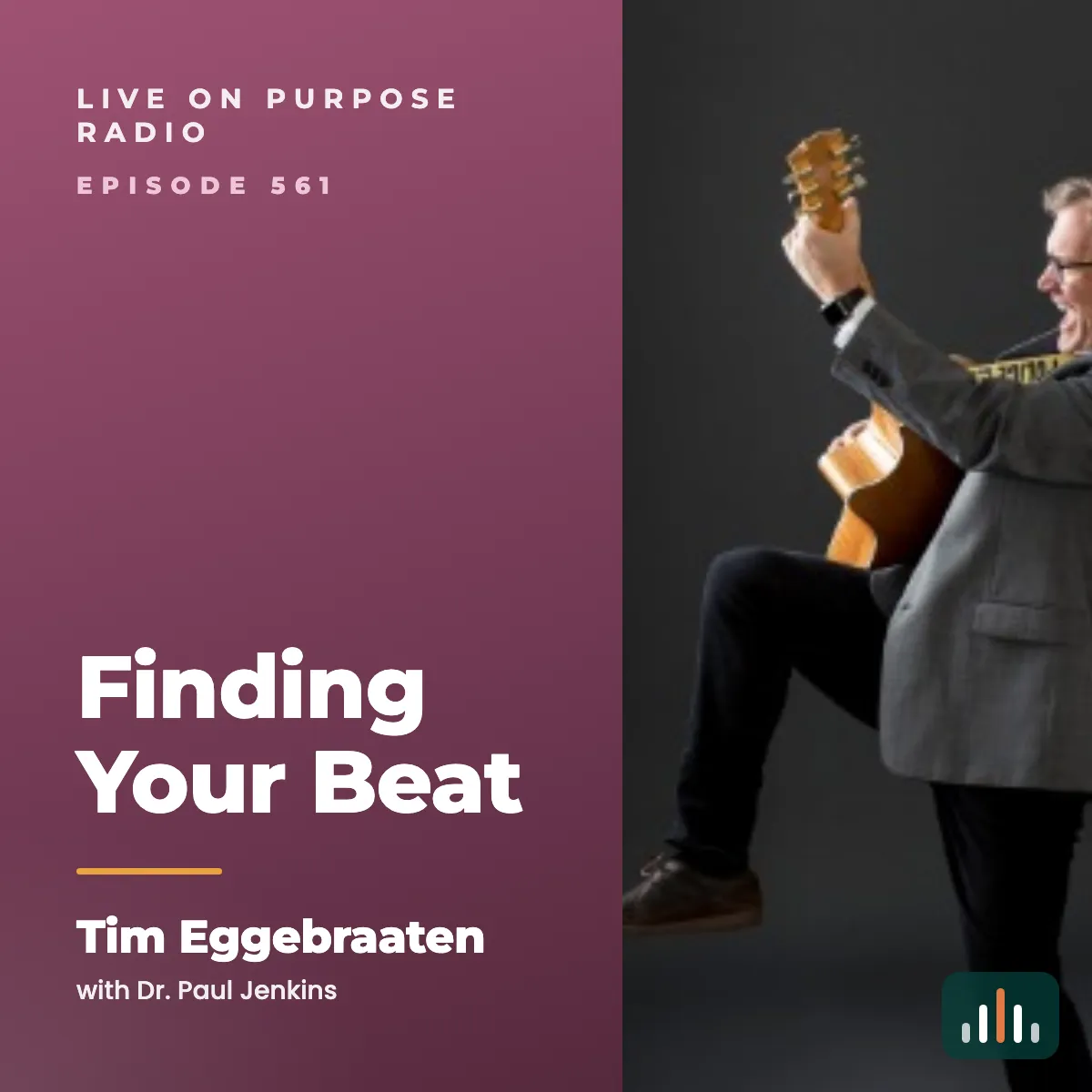
This is Live On Purpose Radio, episode 561, finding your beat with Tim Egebrata. Now is the only time to create and live the life you love. I'm doctor Paul Jenkins, the positivity psychologist. My job is to connect you to powerful positive psychology principles that immediately upgrade your relationships, business, and mental health. Are you ready?
Let's jump in. Hello, everybody. Welcome back to Live on Purpose Radio. This is doctor Paul, the shrink, who expands your life with another episode of Live on Purpose Radio. Joining me today is Tim Egebraten.
He is probably better known as the off duty chief. And I encountered Tim recently when we were both attending the National Speakers Association, the main event, influence two thousand twenty three in Orlando, Florida. And, Tim, when we talked... And it was just brief that we were able to interact there. I think we're in a little breakout session, and and, we made a little connection there, and it was immediately apparent to me that you have figured out how positivity can help people to, as you call it, find your beat.
Right. And as an... As the off duty chief, you've spent couple of decades in law enforcement. And, of course, law enforcement is known for its positivity. Right?
At least that's how we do it. Absolutely. But, Tim, welcome to Live on Purpose Radio. I'm excited to have this conversation with you. Ah, thank you very much.
I'm equally as excited. It's just, when you meet like minded people like that that, you know, you think you're all alone in those thoughts of your positive thinking, and then when you meet people like yourself that that actually put the science into it and it it helps, justify and reaffirm what I've been talking about for quite a while. And, so you put the the muscle behind it by the the science, the actual applying and the techniques and everything. So I'm just... I'm excited for the the whole conversation.
Well, you know, positivity is one of those things that gets thrown around a lot. It... It's touted from the stage or motivational speakers who just think positive. Right? I mean, they they throw it out there as if they know exactly what it is, and most of them don't.
Right. Exactly. And one of the things that caught my attention about you, Tim, I think I might have shared with you in Orlando that I've committed a portion of my career to serving the law enforcement community. Mhmm. In fact, this week as we're recording this episode, I'm heading out later this week to Fort Collins, Colorado, where I'll get to spend a full day with their school resource officer unit and, training them on what else?
Positivity. Yeah. And it... It's been so interesting to me, especially in the law enforcement community, that it's populated with actual humans. There there are people behind every badge.
Right. Unless they're canines, and we know that there's other types of officers out there. But, there there there are people behind the badges, and people operate according to certain principles. Sometimes it's easy when life beats us up or gets messy to lose sight of those principles and get offbeat a little bit, if we were to say it that way. Yep.
I'm just curious, Tim, what you have noticed that has turned you on to this and why you're so passionate about it now. Tell us a little bit about your story. Oh, absolutely. And, again, thank you. So I was in kindergarten, and I knew I wanted to be a police officer.
It was something... It was just I was called to, and I always wanted to be a cop. And, I started in law enforcement in the late eighties, and I worked in corrections for a few years and and a police officer in Detroit Lakes, Minnesota. So we're straight East of Fargo, North Dakota, kinda Northwest Minnesota, and had twenty five great years in law enforcement. But I noticed early on in my career that I started to change.
I was really getting into the the police officer mindset, you know, and I bought into The Us versus them mindset. Mhmm. And I was falling into it, pretty deep, you know, where it was it was not only the the cops versus the the defense attorneys and the bad guys. And, but I started believing that my administration had lost sense of what it was like to be a cop. My family didn't understand.
The citizens didn't understand. And it was... I was really getting into that Us versus them. And, you know, through... And my parents raised me to be very positive.
My my mom and dad were the most positive people on the planet, so that was uncharacteristic of me to to get into that us versus them, mentality. And and early on in my career, I met a man that... Kind of a homeless traveling man that was coming through town, and and he changed my world just by by being himself, this kind and gentle man. And, he made me recognize that my... I I love music, and so all my...
A lot of my my, references are musically based, but this this man made me recognize that my rhythm was offbeat and my life rhythm and that if I didn't do something about it, that I was gonna be one of those statistical burnouts, and I didn't wanna do that. I I knew that there were things that I could do in my life to, keep that rhythm and that harmony and and still be a good police officer. And and, but it's it's challenging when you're in that culture, whatever the culture is, you're in that culture. It's challenging to remember, the good that's out there and... But it's critical.
It's... So so I... When I retired about six years ago, after nearly twenty eight years in the criminal justice field, I I began speaking with organizations about about finding your beat and using some positivity. And and, and the first couple sessions, you know, that I speak on, it was... They were loose, and I I didn't really understand what my message was.
But now I am so fired up about it, and a lot of it's because of this I am, I can, I will, that whole mindset of of attitude and and then using the tools that are out there on ourselves to, you know, beef up our physical, mental, and spiritual health and? So we can be better service to other people. Such a rich story. As you're sharing this, Tim, I'm reflecting on some of my own experience. And I think law enforcement, criminal justice, that whole industry is a really great test case because any industry is going to have some negativity in there somewhere.
Right? And you described this mentality that comes up, kind of The Us versus them. It's the whole world is against us kind of a thing, almost a paranoia. And you can see why that would develop in a law enforcement setting because, obviously, you have to be prepared for anything. Right?
And, tactically, you know, you've you've gotta have a plan in place. Or what if somebody jumps me from behind? Or what if there's a sniper on that roof over there? And so just to keep us safe. See, our brain's main job is to keep us safe.
Right. And then its next job is to prove us right, and both of those get us into trouble all the time. Yeah. But you can see why, practically speaking, that would come out, especially in a in a law enforcement scenario. But the problem is then as we practice that mindset...
I think you used the word mindset there. As we practice that mindset, it starts to generalize, and it sticks its little fingers into every aspect of our life. And it can be destructive, to the point of just stealing our joy where life is not that enjoyable. Right. Yeah.
Have you found that as well? Oh, very much so. You know, I've I've read statistics, and I've I've known a lot of cops. When when police officers are hired, they're scrutinized, they're screened very well. So the new police officers are physically fit, mentally fit, and and they're grounded.
But then, like, six years into it, there's alcoholism, there's divorce, there's, you know, a lot of things. So something's happening early on in the careers of these police officers, and a lot of it is that that us versus them. And how do you... You know, it's easy to say when you get home at night, you just wipe your feet on the on the doormat, and then you walk in, and you, you know, you pet the cat, and you give your your spouse a hug and... But it's not that easy.
You're you're dealing with... You know, nobody calls 911 to say that Billy got an a on his report card. You know? It's Right. You're dealing with, people's emergencies constantly.
And so it's it's challenging, and that's where the whole, this positive psychology where these tactics, you know, the gratitude, you know, practicing daily gratitude. You know, what what is going well in my life? And and reflecting on that and mindfulness and meditation and, all of these techniques, we need not to make the officer susceptible out in the street, you know, to to being injured, but, you know, finding that balance of being alert on the street and looking for that possible threat, dealing with that possible threat, but then also recognizing that that that person is a person. They're making mistakes. They're doing whatever.
And it's not indicative of society as a whole. It's, we we can just narrow our scope down so much where... And we all do that. We can... Like, oh, this is, you know, if we get stuck on on Facebook and you're reading the comments, you think, oh, the world has gone to heck in a handbasket.
It isn't. It hasn't. And Right. You know? And so forcing ourselves to break that chain, break that cycle, and recognize that, you know, maybe maybe filter some of that negative filter where we're getting our information from.
How much do we need? Do we need to watch the news and then listen to it on our radio in the car every day and and just being... Hearing all that that negative stuff where, yeah, there's bad stuff happening, but there's also a lot of beauty around us. And, and, you know, I always tell people it's not like you're you're burying your head in the sand or you're just putting on the rose colored glasses like, oh, everything's sunshine and lollipops, you know, because it isn't. But that being said, it's not all doom and gloom.
And, so so what you are doing, doctor Paul, and and with this podcast and by, that little book that you gave me, that there's no pocketbook. Awesome. You know? And it... And it's just, it just, like, recertifies everything that we hear throughout our lives, but maybe we forget because we're we're deeply embedded in a...
In an emotional part of our lives, whether it's, you know, you're feuding with family members or some tragedy has happened in your own personal life. So... And that can distract us from that there's some really good things happening out there, and there are techniques that we can do, daily. I know sometimes, like, when I was working the night shift, I would get... I'd get in a funk, like, for weeks, and and I would just flip there through the channels, and I would drink a lot, lot of alcohol.
And, and then today, like, these days, the the funks are few and far between. But if I start feeling myself into a a grayer area, I can apply these techniques. I can turn from looking inward, and I can look outward. How can I help people? And I'm a volunteer for hospice, and so I...
I'll bring my guitar to these people that are near or at the end of their life, and I play some music. And I'm not thinking about me and, oh, poor me. And when you think about somebody else and you you recognize what you have going great in your life, it it can pull you out. And it just, it's so... I always say it's simple, but it's not easy.
It's not always easy to write somebody a letter saying, you know, doctor Paul, you inspire me. Thank you. You know, I wanna write you this letter and send it. Simple but not easy. That's...
You know, we might as well have been in the same career because I'm using some of the same words. And it's interesting to me every time I have these conversations, Tim, that we can arrive at the same conclusions from very different angles and paths. Because as you pointed out earlier, my career has been in professional psychology, and I started out with fifteen years in traditional psychotherapy. Also, not a very happy place, incidentally. I mean, our our objective is to to help people be well and more healthy.
But when you're constantly dealing with the pathology and with the problems and with the the trauma, it it creates a negative cast sometimes on everything else. And I love the way that you pointed out that we've got both. I mean, there's great things happening, and there's some scary things happening. But when you look at the percentages... You know, it was interesting.
I had Amanda Dixon on this show years ago. She's a local news anchor on the radio. So her job... And she's still there. She's been there for twenty plus years now.
And her job every day is to bring the news on the radio. Well, if you've ever listened to the news on the radio, what do they report? There's there's this old saying, if it bleeds, it leads. Yeah. Right?
Because the vast majority... And I just heard her saying this this week on the radio. She went on... She did a little PSA thing on the radio. And she said, look.
We bring you these stories because they are extraordinary. They're out of the norm. Mhmm. But when that's all you listen to, you get an idea that this is what the world is like. Most people wake up every day and have a normal day.
Right. And most of your days are normal too. Now are there gonna be some abnormal things that happen? Yes. Occasionally.
Maybe even rarely. But also predictably. Because there's another thing I've learned about this Earth life that we're all enrolled in. And maybe I gotta give a spoiler alert here, but nobody gets out of this alive. No.
It's an inherently dangerous place to be. I mean, stuff happens. Right? But you can live your whole life in fear of a disaster that may or may not ever happen. Right.
Something's gonna happen. But when you when you train your mindset, you hit on one of the most powerful strategies for establishing a positive mindset, and that's gratitude. Right. Essentially, what we're doing, Tim, is we're asking our brain to look for and focus on something different from what we're hearing on the radio. Right.
And it's even more common. It's even more universal than the hard stuff. Right. And it's hard being an optimist too when you hear people chronically complaining. And I find myself just checking my mouth because I'm...
A lot of times, you know, people will say, oh, I bet you're glad to be out of law enforcement. And I... Well, yeah. But, I mean, not for the reasons, you know, that they say, oh, it's the worst time to be a cop. And and sometimes, if we have time and we're conversing, I'll say, I don't think it's as bad.
And I say, well, I think every generation feels like it's the worst or it's the best, you know, that it's ever been. And so I say, well, when I started in law enforcement in the late eighties, the police officers that had started in the sixties that were still there said, kid, you don't know anything. You know, that we've had it the worst. But I'm sure when they started in the nineteen sixties, there were cops from the nineteen forties that were like, kid, you don't know a thing. And, you go all the way back.
And it's just, that I think the the the term is cosmic relevance, you know, like, where we're at, you know, in in the life that... Yeah. It's our life. This is this is the... You know, I always tell people that this is the oldest I've ever been is today.
And so I've got a new record going, and and I can't start any younger. Yeah. I've never been this old before, but it's... So we're experiencing things from our reference point. And in our minds, we're thinking, yeah.
This is... Well, you don't know a thing. This is the worst it's ever been or this is the best it's ever been, but I don't know. It's... I I have a hard time believing that a US marshal in the eighteen hundreds that would walk into a town by himself, you know, and and against all these armed banditos or whatever.
And it's like, I would think that that would be a pretty rough job, you know. And and, so it's it's frame of reference. And I think as we, you know, part of that gratitude when we're saying that we're thankful for things, also when we can try to put ourselves into other people's perspectives, that's easy again as a retired cop. I can do that a lot easier than when I was on the street, and I'd see somebody walking up toward me. I didn't care at that time if they were breastfed as a child or if they were abused.
I mean, it didn't matter. It's like, hey, sir. Get your hands out of your pocket. Well, they didn't, and now things are gonna happen. You know?
And, but it's... So we can... Now I can sit back and I can say, well, here's maybe a reason why these people are doing what they're doing, and and can I help future them, you know, by maybe planting some seeds of, hey? This is what happens when I do these things. And maybe, you know, like, lighting...
Writing that letter of gratitude, if you tried that, I think for men, it's probably tougher because, you know, we're we're tough guys. You know? And and so to write a letter of... To somebody saying, hey. I really appreciate the way you handled this.
I wanna be like that more. Or I... You know, you inspire me because x y z, whether it's a teacher, a coach, a parent, a friend, or, I've even had people say that they've written letters of gratitude to deceased parents. And, obviously, nobody's gonna read it because they're writing to somebody that... But just that act of taking it from our brain, processing it, and going out our hand through the pen onto the paper, it's releasing those chemicals in our in our body and our brains.
And I even heard those... That exercise compared to, like, the effects of Prozac. Mhmm. And it's... How powerful is that?
And it's... And it doesn't cost anything. We're using our brains, and we're writing somebody a letter, and we're sending it. And, it's just powerful stuff. Yeah.
There is so much that people can do, and they're not even aware of it. That's why I love the work that you're doing, Tim, and the way that it overlaps with what we're doing here at Live On Purpose to bring that level of awareness that there are some strategies you can employ. And I appreciate that you said earlier that these are simple. Right. Simple things that you can do.
Simple and easy are not the same thing. Nope. So your programming kicks in, and you're more likely to do what you're used to. And that's what makes it hard. But it's simple.
Mhmm. And like you pointed out, there's a very low cost attached to it. You can get some immediate results starting with gratitude, expressing appreciation, and focusing on the positive Mhmm. Because you have a choice. What you focus on, you feel.
Mhmm. And what we think about, we bring about. So it matters where you steer our brain. I'm wondering if you have just another thought that comes to your mind before we sign off here today of what you'd like to leave our listeners with from this conversation? The biggest thing is that you are, you can, you will.
You know, that's... My mom would drill that into us. I am, I can, I will? I am, I can, I will? And by just telling yourself that in the morning that, yeah, you know what?
I am gonna get through this. I can get through this. I will get through this or whatever the challenge is. But there are ways and there are people that can help. And I don't pretend when I'm speaking, to audiences around the country, I don't pretend that that, somebody in a clinical depression will...
That I'm gonna, like, help somebody out of a clinical depression. But for the average person that that has the ups and the downs, and we all do, and when we're in those funks and those down moments, these techniques can help. They do help. And the people that are in the clinical depression that that see the therapist like yourself, the psychologist, the psychiatrist, the the people that, that are there to help them medically and, you know, the... Through the whole thing.
These techniques do help elevate some of that. And so it's... There are things that we can do. Get help if you need help. For myself, personally, that was a huge part.
There was a a Minneapolis police sergeant that was a trained psychologist that came up to Detroit Lakes, and he talked to a bunch of chiefs of police, and and he walked us through mindfulness. And we thought he was crazy. We thought this is... We're all looking at each other like, what's this all about? You know?
And it was foreign to us. But at 48 years old, I learned about mindfulness and meditation, and it was a game changer for me. It it was huge. I practice it every day. And it, but it...
So there are techniques. There are things that we can do. I just encourage you if you are struggling, if you're listening to this and you're thinking that I'm alone, I don't know what to do, I don't know where to go. There are people, there are techniques, there are things to do. Please hang on.
Get some... Make a call, do something, and find some of these people. Find some of these techniques. People do care. People will listen, and and we can help, and let's let's get after it.
But we can't do it ourselves. We we need we need this community. We weren't designed to go through this gig of life by ourselves. And who doesn't need some help? Absolutely.
I'm a professional psychologist, Tim, and I get stuck in my own head trash. Coaches need coaches. Therapists need therapists. And as we help each other out, it it brings us all to a a much more positive place. And I I just love the hope that you're creating.
Folks, Tim Egebraten, and you can find him probably the easiest at his website, offdutychief.com. Is there anything else that, you'd like people to be aware of, Tim, or, other ways to contact you, or is that the best thing? Just go to the website. Go to the website. There's a contact form on there, and, and we can go from there.
Love to... There's music on there too if you're interested in in some some positive music, stuff that I've written. So Well, I know when you do a keynote or a training, you're gonna have your guitar with you. Oh, yeah. You're gonna bring the beat in so many ways.
Yeah. And, folks, I would just really endorse, Tim Egebraten to you. If you've got an organization that could use a dose of positivity from the off duty chief, Go check him out, and let's see if we can help this world be a more positive place. You've all heard it. It's time to apply it.
Let's go live on purpose. Did you get what you came for? Give yourself yourself the gift of taking real action on what you realized today. Please share this episode with someone you know would value it, and leave us a rating too. It's time now to live on purpose.
Open the transcript on its own page ↗