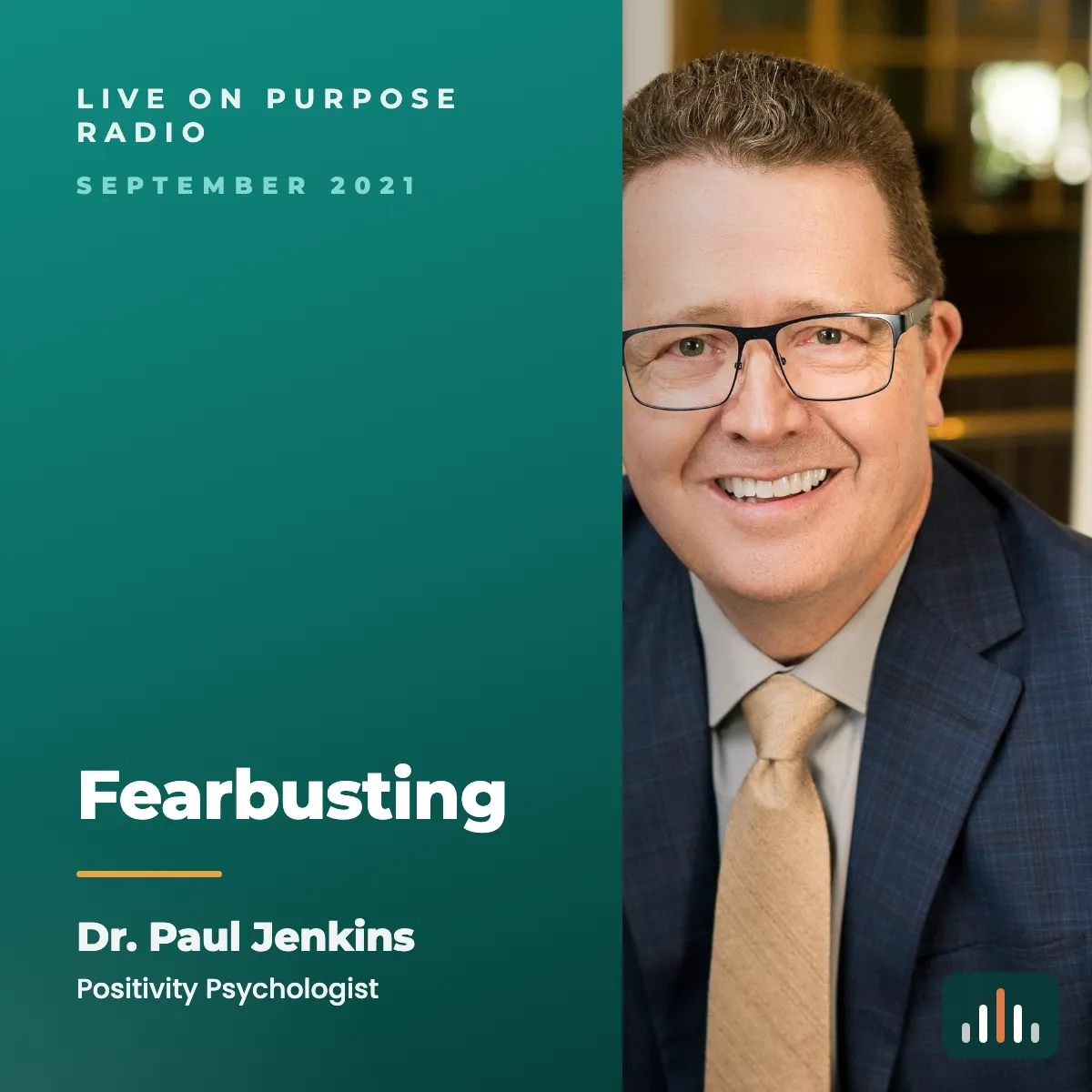
Welcome to Live On Purpose Radio with doctor Paul Jenkins, where you will hear inspiring stories of ordinary people doing extraordinary things. Feed your mind with a regular dose of positive energy and show up for your life every day on purpose. Living on purpose means that you have a purpose and you do it intentionally. And now, here's your host, doctor Paul. Hello, everybody.
Welcome back to Live on Purpose Radio. This is doctor Paul, the shrink who expands your life with another episode of Live on Purpose Radio. Joining me today is Larry Duchin. Larry is an author. He's an educator of sorts.
At least I'm thinking about that, Larry, because you're bringing to light some of the principles that are behind some really important things that we need to understand as human beings. Larry's an author. He's authored several books, including one that we'll be focusing on here today, a book on fear, which is one of my favorite topics. Larry, does that sound weird to you that fear is one of my favorite topics? Not coming from a psychologist.
I think that's pretty normal. Well, it's one of your favorite topics too. And as I present you today as an expert on fear, you said in the preface of your book that you're an expert on fear, and you're an expert in a different way than I'm an expert. Although, as members of the human race, you know, we all get to experience this. I think we all get to encounter it.
Tell us a little bit more about why this is such an important topic to you personally. Well, I think it's... I I didn't set out to become an expert on fear. I think it's something that this was just how life unfolded for me. And so Mhmm.
It it started back basically when I was sexually abused by my mother when I was going through puberty. Not a good time. Obviously, never a good time to be sexually abused, but certainly when you're going through puberty and you're going through those sexual energies, it's not a good time. And so I came out of that experience with a lot of shame, a lot of guilt, a lot of anger, and a lot of fear. And so I didn't I didn't really know...
Understand that. I was what I call pretty asleep and dysfunctional... Very dysfunctional through my twenties. And then through a couple of events that happened, I kind of became aware of these, this dysfunction that I was curing and all this trauma and what I call poison and really started on a long emotional healing path to try and, to heal myself from that trauma. As part of that, I had to work through a lot of strategies to understand and to not give my power to fear.
That's the short version. You've... You know what? As a psychologist, obviously, I've encountered this many, many times, and you mentioned some abuse that occurred. And I hate abuse.
Okay? Because... Wow. But at the same time, when we take a certain kind of an approach, it can become something that educates and and informs us about things that will help to empower and expand our life. I've seen so many people who shut down into what I call victim mode.
Mhmm. And I'm not talking about being a victim of abuse or a victim of a crime. I'm talking about a way of handling our life experiences that keeps us trapped and and that steals and and robs our joy. And I think you and I probably share this philosophy that life is about experiencing joy, and anything that Yeah. That steals that away is something that we're going to vigorously try to eradicate.
Yeah. I I mean, I... I'm in total agreement with you. And I... Actually, I talk a lot in the book about victimhood, and I've got some excellent quotes.
I met... There's one quote in the book from Helen Keller who talks about not being a victim. And and, you know, Helen Keller with all her disabilities, I mean, it's amazing. So Yeah. Being a victim is very disempowering, and we we want to be empowered in who we are.
And so regardless of your past, what trauma you've occurred, what circumstances you're undergoing now, you can choose to be a warrior versus a victim. And only in that space of being a warrior and not being a victim will you experience true joy. It's like taking control over our own life, rather than letting life push us around. Yeah. And and how...
Because life is going... Life is going to push us around certain things. There's certain things that... I'm a very spiritual person too, so I believe there's a number of things that we do control at a spiritual level, but there's also a number of things. We're part of a collective, and there's a number of things that we can't control.
We can't control what the government wants to do to us, or sometimes we can't control if our spouse walks out on us. But we can control how we react to that. You know, it doesn't mean that we're gonna not have... If our spouse walks out on us, we're not gonna have some anger or have some grief. You know?
But we need to allow those motions to be processed and then take our power back from the experience and know, know, in that case, that it wasn't about us. Or maybe it was about us. Maybe we need to take some responsibility for that. One of the things I talk about in the book a lot is know thyself. Aristotle and Jesus and a lot of wise people told us to know thyself.
You know, when you're doing psychology, that's what you're uncovering is know thyself. Know where your traumas are, where your dysfunctions, where your false beliefs are, where your defenses are, and want to change that. So with the goal being that you can enter into a much more peaceful and joyful life. Right. Which to me is the nonnegotiable outcome.
With with any of my clients, with myself, with my family, joy is the nonnegotiable outcome. Mhmm. That... That's what we want. In my book, I call it the feeling.
Capital t, capital f. Yeah. It's what we're all after at the end of the day. Right. And and I think that life definitely brings us...
Life... The universe is constantly driving us towards that goal. So it's bringing us those situations and experiences and people in our lives who are going to make us aware of where we're not joyful, where we have false beliefs that we're holding that prevents us from knowing that joy. And a lot of people have great resistance to looking at these things, and... But we're not being punished.
You know, people try to say, oh, like, god is punishing you. They're trying to put it into a religious aspect of some kind of punishment. You're not being punished. This is... You know, at at at a at a deep soul level, this is what you have asked for.
You've asked, you know, to to come into a greater recognition of who you are and where your joy comes from. Larry, you've presented a couple of ideas through your writing and through your experience here that fly in the face of tradition. And I'm going to label it tradition because I don't think that it's necessarily truth, but but there's a tradition that that certain things that will happen to you are, I'm gonna put this in quotes, bad. That this shouldn't have happened. This isn't the way it should be.
My life is not okay because... And then we point to whatever it is, and it might be abuse. Mhmm. You presented an idea there in your book that perhaps you might be grateful for it. What?
What is... Are you nuts? Yeah. I am kinda nuts. I I fly outside tradition, but that's okay.
I have just some good people that I look up to in the past who have flown outside tradition. Also nuts. Yeah. Yeah. They were nuts.
Or they were definitely considered nuts when they were living, you know, but, then they Yeah. Not so much. But but basically, yeah, I I do consider what... You know, I look at this from... One of the things I try and do in the book is I try and carry people to a much larger perspective than this ego ego centered personality perspective where that's a very narrow lens.
The ego, our personality is important, but it's just a small part of who we are, and it's a tool we have to use here. So we are divine beings, and we're here for a much larger purpose. And one of the things that that I'm trying... I try to do in the book is is I I bring in a lot of larger aspects. So we have psychology.
We have spirituality. We have quantum physics. We have philosophy. I try and bring all these aspects in so that people move from a place where their nose is pressed up against the bark of the tree to the top of the tree and like, Oh, wow. I'm in a forest here.
It's not just brown. It's brown and green and all these other colors, and there's all these other trees here. When I look at it from that perspective, my abuse is a gift because I chose that experience at a certain level of reality. We're multidimensional beings living at many levels of reality, and I chose that experience for the purpose of coming into some gifting and for the purpose of awakening to a greater experience of who I am. From that perspective, I'm able to forgive.
And I'm able to look at my experiences like this is a learning ground here on Earth. People can't go from like, Oh, my God. I just discovered that I was abused as a child, to that perspective. But you can, but you work through the steps, and you're raising your awareness. Then eventually, you come to a place where it was basically an experience that happened to you.
There's a much larger context within which that is held as opposed to like, This was done to me, or, Oh my God, I'm being punished by the universe or punished by God, or whatever. We have to get out of a duality of good and bad and move more to a gray, and everything is an understanding from a perspective of gray. That's the problem in the world right now. Everybody's seeing from a perspective of black and white as opposed to more of a gray perspective. So Well, there's so many ways that that applies to how we show up in our our relationships, how we show up in our communities, to make a judgment about an experience that we've had and to call it bad.
Now I'm not I'm not disputing the fact that it can be painful, difficult, frustrating, challenging. I get that, but I think to call it bad is is a bit short sighted because it's sometimes those very experiences that bring to us the knowledge or the awareness or the understanding, if we allow it to go that direction, that can really empower our lives. And I I look at the fact that you're doing what you're doing now as as you're sharing your experience through your writings, and how many people are empowered and liberated by by reading your words, well, Larry, you wouldn't have even written the words had you not had the experiences. That's true. That's a good point.
That's a good point. And so, you know, everything, to me, everything is manna. It can be used for the right purpose. You can make lemonade out of any type of lemons. There's so many, historical instances of people, let's say, like somebody, getting murdered and then, like, the the parent and the murderer become...
You know, the the the parent is able to to enter into a space of forgiveness of the murderer, and they lecture on this. And, you know, so there's so much that can that can come out of what we call bad. Right. You know? It it requires a greater perspective.
I love what you said about having your nose pressed up against the bark of the tree, or are we at a higher perspective where we can see the entire forest? And because of the nature of of mortal existence, it's hard to get to that place. We're we're in our life, and so we see it from inside. And that expanded awareness can make a huge difference. I'm guessing that some of your experiences that brought you that expanded awareness, were were really a key for you being at a place where you can actually take this on in more helpful ways.
Larry, as we come back from this break, I would love to to hear more from you about what principles have been so powerful for you as you've taken this journey. And I think that's going to be helpful for our listeners too. Okay. Sounds good. Folks, this is Larry Duchin at Live On Purpose Radio.
We'll be right back. Are you ready to take your positivity to a whole new level? I've been enjoying these conversations with my guests at Live On Purpose Radio. My own story about becoming more positive is something that I've shared in my book, pathological positivity. And right now, I'm giving the book away.
You just pay for the shipping. Go to doctorpauljenkins.com, spelled with a d r, and click on the big orange button button right there that will get you a free copy of my book. You pay the shipping, I'll pay for the book. Sound like a good deal? Power up your positivity and get ready to see phenomenal changes in your happiness, your relationships, your business, every aspect of life.
Enjoy this free gift from me, doctorpauljenkins.com. And we're back. Larry Duchin at Live On Purpose Radio today, having a fun conversation about a not so fun topic. At least it's not fun to experience fear. Sometimes our life experience programs us or or, conditions us to see things, view things in a certain way, and that keeps us stuck.
Larry, as we're coming into this second part of our conversation today, you've discovered some principles that have allowed you to have a very different experience with fear that has helped to move you forward in your life. And I remember reading some things that you had had written about being present, about not getting too sucked into the past, maybe the abuse that occurred or the, the way the the world has mistreated you or your life has been unfair or whatever. Getting out of the past, not getting too stuck in the future, worrying about or anticipating worse things to come, that causes anxiety, but being fully present. With that introduction, I'd just love to hear some of your thoughts about that particular topic. Sure.
So science is is actually, in the last fifty years, has really validated what mystics have told us for a long time, which is basically only the now exists. Science has shown us that time is not fixed. It's not linear. Space doesn't exist in in the way that we think about it. And so, really, we exist in the present moment, and it's only our ego mind, which lives in the past or lives in the future.
And that's where fear comes from, because we're always... We're we're like worrying about, oh, did I, you know, did I do this? Did I offend somebody, you know, before? Or really, especially in the future, what's gonna happen? And this is this is really present for us right now in terms of where our world is going.
And I know a lot of people are in tremendous fear about that, and they've got to pull themselves back to the moment and know that we are divine beings, and we're creating our scenario both individually and collectively, and that it's very important for you to energize a scenario that you want. This is extremely important right now. So, you know, we have to, cultivate practices. Most people have actually never experienced the now for any extended period. Sometimes, like, you're like you're daydreaming for a second and, you know, and that's now.
But they think that that's like an abnormal state. That's actually our our natural state is the now. And so, basically, we have to cultivate those practices that bring us to the now. And and we do that through, basically, through awareness and through attention to watching our thoughts, how they go off in all this crazy trail of thoughts, and like this thought leads to this thought, this leads to this thought. Witness your own thoughts.
Pull yourself back in the moment. Cultivate practices like meditation or being in nature is a huge plus for, being able to be in the now because that's what the natural world is. Other practices maybe like yoga, you know, doing something like dance or, or painting or write... You know, automatic writing or anything like that that brings you in the moment. And and then you have to practice it.
I mean, it's like it's like going to the gym. You don't just go one time and do it. You've gotta keep bringing your attention. So life can become like a... Kinda like a walking meditation, and it's a very beautiful place to be because there's no fear there.
And there's also a place where you're not trying you're not trying to control things or control other people. You're just... You're okay with who you are. You're in a joyful state, and you're there. And it doesn't mean that you're not heavy...
It's not... You're not bearing your head in the sand. I mean, there's there's events happening in the world that we have to be aware of, and we have to make decisions, but we need to make decisions from that place of presence, not from a place of fear. The fear is anchored to our focus on the future. Absolutely.
When you really get down to it from a psychological perspective, we are predicting or anticipating or expecting something. And if that something seems bad to us, then we're going to experience a natural emotional response to that which we have labeled fear or anxiety or worry or apprehension. Those are some different words that can come up. But notice that it's all focused on the future. Yeah.
And and and we live in a state that's basically very malleable. The universe is is very fluid and malleable. And so we are creating... We're we're very powerful creators, and we're creating what what is going to happen. And if we focus on something really, quote, good, we can we can create that.
Or we focus on something really bad, we can create that. And it's... And so, you know, we don't want to be obviously focusing on bad stuff there. That's one aspect. The second aspect is, how often do you envision something happening and something completely different happens?
Why would we place any credence in saying, Oh, this is going to happen definitely this way? You know, if we've had enough history to say, yeah, I just need to remain open to this. Hey. There's all kinds of possibilities here. You know, I am I am a spiritual person, so I believe that that in god, all things are possible.
And so, you know, I know that that that... I have a chapter in the book on faith. Basically, faith is very important to me, and faith is a critical component of getting through fear. Having a faith... When you start down this process of healing, and I know you agree with this completely, the first thing that you have to have is willingness.
You have to have the desire to improve your life in some way. Hopefully, you don't have to be like the addict that hits rock bottom. It's kind of like you can catch this long before you hit rock bottom. You have to say, Hey, my life is not working. I'm having the same relationship problems one after another.
I just switched to another person, or the same job problems. You know, here's... There's a pattern here. I'm seeing something. I'm trying to control people.
I'm really not happy. So it starts with willingness. And then as... You know, the willingness has to be like whatever the universe brings you. So if you're in...
I did a lot of therapy myself. If you're in... You know, if you're doing therapy, you know, or it could be like, maybe, reading a good book or whatever it is the universe brings you for healing, you have to continue down those paths, and you can't be fearful of what's coming up in terms of like, oh my god. I can't take a look at this or whatever. You gotta just charge into it.
And and there's faith behind that because you know that at the end of this process, it's going to be... You're going to be a much more joyful person than you were when you started. I think we fail to recognize our own creative power. As you were talking about that, Larry, it became so obvious to me, because I've thought about this as well, that we are creators. It's not that we can become creators someday.
We already are. Mhmm. Just like a puppy is already a dog, we are creators. And maybe we're not very good at it yet, or we're still learning the ropes or the principles around that. You said earlier something that really caught my attention about how we we can energize the scenario that we want.
I I don't know if I got your words exact there, but you said something about energizing the scenario that we want. Whatever we focus on, we feel, and what... Whatever we think about comes about. Yeah. And it go...
And it does go back to the emotion because, basically, where you have to pull in... So you... The way that we create is through, basically feeling gratitude. So you you think about what you want to have happen, and you feel the feeling as if it's already happened because manifestation is actually the second layer. It's the energetic.
It's the thought, and then that transfers into the emotion and into the heart. So it's a feeling of gratitude for that happening, and it's not like... This is not like a... This is... It's a little bit like a children's game, but it's not it's not that it doesn't...
It's not real. It is very real. This is actually how we operate as divine beings. So we have to feel the emotion, be grateful, and keep feeling it. That's what energizes that scenario scenario for it to happen for you.
And this is like... You know, this is what's... That was described, like, in the book, like Rhonda Byrne, The Secret and everything. That's the concept behind that. But also, I put in I put in a big faith component into that because I don't...
You know, I think that we're here to to evolve and be of service and and help others. And so I don't think it's just about, like, hey. I I wanna manifest like a mansion in Bahamas or whatever. You know? It's more like it's more like there's a much larger component to this.
Well, if we expand the definition of faith even then for those who might be hesitant to go down a spiritual dimension here. What if we just define faith as choosing to believe? That's very And and and you don't know what's coming. You get to choose to believe something about that. Yeah.
Yeah. One of the things I do talk about... I I think that's very... It's an excellent way of framing it. I believe...
So when I talk about faith, I'm not talking about faith in the religious sense because so many people have been turned off from that. And I'm not talking about faith in, like, with with with the new age sense. Sense. I'm talking about there's a middle ground where you have faith in some type of creator, some type of thing that has your back, that loves you unconditionally, and that you're supported in a huge way, and that that, you know, that you're going through these processes for a reason to to really come to a greater recognition of of, you know, who you are. And so the faith is like, hey.
This... There there is a purpose for here, you know, and and I am supported. And then maybe I don't quite understand it. I mean, hell, I don't understand a lot of it now, but but I have strong faith. I mean, I...
It's... You know, god is, like, undefinable. It's... So we can't understand it in a human form or whatever that concept is, but we can feel that we can feel that in in ourselves, and we can have that faith that this is... That we're being supported.
As I think about the contrast that you've just very nicely illustrated for us, there's... The fear stands opposite or or contrary to the joy and peace and gratitude, you know, some of these pleasant things to feel. And I I mentioned earlier that we might expand our definition of faith to to say it's choosing to believe something. And since we don't know... Check it out.
How are you doing next week? You don't know. You've got something to do with it, but you don't know. And so all you can do in your imagination from a psychological standpoint is to predict or expect or anticipate. And since you don't know, what if you simply choose to believe something that serves you well?
And this comes back to the awareness, Larry, that you talked about because sometimes we don't even realize that we're already choosing a position, and that might be causing fear. You know? Exactly. Our our our... We're in a in a deep rut we need to get our car out of.
We're... We've been driving in deep rut for a long time because we are conditioned in a lot of ways. I talk about this in the book. We're conditioned. So we have to, like...
We've got to decondition ourselves. I mean, basically, you know, like, if you've been traumatized, you know, if you had any type of abuse or anything that anything that happened to you, even childhood, if your parents didn't tell you they loved you or whatever, you you assume, you know, that you aren't lovable or whatever it is. You've been conditioned in childhood. You've been conditioned by society to, like, look outside yourselves for your self worth to goods or whatever, to reputation, to money control, whatever it is. We...
We're conditioned in so many ways, and so we have to uncondition ourselves. And and then that's how we are gonna get out of fear. And and and so we have to pay attention to our thoughts because they will like, oh, it's like, oh, actually, you know, I'm catching myself here. Like, it's it's going down this trail, and that's that's not where I wanna go. Larry, you've illustrated some powerful places where we can where we can start with our thoughts, with that awareness, remembering that our goal is joy.
I I love these concepts. The book is called A Book on Fear, and that should be easy enough to remember. The subtitle is feeling safe in a challenging world. Welcome to Earth, everybody. It's going to be challenging.
So, I want to, just acknowledge again the book, maybe, point people toward that. A book on fear by Larry Duchin. Actually, the name on the book is Lawrence Duchin, which is, you know, the informal settings you might hear him referred to. But the... Larry's book is available wherever you get your books.
And, Larry, you have a website too. I think it's your full name, Lawrence, l a w r e n c e, Duchin, d o o c h I n, dot com. Yeah. Did I get that right? Yeah.
Or you can just go to bookonfear.com, and it will take you there. A bookonfear.com or look it up on Amazon. You'll find it there as well. Yes. Larry, is there any other invitation or or challenge or, thought that you'd like to leave our audience with before we close today?
Yeah. I mean, the only other thing, doctor Paul, is I think compassion is very important. Life is pretty damn hard right now, and everybody's being pushed in a lot of ways. As we go through these processes, we have to have compassion on ourselves, and we have to have compassion on others. If we have compassion on ourselves, then we will have compassion on others automatically because when we don't have compassion on ourselves, we project that as as not compassion on others.
So come... Try and be compassionate on yourself. Everybody is going through is is going through difficult times and, you know, and so just have that compassion. Oh, wonderful invitation. Thank you.
And thank you for your contributions here at Live on Purpose Radio. Well, thank you for your contributions because I know you've had some amazing guests on there. So thank you. And you are now one of those folks. This is Larry Duchin.
You've heard it. You've felt it. Go do something about it. It's time for all of us now to go live on purpose.
Open the transcript on its own page ↗