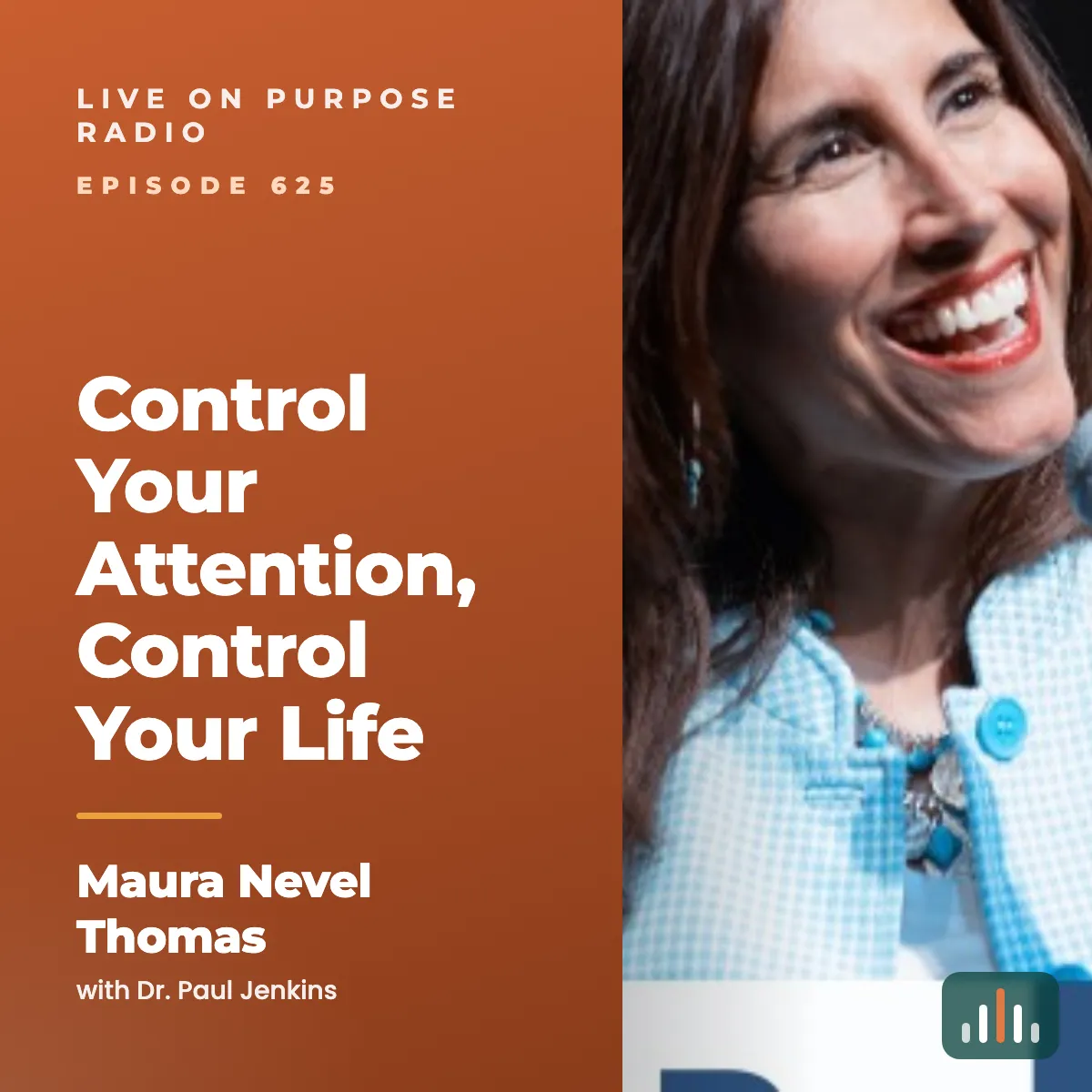
This is Live On Purpose Radio episode 625. Control your attention, control your life with Mara Neville Thomas. Now is the only time to create and live the life you love. I'm doctor Paul Jenkins, the positivity psychologist. My job is to connect you to powerful positive psychology principles that immediately upgrade your relationships, business, and mental health.
Are you ready? Let's jump in. Hello, everybody. Welcome back to Live On Purpose Radio. This is doctor Paul the shrink who expands your life with another episode of Live On Purpose Radio.
Joining me today is Mara Neville Thomas. She is an award winning international speaker, trainer, and author on individual and corporate productivity and work life balance. And one of the things that she is famous for is being an authority on attention management. We're going to learn a little bit more about that as we get into this conversation today. Welcome to the Live on Purpose radio mic, Mara.
Thanks, Paul. I'm super excited to be here. This is... Well, before the show started, you said this is serendipitous. Yes.
Because you and I met in an airport, and we had a conversation. And I believe that some of the best things on the planet are created from conversations. And I was so glad to run into you. We're both members of the National Speakers Association. We both happened to be heading to the same event in Denver, Colorado for the NSA, and, we struck up a conversation.
And from that, I I saw that your work, although you may work with different groups and organizations than I do, it's very aligned with the the themes that drive that. And so, I'm happy to welcome you to the show today. Thank you. I'm happy to be here. Mara, there's this thing that comes up a lot when we're moving forward with our life, our work, our relationships, whatever it is.
And the the the thing that I'm referring to is that we blame time. You know, like, I don't have enough time, and I need to learn to manage my time better. I'm going to use that as a little bit of a setup because I don't think you teach time management. Is that correct? I'm so over the phrase time management, Paul.
I think we really need to retire the phrase. I think not only is it not helping us, I think it's actually holding us back because we've all used this phrase with this caveat. Right? Like, oh, I need to get better at time management. I know.
We we all... We can't manage time, but you know what I mean. Right? And so time management has been this catchall to encompass these, techniques that were taught in a world that doesn't exist anymore, that were created in a world that doesn't exist anymore. We've been using the phrase time management maybe for a century.
I think when... I think I looked it up one time and and the phrase time management was credited to Benjamin Franklin and, and deck... You know, for for a hundred years since then, for a while, it was helpful because we all had an office with a door. And if you if you're not old enough, you won't know what I'm talking about. I think you and I, Paul, are both old enough, but you had an office with a door because everybody had an office with a door.
And the only thing on your desk in your office was your phone and maybe depending on your age, maybe it was a typewriter, maybe it was a word processor. When I got out of college, there was something called a dumb terminal on my desk that was, like, networked with other computers in the office, but there really was... I mean, I think there was barely an Internet back then when I first started. I was at Kelly Tempe in high school, and I think when I was doing that, it was, it was like baby Internet back then. And so you could go into your office and you could close your door and you could schedule your day, which is really what time management means.
Right? Schedule your day. What are you gonna do at nine? What are you gonna do at ten? Write down all the things you have to do.
Prioritize them a, b, c, d, and then slot them into your day and then work through your whole list. That's time management for for a world that existed back then but hasn't existed in forty years. And it's never coming back. Right? It's never coming.
You know, even as you describe it, Mara, I'm thinking... Well, first of all, I'm having memories. And it's like, do you remember the Rolodex? Mhmm. And it's where you kept people's actual phone numbers and phones were actually phones, not handheld computers.
And they were tied to the wall. I mean, it's... So all of this is coming back to me as you describe a world that used to exist. There was a... An idea that may have been useful at the time.
You mentioned Ben Franklin, and we're recording this episode of Live on Purpose Radio just before we turn all of the clocks back from Daylight Savings Time, another invention of Ben Franklin. That money. Is... It's archaic. Yes.
It's no longer useful to us, and yet we hang on to some of the the training or the programming that came from that era. And, yeah, I've... I don't have to get you started on Daylight Saving Time. I've I've got my own beefs with that. But it...
It's another example of a world that doesn't exist anymore that we still make accommodations for. And so we talk about time management as if it is a relevant issue for today. And I I... I'm hearing from you and believe myself that this is not a particularly useful idea anymore. And you've shifted the focus over to attention rather than time.
Talk to us about that. What does that mean? What is the alternative? Well, so I will say something now about time management that some people might find a little bit, controversial, and that is that I think we all have as much time as we need to achieve what we want to achieve. Now we are driven and we are motivated and sure, there there are many, many things that we could do in this life, but I'm sure you have had the experience of saying to yourself at the end of the day, oh my gosh.
That was such a good day. I got so much done. Right? Yes. And you have had the experience where you said, oh my gosh.
I was busy all day, and somehow I got nothing done. Nothing. Nothing. Right? In those two instances, you had the same twenty four hours.
Right? You didn't have Exactly the same. Yeah. Didn't have more time, less time. You had twenty four hours, and you managed to be super productive.
Our biggest challenge in the twenty first century is not that we don't have enough time. Our challenge is that we have too many distractions. And the the distractions cause us to switch what we're doing every minute or two. Right? Most people have their phones and their email open and downloading and other people coming into your space.
You have all these distractions. And so research shows that we switch what we're doing every minute or two. And when we switch what we're doing, everything we are doing takes longer and the quality is lower. In some cases, a lot lower. So then we have to spend time, like, proofreading and doing it over and fixing mistakes and all that kind of stuff.
Right? And so if I could magically give you twenty six or twenty eight or thirty hours in a day, but you still spent it switching what you were doing every minute or two, you wouldn't get any more done. And it wouldn't fix a thing. No. It...
You wouldn't get any more done, and it wouldn't get done any better. How you manage your time only matters to the extent that you also devote your attention. And so what matters much more in the twenty first century than time management is attention management. And the words are important. And that's why I think we need to retire the phrase time management.
Because the more you think to yourself attention management, the more you say attention management to other people, the more you describe your world and your challenges in terms of managing your attention, then the more aware you become of distraction and how distracted you are. And it's not until you become more aware of the distraction that you can start to change your behavior to be less distracted. And so not only do you become more aware of it yourself, other people around you become more aware of it. And then what happens is that you and everyone around you in your house, in your office, in your life, you all become... Start to become more aware of not only how distracted you are, but you also become more aware of how distracting you are.
Yes. That's when things start to shift a little bit. The words matter. I agree. I'm thinking about both of these concepts at the same time right now.
When when we think about time management, you can spend the time and you pay attention. And we're bringing in, you know, how we handle money, is similar. And I... And the thought occurred to me, you know, time is you're talking about the abundance of time. There's plenty of time.
In fact, everyone on the planet has exactly the same amount every day. That's right. We're not all here as many days as everybody else, but we all have twenty four hours to use. And and what if we had a million dollars to spend, but you have to spend it today? And you get another million tomorrow, and you have to spend it tomorrow.
That's how time is. Yeah. And I think about it less from from the perspective of spending and paying. I I think about it in terms of spending and investing. So so a a technique of time management is to, is to write down all the things that you have to do and then prioritize the list and then depend...
You know? And then Right. Pick which one you're gonna work on. If you do that, the time... You spend that time because it'll it'll help you decide what to do right now, but two hours from now, you probably have to do it all over again.
Tomorrow, you have to do it all over again. So if you spent it and it's gone, and you really didn't get much for it. If you instead invest your time in kind of the big picture of what I teach is a whole workflow management system, but the foundation of that is attention management. So if you invest in thinking about how you work and how to make each of the pieces of how you work more efficient, then you regain that. You...
It pays you dividends later. Right. It really is an investment. You... Once you spend time, it's gone and you don't get it back.
But if you invest in your own ability to achieve what's most important to you, which is the definition of productive, right, then that pays you dividends over and over and over and over again. I love what you said also about awareness. Yes. That... It's the awareness of how my attention...
You know, control your attention. Control your life. That's the name of this episode. It's also the name of your keynote. It's one of the themes of your whole enterprise.
Control your attention. Control your life. Until you see it as a choice, it's not. And you just roll with your programming. This is something I know as a psychologist, which we default to our programming, whatever we've been trained, taught, and educated to do.
But awareness puts us into a position of choice. And so as you become aware that, okay. My attention is going here. I'm being distracted by that. I am being distracting to other people.
That awareness then creates a position of choice. And I think that's why it's so foundational as a starting point. I love that you said that. Well, the thing is you can't change a habit. Most of us have a habit of distraction, so we can get into that.
But if you have a habit of distraction, you can't change a habit that you don't know you have. So the awareness is critical. It's the first step for sure. So take us on a little tour for a moment if you went through this idea of of attention management. As we open our awareness to that, what what is it that you train or or teach people to do as we make the shift from the old worn out idea of time management and and get into this attention space?
Where would you take us? Yeah. Well, you brought up the sort of the tagline that I use in the title of my keynotes, control your attention, control your life. And I believe that attention management is more empowering. It...
Just taking on that, those words and that perspective empowers us because we know time marches on and there's nothing that we can do about it. But no one can control your attention except you. If your attention is to be controlled, you are the only one who can do it. And so, really, our ability to achieve what's most important to us, again, the definition of productive, our ability to achieve what's most important to us is 100% in our control. And not only during your workday, but the definition of productive that I...
That... From the dictionary is achieving significant results. Right? Achieving what's important. But if you think about it, the significance changes with the time horizon.
So, yes, attention management helps you accomplish the important things on your to do list today. But if you think about this week, what will be significant? This month, this year, this decade, this lifetime, what will be significant to you that changes? Right? The significance changes with the time horizon, but it's still it's still the same.
When you look back on your life and you think about what was significant to you, it will be things like that I, that I lived according to my values. Right? That I was kind, that I was loving, that I was helpful, that the people in in my life knew that they were important to me, that I made a difference, that I had an impact. Right? And many of those things happen in moments.
And if you are distracted in a moment, then you are not really fully present in a moment. And therefore, you're missing not only the moments in your life, but also the life in your moments. And the way that I see it is that we have... We get to make a decision every day if we live a life of intention and choice or a life of reaction and distraction. And that decision is 100% ours to make every day.
And so if you adopt this... If you retire time management and you adopt this perspective of attention management, then everything becomes in your control. Now that doesn't make it easy, and we will... We we can talk about ways to do it. It doesn't make it easy, but it is a 100% in your control.
I'm imagining, and and you can guide me on this because you're the the trainer, you're the coach on attention management, that it would be very important then to start noticing where and when are my distractions happening. Yeah. And whether I try to get rid of them or not, that's another step probably, but being aware of it and acknowledging it. Am I on the right track here? Absolutely.
And I think part of the problem is that we've sort of thrown up our hands as a society, I think, and said, like, well, you know, everybody needs me, and we have these devices. And, you know, they're pinging and dinging all the time, and everybody expects an immediate response. And so that's just the way the world is now, and that's just the way the way that we have to, you know, we have to figure out how to still do what we need to do in spite of all this. But, honestly, I just reject that idea. And and the world always has expectations.
That doesn't mean that we need to meet them. We get to decide how we live our lives. And if you don't respond to somebody's text message right away, it's probably gonna be okay for the most part. Right? And we...
Wait. A whole lot. Yeah. We have demanding customers and we have all these situations. But the the question is, how can I do the things I need to do and live a life of choice and intention in a way that doesn't make me frazzled and frustrated and stressed out and overwhelmed because being constantly distracted and trying to keep up with the mountain of communication that we have today that our devices bring us?
All of that is stressful, and it's overwhelming, and much of it is self imposed. You say that it's self imposed, and and I'm thinking, okay. Well, that burns a little. Mhmm. You know, that that bites, but it's it's also important to notice it.
Because until we see the choice, it's not, and we'll continue with whatever the programming is. Yeah. I mean, think about social media. Mhmm. Social media creates this feeling in us that we owe people things.
Right? Somebody DM'd you in in Instagram, or somebody liked your post, or somebody wished you a happy birthday on social media. Mhmm. So now you feel like you need to respond or you need to say thank you or you need to... Like, you see your friends having a hard time and you feel like you should say, like, I'm so sorry that your, you know, your cat died or...
You know? Otherwise, you're just a horrible person. If I don't say thank you to everybody who wished me happy birthday or if I don't, you know, support the people who are going through something that they just posted this really raw thing on on Insta or on Facebook or whatever, and I I I saw it, so I feel like I need to respond to it. Well, now, I mean, there are millions of people in the world. We are connected to way more people through social media than really humans have are wired to be connected to.
And so it ends up creating this, like, responsibility, and then we end up spending this extra time because we feel like we have this obligation or we just get reeled in because the social media platforms are really good at manipulating us and keeping us. I mean, the success metric of any technology, certainly social media, is to get us on and keep us on, right, for as long as possible. And so... And even absent that, have you ever found yourself, like, in a political discussion on a social media platform that you had no intention of getting into? But now not only did you spend time, like, researching facts and and composing your argument, but even after you logged off the social media site, you're still...
It's still, like, consuming your thoughts. And I can't believe that person even said that, and I should've said that, and, oh my gosh. Oh, there's that that article that I can send them. Right? And just all of this, and it's just not adding to our lives.
Now I'm not saying that everybody should quit social media, although I did, and it was the best thing I ever did. I'm a little bit on LinkedIn a little bit, but but you don't have to quit social media. You just have to become aware of how it's affecting your life. And is it really additive, or is it reductive? Right?
Is it taking away from other things that you'd rather be doing? And for most people, the answer to that is often, yes. It's taking away. I mean, we think, oh, I'm just gonna scroll to blow off some steam, but that's not how it ends up being. Because you get sucked in.
You get sucked in and you get manipulated. The social media sites are really good at manipulating our behavior. And now, I mean, it's... I mean, there's so much rage and just... I mean, clickbait and scams and false new...
And, again, I'm I'm not... I I don't mean for this to sound like an argument for why people shouldn't be on social media. Social media has benefits for sure. And and engage in the things that feed you with regard to social media, but just get more aware of how much time it's really taking from you. And if if there are other better things you could be doing with that time.
As you set that up for us, Mara, I was I was thinking about another metric that we can use to to evaluate that. Is this consuming me or my time, my attention, my energy? Or is it producing Yeah. That energy for me? Having...
One of my coaches puts it this way that it's energy rich. Mhmm. Or is it energy depleting? Yeah. It's a great way to think.
I I think that we have a responsibility to ourselves and to everyone that we love or serve Yeah. To address that. Yeah. And, again, that... Really, that's just designed to be an example, one of many examples of things that are perhaps stealing our attention that we are allowing but didn't really realize it.
People tell me all the time, oh, yeah. My phone just buzzes all day long. I just ignore it. Except research shows that we really aren't ignoring it. And when we receive that distraction, it does consume some part of our brain, and the more distracted we are, the more distracted we get.
And so it just puts us in this cycle of not only, chipping away at our attention span, but also chipping away at our patients. So we get less and less patient. And so then what happens with constant distraction is that not only are we losing the ability to stay focused and present for any period of time, we're also losing the desire because we're too impatient. And so it... And so that...
When we can't maintain our presence, then we lose that ability to be present with other people. And then we become that person who somebody's trying to talk to, and you're, like, scanning the room or you're looking at your watch or you're glancing at your phone or you're... And people... And then you just... Nobody wants to talk to that person.
Right? And so how much richness, how much nuance, how much human connection, how much, depth are we losing because we can't maintain control over our attention? And we can't maintain control over our attention because we are habituated to constant distraction, and that is on purpose. I have a personal and maybe very relevant example that just came to my mind. Because I mentioned right at the beginning of our interview today, and here we are now getting toward the close of it.
And I mentioned that you and I met in an airport. And I've... I'm in airports quite often. I know you are as well as a professional speaker. And I've noticed that people who are in the concourse are typically in a position where their face is glued to a device.
Mhmm. And they are paying attention. They are investing their intention... Attention in something that is not present, that is not here and now. It's there and somewhere, I guess, in their device.
It... It's very, very prevalent. And you approached me in that concourse. My face wasn't in a device and yours wasn't either. And it created an opportunity for a conversation.
And when you say, what are we missing out on? This very conversation would not have happened had you and I just been blissfully going along with our distractions. And I'm not saying I'm perfect at it. I'm definitely not. And there's things I'm looking at now as a result of our conversation today, Mara, where...
Okay. Can I be more intentional? Can I raise my awareness about that and choose to, to invest my attention in a in a different way? But I... This podcast interview today is a product of, managing attention.
Is that fair? Being present. Yes. Yes. I would say not only are this podcast, but the the relationship that we now have as colleagues and as friends and and who knows where where that will head.
Right? Right. But the... So... And and I I wanna make sure that I'm clear because I want I want people to feel like they got something tangible out this conversation.
And I really think that people underestimate, how much awareness is... How important awareness is. And if you start to realize how distracted you are, if you start to to watch your behavior with other people, you start to become more aware of your behavior with other people and also more aware of other people's behavior with you. Are you present for your family? Are you present in conversations with your spouse, with your employees, with your colleagues?
What kind of impression are you giving? I think that we have... We've we've come to this place in society where we've decided that certain things are acceptable now that didn't used to be acceptable before. Right? When you used to talk to somebody and they were looking at their watch every minute, that was considered rude.
And I think now we give people a little bit more grace for that, which isn't necessarily a bad thing. But what we don't realize is that people still have the same emotion that they always did, which was Yes. He's not listening to me. He doesn't care what I have to say. He's got somewhere else to be.
I'm not important right now. Mhmm. Those feelings have not changed. And so I really am excited about the prospect of help of of my work because I want people to be able to not only make the most of the moments in their life, but also the life in their moments. And when we are more physically present because we are controlling our attention, then everything gets better.
I love that. I'm sure that you, as a listener, are probably loving this as well. And, Mara, I wanna make sure our listeners have a way to connect with you. I know your website, marath thomas dot com, has a lot of resources there, including an opportunity to sample your books, to see what you're doing on the on the speaking front, what trainings are available. All of that is there.
That's spelled m a u r a for Mara and Thomas, t h omas. There's a .com behind that. And, I I want to encourage you to go check out what Mara is doing there. Mara, are there other things that you would want people to know about that or additional insights that you can share with us about connecting with you? Yeah.
So I wrote a book on attention management to... Conveniently, it's called attention management, how to create success productivity every day. And it it it only takes about an hour to read. And I designed it that way on purpose because people have very short attention spans. Right?
It's the first first book in a series about my empowered productivity system, but it is full of, practical practical things. Awareness of your habit of distraction is certainly one, but there are many more. And so that's a really, easy way. And and there's probably three Wonderful. On my blog.
And I know that, that book is available there on your website, marathomas.com. You've also got a available. Yeah. It's available. Discussion guide.
Everywhere you get books, you can find this. Yes. In audio format, in physical format, in digital format, all the ways, all the places. Yeah. Mara, thank you for your contributions here today.
Is there a a final thought you wanna leave our listeners with before we sign off? Every minute of every day, you have a choice to live a life of reaction and distraction or a life of intention and choice. And that decision is 100% yours to make all the time. That is good news. And, folks, it's time for us to go apply what we've learned.
Let's all go live on purpose. Did you get what you came for? Give yourself the gift of taking real action on what you realized today. Please share this episode with someone you know would value it, and leave us a rating too. It's time now to live on purpose.
Open the transcript on its own page ↗