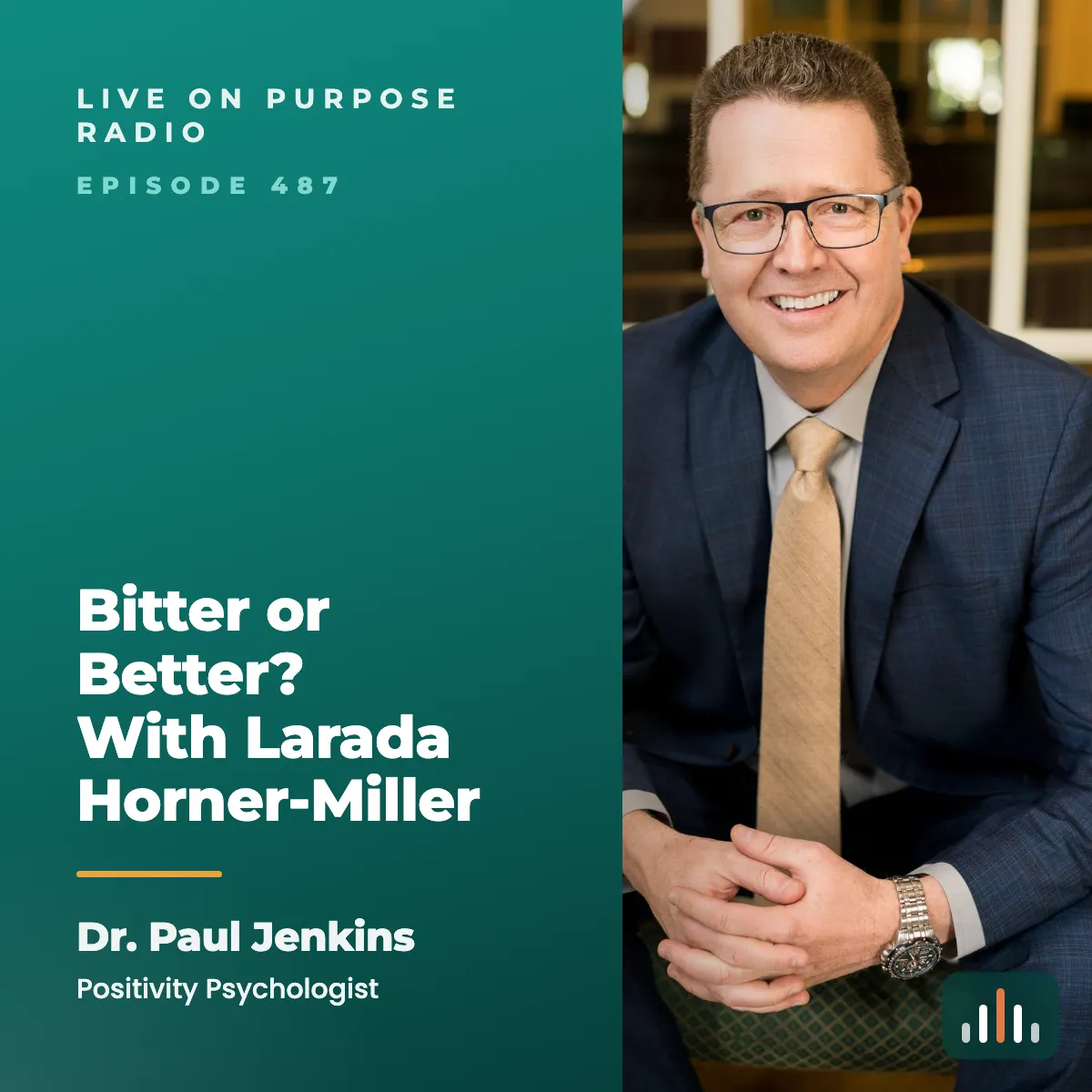
This is Live On Purpose Radio, episode number four eighty seven, Bitter or Better with Loretta Horner Miller. Now is the only time to create and live the life you love. I'm doctor Paul Jenkins, the positivity psychologist. My job is to connect you to powerful positive psychology principles that immediately upgrade your relationships, business, and mental health. Are you ready?
Let's jump in. Hello, everybody. Welcome back to Live On Purpose Radio. This is doctor Paul, the shrink who expands your life with another episode of Live On Purpose Radio. And joining me today is Lareda Horner Miller.
She is an author. I'm guessing that she's my cousin somehow because we share that name. Horner is actually my middle name, Loraida. I just shared that with you earlier, and we'll probably figure out just how we're connected at some point. Welcome to Live on Purpose Radio.
Thank you. It's so great to be here, and I love that we're connected. Yes. Indeed. You know, what caught my attention, Loretta, is one of your most recent books.
Now I know you've written a number of books, including cookbooks. And the one that caught my attention had to do with your reflections about this pandemic that we've been mutually experiencing over the past couple of years. And the title, coronavirus reflections, bitter or better. And I love that because it's not our circumstances that determines whether we become bitter or better. I think we actually have a choice around that.
And I think you'd agree with me, and that's why we're having this conversation. Can you share with us just a little bit about how that book came about and why? Okay. Yes. I can.
My husband and I had just gotten home from a trip to Spain. On March 8, they had five of twenty twenty. They had five hundred cases in Spain. On March 9, they had fifteen hundred. And so, yeah, so we were and we were right downtown Madrid, elbow to elbow with people and flew, you know, home, and we're concerned.
We pretty much figured we were gonna get it. I'm a... I do a blog. I do a weekly blog, and, I deal with my feelings through writing. I've done that for years.
And I do do it through prose and poetry. And so for the first... For for about a month after we got home, I posted about our trip, but I was writing feverishly to deal with the, you know, the insanity that was going on. So I started posting these on my Facebook pay... Or on my blog post.
Mhmm. And readers were responding to me and saying, wow. You put in two words what I was feeling. So I thought, wow. Oh, that's amazing.
So I thought, okay. I'm going to I'm gonna write it. I'm gonna compile those and make them into a book. Well, my editor said, Loretta, you can't ask people to pay for what you gave away free as a blog. So that makes sense to me.
So I, I enriched them. So the the, blog post just became the inspiration for this book, and and I enlarged it. And Mhmm. The the title comes... I'm in recovery.
I've been in recovery for thirty three years. And, the the whole phrase better or better comes from the recovery world. You know, life hands us all kinds of things, and I have the choice to become better or better. And I saw as I was going through the experiences of the pandemic and all the insanity, masks or no masks, mandates, restrictions, shelter in place, the whole craziness of the pandemic, people dying, you know, cases case counts off the map. I just knew that I had to respond, and I knew that I had to go through it, not around it.
I had to go through it. So I tagged on to the Bitter Better Idea, and that's how the book came about. You you called it a choice. Mhmm. And you didn't put a lot of emphasis on that, but I think it deserves a little more attention.
It... It's so common, I think, for us as humans to experience things like the pandemic, and it could be anything really, whatever our circumstances are, and not really see that we have a choice. Talk about that for just a minute and what you've learned about that choice element. Well, that's kind of one of the big basis of my life. I'm also in codependence anonymous.
I mean, you know, I'm in a couple of recovery programs. I was a victim. I I came into recovery a victim. I'm an incest survivor, and so my whole life, my reactions to life was being a victim. And so in my recovery world, I've learned and had to refocus my whole point of view and my whole perspective that I do have a choice.
I don't have to be a victim anymore. And I think that as we look at the world today, you know, there's so much pointing out there. You know? I'm not... I...
I'm out... I've lost the control. You're the one that's in control, and and I've learned through my life's, you know, my life's experiences. I lost both of my parents. I've been divorced.
You know, I've had friends... I've lost friends to cancer. I mean, there's, you know, lots of things, lots of tragedies that have happened in my life. And and early in my life, I was a victim. And then one of my favorite quotes is by a a writer named Ernie Larson, and he says, you know, you're a victim when you're a child.
You're a volunteer when you're an adult. And that just turned me around because that made me realize a lot of the choices. The choices that I made in life were based on that victim stance, and I didn't wanna do that anymore. So that's really what became the basis of this book too. A victim or a volunteer?
And who would want to volunteer for victimhood? Right? No. No. You know, I love this distinction that you made, Loreta, because we're not talking at this point about being a victim of abuse or crime or mistreatment.
You don't choose those things. And especially vulnerable children, they they have no choice in the matter. Right? Right. We're not talking about that kind of victimhood.
We're talking now about a victim mindset or a victim paradigm is how I refer to it as a psychologist. It's just... It's the way we see things, and that becomes a choice. And and so I'm so glad that you pointed that out. We get to choose not what happens to us always.
I mean, some things just land in our lap. Right. But we do get to choose our position or our mindset as we move forward with that. And I think that's what creates the bitterness or the bitterness Right. Once we make that choice.
So what what difference has that made for you? Well, you know, as I have, looked back, the book... I wrote the book in mostly 2020 and the first part of 2021, and here we are in 2022. You know? And I, I really know that the process I went through on facing the fear, facing the anxiety, you know, the horror of what was going on with the pandemic, I know that today, I can look back on that year and let it go.
You know? Mhmm. And one of the things that I I say in the book is that, you know, I'm not trying to discount the horror of that year. There's no way we can wipe that out. But we can choose...
You know, the format of this book is short chapters, a beautiful... I have really great stimulating quotes at the beginning of every chapter, lots of, pictures because I'm a visual person. I'm a retired middle school teacher too, so that kinda shows up everywhere. Yeah. Yeah.
And then at the end of the chapter, I have a reflection... A quest... A reflecting question. So the book can be used as a as a journal sort of, tool. So, you know, I'm not telling...
You know, the whole point of the book is not to go, oh, you know, 2020 and 2021 and now into 2022, you know, they they they were okay. They... We don't need to deal... We don't need to think about the horror. That's not what I'm saying.
What I'm saying is it was bad. It was horrific. And I want you to realize that and look at what happened to you through my experience, answer some questions, take take some minute. I I basically... I say, read, reflect, and respond.
And then that way, by going deeper, hopefully, you can walk away from this book and from that experience, that worldwide experience, and be better, not bitter. It's totally within reach. I I think part of the trickiness to this is that until we see it as a choice, it's not. And we just kinda roll with whatever the default is, but I've also noticed that default is down. And if we don't make an intentional effort to take ourselves to a higher place, Better requires more effort than bitter.
Do you agree? Oh, yes. Well, and I think the thing that it did for me is that, I've been on a spiritual path for a long time. And I think what it did for me, it made... Because I have the choice of which direction I was gonna go, I chose to go deeper into my spiritual walk.
And, I think that's also one of the places where people vary. Because if if you choose to do what you're... You know, kind of go on the default mode and just, okay, twenty twenty twenty twenty one happened. Oh, well, I'm gonna go on and go to go to happy hour on Friday night, and it... That life is the same.
This book isn't for them. And my my my sadness for them is that the pandemic will go with them. They carry it with them. They carry it with them. Yeah.
And I I just think it's an option not to do that. I think it's an option to to, do us... Do something different. You know? Do look at life differently.
There's real hope in that because better is always different. Different isn't always better. That's where we get tripped up sometimes. Yeah. That's true.
But better is always different by definition, And we don't have to just fall into those default patterns. I think we have to be careful about the the media out there too because they'll put a particular spin on it, and we're very susceptible to that. And there may be a spin toward bitterness, from time to time. At least I've noticed that. Yeah.
And so that intentional choice... And, again, we're going to emphasize that word choice. You get to choose. Bitter or better? And, Loretta, you're an example of, of being able to make that choice and do it intentionally.
It's not always easy. Sometimes we need a little help in the process. I'm sure you grabbed a little help along the way. Oh, yes. Most definitely.
I certainly did. You know, I've been to, I've I've, well, for how many years? Probably for twenty five years, I went to therapy on top of doing my recovery program, you know, because I was one of those who believe strongly that, you know, I was gonna use any tool there was out there to make my life different and better. And so I grabbed on to everything I could. And, I was fortunate enough to...
You know, I know a lot of people that's not their thing, and I just... That's their choice. My choice is... Has always been to look look deeper at myself. And Right.
And I was trained that way. I'm sure. That is is a sign in my mind of humility, which is where we can acknowledge maybe I don't have all of the knowledge or all of the information that I could use as I move forward. And so we humble ourselves and open ourselves up to input and resources and coaching and therapy and whatever it is that's going to assist us. I think your recovery journey has taught you a lot about that.
Oh, it has. I know if some of you listeners are wondering, well, where do we go for help? There's a lot of resources out there. And if you want to start with Live on Purpose Radio, so that's the name of our podcast, forwardslash....com/help. We got some ideas for you.
Okay? We've we've got a community where we're sharing ideas about positivity and how we can move forward and choose to be better. Regardless of the circumstances, we don't have to end up in that bitter trap. Loretta, I've got a question for you as we come to the close of our our visit here today. Okay.
What are you most optimistic about and why? I'm... I am most optimistic about the goodness of man because, you know, I am a strong believer that there is goodness, God, whatever you wanna call it. You know, we say in recovery the... Our higher power in all of us.
And, you know, I I have been, you know, a student of... Over the last couple of weeks, I've been watching a lot about what's been going on in Ukraine and Russian. And, you know, just to look at what these Ukrainian people are doing and the depth of of of of resilience, maybe that's the word that I I should add, say more than goodness, is that we are we are resilient. You know? And, I I just...
I listened to a lady the other day being interviewed. I'm 68 years old. She was across the border in Poland, had two bags, and, you know, of course, they were translating, and she had two bags. That was all the things she possessed. She...
And and I just sobbed because I thought I... I thought, look around here. I mean, look at all my stuff. What would I choose to put into two bags? And she was so precious because she said, it's not about things, but I want you to realize this is all I have in the world now, and I'm 68 years old.
And I thought that's the spirit. That is the spirit of resiliency, and and that's really the thing that's kept me going my whole life too, is being a resilient believer. I love that. That gives us hope, doesn't it? That that our fellow human beings are full of goodness and resilience.
Yes. And that gives us cause to hope for better things to come. Yes. I love that. Loreda, thank you so much for joining me here at Livable First Radio.
I know you've got a number of books that some of our listeners might be listed... Are interested in, and your website is loreda, l a r a d a, loreda'sbooks.com. All one word. Loreda'sbooks.com. Did I get that right?
Yes. You did. Thank you. And they'll find there a number of different books that you've written, including the cookbooks. Yes.
Most definitely. That's fun. Loreta, thank you so much. Folks, you've heard it now. It's time for us to go live on purpose.
Did you get what you came for? Give yourself the gift of taking real action on what you realized today. Please share this episode with someone you know would value it, and leave us a rating too. It's time now to live on purpose.
Open the transcript on its own page ↗