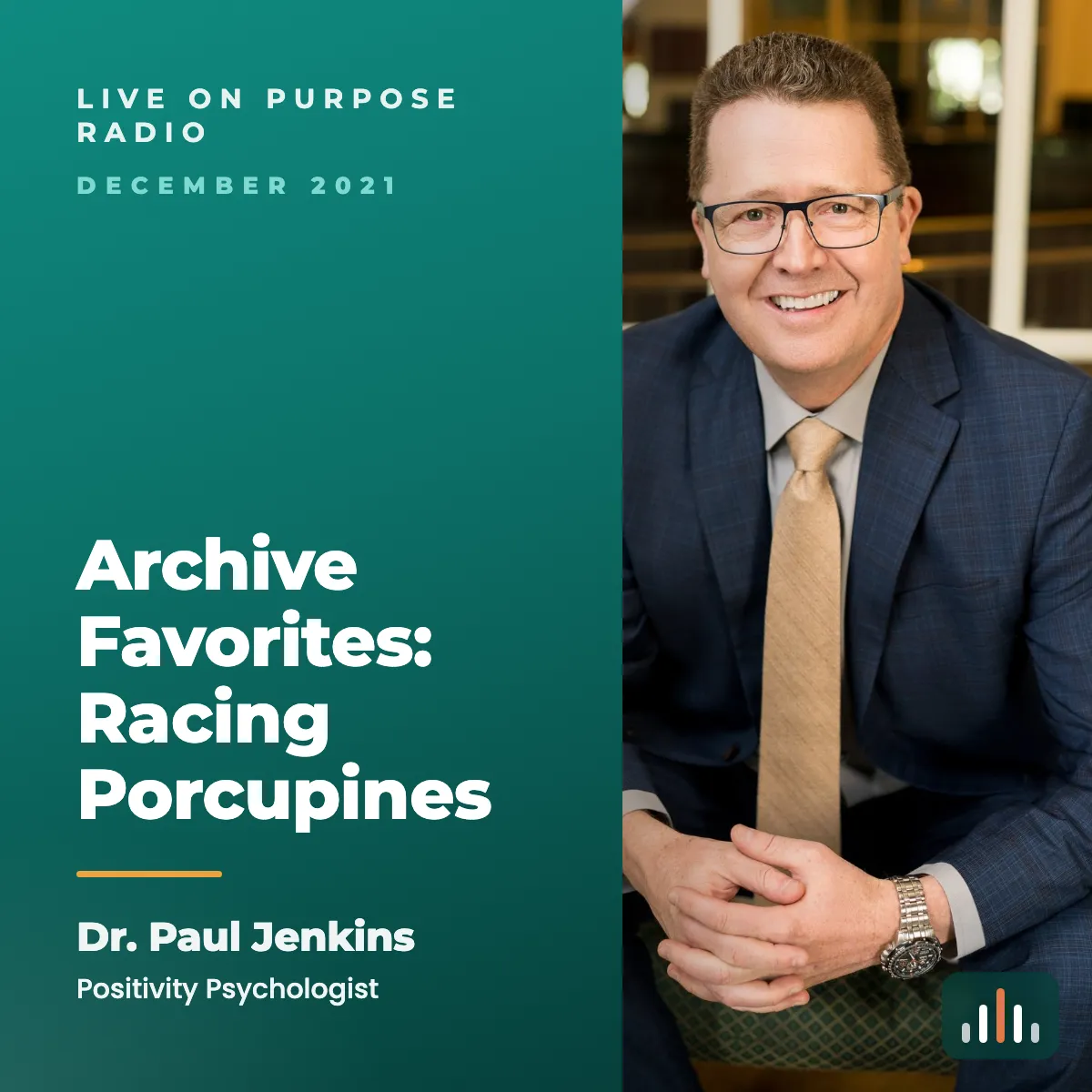
Welcome to Live On Purpose Radio with doctor Paul Jenkins, where you will hear inspiring stories of ordinary people doing extraordinary things. Feed your mind with a regular dose of positive energy and show up for your life every day on purpose. Living on purpose means that you have a purpose and you do it intentionally. And now, here's your host, doctor Paul. Hello, everybody.
Welcome back to Live on Purpose Radio. This is doctor Paul, the shrink, who expands your life with another episode of Live on Purpose Radio, bringing to you one of my favorites from the archives. Enjoy this episode as we put together a brand new format for you to enjoy starting at the beginning of the year 2022. I'm looking forward to that. Enjoy this episode.
Hello, everybody. Welcome back to Live On Purpose Radio. This is doctor Paul, the shrink who expands your life Another episode of Live on Purpose Radio. I have a new friend with me today. This is Steven Iverson.
Say hello, Steven. Hello. So glad you're here today. Well, thank you. It's a pleasure to be your guest today.
I'm used to listening to you. Is that right? That... Well, folks, for for those of you who are listening, I listen to a program called Voices of Experience, which is put out by the National Speakers Association. You know that I'm a member of that.
And Steven, I met you in Washington DC recently. Yes. Where we had our national convention. And Steven is the voice behind the voices of experience. So you interview people for that program.
I do and so this is a big switch. Turn on the other side of the microphone. That's cool. I've also learned some things about you that really resonate with what we're doing here at Live On Purpose. And you've identified, right, through your career, through your life, certain principles that allow people to do what our show title suggests, to live on purpose.
Yes. I have. So that's what we're here to talk about today. Very good. And your experience, give us just a a quick take on where you're coming from, what you do.
Introduce yourself a little bit to our listeners. Well, I started a leadership development firm after a a career that I had, serving as a a minister and working with crisis management and got to a place where I saw that there was a lot of other opportunities being missed that I wanted to to touch base with, other groups that I didn't necessarily have an audience to. And so when I started my business, I started speaking. Mhmm. And that that path led me to conversations with many other people who, were either successful in their own rights, in their life, their business, and also people who were not finding success.
Success, that's a hot button. It is. And how's it defined? Right. Exactly.
And so I started looking at those that seem to really be getting where they wanted to go in life Mhmm. And comparing that to those that were struggling and wondered, well, what's the difference between those? We like to say, there are those who are living the dream and then those who are dreaming of living. What's the difference between those? So that started my research and study in the conversations with those that were finding that place of personal success.
This is so interesting to me because as a psychologist, my whole business has been around getting into people's heads. Mhmm. You know, figuring out what makes them tick. What is it that that really matters to people or makes a difference to them? And this word success, I mentioned that's a hot button.
Yes. Because we define it differently. And some of the messages that are out there in the mainstream media or in our culture, don't particularly resonate with me in terms of how I would define success. Mhmm. And you and I have chatted a little bit about this.
Share what what your take is on that. My definition of success is not about fame or fortune. It has more to do with contentment. Contentment. Contentment.
Absolutely. K. People who in in my estimation, those that really intrigued me as successful were content with where they were in their lives. Mhmm. But also had a little hint of discontent.
Uh-huh. A hunger to continue to grow. They were people who influence influence their families, their communities, maybe their businesses, and they saw a much bigger picture and their success was more about how they are helping others, not so much about how they were helping themselves. Right. So that discontent was what else can I do to make a difference?
And then the return for themselves was an incredible reward. It might be financial. It might be, of interest Mhmm. From the community or esteem of some kind, but that wasn't their end run goal. Mhmm.
Their goal was to have the influence. And so for me, that was the that was the beginning point of understanding what really good success could be. And I've met people who have Yeah. Nothing in the bank that were highly successful because they were living right where they knew they needed to be. And then others Yeah.
Who have that measure of success by standards of the world of a big bank account, but it really didn't matter to them. So there's a little paradox here that I'm picking up on. Mhmm. It's one that I've noticed a lot too. There's there's this feeling that we get that indicates that we're successful.
So you called it contentment. Yes. And yet, that's coming right up against this opposite feeling, discontent. It's almost like you have to you have to get comfortable with being discontented. I don't know if that's even a word, Steven.
Is it? Well, we just made it up. We can make up words if we want to. You see where I'm going with that, though? So there's this discontent that's just a natural part of being a human being and being actively involved in creating our own life.
Yes. And that feeling tells us, hey. There's still something to do. Exactly. Well, and that...
And I think for me, that was my journey. I was having a very good career, enjoying the work that I was doing, but there was still something missing. And I I felt that little measure of discontent and had to sit down and slow down and say, okay. I'm choosing in many ways to follow the path that I've seen others lead Right. And take down and and had for myself six bet...
Success based on their measurements. Yes. But something still in my heart stirred me to pursue that one thing that seemed to be missing. And what was that? And for me, it was looking at a different way to connect with a greater audience, a different audience that maybe wasn't hearing some of the things that I was learning.
Yes. So my discontent led me to what do I need to learn Mhmm. In order to move in that direction. And probably more importantly, doctor Paul was, what do I need to let go of? Right.
It's those things that we're clinging to that sometimes keep us from feeling that we're successful. Mhmm. It's like we keep telling ourselves this story about, well, I'll be happy when Yes. Or after or if or upon completion of Yes. Whatever it is.
And then we complete that thing and what do we feel? There's still some discontent. Mhmm. That's not a bad sign. It's not a bad sign.
It's a good sign. To me, it's kinda like riding a bicycle. If I'm turning the corner and I hit a little pebble or something that just throws me off balance slightly Mhmm. I automatically, without really processing in my brain, make an adjustment. I seek that point of balance again.
And in some cases, I look for grass to dive into. Yeah. But I know that I need to I need to correct something and get that balance again. For me, the discontent is like that. That little discontent means there's a...
There's an imbalance. Right. And I need to pay attention to that imbalance because it's telling me that it's time to make a correction or to adjust so that I can be more successful in the in the future or what's coming next. Maybe what's around the corner. And it does not mean that you're not successful.
No. No. It doesn't mean...... Where a lot of people misinterpret this. Wouldn't you agree?
Yes. Where they get to to a place of, oh my gosh. I'm feeling this discontent in my life. Whether that's pain or a yearning of some kind or just a... And noticing that something could be better than it is.
And instead of interpreting that as, my life's out of whack and this is terrible and this is bad, like you're saying, just see that as an indicator that a course correction Yes. Could bring you to a higher level of success. Yes. Or happiness or satisfaction, whatever we wanna call that. And sometimes that...
And going back to the thought of having to let some things go. Mhmm. For me, I've had to let go of success I've already had. Things that helped me to get where I was at. And you can only go so far depending on those things that have brought you to the point that you are.
That's right. If I wanna go further and I wanna improve and develop, I can't keep depending on the skill set I already have. I've gotta learn some new skills, but it's easy to just stick with what I know because this is what makes me perceived as successful in my own mind as well as my peers. Mhmm. If I keep doing that, then I'll be successful.
But what I learned was... And I'm still learning it even now. Mhmm. If we don't keep growing, we get left behind. Right.
And growth. I'm just thinking of of this concept that you're introducing to us, growth, development, improvement. Mhmm. The process of doing that is one of the things that brings us that feeling of success. Yes.
So if there's nothing to improve, I don't have any opportunity to create that feeling. That's right. So I need to learn to embrace that moment of ink... That that discontent or...... Discontent.
Or that... A little discomfort. Mhmm. It's okay. That's a signal.
That's now time to grow a little more. It's an opportunity Absolutely. Presenting itself to. Yes. So, Steven, you've got somewhat of a reputation for being a leadership expert, someone who's able to coach, companies, organizations, individuals Yes.
Through this process of creating higher levels of success in whatever endeavor they're involved with, whether it's family or or business. And maybe I'm overreaching there. Would you say that the principles apply to all of those... Well, I I do I do believe they apply to all those contexts. The personal family, nonprofit association groups, maybe a work team, and also a larger business concept.
There are some things that we can pay attention to that'll help us go from where we are to where we know we need to be. I call it the gap conversation. Get a plan. Oh. That's all gap means to me is, okay, here's where I'm at.
This is where I see we need to be. Mhmm. And most of us, we see the chasm between the two, and we panic and go, oh, it's the gap. Yeah. It's just simply a new opportunity to get a plan.
And when we get a plan, we start thinking, and we go through a process to bring ourselves to a place where we're achieving that destination or that goal that we wanted, but at one point seems so far away and unachievable. It seems so simple. Get a plan. It is. Yeah.
It's get a plan. But most of us react, find some sort of anxiety or begin to root ourselves in excuses as to why we can't do that. Mhmm. And that's why people someday say, well, you know, this is the way we've always done it. Right.
And just fall back to that default and Mhmm. And this all stinks, but there's nothing we can do about it. Right. Yeah. So what's the process?
Where does where does someone start? Let's say that, well, I I think I'm hearing from you that maybe a first important realization is you're feeling discontent. Mhmm. Awesome. Right.
Right. We give a thumbs up. That's okay. That's right. That's okay.
Yes. But then reinterpret it Right. As an opportunity or as a a a guidance. I'm thinking about a story that you shared with us yesterday with our chapter about racing porcupines. Yes.
And and how they need to be directed. Right. Can you give just a quick summary of that? Do you know what I'm talking about? I think I'm crazy.
No. Well... And and people hear me tell the story and they think I'm making it up, but it's true. I saw the pictures. There's a little town in Idaho that has every fourth of July, the world championship porcupine races.
Uh-huh. And I was a little boy and lived in this community when these races got started. Right. And there's a strategy and the goal is to get a porcupine, that prickly partner Uh-huh. From a starting point to a finish line.
But the conflict is the porcupines typically don't like to go in straight lines, don't like to run, and usually like to hide or run-in circles. So somehow, the teams have to persuade the poor occupying to get to that place, but they can't force them. Right. They have to use certain tools. They use a broom.
Uh-huh. They use a trash can, and they've learned to use boundaries or a fence. A fence. So that it's more... A little bit more contained.
The broom, I think, is probably the the most fascinating part of the analogy because the broom is about persuasion. Mhmm. You can't push poker project porcupines against the rules. Can't just swat it along. You cannot.
You're not allowed to do that. You'll be warned. If you continue, you'd be disqualified. But when the porcupine begins to move in a direction that's not preferable, you just place the broom in front of its nose, and it can see now for itself. This isn't an option available to me.
Go that way. And so it looks for a new direction and hopefully it's a redirection. It'll bring that back to our lives. When we have that little moment of discontent, sometimes what we need to look for is the evidence that says these really are not healthy options. Mhmm.
So then turn and look for new options that move you towards your goal and not back to where you've always been. Right. Mhmm. I think there's more we can do with this analogy. When we come back from this break, folks, we're going to look into how else are we like these porcupines.
Okay. And where can we go from there? This is Steven Iverson at Live On Purpose Radio. We'll be right back. Are you ready to take your positivity to a whole new level?
I've been enjoying these conversations with my guests at Live On Purpose Radio. My own story about becoming more positive is something that I've shared in my book, pathological positivity. And right now, I'm giving the book away. You just pay for the shipping. Go to doctorpauljenkins.com, spelled with a d r, and click on the big orange button right there that will get you a free copy of my book.
You pay the shipping. I'll pay for the book. Sound like a good deal? Power up your positivity and get ready to see phenomenal changes in your happiness, your relationships, your business, every aspect of life. Enjoy this free gift from me, doctorpauljenkins.com.
And we're back. It's it's fun, folks. You guys don't get to hear this because you're listening to the other stuff. While Steven and I are continuing to have a conversation and he said something about good leading with... And I said, Steven, that's my broom.
That's right. You are the porcupine. Right? That's right. I'm trying to lead you to this place.
And it it just occurred to me that this is a pretty good analogy. Mhmm. Because the things that happen in our life throw up certain barriers in front of us. Right. And that doesn't necessarily mean, oh, you don't get to succeed.
It probably means this isn't the direction Right. Toward that success. That's right. So I had a little moment. That's good.
And so did I. Absolutely. And I can think back right now, there have been times in my life where there was a broom. There was evidence that I probably shouldn't keep going that direction. Yeah.
But I had in my mind, whatever was beyond that, that's where I wanted to go, and I would push... I try to push my way through it only to be pushed back. And then I'd get to the place where I almost wanna just give up. Mhmm. Because I wasn't getting the progress I wanted.
And then the moment I got to that point of saying, okay. That was the letting go of my intentions, my plan, and then seeing there were some other options right there the whole time, some open direction Yeah. With no obstacles, but they weren't on my mind until I got to the point of saying, okay. That doesn't work. What else is available?
And I think that's what the porcupines in the race find. Is that okay. This doesn't work. So where else do I turn? And when they turn, they see open field and an opportunity to run.
Right. Which they don't even have access to as long as they're hanging on to whatever it is that they're already thinking. That's right. Wow. You know what?
There's so many great applications for this as as we go through life and we come up against those barriers. Really? Barriers? Mhmm. What if we just rethink that whole thing?
Mhmm. Our perspective isn't the same. Right. So if I'm the porcupine, I don't see the entire course. No.
I don't know how to get where I'm going. Right. But that person with the broom does. Right. Yeah.
They have a better sense of the direction Mhmm. And where we need to go, and they have a plan to help us get there. And it's finding that way to cooperate together. Steven, you're a a parent Yes. And a grandparent.
Yes. We've talked about that a little bit as we... We're we're on a roadie, you guys. We've taken Live on Purpose on the road. We are now in Boise, Idaho.
We're just about to go to an event, but we had a few hours in the car We did. To have some conversations, and I'm seeing some analogies to parenting. I remember, when my kids were younger, I used to take them hiking on Mount Timpanogos by our home in in Utah. And this is a an amazing majestic mountain. As you go up in elevation, your view improves.
Yes. And the analogy that that makes sense to me here in terms of vision is that, yes, my view is really great from where I am. Right. And and parents don't discount the view of your children. They see the world better than they ever have.
That's true. Now do they see it like you do? No. Of course, they haven't been hiking as long as you have. But the higher you get on that mountain, the better perspective, the more this vista opens up to you.
So with that perspective, as you're looking, you know, as a parent, have you ever felt this way? Where it's like, no. Don't go that direction. Mhmm. And your kids are like, I'm hiking here.
That's right. And see just fine. Uh-huh. Get on my face. Right?
Yes. Parents aren't any smarter necessarily than their kids, but they've been hiking longer. Right. Yeah. And that's the perspective thing.
So what if we were all humble enough to realize, you know what? I don't see the whole thing. Mhmm. If this barrier is coming up in front of my nose, maybe it's just a little nudge Right. A little redirect.
That's right. Well, and in the porcupine races, when I was a kid, they didn't have a fence that defined the course. Oh, boy. It was just a crowd of people who would gather around the city park. And, of course, when a porcupine runs at a crowd, the crowd scatters, and the porcupine is now off course.
But, eventually, they decided a a good fence around the course would be would be helpful. Mhmm. Sometimes the porcupine will get loose and head towards that fence, but that fence all of a sudden becomes the boundary Mhmm. That says, no, we don't go beyond this point. But it doesn't mean that there isn't more room for the porcupine to function, to make choices, and to stay engaged.
And as a parent, that was something that I had to come to terms with. Mhmm. Oftentimes, I made the boundaries a little too tight, and it felt restrictive. When I learned to stretch the boundaries out a little bit and then give my kids permission Mhmm. As long as they stayed within these healthy boundaries that I know are good for them Right.
And then give them that permission to figure out their way Within those boundaries. Within those boundaries that engage them more. Mhmm. And it also taught them to make better choices. It helped them to be wiser.
They learned from some prickly moments. They got stuck. My job is to help them get unstuck, and that's where I would bring back the the broom of persuasion. Yeah. And for me, it's what you did a moment ago.
You asked me a question, and it led my thoughts to a certain direction. Certain direction. Mhmm. So a question or a statement. Sometimes all we have to do is point the obvious out to our kids and say, if you keep going that direction, where where do you think that's gonna lead you?
And and they look down the path and go, oh, there's a cliff there. Probably shouldn't go. What do you know? They'll come to that conclusion. Sometimes all we have to do is point out where those particular boundaries are Right.
And they respond well. So that they look up from their head and the other stuff Right. To see more clearly what it is that you want them to see. Yes. You talk in a different way about some things that have been sometimes overused.
The comfort zone. Yes. For example. Oh, yes. You've got a little take on that that's a little different.
I do. Yeah. I Care to share that? I got tired. I'm sure your listeners and, most most people get tired of people telling us, yeah, you need to get out of your comfort zone.
Get out of your... I I personally just can't stand it when somebody says get out of your comfort zone. The minute we say that to an individual, we cause a couple of things that trigger in their mind. One is, how am I failing? Because if you were implying that I'm not getting where I need to be, well, then somehow I failed.
And secondly, it pushes them to what I call really the the, the panic zone. I was just thinking anxiety. It does. It's like, oh, no. I can't go out there because that's scary to me.
And by definition, I will be uncomfortable. Exactly. Mhmm. So most what most of us do is we retreat to our comfort zone. Yeah.
The minute I'm told get out of your comfort zone, I go back to it and go, well, why? Well, the comfort zone is comfortable because it's safe. Mhmm. I know this place, this this space well. I'm successful here.
What I do is good. That's why it's comfortable. Right. And then there's that gap between where I am and where I probably need to be. And what is what is it that I have to do to get there?
Because I've desired to be there. Mhmm. And sometimes I'm told I need to be there and I don't wanna go for... If employer says this is where you need to be, and I'm going... I really don't wanna do that.
But if I wanna be employed, I probably need to learn how to do that. Right. But I've gotta somehow deal with this comfort zone issue, so I call it the power of the comfort zone. And what I teach what I teach business groups and leaders, in all kinds of environments is stop saying get out of your comfort zone and start helping people grow their comfort zone. Grow it.
Grow it. Expand it. So that you're comfortable with more things that weren't there before. That's right. So I'd have a a little system.
We start with our comfort zone, and then we've just moved the circle out a little bit, and I called that next level the contemplation zone. If I'm gonna get where I need to go, what do I need to think differently about? Mhmm. What questions do I need to ask? What kind of things do I need to learn to get there?
It's like you go there mentally first. Absolutely. And I'll do that in a conversation with people. Mhmm. Maybe a team of people are working with me, and I can tell some of them aren't sure about where to go.
Well, let's talk and let's think about what we could do and get people engaged in that process. Children do this all the time. Little kids, especially. I love watching my granddaughters. They're learning new things.
Well, they can see in their mind something they desire. Mhmm. But they've not mastered the skills yet to do it, but they can tell they should be able to do that. Right. Their little brains go right into the contemplation zone.
They start thinking, how do I do that? Mhmm. And they soak up all kinds of things. Once they've thought about it, they determine a couple of things they want to try. And that's where we then move the circle out just a little bit more.
We call that the creating zone. Uh-huh. It's where we get to test. We try things that we've never done before. So a child who hasn't learned how to walk yet starts getting up and starts walking around the furniture or holding onto your pinky or whatever it may be.
And if they fall, if they let go of the table and they fall, they cry, but usually not because they were hurt. It's because they're indignant the fact that I should have been able to do that. It's not how it went in my head. It's right. And so they go back to and they keep creating until they get comfortable enough to let go and to begin to take the steps and suddenly they're doing it, which leads us out to that very last circle where now we've gone from comfort zone to contemplation zone to creating to what I call the confidence zone.
Because all of a sudden, I'm reaching the goal. I'm an... And now I'm confident. Yeah. And suddenly, that's comfortable.
Now that becomes your new comfort zone. It is. It is. Now most adults don't do what children do. Children will get out into that creating zone, fail, have a have a barrier, and they will go back only a little bit to the contemplation.
They'll go back to thinking, okay, that didn't work. What else do I do? Where do you think this? Adults will go from that creating zone and then hitting a where... A barrier and suddenly race all the way back to the original comfort zone and say, see, I told you it wouldn't work.
Yeah. And that's our trap. Crawl back down in all. They do. And they give up.
But those are, as we've mentioned before, who are successful, have a measure of content, but a little discontent. They get to that place where they hit those moments of imbalance and they go, okay. Well, let's step back and think. What else can we do? And then they test it again until it becomes comfortable.
They're really more childlike in that way. Very much so. Isn't that interesting? Yes. It is.
It comes down to some really basic principles that somehow, as life beats us up a little bit, we tend to abandon that and like you said retreat back into the comfort zone. When really, the success, the happiness lies in being willing to experience the failure and that's another word we could redefine, isn't it? Yes. I love John Maxwell's idea about failing forward. Yes, I do too.
And Robert Kiyosaki, if you want to succeed, start failing faster. That's right. Love it. Yes. Because that...
As we rethink that then, okay, this failure is just that broom in my nose saying, nope, this isn't the direction. Mhmm. But keep looking. Right. Keep looking.
Don't give up. And keep learning. And keep learning. Just just keep learning. Okay.
That didn't work now. What do I do? And I think for most people when it comes to really having that place of contentment, it's it's really... If we can just maybe unpack that a little bit, it's getting a place where you have that personal sense of satisfaction of having achieved. Right.
And that feels so good. You know, we we try to motivate people with rewards and games and little things, but really, the thing that motivates most of us, especially thinking back about children, is getting that place where you can see in the child's face, I did it. Yeah. I actually did it. And they're so happy with themselves because they stuck it out until they achieved.
Look at daddy, I'm riding a bike. Look at I climbed the tree. Look at I'm... And we still as adults want that feeling of achievement. And there's this moment of pure joy and celebration of life the way it is right now where I am.
Yes. And and without diminishing that, it moves almost seamlessly into, okay, what's next? Right. Right. It's an energizing...
You're the motivational speaker who doesn't believe in motivation. I thought that was gonna be our secret. We weren't gonna tell anybody about that. Sorry, you guys. Do you still wanna hire Steven to speak at your event?
But with that clarification, it's it's not just about being motivated. Right. How would you summarize that? Just as we close this Okay. Interview today.
I... Well, I can tell you that what for me was the turning point of understanding motivation and why I don't believe in motivation. Because I was having a conversation with the gentleman who was in his early nineties. Mhmm. He was one of those people I looked at that was just influential, still very vibrant, maybe frail physically, but just really having an impact on the people around him.
And I wanted to know, what is it that really makes you tick? What's going on? And I asked him a question I've asked everybody else. I said, Willard, every morning when you get up, could you tell me what motivates you? And he looked at me and he said, Steven, I don't do what motivates me.
I do what matters. And that for me was an because I realized some days I'm not motivated. I don't feel it. Right. Or or what motivated me in my early years of adulthood doesn't motivate me now.
What motivated me a week ago maybe doesn't motivate me today. Yeah. Sure. But I know what matters. And sometimes it doesn't feel good to do the things that matter.
But being faithful to it because I believe in that purpose, I still do it. And that's what leads us to that place of achievement, contentment, or as you wanna define it, a success. That feels good. Yes. And that's it, folks.
That's the way you live on purpose according to Steven Iverson. Thank you for letting me on your show. I know that's not everything you know, Steven, but that may be all the time that we have for today. Thank you so much for being here at Live On Purpose Radio. How do people get in touch with you in connection to what it is you're doing?
Is there a website? Is there somewhere you'd like us to do? My website. It's www.steveniwersen, spelled s t e v e n I w e r s e n dot com. I worsen.
Yeah. Well, we use a w to mess people up. Right. Just to play with their minds. That's right.
Yeah. We do that. Thank you, Steven. Thank you, all of you listeners. It's time.
Go out there and live on purpose.
Open the transcript on its own page ↗