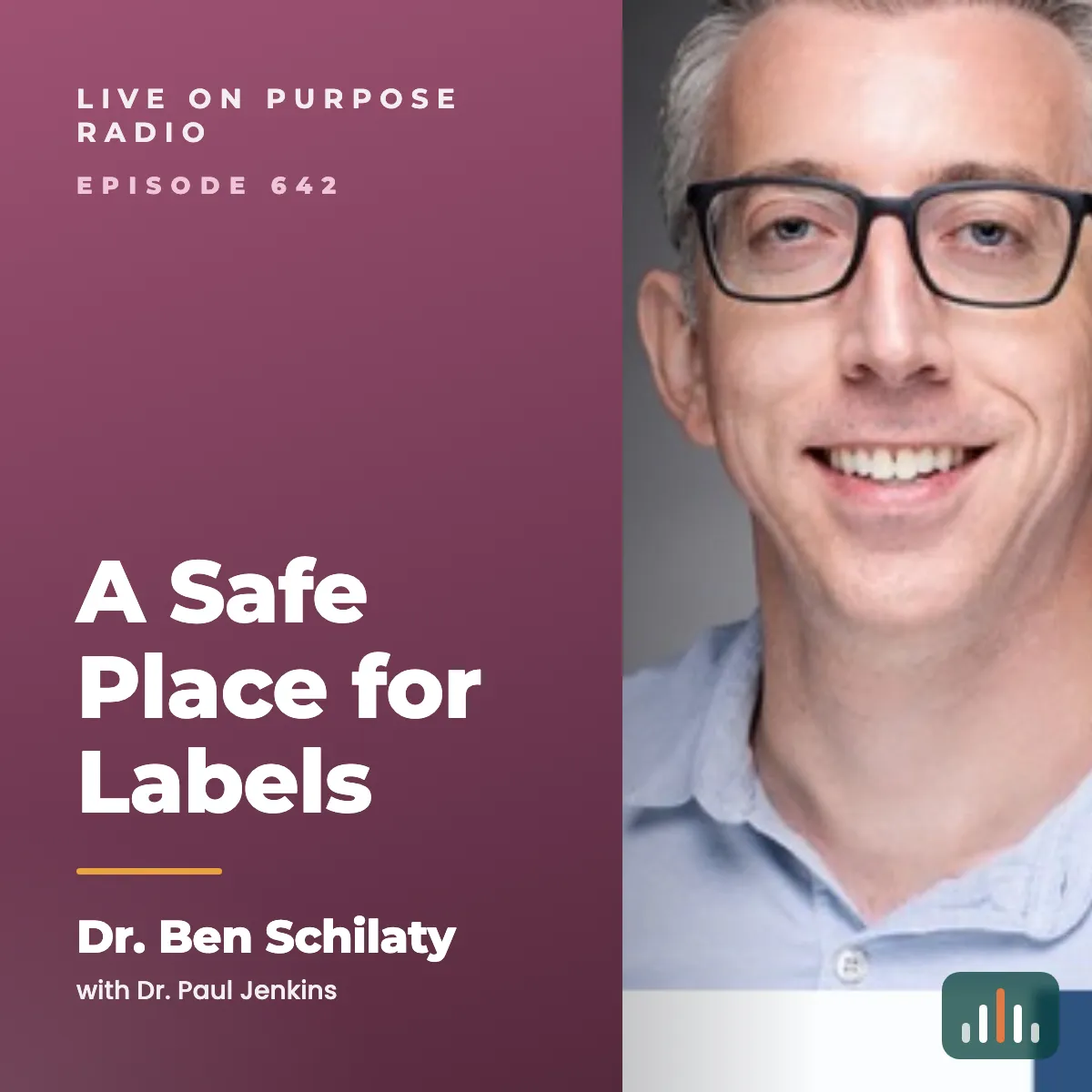
This is Live on Purpose Radio episode 642, a safe place for labels with doctor Ben Shiladi. Now is the only time to create and live the life you love. I'm doctor Paul Jenkins, the positivity psychologist. My job is to connect you to powerful positive psychology principles that immediately upgrade your relationships, business, and mental health. Are you ready?
Let's jump in. Hello, everybody. Welcome back to Live On Purpose Radio. This is doctor Paul the shrink who expands your life with another episode of Live on Purpose Radio. Joining me today is doctor Ben Shalati.
He is an author. He's a therapist. He's a podcaster like I am. We've got a lot in common. And, Ben, welcome to Live On Purpose Radio.
I'm so glad that you're here. Thank you, doctor Paul. I'm so thrilled to be here and just honored to be invited. And, I love attention, so this is great for me. Well, let's get you on the mic, in the spotlight, whatever we need to do to bring some attention to you because you are shining a light on something that I think is really important.
Just a little background. I shared some of this with you before the show, Ben, but, I was introduced to you through my daughter. My daughter, Lindy, who also works here at Live On Purpose, encountered you when she was a student at Brigham Young University. Now that happens to be my alma mater. I got my PhD at BYU years ago.
And so I'm very familiar with culture, and this is a very conservative religious institution, private university that is, operated by the Church of Jesus Christ of Latter day Saints, of which you and I are both members. And at the time, you were serving as an administrator in that institution as an openly gay man. And that doesn't always fit so well in a conservative religious environment. So that that was the context in which I think you showed up as a guest lecturer in one of her classes. And it just really caught her attention, and she introduced me to you at that point, Not officially because you had no idea who we were at the time.
But we started following your podcast a little bit and, noticing that maybe there's a better way to approach things that we have traditionally put into categories or in specific labels. And so for today's show, I wanted to have a conversation with you about that. So maybe a little bit about what your journey has been along those lines and what we can do differently to open up new possibilities. So with that introduction, Ben, would you just share a little bit about yourself? Anything that maybe I missed that you think is relevant to our listeners today?
Well, thank you so much. You know, you you hit the nail on the head about who I am. You know, most people know me, for for being both a Latter day Saint, and someone who is gay. If you're to... If you were to, like, Google gay Larry Saint, I'd probably come up at some point.
At the top of the list, probably. My blog or or or my book or my podcast would would come up. So I'm well known in that community. But outside of that, I'm... No one knows who I am.
So I I get to be, you know, a bit of a a a leader in one space and then anonymous everywhere else, and I kinda like that. I'm also a university professor. I work at Utah Valley University. I'm a professor of social work, and, Utah Valley University is the largest university in the state. So I've got a lot of kids I get to work with.
It's it's a blast. And the other thing that's important to know about me is I also love cacti. So... Yeah. And I know it's an audio podcast, but I'm seeing just over your shoulder, there are some images of saguaro cacti along your window.
And, I love that, Ben. I just, I did an event in Phoenix not too long ago, and that's one of the few places on the planet where you can actually see that particular strain of cactus. Yeah. They only they only live in the Saguaro Desert. It's not Saguaro Desert.
The Sonoran Desert. Yeah. Which we might as well rename because that's the most prominent feature of the desert. So... Yeah.
So those are some important things about me. The other thing that that has been a big thing in my life, my my mother recently passed away, and she I saw that. Yeah. She had a long journey with Alzheimer's. So I've been working on, you know, writing her story and, you know, what the grief and loss has been like, for me to lose a parent, of someone with dementia.
So I've stepped more into that space of helping people work through, you know, grief and loss. And and, it's been a a really beautiful journey that has been hard and painful, but also wonderful in many ways as well. And I did see that on... I think it was on your Instagram, where you had mentioned something about that. I'm so sorry for your loss.
I know I've had a couple of members of my family, mostly grandparents, but also my father-in-law who had suffered with dementia. And, you know, and that's one more example. We've got labels we attach to people, circumstances, relationships, sexual orientation, national origin, gender. All of these things get labels attached to them, and then we infuse meaning into that. Because psychologically, I think we are meaning creating beings.
And so the label carries some meaning, but there are some inherent problems with labels too. And I'm just gonna kinda seed it with that and see where your brain is going with that. Yeah. So, you know, the labels I have used to describe my orientation have changed a lot over the years. When I was when I was about 11 years old, I first started realizing that I was attracted to guys.
I'm 41 now. So this was back in the in the in the mid nineties. And, back then, you know, even in society, it wasn't, acceptable to to be LGBTQ. And I I remember I was in middle school or high school when, Ellen DeGeneres, she had this, sitcom called Ellen, and character came out on the show. And then shortly after that, it it got canceled.
I I remember people, you know, in my orbit saying, well, who wants to watch a gay person? You know? And and so back then in in my teens, there there is no way I would have acknowledged in any way that that I that I was gay or attracted to guys. I was just in a state of denial, and I tried to explain it in a way... In in any way I could.
You know? It's not that I'm attracted to this person. I just wish I looked like them, or I'm I'm jealous of them. You know, that... That's not what...
This is an attraction. And, like many Larry's saints, I planned on on serving a two year mission, for the church. And I thought that, you know, I'll go and serve God for two years, then he'll bless me with with healing, and he'll fix me. And so that was kind of always in the back of my mind. So when I was 19, I moved to Mexico for two years, where I served as a missionary.
And then I got home, and I was still attracted to guys. And I remember thinking like, oh, shoot. It didn't work. So I went from this phase of, like, being in denial to this phase of, okay, this is a real thing, but I can fix it. And and so that's when I started to get this fix it mode.
And so I thought, well, if I could just be perfect, God will bless me with what I would have described as, you know, quote unquote healing. And so I I went I went to see a therapist to change my orientation. You know, I was extra religious. You know, I prayed every day. You know, I read the scriptures every day.
You know, I I served in in in in church assignments as much as I possibly could just to change my orientation. And I also went on lots and lots of dates with women trying to find someone that I could marry so I could live a, quote unquote, normal life. And that all started when I was 21. Then when I was 23, I just like I'd been holding this in. And I was just like like like just drenched in shame and self hatred.
And, and I finally knew I had to tell some of my, like, like, tell someone in my life what was going on. But I... And there there was like this very specific feeling I would get when it was time to tell someone. And I started to recognize that feeling and it terrified me and I pushed it away. And I missed a lot of moments of connection because I didn't listen to my my gut when it told me, hey.
It's time to tell this person what's going on in your life. But at one of those points, I was on a walk with my two best friends, my best friend from high school, and my my current roommate, in college. And this feeling just bubbled up inside of me, like, you have to tell them. And, and I I I handed hawed. I I didn't want to.
And then I just, like, you know, I'm a I'm a believer. And it it was like as if God said to me, I orchestrated the situation so you could tell them. And we were in a in a park all by ourselves, just walking through this park. And I said, hey, can we sit down for a minute? I wanna tell you something.
And we sat down on the grass. And and I I was so nervous. I felt physically ill. Like, I thought I might actually throw up. I was so nervous.
And I I didn't use a label. I said, for as long as I can remember, I've been more attracted to men than women. Because that felt not only palatable to them, but I wanted that to be true for me. Not that I wasn't attracted to women, but just that I was more attracted to men. And they responded with so much love and kindness.
And, my my my friend, Mitch, who was my friend from high school, he asked a lot of questions. He expressed love. But Craig, who was my roommate, like, we shared a bedroom together. He wasn't saying very much. And so I finally verbalized this fear I'd had for months.
And I said to Craig, I understand if you don't wanna be my roommate, because, I'd like like, now that you know about this. And he said, why wouldn't I wanna be your roommate? You're the same person you've always been. And that was the beginning of of my healing. And so over the next few years, I'm just gonna give you my whole labels journey.
Yeah. I would tell people that I that I experienced same sex attraction or that I had same sex attraction. And I started to not like saying that I I have same sex attraction because it was like I was telling them I had some kind of disease. And and I was trying to, like, get rid of the the shame. And so I just stopped using that label at all.
And so, what... After I graduated from college, I moved to Mexico for the summer for an internship. And after work, there wasn't a lot on TV, that I wanted to watch, just lots of telenovelas. And so I would watch the Disney Channel in Spanish, and I I got really into Hannah Montana. And I was like, oh my gosh.
This is like my life, because Hannah Montana has the secret that only her close friends and family know about, and everyone else doesn't know what's going on. Like, this is just like my life. So I started using, Hannah Montana as my code word for being gay. And so, that's what my friends and I call, like, oh, yeah. Like, blah, blah, blah with Hannah Montana, you know, but that was my code word for for being gay.
Because I didn't wanna say I have same sex attraction. I I wasn't ready to use an identity label like gay. And so that's the label I used for a while. Like, I... Like, Hannah Montana was what it was.
And then, about the time I was 29, maybe 28 or 29, I had tried so hard to change my orientation. I had tried to marry a woman, and it just... That just wasn't working. And God is so good at answering my prayers, but he just wasn't answering this one. And it hit me like, maybe this isn't gonna change, And maybe this is how I need to live...
Like like, maybe this is how my life is gonna be. And so around that time, I I started to, use the word gay to to identify myself. And then that was a very deliberate and very purposeful purposeful choice. Because earlier in my life, I've been told very explicitly at church that the same sex attraction was a trial, a temptation, and an affliction of this life that wouldn't exist in the next life. And that...
Those are the words. This is a trial. It's a temptation, and it's an affliction. Those are the words that were that were often associated with it. Mhmm.
And I sort of think, you know... And and because of that and being told that this wouldn't exist in the next life, I just wanted to get to the next life. And so these were years of my life when I would have rather been dead and straight instead of alive and gay. And so to me, the term same sex attraction carries with it that weight of, like, this passive suicidal ideation, just like wishing, like, can I get a mentor? Can I can I get a terminal illness?
Can I get cancer? So that my life will end in a heroic way and I won't have to deal with this anymore? And and so, that... That's what... Like, that's what that term same sex attraction holds for me now, and some people prefer that term.
And so when I started to self identify as gay, I thought I am going to live my best life the way that God sent me to Earth. And so for me, the term gay is very life giving and very affirming. And and so that's the label I choose to use. The the word, queer, this is just the last part of my labels, and then we can... Then I'll I'll let you say something.
Yeah. I'm enjoying listening, Ben. Keep going. And then, you know, the the LGBTQ community has used the term queer to, like, talk about the queer community. And and that was a term that felt uncomfortable to me because that, like, that was a that was an insult when I was a kid.
And I don't usually say, like, hey. I'm queer, but sometimes I I will. And that's just because the the term queer for me connects me to other people. Like, it connects me to a community. And so to me, the term gay describes me, and the word queer connects me to a community of people who who are like me, who might have different labels or different experiences.
But, we all fit in this... The the the space of, we weren't what we expected to be, and we had to learn to love ourselves. And now we do. As you're sharing your journey, Ben, I'm noticing something interesting because your your early journey with this, the labels... I remember in hearing you speak, you talked about the label on on a can of food or something.
Right? And it it says what the ingredients are, and then it lists those things. And there are many ingredients. And sometimes we'll pick one of those and say, well, that one's the most important one or, this is the one that really defines what's in this can. And we do that with our own labels.
And as you were talking about it, I heard words like healing, fix. You shared some of these words and that there was some need to repair something that was broken or disordered or somehow pathological. Yeah. And that there was a shift in that. In in later years, Ben, since since I've been familiar with you, you present with a very different energy from I'm broken and need to be fixed.
And even the term gay, the label gay is also applied to happiness and joyfulness and mirth. And that's how the the word has been used traditionally in the past. Mhmm. And so there's a very different energetic feel to that. And what occurred to me as you were talking, Ben, is that the labels that we choose for ourselves or anybody else is what defines how we interact with ourselves or whoever we've attached the label to.
Yeah. I... In fact, just to put a little more context around that, I was in a training once with Ron Zeller, who's a world class leadership trainer. He passed away a few years ago, but I had an opportunity to have a private, kind of intimate, training with him. There were maybe a dozen of us in a hotel room in Lake Tahoe.
And he was talking to us about labels and how when we label something, it determines our own interaction with that. So he gave an example of Adam and Eve in the Garden of Eden. K? What are the oldest bible stories? How do you get older than that?
So, he's talking about Adam having the responsibility to name all of the animals. And so god presents him with a horse, And he watches that horse, and he sees how powerful and strong it is, and it's jumping around and doing things. And so he named it Seuss. I don't know. I wasn't there, but apparently, Ron Zolder and I was.
And so somehow he knew what Adam named the horse, which interpreted his jumping thing, leaping creature. And I still didn't get it. But then Ron said, what do you do with a jumping thing, a leaping creature? Well, you might climb on and try to hang on. You might simply sit back and observe and marvel at its power and majesty.
I still didn't get it. And then he said, he did not name it lunch. And that's when it occurred to me that the label we give to whatever determines our own behavior toward that thing. It doesn't change the nature of the thing. Mhmm.
But it it drastically changes how we show up for it. Yep. Yeah. I think you've probably experienced this firsthand. And and in your clinical and academic work as well.
Yeah. For sure. And, you know, when I, like, when I use the term same sex attraction to describe myself, that was to me a pathology. Like, it was it was a problem that not only could be fixed, but should be fixed. And then when I, you know, use my own label of Hannah Montana, it was like, hey, we can talk about this thing, but, like, let's not talk about it too openly.
And those were years where, like like, people were... Like, I let people into a part of my life, but I didn't super let them in. But then, and and and so... And and people responded, you know, how how I told... Taught them how to how to react to me.
You know, that's how people respond to me. So, you know, I'm a professor of social work, at UVU, but I also am a... I'm a I'm a licensed social worker. And so I see clients as well. And, most of my clients are LGBTQ Latter day Saints.
Yes. Most most of them are are college age as well. And so they're in the space of, like, trying to figure out who they are, reconcile their faith and their orientation. And it's a it's a fun space to be in. And and I I have learned...
I need to honor the labels that that that my clients use always. And so I had a client come in, and he told me right away. He said he said, I don't like the word gay. I don't like the word same sex attraction. I did not wanna use those labels.
And I said, great. We won't. And so for weeks, we we talked about his orientation without using any labels. And then just slowly, he started using the term gay to describe himself. And that was okay.
And then once once he did, I I I I noticed that he was doing that. And and I said to him, I noticed you've been using the the term gay. Is that the term you would like me to use to describe you, or do you like me to continue not, using any label? And he said, no. That that feels right to me.
And then the next session, he he was like, I'm not gay. This is all in my head. I'm making this up. You know? And then there was this this pendulum swing of this back and forth, and and, you know, that's okay.
And so I I I try really hard not to prescribe any labels to anyone and just to, you know, I think we... But like you said, we we... Like, the label we use affects how how we see people and interact with them. And I I really do try and see people, holistically, you know, as their whole self. And, I do try and be careful with the label that I use to describe them and always honor the label that that they that they offer for themselves.
Yes. You know, when you mentioned the same sex attraction, you and I are are similar in our upbringing, I think, you know, in this conservative religious community, of the Church of Jesus Christ of Latter day Saints, sometimes known as Mormons. That was an old nickname that has is in some level of retirement at this point. But, there's reasons for all of that too, and I I thought you were probably too Mormon to be gay and too gay to be Mormon. And so so none of the labels perfectly fit.
But even as you were talking about same sex attraction, I I remember in my tradition meeting with my ecclesiastical leaders and having been one myself and sat through some of the trainings about how do we deal with these kinds of things as if they are problems. And the term wasn't just same sex attraction. It was struggle with same sex attraction. That's all part of the label. Yep.
Right? So it's a struggle. It's a... It... It's something that you're fighting or, that must be resisted.
So I I share that mostly to point out and to call to attention some of the subtle nuances that can come with any particular label. I I learned through another podcast guest, actually, Greg Delson was here on the show, and he does some amazing things working with people and their voice. And I had for decades, Ben, I had carried a diagnosis of a neurological voice disorder called spasmodic dysphonia. I no longer carry that diagnosis because I retired it. And it it...
Similar to what you're sharing here, but this is a very neurological, physically based diagnosis. I got it from a bonafide certified physician. And so how do I retire that? Well, it was no longer serving me well, and it affected how I showed up. And so being able to retire it...
Here's what I learned. All diagnoses, and we can use the word label here if we want, are broken, and some of them are useful. Mhmm. And so if it's useful in serving us well, awesome. If not, maybe we consider retiring it.
You have some thoughts about that, and then I wanna shift to the safe place aspect of our conversation. Yeah. Definitely. One of the things that that I've noticed is as I've interacted with, you know, other LGBTQ people is there's this part of our lives where we we don't want this thing to be real, and we just want it to go away. And so we we ignore it.
And then there's this big pendulum swing to where it's the most important thing in our lives. And so... Oh, and and there's a stage we go through where it's just like all we're thinking about, all we're talking about. And this is... Doesn't happen for everyone, but it happens a lot.
And, it's often called the pride stage. And in my pride stage, you know, I'm 41 now. I was about 30 years old when I when I came out publicly and I came out on my blog. And so for the next year, I was writing blog posts about my experiences as a as a gay Larry Saint, like, four times a month. And I started, a support group for other gay Larry Saints in in Tucson, Arizona, where I was living at the time.
And, we met twice a month. And then members of that group, we would get people together once a week for things that we called ally nights where we would, two of us in the group would share a story with the people who came, and then we let them ask us questions. We would just have, like, like, an open dialogue and an open discussion. And those were, like, always beautiful and so fun. And so, like, that...
Like, the the next two years of my life were so gay. Just like it was what I was thinking about, what I was talking about, what I was writing about. And that was a very healing thing for me because since I had hidden for so long, this was part of me purging myself from my shame. Just saying like, hey. I hit...
I'm just gonna let it be out in the sunlight and let sunlight be the best disinfectant. And then, and then as I as I as I went through that and heal myself from that shame, then, then then my orientation, instead of being no part of my life or all of my life, just became one of the many ingredients, like you said, that made up that made up who I am. And so my orientation, like, for for many people is an important ingredient to who I am, but it's not the whole recipe and it's not none of it. And so my my label gay has has really helped me to to to heal from shame and learn to to love myself and when I really didn't want to... When I didn't want to.
And, you know, like, when I think of those years in my twenties where I experienced passive suicidal ideation, it just seems so silly now. Like, I I don't experience that even a little bit now. And I... I'm so glad that that I have have grown beyond that. But the label gay matters for me still, because I live in a world that is heteronormative.
Like, I I live in a world where people aren't expected to be gay. And so it's it's nice for me to be able to signal, oh, you you think I am one thing, but I'm I'm actually this. And and, and I I want you to have some information about about me in my life. So, you know, I'm I'm a single person. And and so and, you know, I'm I'm fun and attractive and, you know, educated.
And so people often wanna set me up with their loved ones and their friends, which is so nice. And I don't wanna be set up with their female friends. And so so telling them, like like, hey. I'm Ben. I'm this and this and this, and I'm gay, you know, signals to them something, that is that is important about me.
Now, there... If I had stayed in that place where gay is the only thing that matters or the most important thing about me, I think that would have led to some certain unhealthiness. But for me, it it was very helpful and also and also signaled... And and now signals to people things about me. I I interact with someone not too long ago who had a a depression diagnosis.
And, the... This this was in a setting where there were a lot of other people, and she would not stop talking about her depression diagnosis. And, you know, I'm and I'm happy to know that. I I... I'm curious about people.
I I want to learn. I I ask some questions. But it it was... But it was all she could talk about. And and and when she when she was gone, I I was talking to another friend.
I said, is that how I talk about being gay? Like, where's the only thing I can talk about? And my friend said, well, you used to be that way. Mhmm. But but now now you're not.
And and so so, you know, I I want... Like, I I think that that for so many of us, it's good for us to be like, this is what's happening in my life. This is what's going on. And I don't think there will ever be a time where I will retire the label gay, because it is something that will always be an important part of my life that I want people to know. But, you know, may...
Maybe there are other parts of me that that, that aren't serving me, but the label gay continues to serve me in in a lot of ways that I'm grateful for. That choice to carry a label is different from feeling like you have no choice. And and I'm not saying that we have the ability to change certain things about ourselves, and this is probably part of what you realized in finally adopting that particular label. Yeah. My voice disorder is a neurological condition that hasn't changed, but the diagnosis no longer serves me.
And so the condition still remains. But like you were saying, you know, I used to start off if I had to use my voice, if I was asked to speak or or be a guest on a podcast or something, I I would feel almost apologetic. Well, I have this voice disorder. And that became so tiring to have that be the main ingredient. Is it still a list in the ingredients?
Yeah. The condition of my vocal apparatus, is still what it is, and it's in the list of ingredients. But we've moved it down a little bit. You know? It's...
And it's definitely not the label of my can. And so that's what I mean by retiring a diagnosis or put... To the extent that they're useful. And remember I said, all diagnoses are broken, and some of them are useful. And to the extent that they're useful, yes.
Depression. You mentioned that. We're both in the mental health industry, and, sometimes people put... Move that up to the the main title of their label instead of having it simply be an ingredient that they can deal with. It's kinda like may contain tree nuts.
Yeah. Well, that's important information if you've got some allergies, but it's not it's not what defines the contents of the person. Yeah. Exactly. And and, you know, I...
And I think for a lot of people who receive a mental health diagnosis, you know, there's this there's this moment of, like, realization, like, oh, this is a thing that's happening in my life, and it's a good way to understand oneself. But I I think there's always a danger, if we let one thing be the thing that defines us. And yet some... There are different parts of us that that rise to the surface as we're working through and dealing with it. Ben, I wanna get to this other part of our title today, the safe place.
According to my understanding, and obviously, you have a different context for understanding this, If we can create safe places for the labels at whatever level they're currently being used by the people that we interact with or by ourselves, it it speaks to me of interacting with our loved ones, for example, or people in our community with a a bit of a withholding of judgment or infusing meaning and just taking the label maybe at face value and then allowing them to define what that looks like for them and not becoming too attached to what... Whatever meaning we've already put into it. And that's my clunky way of introducing this safe place idea. But I think as we become a safe place for others, that's what's necessary for the healing, I think, that we're looking for as a society, as a culture, as a a human family. I'm gonna back off and just let you run with that for a minute.
See where it goes. You know, I I think, you know, what what you said is is so true. Like, people have an inherent need to be seen and to be understood, and to have to and to be known and then to be loved as we are known. I'm just gonna share one quick Bible story, and I'll explain it because it's not one that many Christians are probably even familiar with. It's just a little vignette in the book of in the book of Acts.
So this is after Jesus has died. Peter is the chief apostle. He's running things, and he gets put in prison. And while he's in prison, he gets, freed miraculously by an angel. So he's out of prison, but all the other Christians think he's still in prison.
Like, they don't know who's been freed from prison. And a bunch of Christians are are worshiping together in someone's house. And Peter goes to that house, and he knocks on the door for someone to let him in. And this this young woman named Rhoda goes to answer the door, and she's so excited to hear Peter's voice. Instead of letting him in, she then goes and tells everyone, Peter's here.
Peter's here. And they all know he's in prison. So the first thing they say is, you're crazy. Like, he isn't out there. And then it says, in acts chapter 12 that that that she caught...
That she... I think it was... Like, she constantly affirmed what she knew to be true. And then they say, oh, well, maybe it's just his ghost. You know, when she, like, won't give up, like, the...
It's actually Peter. Then she's... Then they rationalize away what what she has experienced. And then because Peter keeps knocking, someone someone else goes and answers. And Peter comes in, and they're all astonished that he's actually there, when when she had told them all along what was happening.
And that that is what I have experienced, that people, will first deny what makes them uncomfortable or what doesn't seem real to them, then they'll explain it away if we won't shut up about it and if we'll we'll constantly affirm that it's true. And then when they see for themselves, then they believe. So so what what what I try and do is is let people into my life. Let them let them see what I have experienced. And the the title of my book is a walk in my shoes because I I...
It's my invitation. Like, like, come see what what I have seen. And so a a safe place for someone is when you say, I want to see what you have seen. I want to hear what you have heard. I want I want to walk in your shoes and and experience what you have experienced.
Now we can never do that. Like, we can never fully experience what it's like to be someone else. Like like, my my most recent experience with my mom who passed away just a little over a month ago. Like, I've been working on a book about this. I've read books on grief.
I've listened to podcasts. You know, I I have I have thought about grief and loss so much and losing a parent. I've talked to so many people who lost their parents. And yet when it happened to me, it was shocking. Like, I just was not prepared for it.
And so I understand that there's no way I can fully understand or know what someone else has experienced. Like, I have to experience it myself. And so the the... Like, I feel safest when when a when a straight person will say to me, Ben, I would love to understand your experience. And I know they're never fully going to get it, but we can have a conversation where they understand a little better.
And that means the world to me. So so safety to me looks like sincere curiosity. It looks like wanting to learn more, wanting to understand. And, you know, I hope that that the people who have experienced things that I've never experienced, like like being a woman or being a parent, you know, that that they'll feel safe, like telling me about about their experiences. And so that's what safety looks like to me, like a sincere curiosity and wanting to really understand someone's life experiences the best that we can as outsiders.
I love that you landed on the word curiosity. And to me, that that resembles, a level of humility, really. And I I like to define humility as giving up our need to be right in exchange for being open. And that kind of goes against some of our human nature. I was I was interviewing doctor Richard Nisbett on this show.
He wrote a book called Thinking, which is endorsed by Malcolm Gladwell, of all people. And doctor Nisbeth pointed out, he said there is one error that we all make as humans, and that error is that we believe what we think. And so we go into this kind of with with a little bit of an uphill battle because we already believe whatever our current thought structure is. And using your history and example, you know, like with the LGBTQ community, there are traditional and cultural and religious and family traditions around that topic. And everybody in the tradition already knows that they're right Mhmm.
Yeah. Which is the problem. Right? So I love that you're advocating here curiosity. What if we could withhold judgment?
What if we could remain in the question? What if we could be curious and open and give up our need to be right? And, you know, and as a as you've been talking, you know, I'm thinking about all these times when people have they want people want to simplify human experience. And, you know, if you're in this religious space where being gay doesn't really fit into your into your church teachings or culture, then you just wanna explain it away. Like, well, here's how you fix it.
Here's here's the way that's not happening. Or if you're an LGBTQ person who has had painful experiences with religion, like, well, let me just explain that away. Like, your religion is stupid, and there's no place for you there. And so we want we want things to be simple and comfortable. We wanna have easy answers because that just makes life seem easier for us.
But that's just not how life works. That's not how it is. And so allowing people to be complex and, like, understanding their complexity is just so, so wonderful. Because, you know, like you said earlier, like like, I'm too gay for the Mormons and too Mormon for the gays. Like, yes, that is my life.
But do you know what I did? I built a whole community of gay Larry Saint, you know, gay Mormons like me. And, there's this real safety that comes from being with people that I don't have to explain myself to. That I don't have to say, this is why I still go to church, and this is this is about my orientations. And we'll be like, yeah, I get it.
And even though our experiences differ a lot, just being with people who have similar experiences has been so helpful. And, you know, to tie us in with my recent experiences with with my mom's passing, I'm very loved. Like, I have a lot of friends, who were there for me. And so many people reached out like, hey, Ben, if you need to talk, like, I'm happy to talk. I know they meant it.
I know I know that I could call them and they would listen. But the people whose imitations I have accepted are people whose parents have also died because because they get it. And while I can explain what I've experienced to someone else, like, with them, I don't have to explain my experience. I can say, like, this is what I'm experiencing experiencing. Like, yes, I get that.
That... That's that's that's what I feel too. And so we we can feel and experience safety, and we we will experience that safety, with people who are sincerely curious, who don't know anything about our life experiences. And we can also feel that with people who who have very similar experiences. And, there's this great researcher at the University of Utah.
And as someone who went to BYU, I contractually have to not like the University of Utah. Not just cannot. It's okay. You wear green now, not blue or red. That might be funny to people from Utah, but probably we're not.
I mean, well, anyway, big rivalry between BYU and the University of Utah. Yes. The research there, her name is doctor Lisa Diamond. She is gay, but, not a a Larry Saint, like many people in Utah. And she has done all this research on social safety.
And, and and and what her research shows is that that people need repeated reminders that we love them, that we claim them, and that we welcome them. And she said it might feel overdone, but you have to be explicit in your love for someone and how you feel about them. And, we interviewed her on my podcast. And as she was talking about this, I thought about my parents and how... Like, I'm from Washington state, but I live in Utah.
And every time I go home, my parents would say, Ben, it was so good to have you here. Come home whenever you want. And I remember, like, rolling my eyes. Like, yeah, whatever. You know, it's like, like, why you have to tell me this.
But because they did that so explicitly and so repeatedly, every time I went home, not for a second did I ever wonder, am I gonna be a burden to them? Do they want me there? Because I knew it because they told me so many times. And so providing that kind of safety is, you know, reminding people again and again and again and again, like, I love you. I claim you.
I am so glad to have you in my life. And once I learned about social safety, I was more explicit about that in my everyday life. So now with my coworkers, I'm like, I'm like, hey, it's so good to work with you. Like, I love seeing you every day. Like, thank you for collaborating with me on this.
That was such a pleasure. And and and people are kind of shocked. I'm like, it's it's so good to work with. Like, oh, yeah. Thank you.
Good to work with you too. And, I just try and provide that that safety now by just reminding people explicitly, like like, I am so glad, like, in whatever aspect of my life you're in, that you are in my life. I love that. There are so many directions we could still go with that, Ben. Unfortunately, our time for today is drawing near.
And, I would love to give our listeners a way that they can contact you, follow you. Where where do you prefer that people go if they want to be part of the Ben Shalati fan club? That is so kind. I'm very easy to find because I'm the only Ben Shalati on the Internet. Spelling Shalati is the hardest part.
But the way most people reach out to me is on Instagram. You can do that. I also have a website, benshalati.com, and there's a way to message me, through there as well. Awesome. If you wanna keep keep up with my life.
Follow follow follow me on Instagram is probably the best way. You can follow me on Facebook as well. I don't accept friend requests from people I don't know, but you can still follow me on Facebook. And, yeah, life is fun. I would be honored to get to know some of the listeners.
Awesome. That is Schillady spelled... But I'm gonna try it, Ben. You ready? S c h I l a t y.
Perfect. Yeah. Nailed it. And then the way you would normally spell it. Yeah.
Honestly, doctor Paul, I'm honored that you not only could spell it, but you pronounced it correctly because most people pronounce Shalati wrong. So I'm honored. Yeah. Rhymes with beef patty. Indeed.
I saw that on your blog. Alright. Well, folks, if like you, you're feeling inspired by what Ben has shared with us, go look him up on Instagram. Follow him in the social media. It's worth your time.
It has changed some things about the way I approach life and my ability to create safe spaces for those that I love and those that I'm about to love. So I would encourage you to look out for Ben Shiladi. Ben, thank you again for joining us here at Live on Purpose Radio. It's a pleasure. Okay, guys.
You've heard it. It's time to apply it. Let's go live on purpose. Did you get what you came for? Give yourself the gift of taking real action on what you realized today.
Please share this episode with someone you know would value it, and leave us a rating too. It's time now to live on purpose.
Open the transcript on its own page ↗