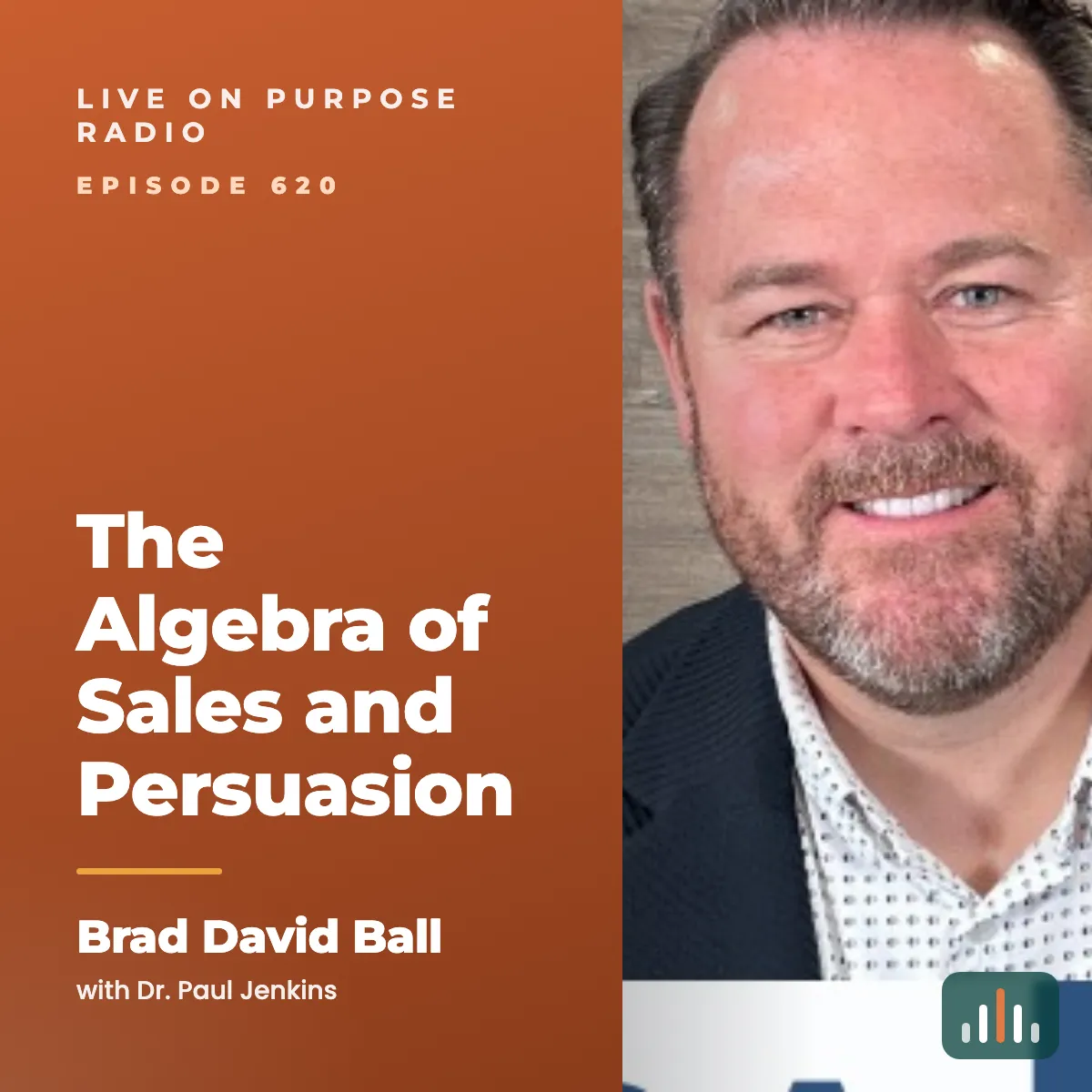
This is Live On Purpose Radio episode 620, the algebra of sales and persuasion with Brad David Ball. Now is the only time to create and live the life you love. I'm doctor Paul Jenkins, the positivity psychologist. My job is to connect you to powerful positive psychology principles that immediately upgrade your relationships, business, and mental health. Are you ready?
Let's jump in. Hello, everybody. Welcome back to Live On Purpose Radio. This is doctor Ball, the shrink who expands your life with another episode of Live On Purpose Radio. Joining me today today is an international sales expert.
This guy has been pounding the globe for... I don't know how many years, Brad, you've been doing that. But... Over a decade. Yeah.
It's it's been your thing. And, in many countries and continents across the globe and and this expert, dear listener has dialed in on the formula for sales. Brad, in your book, you call it the algebra of sales and persuasion. And as I was reviewing this book, it it occurred to me that, yes, the... These are the basic principles.
And I'm excited to welcome today, Brad David Ball to the Live On Purpose Radio mic. Welcome, Brad. Doctor Paul, pleasure to be here. Excited to join you today. Well, so I've set you up here as a sales expert.
And you own that because you've been you've been doing this for quite some time now. And I love the way in your book, you've you've honed in on some basic principles. You know, I was just recalling a story. Coach Lombardi in the NFL and a classic story where he... At the beginning of an NFL season, this is the highest level of American football.
Right? And he comes out to the team, all of them professionals, and he presents to them a football. And he says, gentlemen, this is a football. And that always struck me as being profoundly wise and a little weird because he's going back to the very basic principles. And and what I experienced as I reviewed your book, Brad, is that you are identifying for us, gentlemen, this is a football.
When it comes to sales, these are the basic principles and techniques that we really need to be aware of, and it changes the outcomes. So that that was the initial impact that your book had on me, and maybe that's what you were intending. I don't know. That's the impact it had. Well, I think you're so right that there's a a certain simplicity.
And, I mean, I've... My career, you mentioned it, has taken me over the last decade. I think I've got something like 85 countries I've been to, and I've sold big deals on six different continents, but but I I didn't start there. My career started about thirty years ago selling shoes. And this is when I was a teenager back in the nineties when Reebok pumps and Air Jordans were the hot thing.
And I kinda got a love for selling originally doing that. And, of course, I did the college thing and and then went to grad school. And most of the two thousands, I was an entrepreneur and, and then had some good years. And then, of course, the great recession happened and kind of pivoted my career and got into the corporate marketing and sales. And, and right now, for over the last decade, I've been a co owner, of a a company we build and sell simulators.
And just a quick sidebar, when most people think of simulators, they think of, like, flight simulators or maybe something Pilot play on the game. Yeah. Ours are very similar. They're they're actually big, expensive pieces of equipment. You you walk up into them.
They're on a big motion platform. But instead of planes, they are for cranes and heavy equipment. And so a lot of the work I do is, at ports. A lot of those ports have massive pieces of equipment. Those those gantry cranes, you know, they cost, like, $30,000,000, and they're incredibly dangerous and sophisticated to operate.
And so our simulators simulate that that equipment. And, I think I've been to every every port city in the world from Shanghai to Chittagong, Bangladesh, Dubai. My biggest client is actually in Antwerp, Belgium, so I'm there frequently. But... So I started this career selling selling shoes, and then, you know, that's taken me all the way to where I'm selling this, million, sometimes multimillion dollar equipment all throughout the world.
But there is, as you mentioned, a a core simplicity to it. And so over the last... Really since COVID, about three or four years ago, I decided that, hey. You know what? I'm gonna put this down.
I'm gonna start writing a book and try to, you know, codify a lot of this, information that I've gained over the years. And, the book took me took me a little while, but, just published the book, and I do some public speaking and training as well as part of that. And, a big part of what I train and teach is we overcomplicate things in the world of sales. It's, more simple, and I... What I have done is taken two two simple frameworks.
One of them is a little bit on the psychology side, also a principle that's taught among debate professionals. And another principle is kind of a wonky marketing concept, very simple, that, but neither of these are really taught in a lot of sales training. And that's what I explore in the book. That's the sales algebra that we we get into and discuss. And it might be interesting to to sample what that is as as you introduced yourself, Brad, and you you shared that you started in shoes.
Right? You were a retail, sales person at a shoe store. Yeah. And you told a story in your book about a little experience you had on a Christmas Eve. And and Yeah.
You know, how we get so focused on commissions. And and I don't wanna steal your thunder. Maybe you could share that story with us because I think it illustrates some some obvious but unnoticed principles that are underlying the whole process. Would you share that with us? Happy to.
You know, and and I I honestly believe that, you know, we can talk about success stories all day long, but a lot of times, the stories that you really learn from are your failures. And Right. Yeah. This goes back... This story goes back to Christmas Eve nineteen ninety four.
And, it... A a situation where it was it was a big day. You got an extra you got an extra commission, an extra bonus if you sold over $2,000 of shoes. And you gotta remember, that seems like a lot of a lot of shoes even by today's standards. But you gotta remember, in 1994, you didn't have Amazon.
You didn't have Zappos. If you wanted to buy a shoe, you had to go to the mall. And, this was a a busy athletic shoe store, and I was one of the top sales guys there. But Christmas Eve, it was busy. Everybody's gonna be working.
And so it was kind of this competitive nature between myself and the other sales professionals. Well, I got a lucky start because right as the right before the store opened, this old lady comes and kinda knocks on the gate and says, I need some help. And, Paul, I mean, think of an athletic shoe store. And and this old lady comes in. You know she's there to buy a couple of pairs of shoes for her grandson.
And we call... We used to call that a birthday sale. And, you know, it might be common to call it in the... A bluebird sale. You know, something that's gonna be easy.
She's gonna come in. She's just gonna ask for a size nine Air Jordans. Yeah. I'm gonna ring her up. I'm gonna be on the board.
And, well, I I welcome her in. She sits down, and all of a sudden, she starts to want to try on every pair of Reebok walkers, you know, the most inexpensive shoes in the store. And this is going on now for fifteen or twenty minutes. She's trying on every... You know, there's no no end in sight.
And so at one point, I kinda mumbled something under my breath. And may... Maybe I gave that, you know, little teenage eye roll. I don't know. But I went back again to get her another pair of shoes, and she was fuming when I came back out.
She was talking to my manager and kinda making a scene saying, I need another salesperson. You know? I don't want somebody who only cares about his commission. And, turns out my manager, you know, kinda quieted her down and sent me to the back room, and he gave, he kind of handed her off to one of my one of my competitors. Bianca as I recall.
Yeah. And and and she's sharp. Well, she ended up helping her out. And about ten minutes later, out of the corner of my eye, I see that Bianca is ringing this old lady up. And not only that, she bought the pair of Reebok shoes, but she also bought those size nine Air Jordans.
And the funny aspect of this story is, yeah, I lost the deal. But at the end of the day, you know, hours later, we're ringing up and tabulating our our sales for the day. And remember, $2,000 is the magic number. And I finished with, like, just over 1,900. And Bianca barely cracked 2,000, so she got the big Christmas gift.
Yeah. And and I I learned a valuable lesson that you've... You know, authenticity and not, you know, not having that commission breath and being sincere is a huge, huge thing in sales that's so often overlooked today. And it's critical. It doesn't matter if you're selling shoes.
It doesn't matter if you're selling million dollar technology. You've got to be sincere. You've gotta be authentic in... With your interactions. It's an important thing.
You know, I love the way that that story demonstrates a couple of important things. You said commission breath, and people can smell it from yards away. Yeah. Right? And it and it stinks, and they're going to be repelled by that.
And and what that means is, you know, you're coming at it. If you're the salesperson and you desperately need this sale, it's going to be really slippery. It it it Yeah. Has this been your experience, Brad? If you need it as the salesperson, it almost always falls through.
It's counterintuitive, but you you have got to... You cannot act desperate, no matter what your situation, no matter what your industry. I I call You said act desperate. Yeah. What if you are desperate, but you're acting?
Yeah. I mean, they can still smell the commission breath. 100%. 100%. I mean, you've gotta look at it in the...
From the framework of help, being helpful, and and sharing knowledge and information. And I I like to call this... I think in the book, I refer to this as the original sin of selling. The original sin is being salesy. No matter where you're at, no matter what you're doing, you cannot afford to be salesy.
That authenticity and that willingness to help is so critical. And yet the funny thing is even by today's standards and there's a lot of education out there. There's a lot of good insights. But you know, one thing that that bugs me to this day is you go online on a Google and you type in, how to close a sale, you know, closing tactics. Mhmm.
And you'll you'll see a whole list of things come up, and a lot of them have names. There's the puppy dog close. There's the Columbo close. There's all these closing techniques. And almost all of them are just terrible or cringe worthy, and yet they are still taught.
A lot of times Oh, it's the ABC of sales. Right? Oh oh, yeah. That's exactly right. And, of course, that's an iconic scene.
Most people haven't seen that movie, Glengarry Glen Ross. But most people have have seen maybe on YouTube that scene with Alec Baldwin, you know, where he's always be closing. And and the funny thing is that movie, that scene, he never even shows us what he is talking about there. You know? He he doesn't give us an example of how to always be closing.
And so, you know, one thing I say is you don't wanna always be closing. You wanna always be curious. You know? That's how to Change Winsdale is being curious about the person you're trying to help, curious about where they are in the sales process, in... Not in the sales process, but in their buyer's journey.
Oftentimes, buyers are more Yes. Than than us sellers realize. We try to figure out a way to place them in, you know, 20 different buckets in our CRM system. You know, a buyer oftentimes is just looking to research and find out more information, and they're gonna do it on their timeline. The key is understanding their timeline.
I love the way early in your book that you set that up. We've got sales phases, right, that we try to move people through in our CRM. And and listener, if you're wondering, what are all these letters that you're throwing out there? I've been involved in sales because that's the doorway to my service. And that's how people can get in.
But like you're saying, the buyer has a very different experience than the salesperson. And when you understand that and you serve them in their process according to their timeline, then it doesn't feel salesy. And and it's really just opening the door to your service or your product, whatever it is that they need that solves a problem that they have. And you're there to facilitate that. And then they're gonna send you Christmas cards Yeah.
Yeah. When you can fill that role for them. Right? Yeah. There's no question about it.
And and I think also, you know, we we talk a little bit about the concepts of persuasion, which I know in in your realm, in the world of psychology, persuasion and some of the psychological aspects, ethos, pathos, logos. Mhmm. You know, those are things that have been around for quite some time. Aristotle, I think, kind of coined them back, like, twenty four hundred years ago. And yet, we use them in the wrong order when we're selling.
At the wrong time. At the wrong time. And and here's a common example that I think maybe can provide a little perspective for those not only in sales, but even if you're a small business owner or an entrepreneur. Too often, we like to go to pathos, right, which is the emotional appeal. And and that stuff works, but it only works if the timing is right.
And so if you're talking about a pathos or an emotional appeal, that might be a testimonial. That might be a a really influential, powerful story about somebody that's using your product and that's loved it, or it might be a demonstration that you're trying to give. Maybe you, maybe you sell bicycles or you sell some sort of software, and you, you know, you invite somebody to demonstrate it. Listen. That's great.
But if somebody is in the awareness phase of the buyer's journey, if they're just starting out, if they're not in the market for what you're selling, it's gonna come across as extremely salesy. You you kind of violate that. And and it's it's just so common that, you know, you're... You go into this pitch mode of trying to get people to sample your product, you know, telling this emotional story. And it works if somebody is in that buying mode.
If they're in the choice phase of the buyer's journey, that works great. But the vast majority of people are usually in an awareness phase of a buyer's journey, and it will come across as extremely salesy and even in some cases kind of manipulative and cringey. And so that's a key aspect. You know, if you're... Even if you're just a a small business owner, you kinda have to know some of these principles that really help you out to understand some of the timing here.
Somebody's, you know, not in the market, don't try to oversell. Well, they're not ready for it, and so it will be wasted effort at best. Yeah. And at worst, it will repel them, not attract them. That's right.
And and it really... Even if you are not a salesy person, if you are doing this, it come... It can come across far more salesy than you realize when you try to when you try to spin that emotional pitch. So that's a... It's just...
It's, it's very simple, but understanding and knowing where somebody is in the buyer's journey is is a critical thing. Yeah. You know, and as you were describing in in your book, you talk about this, ethos and logos and pathos. And, they're different, levels of of decision making energy, if we can think of it that way. And I was I was thinking as I was reading that part of your book, Brad, I had an interview with, Art Coombs here on the show, and he's a great leadership expert, authored many books on on the subject.
And he said this to me, it fits right with what you're teaching. He said, people will make that decision to move forward or to purchase or close or whatever Yeah. When their heart is convinced that their head has it right. Yeah. And that assumes that we've been through the ethos and logos.
You know, they... They're getting the data. They're being exposed, first of all, and then they're getting enough information. This is all head stuff. And then they have an emotional experience so that their heart is convinced that their head has it right.
And you presented that in a different way, but it really verified what I was hearing from Art in that conversation. Yeah. Yeah. Well, I think so. Either...
There's no question that, people make decisions even in a b to b world. I mean, I'm dealing with... I'm I'm dealing a lot of times with executives or with senior training, personnel that are buying a million dollar piece of equipment. You know, that's different than going and and buying a dress shirt where you make that decision, where you essentially go through the entire buyer's journey in three minutes as you're, you know, walking through Nordstrom's. Right?
Very different sell. A lot of times, it takes me a year and a half or longer to sell some of these sophisticated simulators. But even then, at the end of the day, the decisions are oftentimes emotional based. In fact, I would say almost always, they're... They come down to emotion.
Yes. In a b to b situation, people do their research. They they want the statistics. They want the evidence. They want the demonstration.
But at the end, I call it the battle of gut feeling. At the end of the day, in our world, there's always a competitor. There's always some... In in in today's world where manufacturing, where knowledge is so interchangeable, oftentimes, you're competing against someone or something that is extraordinarily similar to what you're offering. And so how do you win if you've got two competing prop...
Two competing products or two competing services? How do you win the deal? Well, from the buyer's perspective, it comes down to that, I just have a gut feeling. You know, I'd rather use doctor Paul than go with that other shrink that I... You know?
It comes down to gut feeling. So how do you win that battle? And, and we... And I talk a lot about the the tactics on how to win the battle of gut feeling. And, there...
There's there's a lot to it. It's not just one thing. It's not a silver bullet, but there's a variety of factors. But authenticity is a very, very key aspect of that, being sincere in your interactions. Now you've mentioned this authenticity a couple of times now in our conversation, and what it says to me is be real, be human, interact with these actual human beings as a human being.
Is that too broad of a generalization there? Did did did I catch that? No. I I I think it's right. And, you know, and and authenticity, I think, is just one piece of the puzzle.
There's a lot more. I did I did a a survey. It lasted over a year. I think I surveyed about 450 people, business professionals, asking what are the key components, that you look for in a in a b to b sales interaction? And, authenticity wasn't first.
In fact, it finished, I think, fourth. But I think authenticity is critical in that if you don't have it, it can be detected almost instantly. I I I give this analogy of, you know, your your credibility as a salesperson is like a reservoir. You know? You've you've gotta fill that reservoir.
Have you ever been to a reservoir where it's half empty? You know? Not a very desirable place. But, the reservoirs that that are full... Hey.
You know? My favorite place on the planet is probably... And I've been a lot of places, doctor Paul. But, Lake Powell is perhaps one of the more beautiful places that I've been, and and it's a reservoir. But when it's full, it...
It's a beautiful place. Right? But... So how do you fill that reservoir? Well, you gotta do it.
Authenticity is critical. You gotta have competence as well. And competence has a twin brother, reliability. Those are both very critical. If you're not competent, you know, you're you're not gonna sell much.
The other aspect is, and I think this is important because it's overlooked, and that's likability. Very often people forget about likability. And there's this, and and we could go into reasons why. I think there's the... There's been a couple books out there that say our likability is not that important.
Well, I I beg to differ. You know, maybe it's not that important if you're selling widgets and you're doing it just here in The States. But I'll tell you what, you wanna do international sales. You want to... Yeah.
Try doing business in Southeast Asia and and not being likable. That that doesn't fly. You know? I Mhmm. I I just closed a a deal last year in Ho Chi Minh City, Vietnam.
Took me six years to get that deal. And, you know, I mean, I I was pretty much part of their family almost in that company before before they finally signed the deal. And, a big part of that was, hey. You know what? They they like me, and and I like them.
And so likability is a a important aspect that can't be overlooked. You can't be a jerk and be selling and have sustained success. Or at the very least, you're gonna lose any tiebreaker if you're a jerk. You... You've gotta be a a friendly person.
So those are the big four. The fifth one is confidence. You know, you gotta have confidence. And so authenticity, being competent, being reliable, being likable, and being confident. Those are kind of the pillars that that, my research has shown are are the most important aspects of, at least in a b two b sales realm, but probably transferable almost to any small business, even in a retail type of environment.
You've gotta have a recipe that has those five ingredients in there. You know, I'm... I do a lot of work, Brad, with key relationships. And I believe that a sales relationship is one of our key relationships. It's a little lower on the list than your spouse and your kids.
Of course. Yeah. But it is one of the seven key relationships that we talk about in my coaching programs. And I'm thinking about how these principles that you've illuminated to us apply across all seven in so many ways, because how many times as a parent are we trying to sell something to our kids? Yeah.
All the time with less success. And no wonder we're struggling in our success when we approach them in a in a... In your face. I remember part of your book you're talking about just positioning, you know, and if you're nose to nose with someone that feels a little confrontive Yeah. As as opposed to if you're side by side with them and some of the body language.
I remember you were talking about that a little bit in your book as well. And as parents, sometimes we ignore effective sales principles, including... And this is interesting, Brad, because I've been teaching a lot lately that our effectiveness in that realm, in the parenting realm is determined by our detachment from the outcome. And it has to do with that commission breath that you were talking about. Right?
Right. It... Somebody has to be attached to the outcome. If it's you, it's not your client. It's not your kid.
It's not your prospect. Yeah. No. No question. So I see how these principles...
I... That's how I know something is principle based Yeah. If if it translates across our other key relationships. So as we're talking about sales, we're also talking about how to how to show up as a human being in a way that allows you to have influence and persuasion. But if if you're doing it for that purpose, if that's your whole agenda to influence people, then it kind of spoils it.
Yeah. It... It's an interesting paradox. Have you found that to be true as well? Yeah.
I have found that to be true. And, you know, and here... Here's a a little bit of context there. And, again, I I look at my own career and the mistakes that I've made. Right?
And and, of course, as a father as well, it's still a learning curve there. But It's a work in progress. Always. Always there. No question.
You know, one one aspect, you know, as somebody who's a small business owner. And, a lot of times, we get so passionate about what we sell, about our business, about our about our life even. And we will go, and we will research little facts. And, sometimes, you even do this on a... If you're passionate about politics, you might do that.
Right? There's there's always facts and statistics and evidence that you can find to solidify your case. But but here's a mistake a lot of people make. Facts don't translate in cells like you think they do. I I often say as a...
As a quick analogy is, facts are like are like salts in a cookie recipe. You know? Have you ever tasted chocolate chip cookies without salt in it? They don't taste right. You you need salt.
But I'll tell you what, you don't need much salt to make a cookie recipe good. Right? Right. Too much, you'll ruin it. So if if you're a...
If you're an entrepreneur or a business owner or even just in, you know, an account executive for a for a midsize company and you're putting together a sales presentation or a sales pitch, there is this tendency to add all these facts, to add... To create a slide deck, and and you have all these facts and information. And that's the wrong approach. Facts, you've got to use sparingly. In fact, what I tell people is remember in remember in, elementary school when you learn about fractions and you learn how to convert a fraction into a into a decimal so that you can do some calculations.
Mhmm. Similarly, take your facts and turn them into stories. That's what you need to do for literally every fact you have. But here's where people make the mistake. There's a lot of great storytellers out there.
There's a lot of great advice on how to tell a story. Your story can be twenty seconds long. I call them micro stories. You know? Whatever fact, whatever evidence that you have, turn it into a quick twenty second story, and then practice that and be able to expand on that.
I've got a lot of stories that I tell. Some of them, I keep to twenty seconds long. I make a point. I give a quick analogy, and then move on. Other times, maybe I want to expand on a story.
I've got a story about, I I sold a product. I sold a big simulator in Germany. And, the guy I worked with there, he had this Sharp guy, by the way. He was an engineer and this senior manager, and it just looked the part, athletic, dressed to the nines. And he he calls me up.
He was familiar with who I am. He calls me up and says, Brad, I need a simulator. I'm gonna send you the plans that I made for a simulator. And he'd already, like, engineered this simulator that he wanted me to build for him. Well, that's that's kinda not how it works.
What I did, I went back with my team, and, I looked it over. And I I... Instead of blowing him off, which I kinda felt like doing because he... But we went and we priced it out. I took a day or two with my team and said, you know what?
If we build it his way, then, it's gonna cost him $3,000,000. I think it was, like, 2.8, whatever. Got on a plane, went to Germany a couple weeks later, sat down in person with him. And I said, Thomas, the simulator that you want, I have the plans and the price for it right here, and it is $2,800,000. And he nearly choked.
That is way too much, Brad. You know? And I said, but, Thomas, I have a simulator that can do 80% of what you want, and it'll only cost you $800,000. Oh, really? And and now now I had him on our standard product, and I changed the narrative.
And, we went... Took another year till the deal finally closed, but now they're a great client, and they have been for, five or six years. So so, anyway, I tell that story. I gave you the one minute version. I could have shortened that down maybe to twenty seconds.
It would have been really tight. But I can tell that story in a ten minute version as well. But what you need to do when you're selling is whatever evidence, whatever facts you have, convert them to a story. And it might be a micro story. It might only be twenty, thirty seconds, but learn how to polish that micro story so it has impact.
They will remember those micro stories a lot more than they remember the facts. You know, as you're telling the story about, this this interaction, the the custom built simulator versus the the one that we offer already, the standard. Yeah. It doesn't have all the same features. And you told a little micro story in your book that sounds almost like microwave and how it doesn't have all the features.
Right? Share that example, Brad. I think that's a compelling example quick anecdote. I... And I...
I've got... I probably have 50 of these that I use all the time. It... I call it the microwave anecdotes, and it's simple. Everybody has a microwave.
Right? And my microwave has, like, 30 buttons on it. Mhmm. Guess how many of those buttons I actually use? Like, two or three.
I use Two or three. Thirty seconds. I use the popcorn button, and I use the stop button. And all the other stuff, I think my microwave will, like, bake cookies or defrost a chicken and all. I never use that.
Right? And that's the way most people are. They don't use every single feature. And so now here's the parallel. The analogy is, you know, if you're looking at...
If somebody is looking at a piece of software or a technology, a lot of times they get dialed in on different features and different capabilities. And the real question is, okay. How often do you really use that? Is it like a microwave where, yeah, you want that feature, but in reality, you're only gonna use three buttons 90% of the time. Let's make sure those three buttons work and work exactly the way you want it to.
So, anyway And save you $2,000,000 in the process. Of course. Yeah. Absolutely. And and, great to have every bell and whistle.
You know? I don't know what I would do without that, heated steering wheel, But, you know, somehow I lived forty years before I ever had it. Somehow. That's right. Folks, the book is called the algebra of sales and persuasion, and that's the one that I've been referring to as I've, interviewed the the brilliant author of this book, Brad David Ball.
And, folks, you can connect to Brad at his website. Put some w's in front of that. Www.braddavidball.com. And, that's where you can connect. Brad, I know your book is available there.
You... In fact, you're giving away a free chapter of that book if people wanna sample it. What else will they find there on your website, Brad? Well, yeah, you go there. I'm really active on LinkedIn.
I'm active on YouTube as well, and so you can connect with me on either of those. And like I said, I got a handful of free resources there. I I think the the most fun I had was writing chapter 10 of the book, which is on how to close. We touched on that a little bit. You know?
There's this idea of what you might see in Hollywood that I think is just totally, totally off, but I I poke fun of a handful of movies. And, anyway, so you can download that, that chapter there for free. But, feel free to connect with me on my website. That's the best place to to catch me. Awesome.
Once again, that's Brad David Ball, and it's spelled exactly as you would expect it to be spelled. And so go connect with Brad at that website. Brad, thank you for your contributions here today. It was fun having this conversation, and I can see a lot of overlap in the psychology and the algebra of sales. Well, doctor Paul, a pleasure.
You know, we could talk forever about some of this stuff. There's a there's a lot to it, but, always a pleasure to to chat with you, and, and I appreciate the opportunity to come on the show. Alright, folks. You've heard it. It's time to apply it.
Let's go live on purpose. Did you get what you came for? Give yourself the gift of taking real action on what you realized today. Please share this episode with someone you know would value it, and leave us a rating too. It's time now to live on purpose.
Open the transcript on its own page ↗