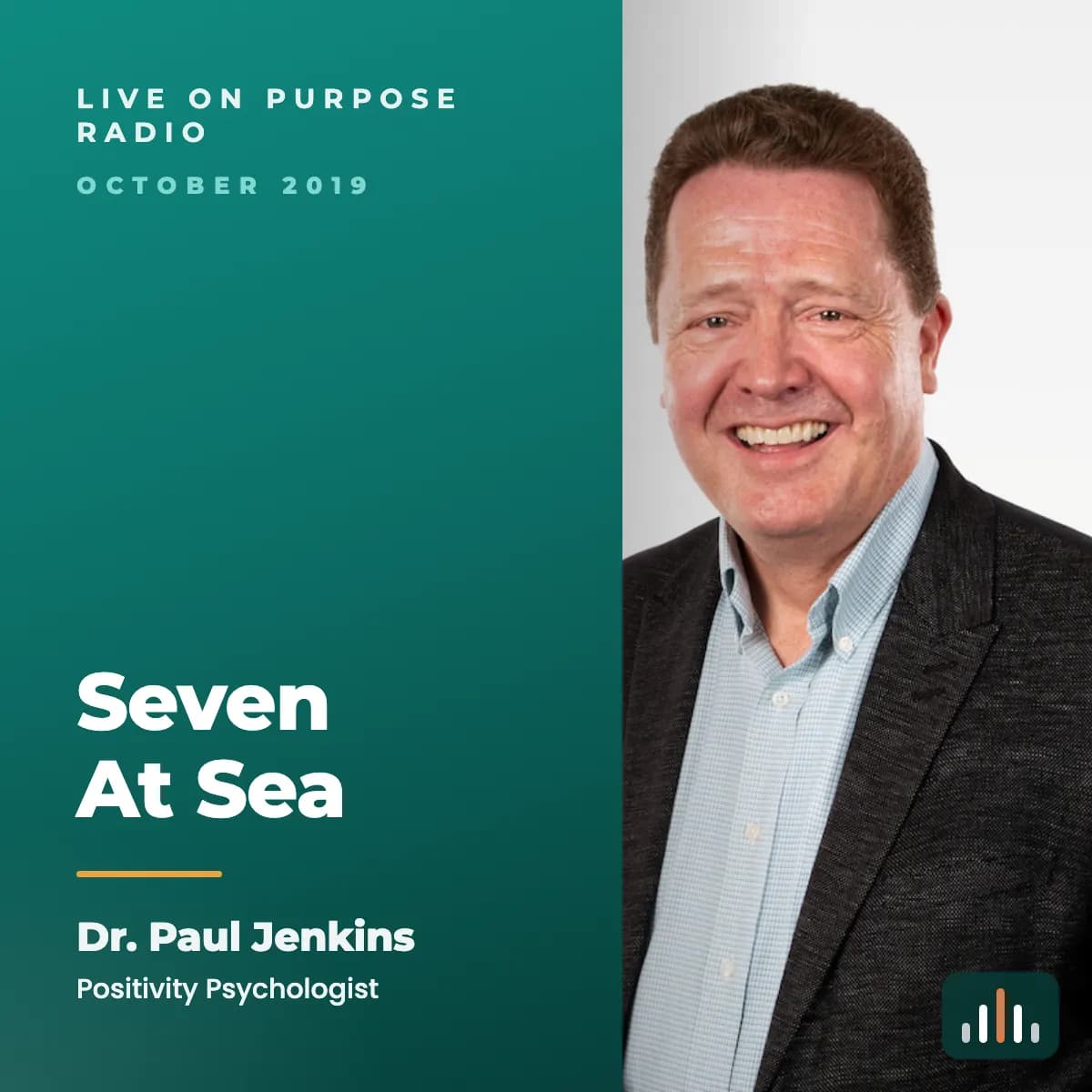
Welcome to Live On Purpose Radio with doctor Paul Jenkins, where you will hear inspiring stories of ordinary people doing extraordinary things. Feed your mind with a regular dose of positive energy and show up for your life every day on purpose. Living on purpose means that you have a purpose and you do it intentionally. And now, here's your host, doctor Paul. Hello and welcome back to Live On Purpose Radio.
This is doctor Paul, the shrink who expands your life. Yes. That's good. You love to hear that. The shrink who expands your life.
Here we are with another episode. And joining me today are my friends, Eric and Emily Orton. And you may have heard of these people. I love to bring crazy people onto my show. As a professional psychologist, that's just fun for me.
That's what you do. Right? Yeah. Yeah. And so I scour the globe for people who are just a little nuts to talk to on my show and, when when I tell people what you did, they might agree with me.
Okay. We'll see. We've we've heard that before. We'll see. Yeah.
These guys left everything behind, closed up their home, quit their jobs, whatever they had to do, jumped on a sailboat and spent a year on it with their family, which includes five children. Mhmm. They've written a book about their adventures called Seven at Sea. That's just a little crazy, you guys. That's what people say.
It's a little unconventional is usually... Yeah. We we go with unconventional. I am a professional psychologist. So you...
Okay. You you can... This is a... I think we're getting a free diagnosis. I think...
Yeah. This is a... Actually, I quit diagnosing people about a decade ago. Okay. Okay.
But this this story caught my attention because the name of the show is Live on Purpose. Mhmm. K? Live on Purpose radio is all about illuminating principles that allow us to do just that. To live our lives on purpose.
Yeah. And not just let life push us around. Mhmm. Yeah. It's easy to get into patterns where we start to feel stuck.
And, I can't tell you how many... Well I could tell you, you're my friends. Right? Yeah. I can't tell you how many people I have talked to over the years who who just feel trapped in a life like like they have nothing to do or to say about it.
And here you guys uproot your family and head out to sea. Yeah. I believe we have a lot more power over our lives than we sometimes think, that we really do get to make choices. This is one of the things that I do to, really annoy my kids when we're watching a movie. There's so many movies and there will be a character who says, I had no choice.
And I always jump in and we're like, oh, you had a choice. You know? You always have a choice. It could have been this and you didn't like that choice. It seemed like obvious you weren't gonna choose it.
But don't say you didn't have a choice and now my kids, they jump in and say it too. And then now they never say I didn't have a choice. Yeah. And they irritate and annoy other people by jumping. Right.
We're just spreading the infection outward. You do have a choice. You know what? We we do. And and it's not always a choice over what we think we should have a choice over.
Yeah. Like what happens to us, for example. Right. Oh, yeah. Our our daughter spent a couple years serving a volunteer mission in Florida for our church.
And she, was in an area that was just ravaged by a hurricane. Mhmm. Did those people choose to have a hurricane? No. No.
Did they choose to set up shop in Florida? That was part of the reason we did. Yeah. Yeah. I I had somebody ask me last week if you could live anywhere you want, where would it be?
And I'm like, my house? I choose where I'm living right now.... Anywhere I want. Yeah. Exactly.
And and we lose track of that choice. But like the hurricane, sometimes we don't get to choose what happens to us. Yeah. But there's always an element of choice over what we're going to do with it. Right.
Or how we're gonna have it. How we'll respond to it. What's next? Absolutely. I feel like we can always choose growth through disruption.
And most of the time, like with the hurricane, we're very often disruption comes to us Right. That we're not seeking it out. Surprise. And in and in our case, what was really different is that we were choosing something incredibly disruptive because we knew that growth comes through disruption. And we knew it would be uncomfortable, but we believe that the the growth would be worth it.
Wait. So... You said growth comes through disruption. We can choose growth through disruption. Mhmm.
I think disruption can come and we cannot grow from it if we Right. Because you could choose misery and despair too. Exactly. If we wanna be, like, afraid of it or something. But if...
Yeah. I think we can choose growth through disruption whether disruption comes to us or whether we seek it out. But I think we have to choose growth. I wanna dig into that a little bit more with you guys, but I think we need to give our friends a little bit of context. Okay.
Alright. I know I know your story. I've looked at your book. I've seen the pictures. Yeah.
Would you share at least the brief version of of what this disruption was? What did you choose to do? Sure. Well, I had taken a job in New York City that I was... That was a serve...
What I call a survival job because I'd had a business failure and I had to keep paying rent and pay for groceries and all that. So I had this, what we came to call a disposable job downtown in the Financial District where I was in a cubicle, in a high rise, and I worked night shifts to, you know, make a little bit more money. And... But ultimately, we decided, you know, this was not what we wanted for ourselves. We wanted something different.
And so we ended up taking sailing lessons from a school that was right downstairs from us. Yeah. Emily joined me. We enlisted our two oldest girls. And Can I just say that I did not wanna be in on the sailing lessons?
I I wanted it to be something that he did because he didn't love that job. It wasn't feeding his soul, but, like, seeing those boats out there was something that really called to him. Called to you. And so, we we tried to find, like, three other friends who could join him so he could do this thing for him. And when he invited me and the kids to join him because nobody else was piping up, I was like, wait a minute.
I I don't wanna do this because I was, at that time, I had been scared of deep water for over thirty years. And, he just said, don't get in the water. Right? Like, stay on the boat. It's all good.
The water's irrelevant. That's You're not gonna be in the water. Right? And I was like, ugh. But, with him and the and the kids both really wanting to do this thing, we went for it.
So, yeah, I just don't want it to seem like, la la, easy because I I really didn't want to. You weren't sure you wanted to sign up for this thing in the first place. And then and then I thought it was only gonna be like a five week class, and Eric will tell you what happened. Well, it wasn't a thing at the beginning. It was just like, you know, it would be beautiful to learn how to sail.
It's kind of a diversion. It was a Yeah. Let's see if we can enhance our life a little bit in this sterile existence of the cubicle. Yeah. Because, you know, sometimes our story has been characterized as sort of chuck everything and go sailing.
Yeah. And and we didn't just chuck everything. It was a five year build up between when we first took sailing lessons and then when we left to go sailing. This was not a a knee jerk decision. It was very deliberate, and we just sort of incrementally moved through sailing lessons with an instructor, then we went sailing by ourselves, and that was crazy.
And then we started to sail as a family in a little sailing club outside of New York City, you know, with all of our kids. We'd go regularly a few times a month. And then Emily and I would go to The Caribbean, and we took more classes. And it was always sort of scrapping. How do we figure out how to pay for this?
And I would take friends sailing, and they would cover the cost of the boat, and I would get practice and, you know, and we would just Yeah. We would just kind of bootstrap it. And then we started shopping for boats and that was, a lesson in, in naivete, all the things that we didn't know. You didn't know what you did. We just sort of threw ourselves at it.
And we walk into a boat brokerage and like, yeah, we wanna buy a sailboat. And they showed us a few and we walk out and we're like, we have no idea what we're doing. And... They're, like, half the words on the amenities list. I don't even know what these things mean.
Yeah. Oh, good. We get this. Exactly. So, you know, it was just this this five year period of trial and error and Wow.
And it just sort of grew over time. It wasn't something that we specifically set out to do. Although, I can say that at one point, I was working with a friend who was starting a life coach business and she needed a guinea pig and I was one of the guinea pigs. And I was too. And...
She she wanted him and I was like, only if you also take me. Life coaching, you guys watch out for that. Yeah. Yeah. Just saying.
And so, you know, we we made a list of a few things and one of them was what would you do if you weren't afraid? Mhmm. What would you do if you knew you would succeed? What would you do if money were no objects? And I had this big long list, and one of them was stay with my family for a year.
For a year? For a year. Not an afternoon. A year. A year.
And and that was long forgotten, like like, in our way back in our wake is what we would say. Yeah. And then as we're getting around to buying a sailboat, we realized, oh my goodness. This this seed was planted a long time ago. And, so, you know, these things creep up on you.
We're big believers in... If you have an idea, write it down, and you'd be surprised where things go from there. Yeah. It definitely creeped up on me because I didn't even know that he wrote that down. And, one day, he just said that he he thought the seven of us on a sailboat would be enough universe for him.
And the idea kind of spread from him to then me getting on board and then, you know, to our kids. So they actually started holding our feet to the fire, and, we were, like, talking and talking and taking classes and talking and talking. And, our farm is pretty small, so we just gather at this, dinner table for a lot of things. And we were gathered there, and I just remember our daughter who was 14 at the time saying, do you guys really have the guts to do this, or are you just talking? Because our poor kids, they, like, hear us talk about.
Right? Totally. And they're like, should I be emotionally invested or should I just, you know Let you guys let this go over my head. Go do your dreams. And so she's like, are you serious or not?
You really have the guts. And we were like, I don't know. That's a great question. Yeah. Yeah.
It was it was scary to pull the trigger on it, but the fact that our kids were watching us to see if we were gonna do what we said we would do was, I think, a a strong motivator for me.... Inspiring. We wanted to do it, but we also realized that we would be setting... Whatever we did, we would be setting an example for our kids. If we stayed where we were, that's setting an example.
If we went sailing, that's an example. Kids are learning something regardless. Yeah. Exactly. And what do you wanna teach them?
To come up with excuses or to Yeah. In fact... Make it happen. In fact, we looked at this situation and we said, you know, we have five kids. Our youngest has Down syndrome.
Those are really good reasons to not come To not go. To not go. Good excuses. Yeah. And we said, or our kids could be our reason.
We... Because we have five kids and because we have our, you know, our youngest has Down syndrome, that's the reason why we need to get out in the world. We want to show them this planet. We want them to see beyond the walls of their own home, beyond their community. And so, you know, we...
One of our... I guess our tactic is is we... You could say we we inverted our... We turned our excuses into reasons to go. Yeah.
Okay. Hang on. We can't just gloss over that. You turned your excuses into reasons. Yeah.
It's it's kinda painful sometimes. Wow. When an excuse comes up now, I'm like, oh, that's an excuse. Can I turn it into a reason? And I usually can.
Usually... Then I don't have an excuse anymore. Like, dang it. Guess I'm doing it. That is so cool, you guys.
You know what? Psychologically, I'm I'm picking this apart a little bit. Oh, good. And excuses, you can come up with pages of excuses or or reasons not to do something. Yeah.
Yeah. Yeah. What if we just looked at those as reasons and and dropped them to not to. Right. They're reasons.
Now, how can you turn those into reasons to do exactly what it is that is stretching you or that terrifies you? And and maybe if it doesn't scare you, you're not thinking big enough. Well, well... That's what you believe. That triggers life.
It's like if if... Yeah. Nobody... Nobody's inspired by a dream to buy a new car. Tissue box.
Yeah. Yeah. It's like it has to be big enough that it scares you a little bit. And for us, it was... It had to be big enough that, like, our whole family could be involved in it.
Yeah. We did get scared a little bit. But we found out, when we were on one of these classes... I guess we never went to The Caribbean just to go on a vacation. It was always a class.
But Oh. We did get a little play time. And, the instructor would take all the other students out, and they would go for a snorkel. And I would sit on the back of the boat because I was scared to go in that... That's 30 feet of water.
Deep water thing. Yeah. And so, the whole class had flippered off, and I was just sitting there on the boat. And I was like, this is what I really believe that growth comes through disruption. Like, I have to get off the boat.
In the water. And I was so scared, but I I put a... You know, now I'm alone too. If I would have thought of it sooner, it would have been a good idea. But I got in the water Yeah.
And there was a green sea turtle, and then there was a parrot fish. And then, you know, I'm swimming as fast as I can because I'm scared putting that adrenaline to good use. And I got to the coral reef, and I saw all the the fans and the different colored fish and the Whole new world. It. I was completely fascinated.
Yeah. And what I discovered was that this was my new favorite thing, and it was hiding just on the other side of fear. And for thirty years, I hadn't been doing this favorite thing because I was too scared to even know it was out there. And so that really changed it for me. That's really when I got a 100% on board with the trip because I had to turn my excuses into reason, and I had to peek around that fear and see what was on the other side.
Getting on board. That's sailing lingo. Yeah. Isn't it? That's a sailing term, everybody.
As we come back from this break, I would love to dig into some of the principles that this taught you. Are you down for that? Yeah. Absolutely. Definitely.
Folks, this is Eric and Emily Orton at Live on Purpose Radio. We'll be right back. Hey, Live On Purpose family. I know you're a fan of personal development, and that's why you're here on the podcast. Something else that I think you would really like is Live On Purpose TV.
Come on over to youtube.com/liveonpurposetv, where you will find daily episodes that are all geared toward powering up your personal development program. I'm looking forward to seeing you there. Make much sense to stop and give in. And welcome back. Eric and Emily Orton today at Live On Purpose Radio.
And this this theme of live on purpose. Eric, you were saying earlier that this wasn't just a knee jerk, impulsive, you know, come home from work and say, load up the car, honey. We're gonna head down to the marina and take everybody off for a year. Make sure the cats got somebody to watch. Yeah.
No. It was it was a process. You said about five years Yep. To build up to a courageous step. Mhmm.
And notice that the word courage implies fear. Yes. Absolutely. If you don't have fear, it's not courage. Yeah.
That's right. That's right. So it took a little courage, didn't it? Yeah. I love what your daughter said to you about, hey, is this just doc or Or do you have the best?
Are you guys for real? Yeah. Yeah. You know, I'm sure you learned some things about keeping your promises Mhmm. Or keeping your word, you know.
Even to yourself. How how often do we tell ourselves, I'm gonna do this or whatever and... That credibility, I think, is the most important. The credibility with yourself. Yeah.
Yeah. Not only with other people, but you you know yourself whether you're doing what you say you're gonna do, and that has a huge impact. At least in my experience, it had a huge impact on how I perceive myself and the world as I move through it. Yeah. Absolutely.
I can only imagine and I know that you you include some of what you've learned in this book, Seven at Sea. I would like to ask each of you to respond to this question and and you might have totally different answers. I don't know. We'll just see where this goes. What rises to the top for you as some of the primary principles, the things that it taught you about life, about your family, about yourself?
What comes to the top for you as you consider this grand adventure of spending a year on a sailboat with your family in some of the most beautiful parts of the world? Oh, yeah. Who gets to go first? Do you want me to go? Do you wanna arm wrestle?
Yeah. You go first. Sounds like you're ready. Go for it. Alright.
I would say that, speaking of credibility, that that doing this sort of thing cultivates what Emily and I have come to call three kinds of confidence. Yeah. The confidence that comes with competence. First of all, in learning to sail in all the classes that we took, we learned new skills, practical skills, navigations, you know, the actual raising and lowering an anchor, you know, forecasting weather, things like that. You just learn new skills.
And the more things we know how to do, we feel more confident as we move into the world just because we have practical skills. So that was one kind of confidence. The second is what we're just talking about credibility. When I say I'm gonna show up at a certain hour and talk with Paul, when I show up, we have... You...
I have credibility with you. Right. And when we tell our kids we're gonna go live on a sailboat for a year and we do it, we have credibility with them. We also have credibility with ourselves because we've done what we say we're gonna do. And that gives us confidence that we can...
That that we will We trust ourselves. We'll follow through. We trust ourselves. Yeah. And Right.
And so not only do... We want the trust of other people, but we wanna trust ourselves, and that creates a second kind of confidence. And the third is that, we gain a a sense of calm. And Emily and I have discovered that as we look back, as we go through a series of experiences where we face challenges, we face hardship, we overcome fear through courage that we are able to have a track record. Mhmm.
And we can look back and say, okay. I've got some problems ahead of me here. I don't know how they're gonna sort themselves out, or I don't know exactly what I'm gonna do. But precedent indicates that I've... I'm able to solve problems.
And I'm gonna just take this gradually as it comes, but I can move forward calmly because I know that I have the ability to do this even if I don't know how I'm going to do it right now. And so Right. Competence, credibility, and calm are the three kinds of confidence that we feel like we took away from this experience and and have continued to serve us well as we go into new adventures. I'm extrapolating in my mind. What if what if we could establish that in every aspect of life?
Yeah. If you if you could feel competent, credible, and calm in your business. Yeah. In your relationships. When you were talking about the credibility, Eric, it seems to me like the definition of integrity is tied to what you were just talking about.
When what I say matches what happens. What I do. Yeah. That I think is is a definition of integrity. And that leads to a peaceful Yeah.
Life. Not that life is peaceful, but that you are peaceful as you move through life because you live with integrity. The the seas weren't always calm and tranquil? Definitely not. Also, we didn't mention that we all get seasick.
Oh, yeah. Lots of puking went on. Yeah. Oh, nice. Yeah.
That's a great image. Happy to share it. Well, I just speak like, yeah, if your dreams make you puke, that doesn't mean you shouldn't do it. It just... No matter what you choose, there's gonna be some element of undesirable...
Some undesirable aspects to it. There's upsides and downsides to everything for sure. Yeah. And you mentioned the puking, but there were also moments of just serene bliss Mhmm. As you experienced this together as a family.
It was so beautiful and we just made incredible friends along the way. Mhmm. There's actually hundreds of families that do this so we met other kids. Well, you're not the only crazy ones. No.
There's No. There's a lot of crazy people out there. There's more On the wet side of the planet. Yeah. Yeah.
I... Yeah. You could just gotta get your head in there and suddenly you don't feel crazy anymore. You know, that's so interesting that you would mention that because a lot of times our dreams feel unreachable. Mhmm.
Mostly because they're unprecedented for us. Right. Yeah. And that doesn't mean other people haven't done it. And you set out in that direction, and who do you encounter?
Other people going that way. Exactly. Maybe you wanna talk about some of our mentors that... Oh, well, we... Yeah.
We... Once we got out there... Okay. I'll just start with this little analogy. When, Eric and I were first married, he noticed that when I drive, I make sure that when I wanna change lanes that the other lane was clear first.
And once it was clear, then I would turn on my signal. There you go. Yeah. And, he talked to me about how helpful it would be if I would actually turn on my signal first, and then the lane would make room for me. And he was right, and that's how it is in life as well.
So as we got out there, then we just started, you know, we turned our signal on and we just started meeting other people who are out there. They made space for us. They were happy to help us learn, like, the right fuel to oil ratio to mix in our engines or really just to talk to us about, like, oh, yeah. Usually takes about six months before your brain really slows down to accept the sailing lifestyle where you have to account for the weather and you can't be a certain place by a date and time and just letting go of a lot of those expectations. And so there were two boats that we traveled with for three months, and those two families really, like, tutored us in kind of how to make it work.
And also, sometimes we really still had to be deliberate about family time, like, say, hey. We're hanging out with these other people. We live right next door. You could swim to their boat, but today is just gonna be a day for our family. Mhmm.
You know, we still had to be deliberate about our calendar and and our routines and our goals, but they Yeah. Kind of showed us the way and helped us along. And I would say this. A lot of people might look at going sailing for a year and feel like that's a big leap. But one thing that Emily and I have come to practice in our life during this trip and things since then is what we call scouting it out and baby steps.
Mhmm. Scouting it out is just going in and getting... Gathering a little information, and then you go home. Yeah. Come back.
So I go into the sailing school and I'm like, okay. How does this work? They give me a little information. I go home. We don't make any decisions.
Yeah. Yeah. And then, you know, we say, well, we're gonna... We're not gonna commit to buying a boat. We're gonna charter a boat for a week with friends so that we're keeping the cost low.
We go... We try out a boat for a week, then we go home. Let me think about it.... While we're... We call this expand...
Expanding concentric circles. And each time we're expanding our comfort zone as we venture further and further out. And what was the other thing I was saying? I said, scouting it out and then Oh, baby steps. Baby steps.
Yeah. So baby steps, and they're a little bit similar. Just that you take some... You take it in small bites. And then by the time you're...
By the time we were ready to buy a boat and move aboard, we had expanded our comfort zone gradually over time so that it was a logical next step. It was it was a stretch still for sure, but we weren't we weren't... We didn't feel crazy. It wasn't a leap at that point. It was the next step.
By this time, we're talking with people already out on the water who are living on boats, and we're getting advice from them, good practical advice that we can trust. We feel like we're making good decisions. There's still plenty of unknowns, but we're not jumping off a cliff blindly. Right. We're just saying, you know, given what we have in front of us, we're gonna take the next baby step.
And we continue to do that. We're planning another trip hopefully to Patagonia for this winter, and we're already talking about, well, maybe maybe I just go with one of our kids and we scout it out, and then I go home, then we go with the family. We just try and we Yeah. We try to keep our fear in check by taking it in small bites. Wait.
Are you are you trying to debunk this theory that I had that you're crazy? Yes. Definitely. And and thank you for bringing that up because, if your dream seems crazy to you, just break it down into what's next. Absolutely.
What is this next logical step to take? And you did a series of those and now you have a story. Mhmm. Now you have an adventure that you can talk about. And it's not your last one.
Yeah. That's for sure.... Best adventures have been since then because it changed our lives. And Yeah. You know, we we still live in New York City.
That's still our home, but we travel, I would say, eighty eighty to 90% of the time now doing... Well, this microphone is not in New York City. Right? And the only reason you're on this mic is because you got on the boat. Yeah.
It's true. And so it opens up all kinds of new menus. What happened on the boat was we still worried a lot through that whole process. We had a lot of theories and beliefs going in, and living on the boat, like, validated those to us. It validated to us that time mattered more than money.
It validated that... To us that we could figure things out, you know, things like that. So we... After that, we're like, wow. That worked.
We survived. Mhmm. We're not ruined. It strengthened our family like we hoped it would. Our kids are comfortable being uncomfortable now.
We're comfortable being uncomfortable. And so what happened is that in large part to much greater degree than ever before, instead of worrying, we wonder. So it turned that worry into, like, well, what if this and what if that? And so we're like, I wonder how we're gonna figure that out. I wonder what's gonna come up.
I wonder who we'll meet. And and we started trusting that things With folks that it would. Would emerge. And and as we would get closer to whatever the next adventure is or the next step, more details come in just like as our boat would get closer to an island. We'd see like, oh, well, this will be a good place to anchor and I can see the trees and we'll pull in and we'll find a grocery Mhmm.
Place to buy eggs or whatever. Yeah. It will emerge. So our our worry turned to wonder and when we're not worried, wow, life got a lot more fun. There are so many principles embedded in this story.
Emily, I want to modify my question for you to respond directly. And you've kind of indirectly responded to the one I asked earlier. Here's the modification, what do you hope that other people could take home from your story? Well for me, the reason that I, was willing to put in the time to write this book, is because I wanted other people to see that failure is an essential part of learning. That we can dream that we can dream big with big responsibilities, you know.
And, just that we really do have a choice. We have a say. Like, this is your life. And a day in a dress rehearsal. This is it.
This is the one you get to have. And... Yeah. So for me, I learned... One of the things I learned was to care so much about other people and care so little what they think about me.
That should be easy. Yeah. It's not easy. I still Simple principles aren't necessarily easy, but the simplicity of that is beautiful. Yeah.
Yeah. The book is called Seven at Sea. Mhmm. You speak and you share your message with with groups and organizations and, how can people find you? Talk to us about where we find Eric and Emily, Orton, or this book, Seven at Sea.
The easiest is just to go to 7@c.com. That's the website. That's easy. That's that's us in the book. And from there, you can find our blog, which is fezzywig.com.
Fezzywig was the name of our boat. That's the name of the boat. But it's spelled so crazy. Just go to seven at c to find it. 7@c.com.
And and we're on Instagram and Facebook as well. We love hearing from people and and communicating, and we we throw up YouTube videos now and then of whatever we're up to. But mostly, seven at c is a great place to start. 7@c.com. Wonderful.
And I understand that people can connect to your blog there. You've got ways for them to get your book, maybe even get a complimentary copy if Yeah. You play your cards right. If people go to our website, any one of our websites and, sign up. And just in the little tell us something about you, if you mention Paul, doctor Paul, the shrink who expands your life, then That's why.
You know, if you if you mention Paul, we'll, we'll pick a And you do any giveaway. Pick a winner and send out a couple copies of the book. Oh, wonderful. Thank you. We'd be happy today.
It's a fun book, you guys, and it's gonna open your your eyes a little bit to maybe what's possible for you as well, which is what I appreciate about your story. Thank you so much for joining me here today. Oh, thanks for having us. It's been a blast. It's been great.
Thank you, Paul. Folks, whether you take your family to see or do something else crazy, it's your turn now to go live on purpose.
Open the transcript on its own page ↗