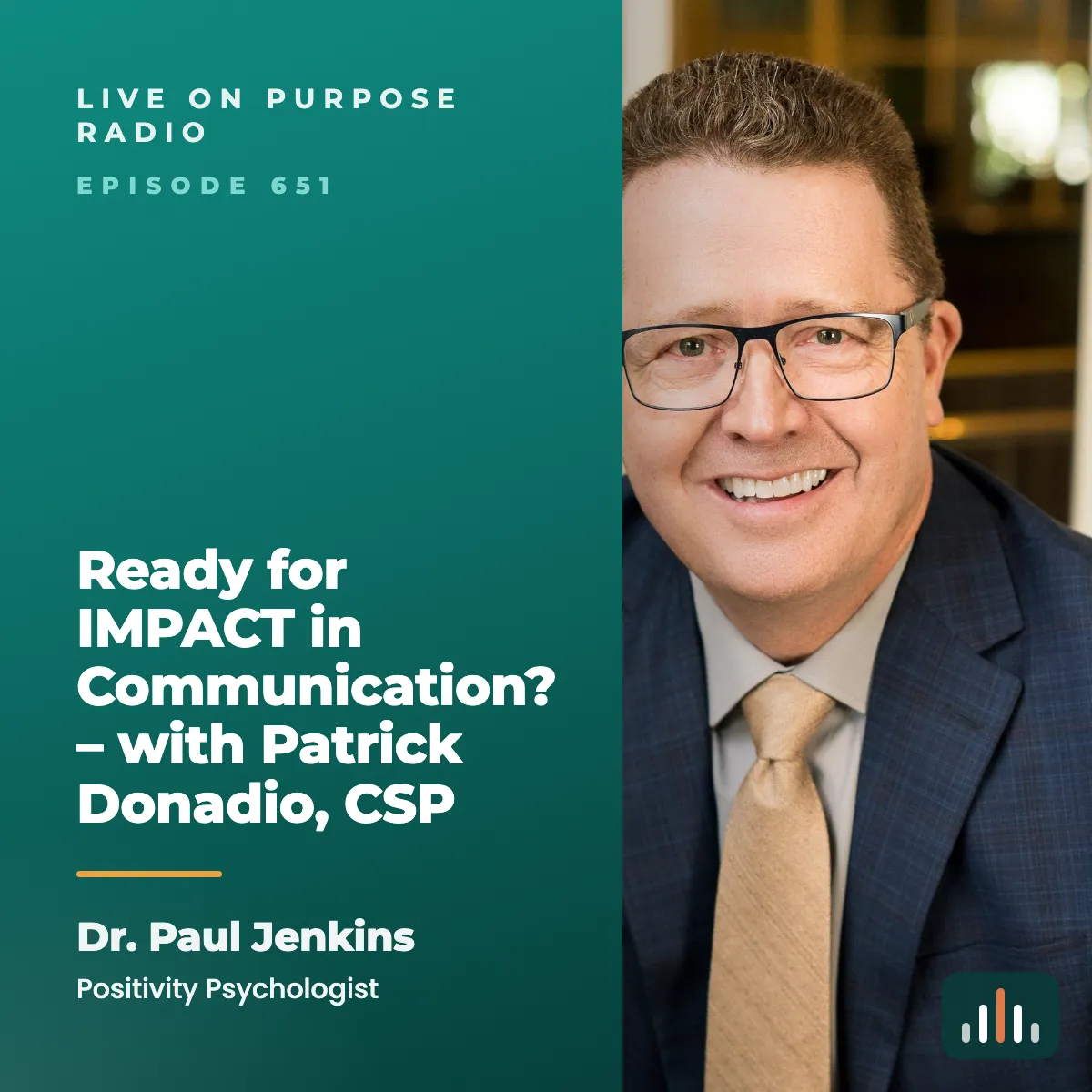
This is Live On Purpose Radio episode 651. Ready for impact in communication? With Patrick Donadio, CSP. Now is the only time to create and live the life you love. I'm doctor Paul Jenkins, the positivity psychologist.
My job is to connect you to powerful positive psychology principles that immediately upgrade your relationships, business, and mental health. Are you ready? Let's jump in. Welcome back to Live on Purpose Radio, everyone. This is doctor Paul the shrink who expands your life.
I'm bringing you another episode today with a friend of mine that I've known for a number of years now. Gosh, Patrick. It's probably going on a decade at least Yeah. At least. If not more.
Right. We know each other through the National Speakers Association. And Patrick Donadio has the credential of CSP, And I want to just comment about that because it stands for certified speaking professional. And that means that he does this regularly. He is a nationally recognized communication strategist, keynote speaker, educator, coach, and author of a book called Communicating with Impact.
We're going to get into that a little bit today on the episode. Welcome to Live on Purpose Radio, Patrick. Good to be here, doctor Paul. Always great to see you, my friend. It's about time.
Right? Yes. Yes. We've we've had the idea of getting you on the show for a while, and we've got our our schedules to finally correlate in a way that here we are on the mic having this conversation. You're going to help us to communicate with impact.
There you go. And before we get into that, Patrick, I would love to know just a little bit of the backstory of why you are so interested in this. What what is it that makes you passionate about communication? Well, you know, doctor Paul, all of my grandparents came over from Italy, And so I grew up in a really cultural environment. My parents spoke Italian.
They spoke English. My grandparents spoke mostly Italian with accents. So there's a lot of communication going on growing up. Some that I understood and some that I didn't understand. You know?
Because sometimes my parents would talk Italian to my... To each other or to my grandparents and we didn't know what they're talking about. But I was always intrigued by learning about communicating and as a middle child, I always spent a lot of time trying to get attention. I was a reader at church. I was in theater in high school.
I undergrad degrees in radio television. So I just always liked to talk. And then little did I know later on in life, like you, doctor Paul, we can get paid, you know, for the talk. This is good news. It's just been something I've been in...
Really enjoyed doing and learning about all my life. So it's pretty much a great gift to be able to do what you love and make a living doing it. You know, I was thinking as we were coming together today, Patrick, that we can't not communicate. Yes. I know that's a double negative, but we're going to communicate in some way.
And if we can become more intentional about that, we can we can transform our communications not only to be more effective, but to really have the impact that we're hoping to have. Yes. I agree. With everything with everything that can go wrong in communication, it's amazing that we can even communicate at all. Yeah.
Yeah. But I think you understand those dynamics in a way that is unique. And I know you've been training on this professionally for years, if not decades. And, so walk us through this. Would you introduce us to your impact model and what that's all about?
And then we'll, we'll get into whatever detail we feel like getting into. How does that sound? I love to. You know, I've been teaching communication skills for a couple decades now, doctor Paul. And Mhmm.
When I started teaching it, I didn't have a process or a system. And I started to realize, you know, that when you have a system or a process, you get a greater result. So, over time, I tried to figure out how could I come up with a recipe or a process. And this started actually... I was in Japan as a goodwill ambassador couple decades ago, and I was staying with Japanese families every couple days.
So I really got to have a great experience. But one thing I realized after a couple days of rotating different families, they kept bringing me sushi. And I, you know, I like fish, but I didn't like sushi, but I was being very polite. Talk about communicating. I kept saying, oh, thank you so much.
And then they would tell the next family, oh, he really likes sushi. So then I had more sushi and about the third family, I said, could I go to McDonald's? I said, I just want a hamburger. So the the young kids in the home were excited. We went to McDonald's and I got a a big o maku and I got the fries.
But here's the thing, I was eating these fast food restaurant foods, and they taste exactly like they did back here in The States. And that's when it dawned on me, you know, if you have a recipe or a system, you're always gonna get a consistent result. So I came back, and then I started to figure it out how to get this model into a process. And they came up with the word impact, which I think is a great term because you wanna make an impact when you're communicating. So the six keys pretty much spell out the word impact.
So I'll get you to them pretty quickly, and then we can dive into any of the ones you wanna hear about. So the I stands for the intention. And I know you talked about this word earlier, and I'm a big proponent of everything we do should be intentional. So the first start to getting... Becoming a good communicator is to think before you speak.
What's the intention for my communication? And we can talk more about that. There's a lot of intentions ones can have. Like, our intention today, at least my intention today is to give as much value as I can to your family to help them be better communicators and relax and have more fun at home at work. The m is the message and the method.
So, you know, we want you to know an intention. You say, gee, what's the right method to use? Because there's so many methods. You can make a phone call. You could send an email.
But sometimes the intention dictates a certain method. And then, of course, you have a message. And the key is what do you wanna say or communicate that's going to achieve the intention? So everything goes back to the intention. So you got the intention, you got a message and a method, then the next step is the person.
So even though you know what you wanna communicate, depending on who you're communicating with, you need to adjust that. Right? If the person is a more relational or more analytical, if they're more introvert or more extrovert, if, if they... In my case, like, when my grandparents didn't speak a lot of English, then we did a lot of hand gestures. Right?
Mhmm. So you personalized the message. That's the IMP, the I am planning, the first half of the process. The second half, again, you're still planning. You're still thinking in advance.
You're still being proactive. The a is activate, and there's two parts of activation that are important to communication, active listening and active engagement. Now, I talk a lot about in in this step about engagement because particularly in the workplace, the Gallup study has been going on for, I don't know, probably fifteen years now. And engagement is only about, I'd say, a third of the folks at work are engaged in work. So engagement is very important, and that's true even in your personal life.
You wanna keep people engaged in the conversation, feeling like they're part of the family. And then, of course, active listening, which to me is a skill set we don't teach anywhere. You know, when I do a workshop, doctor Paul, I always ask every audience, how many of you had a sixty minute listening skills training seminar? And about 15% or less raise their hands. Right.
So the a is active listening. C is clarify. How do you make sure the message you sent is the same message? Because there's a lot of misunderstanding, a lot of interpretation, a lot of unconscious bias, conscious bias. Right?
So you wanna make sure you clarify. And then the t... And this is good. I think we talked about this on our pre call about mindset. In the transformation step, there's two types of transformations.
There's the external transformation that we probably... We all know about. Right? I wanna set a deadline. I wanna make sure that we, you know, we follow through and follow-up.
But then there's the internal transformation that I don't think I knew a lot about doctor Paul stood up till I started to get trained as a coach, and that is what's gonna get in the way of us achieving the intention? What's gonna get in the way of the receiver? Is there a mindset or a belief that they have that maybe needs to be addressed or shift or talked about? So there you go. The impact process, I m p a c t, doesn't take but a minute to think it through.
It takes a little bit longer to implement, but it's not that complicated. It just is something that people don't always use a structure to communicate. I love that you've put a structure on it, Patrick. And and we know that models are more more powerful, really, and brain friendly. Our friend Scott Halford teaches this.
If you if you have a a model, it's more brain friendly, and you can remember it better. And dear listener, you're probably thinking, oh, I wish I had a a visual of Patrick's mon... We've got you. Hey. We've got you.
Just go to liveonpurposeradio.com. Remember the name of the podcast, liveonpurposeradio.com, and then do a little forward slash impact, which is the acronym that Patrick has just shared with us. When you go there, liveonpurposeradio.com/impact, you're going to see the wheel. Yes. Patrick has designed this into a wheel.
It's got all of the letters in it, and it ties them together in a way that your brain is gonna remember this better. You can also connect to Patrick and all of his other amazing resources because there are clickable links in that PDF. So I just wanted to throw that in, Patrick, because the work that you've done to structure this and put it into a model, I think, is making this kind of shift the idea of communication Right. A lot more practical and applicable so that we can wrap our heads around it. Yeah.
Yeah. I agree with you. And it's really something I did for me, doctor Paul. I'll be right... I I like systems and processes, and I thought to myself, if I had something that would help me...
And so I wrote the book for everybody, but it really eroded for me. And and I think most people were all like, we we all want somebody that's easy to implement that's gonna make a difference or an impact. So I hope people go there, get some free tips because I do wanna keep giving value. Yes. I wanna dive in just a little deeper on a few of these points, and you caught my attention with that first one.
Yes. Intention because this has everything to do with our why. Why are we communicating in the first place? And that's going to drive everything. Can you just talk a little bit more about that point?
What what do we need to know about intention? Yeah. Well, you know what, doctor Paul, the first step is probably the easiest step in the process and the one people tend to skip most often. Because we wanna just jump. We wanna just start picking up the phone.
We wanna just start typing. Right? We just wanna start communicating. But I say take thirty to sixty seconds, stop and think and ask yourself, why am I communicating? Why am I picking up the phone?
Why am I sending an email? You know, why am I going in to knock on the kid's door because I wanna have a conversation with them right now? Why? So often we start with the what, but I think if you take a few moments and start with the why, you're gonna have a much more powerful conversation. For example, like today, you know, our why is to add value to the family who is listening right now.
Yes. So my goal is to try to make sure when I'm communicating, I'm giving valuable ideas and and concepts. I'm sharing things that are practical. I'm giving examples. Right?
And so that's, like, if if our... Like, when I'm in a coaching session, which I know you know this, doctor Paul, because you've done, you know, one on one sessions as well as a speaker. But But when I'm in a coaching session, because I'm an extrovert, I gotta keep reminding myself that I'm not here to give out wisdom. I'm here to ask good questions. So even even a mantra that I have is that, I'm the sage on the stage when I'm in front of the group speaking.
I'm the guide by their side when I'm in the one on one conversation. So even that little intention of knowing I'm the guide by their side guides that whole session versus I'm the sage on the stage. So the intention really kinda sets the step for everything we do, and it's not that hard to do. But yet so many of us just wanna jump in and start writing or start focusing on the what. Well, the name of our show here is Live on Purpose Radio.
Having a purpose, doing it intentionally Right. The... It's a nice little double meaning, and it all speaks to this idea of intention Yes. And where we're going with it. You know, you mentioned something about, the distinction between the why, which is intention, and the what, which is the thing you're trying to communicate.
And I would agree with you on this point because most people go into a communication wanting to get this point across. Yes. And when we pause long enough... And I think you said just sixty to ninety seconds. Yeah.
Right? Just pause and ask yourself why. What is the intention? What is the purpose? It...
It's going to save a lot of problems as you get into the actual communication because of the pitfalls that we encounter when we're trying to communicate if we're really clear about the why. Yes. And you may approach it very differently because of that. Yeah. And, you know, if it's a very complex communication, I even encourage people to write it out.
Right? I even have in in in in the book, I have what I call the laser focused intention template. And it's like four or five lines that just ask you critical questions so you can just fill it in. So that way you're really spending some time thinking about it. Again, not every communication has to have this much time, but something that's really important.
You know, if you don't spend the time to get ready for that, you're gonna spend a lot of time fixing something that you probably could have avoided if you spent a little more time thinking before you're speaking. That's right. It's probably a good idea to think a little more. Yes. And then we have to avoid the problem of overthinking things.
But that's not what we're talking about right now. We're talking about getting really clear about your purpose, your intention, the why behind this communication in the first place. Yeah. I love it. Okay.
My brain is is jumping ahead a little bit now to the p. Okay. The person. Yeah. Right?
This is going to be personalized. And and let me tell you why my brain just went there. Because as you were talking about getting clear about our intention I I just finished, a retreat recently where we were working on marketing messages. Mhmm. This is communication.
Yes. Right? And being very clear about about our purpose then leads right into and who is it for. Right. Because you're going to speak to that person.
It's... And in the coaching industry, I I train and certify coaches now. Mhmm. And in the coaching industry, I get this a lot. People say, I just wanna help people.
Right. And I'm like, which people? Right. Because if you wanna help everybody, you're you're not gonna be clear enough to help anybody. Yes.
I hear you. And, you know, when I think about this piece step, there's two parts to it. One is to know yourself, and it's also important to know the other person. So you don't wanna just think about the other person. Going back to example you mentioned, you don't wanna overthink it.
Well, for example, analytical people tend to overthink it. Right? You know, relational people tend to just start talking like, I'm very extroverted relational, So I get myself into a lot of trouble, doctor Paul, because things come out of my mouth before I start thinking. Yes. You know?
And then you get other people who sit there and they wanna like, I call it, you know, fire. I'm like a fire ready aim kind of person. Just get it out there. And other people are like ready aim, ready, aim. I'm like, okay.
You gotta get going. Well, almost there, ready, aim. So again, in the p step, know yourself because you wanna blend you and the other person together, particularly if it's in person. And if it's in writing also, but in person, if you're trying to work with someone who's a little bit different, you wanna think about how would I blend that? Quick example.
As a extroverted person, when I'm working with more of an introverted person, I remind myself to, you know, talk a little slower, take down the volume a little bit, leave a little bit more space for time, and and because I know that I can go pretty quickly. And I know the other person who may be different than me would be benefited by me making some adjustments. So so there's both... Think about the receiver and also think about you as the sender. That's good.
You know, I just had an episode, here on this mic with John Bates. Uh-huh. And you might be familiar with John. He's a a very well known TEDx coach and, an amazing speaker in his own right. And he was talking about that very thing, understanding the audience as well as understanding the person that you are delivering that message.
Right. And we have all kinds of thoughts flying around on both levels Mhmm. On both sides. He he calls it the monkey mind. Yeah.
The... This monkey, you know, chattering away in your mind somewhere that has all kinds of opinions about you and about your audience and what they think about you. And I think becoming aware of that and being mindful and cognizant of what are those narratives that are bouncing around about me, about that person. Yeah. And and trying to cut through that to what's really more likely to be the actual case.
Yes. You know, in this step, I talk a lot about, you know, practicing the platinum rule versus the golden rule. And so a lot of people know the golden rule. Right? Treat people the way you wanna be treated or as I hear people say, those with the gold rule.
Right? But but the platinum rule is treat people the way they wanna be treated. And I think to me, when it comes to communicating, I think the platinum rule is way more important. And by the way, there's a book out there by one of our colleagues, doctor Tony Alessandra. He wrote the book called The Platinum Rule.
But the platinum rule to me is really important in this step. Is... So whether you're having a conversation or sending an email, you know, you wanna be thinking about the other person and what would they like. So going back to the end stuff real quickly. You know, like, we tend to pick our preference.
Like, oh, I love phone calls, so I'm just gonna call somebody. That's my preference. But but if I'm calling somebody who doesn't really like phone calls, like my kids are in their late twenties and thirties, and there's no way I could ever call. I tried calling. The voice mailbox is full.
So even though I would love to call them, I know that I have to use the text to get started. So again, these things all interrelate. Even though it's in a circle and you go I and m and p... I mean, they all interrelate to each other, as you think about being a good communicator. So so the p step, you're right, is a very important part of the process.
I think that point that you just made is so, important. And I... I've talked to people who are frustrated because they're like, this person won't pick up the phone. Right. And you're acknowledging, yes.
There are people who will not pick up the phone. Understand that and communicate with them in a way that they want to receive communication. Exactly. And I tell people, look. You start with their preference, then you can move them to your preference.
If you wanna have a phone call and they don't like phone calls, start with a text and say, listen. I I really would love to talk with you a little bit more about x, y, and z. I think it's better if we do it on the phone. Can you let me know when's a good time to have the conversation? They're gonna open a text, but they probably will never listen to a voice mail or maybe not even pick up the phone.
So, yeah, it's always good to think that way. So let's let's jump ahead, not because we're skipping anything. Right. Necessarily because we're going to give you the whole model. Once again, dear friend, you can go to liveonpurposeradio.com/impact.
You're gonna get the whole model there. There's a link to connect to the book where where Patrick goes into all kinds of detail about this. But I wanna move forward to the transformation. Yes. The t.
And, Patrick, you gave me a little thought nugget there that's just kind of got my brain working on this. Because in in my mind, there's different levels of learning. Yes. You and I are keynote speakers. That's part of how we deliver our message in front of audiences.
And in a keynote, a person might have what I call a breakthrough learning experience. It's that moment. Right. It's when the lights go on and it's like, oh. And then there's a different kind of learning that is more transformational over time with practice and repetition.
Yes. Like learning a language Right. For example. So I started on, New Year's Day. I started using Duolingo.
Me too. Did you? Well, it's a fairly popular thing to do because language is such a key element of our communications. I have a lot of people in my neighborhood who speak Spanish. Si.
And so, I'm learning it slowly through Duolingo Right. So that I can communicate better with them. Well, Spanish... See, this is an example of that transformation. I think you called it, like, an internal transformation.
It's a reprogramming of our neural pathways. Mhmm. It's not the breakthrough. Uh-huh. I got it.
Right. It's the, okay. Now I'm a hundred days in. I'm getting it. Yep.
Right? Would you like to just kind of chime in on that? I... I'm curious what you think. Yeah.
I mean, look, there are important parts of f... Let's... Let me do it external pretty quickly. Right? One thing I like to talk about is if you don't have a deadline, things don't get done.
That's an external transformation. So if we... Like, we had to put this on the calendar or we never had this podcast interviewed set up today. Right? Right.
So we had to talk about it. Schedule it. Yeah. But we're talking about it, but the one way to transform it is to give it a deadline. So that's an external piece, which, again, you can learn and people know about that.
On the internal side is to understand how our beliefs drive our behaviors and our behaviors drive the results we get. So I already talked about a belief shift, and that is moving from the golden rule to the platinum rule. The platinum. Right? Once you think, oh, I'm gonna use the platinum rule.
That means treat people the way they wanna be treated. That has to first start with a mindset shift because then I will start thinking, oh, well, that person really doesn't like phone calls even though I do. So I'll use a text to get started even though I like phone calls. So, again, the mindset shift is really that part of the transformation that I don't think a lot of people think about in communicating. We we don't tend to think about, like, how would I have to adjust the way I'm thinking, or how would I have to adjust the way they're thinking?
So I know you've heard about this. When I talk about it, it is the, fixed mindset and the growth mindset. And doctor Carol Dweck, I mean, it's just... Again, her book is is powerful. And, you know, doctor Paul, I hate to even say this, but these are things that have been around for a long time.
Right? A lot of things we talk about, I call them universal truths. They just get maybe repackaged or maybe developed in a clearer way. But but the growth mindset is so critical. And I remember years ago when I first started speaking, I was just a nervous wreck.
And I was in I was in a present... I was doing workshops, and I was in a room, and all of a sudden in the back of the room, it's like one of my early workshops, a woman fell asleep. And my first thought was, I am the worst speaker. Oh my gosh. What is wrong with me?
I should never quit my job. And I'm going on and on, and I'm I'm trying to catch myself because, you know, your mind starts to go and then everything goes with it. And then at the break, the woman came up and she said, oh, mister Donadio, I wanna just tell you that my son was up all night. He's been sick, but you were doing a nice job. I just apologize.
I kinda been dozing a little bit, but I wanna let you know there's nothing about you. And I thought, oh my gosh. The whole time, I was thinking it was all about me because I was in that fixed mindset. So in communicating, there's really that, you know, that underneath layer that sometimes we have to give some thought to to make the transformation happen. That's right.
And as you pointed out, these aren't particularly new ideas. I think what you're doing is confessing that you did not invent communication. No. It's better how long before Patrick does so. And you've you've put a structure around it that helps us to talk about it and work on it and become more intentional about it.
Yes. And as you talk about this internal transformation, the external transformation, you know, we give ourselves a deadline. We put it on our calendar. We decide, okay. This is more than an idea.
I'm going to do this. And then we get to actually do it Right. Which requires some practice and repetition. Yes. Thinking, you know, about this, the shift, you know, that that we've been talking about here.
Okay. I like phone calls. They like texts. I'm going to approach it with a text first. That's an intentional shift.
Exactly. And it requires a little bit of practice because you're wired a little differently. Right. And that's what I'm saying.... Go to our comfort zone.
Right? What we do, what we like. Of course we do. Yeah. And, you know, in this step, I always like to make sure I remind people about something that I found very helpful for me over the years, and that is how to turn mistakes into learning opportunities.
Because there's another fixed mindset. Oh, I made another mistake, as opposed to, oh my gosh. I have another learning opportunity. I know that's semantics. Right, doctor Paul?
But it's amazing when you think of it that way. So the tool that I have, and I can't say that I invented it, but I've tried to make it simple and embedded in my impact process. I have little mini tools, and this one's called the WD. And so what I tell people when you're learning something new, like if you listen to the podcast and you get one new idea and you wanna try it out, you're gonna make mistakes. That's part of learning.
So when you make a mistake, don't automatically say, oh, I'm a failure. I want you to shift it to a growth mindset and say, wow. What a wonderful learning opportunity. And you do this exercise. It takes, like, sixty seconds.
What did I do well, w, What did I do well when I had that communication with my boss, with my partner, with my child? And what could I do, d, differently the next time I have that conversation? So Right. I think life is all about continuously learning. And and that's what I love about being in NSA, National Speakers Association, because I'm coming all the time and, you know, I've been doing this for thirty years now.
I don't wanna say how long, and I'm still learning because I know that we can always learn. So turn mistakes into learning opportunities. Just ask two simple questions. What did I do well? What can I do definitely the next time?
Take some notes. Go back and do it again. And then you'll make another mistake. Exactly. That's...
It's it's part of the dealio. Right? We Yeah. It's not about getting it perfect. It's about continuing to learn.
Yes. And I love the way you just framed that as well because calling it a mistake even Yep. Is a traditional, maybe fixed mindset kind of an approach. Yeah. Well, how else can we look at this?
Here's another opportunity. Right. And that's going to take some practice as you pointed out. Yeah. And even language, our language could be, you know, challenging.
I remember my son was really young and we're going to his first soccer game, and he says, daddy, my stomach's queasy. And my first thought was, how do you know the word queasy? I can't even spell that word. And then my second thought was, you know what? Honey, you're...
It's... You're not nervous. You're just excited. That's... Those are exciting feelings.
That's your first game. You're excited. They wanna see what it's gonna be like. You're excited. They wanna know how good you're gonna be.
And so trying to reframe it because, again, our language, our thoughts, right, drive our behaviors, and our behaviors drive our results. So so That's right. I just love this this concept of the of the mindset, doctor Paul. I I know you know a lot more about it than I do, but it's really a powerful piece. Whether it's in therapy or interactions or in communication, it...
It's a key component to a lot of things. Absolutely. And the words do matter. Yeah. That's that's part of the context of our communication.
It's the code that we use to convey an idea. And what we call it changes how we interact with it. Yes. So you talked about, you know, the queasy to where it came out of left field somewhere. One of one of my colleagues that I've had through my whole career, doctor John Skidmore, we've led parallel careers.
In fact, his office is right across the parking lot from mine right now. And he's a certified positivity practitioner. He trains on performance, and it's very common for people to feel what they label as nervousness Yes. When they are preparing for a performance. And he he has expertly given them another word to use, and that word is activated.
Oh, like that. You think about it. This is very consistent with the psychology behind performance because you have to be activated. If you're asleep, you're not ready to perform. Exactly.
And we talk about this optimal level of arousal that allows us to get up and do what we need to do without being paralyzed by anxiety or fear or panic. Right. When you look at it as activation, you know, that's the conversation that you had there with with... Was it your son? Yeah.
Right. Right. It's... It... You're not nervous.
You're kind of excited. You're you're, you know, you're activated. Yep. That's a good word. I love it because this is my impact process.
Right? A for activate? That's the a. Activated listening means you have to be engaged. Right?
You have to be present. Activate. I love that. Well, you're welcome. And that's from doctor John Skidmore.
Yeah. Well, tell doctor John thank you. Patrick, this has been, as I anticipated, a fun conversation. I know that, people are going to want to follow-up and, maybe get a copy of your book or dig deeper into this impact process. Once again, listener, as you're tuning in, liveonpurposeradio.com/impact will take you right to a visual model of what we've been talking about here.
There are also links there to Patrick's website, to the book itself so that you can purchase that, get it into your clutches so that you can become more intentional about this. Patrick, is there anything else you'd like to share with our listeners about how they can interact with you or where to find you. Yeah. I think you've done a great job. I love that you created this nice resource because I do have a lot of things I like to help people with, and a lot of them are free.
So, yeah, you can always go to my website. It's patrickdenaudio.com, which is pretty easy. If you're in the business world, you can go to my LinkedIn page. But but most importantly, I hope people are getting one or two things that are starting to stick with them. Because I like to wrap up every one of my workshops to my keynotes always with the same phrase, and that is nothing changed until you change.
Yes. So, you know, if you love the idea of shifting from the golden rule to the platinum rule, or if you like the concept of thinking about how do I debrief after I make a mistake and turn it into a ruining opportunity, you know, take one of the things that we've talked about today and and just start doing something. Right? And and... Yes.
Because I know for me, I just know that for many years, I wanted to do something and I never done it and I needed to get off, you know, off the starting block. So I've I've learned myself to take... I'm not a natural risk taker. So I have a phrase I like to use I call make a risk. So I don't take a risk.
I make a risk. Let's talk about language. And make a risk means I'm gonna give it some thought. I'm gonna make sure that I, you know, a little bit about what I'm gonna be doing, but I'm still gonna do it sooner rather than later. Yes.
And then it becomes less scary. Well, dear listener, you have heard some real gems today, and hopefully, you can grab on to whichever of those makes the most sense for you as you actually take action, activate, that's the a part, and and actually get some transformation, that's the t part, into your own communication. Oh, Patrick, thank you once again for your contributions here today at Live on Purpose Radio. My pleasure. Great to see you, my friend.
I'll see you this summer, I hope. And, I'll give you a big hug in person if you're okay with that. That I'm planning on it. I'm counting on it. And dear listener, you've got, hopefully, exactly what you came for.
It's time to go apply that now. Let's go live on purpose. Did you get what you came for? Give yourself the gift of taking real action on what you realized today. Please share this episode with someone you know would value it, and leave us a rating too.
It's time now to live on purpose.
Open the transcript on its own page ↗