
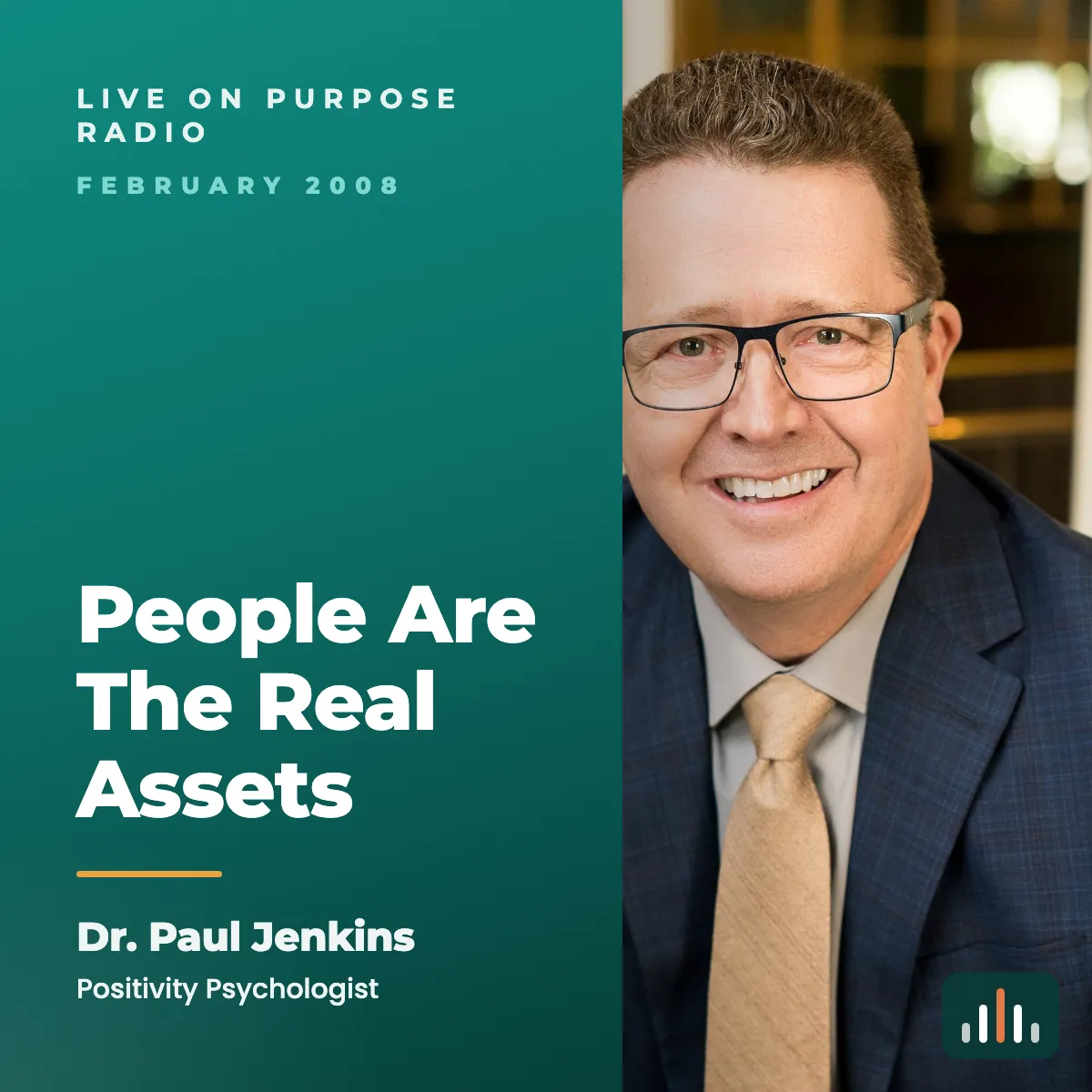
Episode 27
People Are The Real Assets
February 22, 2008 · 59 min
59:16
Listen on
Show notes
About this episode
In this episode
Dr. Paul Jenkins interviews young entrepreneur Jeff Fabian about people being the true assets. Jeff encourages listeners to live on purpose by building a powerful portfolio of people.
Dr. Paul interviews young entrepreneur Jeff Fabian about people being the true assets. Live On Purpose by collecting a powerful portfolio of people.
Read the full transcript
Are you cruising through life not always knowing what direction you were headed? Let Live On Purpose with doctor Paul Jenkins be your guide. Live On Purpose will give you insights into your life and show you how you can become the driver and captain of it. No more aimless wandering. By learning the principles that govern happiness and wealth, you will be able to make personal progress that you have only dreamed possible.
And now, here's your host, the shrink who expands your life, doctor Paul. Hey folks, welcome back to Live On Purpose Radio. This is Doctor. Paul, the shrink who expands your life. We've got another great episode of Live On Purpose Radio coming at you today.
I am so excited and enthused about some of the things that are going on lately. I hope that you're tuned in. I'm glad that you're here on this podcast. I wanna give you a little heads up to some other things that are happening. We have currently a parenting teleconference that's going on once a week and if you wanna check that out, go to parentalpower.wordpress.com.
That's the blog site that I've set up for Prental Power, and I've been posting these calls, so you can actually click on the little thing there. It's just like Live on Purpose Radio. You can click on the audio icon and you can listen into the calls. What I'm doing with that is, just trying to create an opportunity for parents to have a forum where they can have some discussion and some, and we can answer some questions and talk about some principles and just help people with that important aspect of what they're doing. And then also, I've got another blog, you can link to it right there through Parental Power, you can get to it through doctorpaul.org also.
Here I am branching out onto the internet, which is kind of cool. But the other one is the the EMPOWUR blog. Some of you are recipients of my weekly emails called EMPOWUR, which stands for harnessing the power of the mind. And that is also now on a blog, so you can go on there and post your comments. You can do that for this radio show, too.
I am looking for and asking for more feedback. So if you like what you're hearing, if you if you are receiving value from the things that we're doing here at Live On Purpose Radio or at the other websites, please go on and feel free to comment. And even if you don't like it, post a comment about that. We will accept contrasting points of view. But, I wanna put that invitation out to you because there's some exciting things happening along those lines, and I'm finding that the more people contribute and participate, the higher the value of what it is that we're putting out there.
So let's help each other and support each other in doing that. Feel free to, to go browse those sites and see what what you can find there and spread the word. We have a growing listenership here on Live On Purpose Radio and, it's just because of you. It's because of you sharing this show with people that you care about and spreading the word and I I appreciate that. So I wanted to get that out right up front.
Hey, we've got an opportunity here today to have some fun discussion. I have a friend here with me in studio who has done a show with me before, but not here on the podcast. It was back in the days of Live on Producer Revolution Radio, and I'll introduce him now. This is Jeff Fabian. Hi.
How are you doing? I'm doing great. Thanks for joining me here, Jeff. No problem. I kinda roped you in here at the last minute today.
Spur of the moment. Spur of the moment. So you're gonna get some impromptu from Doctor. Paul and Jeff Fabian. I had another guest lined up who will actually be joining us next week instead.
We had a little scheduling change. Mhmm. So Jeff, you and I got together a little earlier this morning, and we talked about some things that we'd like to include on today's show. But before we get into that, I want to give you a chance to just tell our listeners a little bit about who you are, what you do, where you're coming from. Just give us a little bit of the picture, the profile of Jeff Fabian.
Well, I'm, I'm 21. I started doing this... I started taking the ideas of the producer mindset about the age of 18. Friend of the family, Fremont Woodward, I ran into and, he, got me on track pretty well. I've been doing this since then.
I'm currently building a bunch of homes right now. They're under construction and, I do a lot with cars. I'm having fun in a renting market down in Las Vegas and renting cars out there. And, also looking to do some, vacation rentals as well. But, right now we're just focused on...
I'm doing some coaching with Fremont, helping them out with some coaching. And, basically, that's about it right now. I've got a little girl just barely starting to walk. She's, she's about 0.5 now. And, got a great wife, and, we're getting ready to move into our house that we custom built for us.
And so that's exciting. But, not attached as you can tell. I'm not attached. So, but anyways, yeah. It's been a lot of fun and, I'm getting really excited about some things we have coming up, and, it should be fun.
Now I'm sure our listeners didn't didn't miss the little detail that you shared, that you're 21. Mhmm. And then you list all of these these, business things that you're doing and investments and production that that you've gotten into over the past couple of years. And you were you were younger than that the last time I interviewed you on the show. I think I was 19 when he interviewed me.
That was probably true. It was 19. Because it's been a while ago. Yeah. I think it was 19.
And I've known you for a while, Jeff, and I've Mhmm. I've found you to be the kind of a person who is who is not interested in waiting around, obviously. Yes. Very. When you Impatient.
When you notice a principle, you tend to latch onto it and run with it. Mhmm. And that's, I think a big part of what you can credit some of your success at such an early age to. Oh, yeah. Definitely.
But you're just getting started too. And I've I've had some good discussions with you lately about facing giants. Oh, yeah. And this, as a lot of people listening know, I mean, any any industry has its ups and downs. And right now, the real estate market as we know, it's it's...
It... There's some areas that are quite a giant right now to get over. And so there's some hurdles. But, I've been getting them over. I've been getting over them pretty well lately and, things are looking really, really good lately.
I've got a couple deals that just closed and, working on leveraging some of those assets a little bit better. Mhmm. This is is going to lead into some good discussion today that I think will be very valuable to our listeners and has been personally valuable to me. If you look back through some of the recent shows on Live on Purpose Radio, and if you go to the MPOWER blog and you see some of the things that I've been writing about in the weekly emails, it has a whole lot to do with how you handle the adversity or the challenges that come up in life. Because it's sure to happen.
Mhmm. You can't just sail through life without hitting any bumps. I think it brings out a lot of your true character as well. I mean, it's kinda hard to bring out the... It's it's the champions and the heroes that are built when they face adversity and succeed.
That's when the true the true hero comes out. It it begins to illuminate character. Mhmm. And you really can't bring that out in a time of of non adversity. Should we call it that?
Mhmm. Let's pursue this a little bit, Jeff, because you've got a little bit of experience dealing with this personally, but you've Mhmm. You know a lot of people too that are facing things. Oh, yeah. I have found, as I've talked with people, that quite commonly they think that the solution to their problem would be to get some more money.
It's a pretty common thought. Oh, yeah. I've thought that myself. I'll admit to that. We all have.
I think we all have. And when we think that way, we're missing an important principle, and that's the principle that you and I talked about as being the topic of today's show, which is that people Mhmm. Are the true assets. Definitely. People are the true assets.
What does that mean to you? Well, the biggest thing is is, well, for example, this, we've had of several cars. I I mentioned that I'm in the renting business of renting nightly rentals and, you know, I've I've partnered up with you on actually one of them. Mhmm. And we've got several cars that, I mean, for the most part we had them and it's nice to have a lot of cars.
I'm a car nut but, Mhmm. We, didn't feel like they were being utilized to their fullest potential. And so instead of throwing more money at the situation, we started thinking of, okay, what people do we know in the car industry and the car business and renting them and stuff like that. And I started doing some research and, you know, the... When it really came up to it, I have a person that I partnered with and that has generated a great deal of value for us.
And it's all about the person because I also partnered with another person that was in the same industry, totally same business, same area and everything, And it was very unsuccessful and it was it was a good tuition because the tuition was it was a good tuition to remind me that it is about the people. The technique was the same they were doing. I mean, basically, same techniques, same marketing. I mean, they were a lot a lot very similar, but when it really came down to it, it was the person behind the techniques that was really making one happen and one not. So let me make sure that I understand what you're talking about here.
You had a situation with these vehicles Mhmm. Where you wanted to put them to a more productive use. That's kind of the nice way of saying that it was sucking all the cash out of you. Mhmm. Right?
Oh, yeah. This is sometimes how you can monitor whether something is productive or not. Mhmm. If if if it's pulling resources away from you, it's probably not productive. So you wanted to put these cars to a better use that would essentially help you to pay for the vehicles, but also maybe create a little bit of cash flow for you.
Yep. You found two businesses. I'm gonna use the word business here. That'll work. For just a minute.
You found two businesses in Las Vegas. They're both in Las Vegas? Yes, both. And and they do essentially the same thing in renting out these vehicles. Yep.
And these are higher end vehicles. Yeah. We're talking Porsches, Mercedes. Mhmm. And lowest in car we have is probably a little four door Mercedes sedan, but other than that, everything else is sports.
So the basic idea is that people come into Las Vegas for their fun weekend vehicle for the weekend. Mhmm. Something like that. Yep. Okay.
So both of these businesses do that business. Yep. Same techniques, basically. Basically. Yep.
And you had very very different experiences with these two businesses. Yes. Very. What I heard you saying was that the difference was the people Mhmm. Or the person behind each of those businesses.
They're in... One of them was in a totally... It was very obvious that one of them is in a a paradigm of abundance and that there's plenty to go around and he loves competition. And the other one, it was more scarcity, keep things to myself and I can't cut my revenue and and stuff like that. And so when it really came down to it, the person with the greater paradigm of abundance has really come out very successful in this industry, and the other person has not been so successful.
And so Mhmm. He's having a really hard time getting out of the position that he's in. But the other guy is, you know, he's one of the biggest renting companies in Vegas. And so very successful person and very great to work with. Well, this might seem like a kind of a conclusion, but there's a person behind every business.
Oh, yeah. Behind every company, behind every entity, there is a person. Definitely. Let's develop that a little bit more as we come on back. K.
Stay with us. We'll be back. This is Ross Kellen Moore of Creation Tree Coaching, and I've got two questions for you. Who are you? What do you want?
You see, I figured out that you and I can absolutely create anything that we really want. But to do that, we've gotta be absolutely clear on who we really are and what we really want. So what do you want? More financial abundance, more fulfilling relationships, a higher level of health and fitness? How about finding your work that allows you to create massive value for others in the way that you love most?
Welcome to Creation Tree Coaching. We are the world's premier provider of abundance, education, and resources. We are here to help you create the life you really love. Begin now at creationtreecoaching.com. Check out our live teleseminar classes and podcasts.
Get to know our coaches and schedule a coaching session. Explore training for your business and employees. Welcome to creation tree coaching and a whole new world that you create on purpose. If the pile of books you want to read is growing faster than the pile you have read, then abundant reading systems can help you. After taking abundant reading systems course, I dramatically increased my ability to expand my knowledge in a much more efficient way.
My fastest test today was in 7,000 words per minute. I highly recommend this program from what I've seen it do for other people who've been through the entire program and from what I've seen in myself today. I've teamed up with Abundant Reading Systems to offer a single day intensive speed reading workshop that will at least double your reading speed guaranteed. This belief started to grow inside of me that I thought, you know, I can really do this. I can read, you know, as fast as I let myself read and, ended up doubling my time, my speed reading time, which was really good.
This is David Hinton, founder of Abundant Reading Systems. I want to personally invite you to join us for our next event. Visit abundantreadingsystems.com now. Abundant Reading Systems, reading at the speed of imagination. So as we were developing this topic, Jeff, there was a a comment earlier that I made that a lot of times people believe that that money is gonna solve their problem.
Or another version of that is, gosh, you know, if I just had x number of dollars I could do this. I could make this go away. Mhmm. I could do this. I could whatever.
Yeah. Now you're grinning. You've heard that before. You've said that before. Mhmm.
You've thought that before. Several times. And you've had some realizations about that. Oh, yeah. I've got, I've got a couple of things I wanna share about that too.
But why don't you share some of your experience with that? Well, the biggest thing too is when I get into a situation like that where I'm starting to think if I had more money or if I could... If I had more money to do this or if I had more money to fulfill that opportunity that I wanted to to to go after. It's put me in a position to where then the next question is I stop, reframe for a minute and okay, what do I have instead of thinking if I had more money, what do I have in my control right now that I could utilize to do what I wanna do to fulfill this opportunity? And then I kinda stop, think about it for a minute.
What's some... What what can I leverage in my own human life value that I currently have at the time? Because a lot of people don't really look at themselves when they're looking for more money. They tend to look other places except for within themselves first. Mhmm.
So it's it's kind of a default. Always the best place to look, isn't it? Mhmm. To start with because it's your you you just kinda glossed over a word that gets thrown... Or a phrase that gets thrown around a lot.
Human life value, huge. I think we ought to talk a little bit about that for a minute. In fact, I just taught a client this morning about this concept of human life value. Some people get all offended when we talk about human life as having a value. Mhmm.
Of course, to you, your own life is priceless, isn't it? Yep. You wouldn't trade it for any amount of money. That doesn't even make sense. So, people get offended sometimes, like with life insurance companies, for example.
The life insurance companies go out there and they place an economic value on your life. They say it's worth a certain amount of money. Mhmm. Certain number of dollars. Right?
Oh, yeah. Anytime you talk about what something is worth, you have to go on to the next question, which is to whom? To whom. To whom? All they're saying is this is what it's worth to us as a life insurance company, you know, in that example.
Well, what's it worth to you? A whole lot more than that. Right? Oh, yeah. So asking the question to whom helps to get you thinking about how you're going to exchange certain things in order to solve your problem.
So if you believe, for example, that your problem can be solved with some amount of money. Let's say that it's $2,000. Mhmm. Okay? I'm just pulling that right out of the air.
Let's say that it's $2,000. Do you believe, Jeff, just pretend like you're a client or something for a minute, okay, and you think that $2 is gonna solve your problem, okay? Do you believe that the $2,000 that will solve your problem exists? I believe it exist. If I'm sitting here as a client, I'm saying, no, it doesn't.
I can't... I don't have $2,000. I don't know how I'm gonna do this, and the world's gonna come to an end if I don't get it. But Jeff, think about it. If you think that the $2,000 would solve your problem, there's a little part of your mind that says, and it's out there somewhere.
Right? The $2,000 actually exists. The biggest thing is is a lot of people think it's not within their grasp. It's unreachable. So the next question, where is the $2,000?
If it exists, where is it? Well, and the common answer is a lot of people will throw out a place, an actual place that it's at. It's at the bank. Like at the bank. It's at this company.
And, a lot of people are missing the key point of this whole show is it's actually with a person somewhere. And... Because there is no bank. There is no company. There is no entity that exists without a person Exactly.
That represents. Okay. So the the basic answer to that question, if it exists, where does it exist? Well, it exists in the pockets of other people. Mhmm.
Is that always the case? Yes. I think it is too. If it exists, and it's not in your pocket It's in other people's. It's in someone else's, right?
Mhmm. And a pocket can be a number of things. Yeah, sure. And it might be a dollar that's collectively held by a number of people. Mhmm.
Could be in some kind of a fund, or it could be... So so there's different ways that these dollars reside out there in the world, but if the money exists, and if it exists in the pockets of other people, then in order for it to come into your life and have it solve your problem Mhmm. Means that they would have to give it to you. True? True.
Why should they do that? Well, it depends on what your... What the exchange is, obviously. I don't think Okay. Get I don't think give is the word for it, but what are they going to, the question is is, why would they exchange it with you?
Well, unless you're gonna extract it by force and deception, which they're going to voluntarily give it to you. Yep. Why would they do that? Because you have something a lot more valuable to them than the dollar. And that's the kicker, isn't it?
Yep. Because you have something that they want more than that amount of money that you want from them. Now this boggles some people's minds because in their mind there is nothing more valuable than money. Mhmm. But that couldn't be further from the truth.
We don't even want money. What do we do with it once we get it? Spend it. Right. We trade it for something we really want.
Yep. Right? So it's just a... It's a medium of exchange. It's a tool.
It's a receipt for value Mhmm. Is what it comes down to. K? And I have found with a lot of people that I consult with that they don't fully understand the value that they have to offer. And if they would start to clue into that, then they'd know how to make an exchange with the people who are holding the dollars that are gonna solve their problem.
Mhmm. So you had an experience with this very recently. Oh, yeah. I was in a position to where I didn't quite wanna utilize my own money for a particular deal that I was looking to do. So I, started thinking, okay, what can I leverage that I currently have in my possession?
And not even have in my possession, just necessarily what do I have that I have control over? It's not about ownership. It's just about a control. I'll do a control. What do I have that I can leverage that I have control over?
And so I started thinking and I have a house that's currently under construction. It's just being framed right now and, Can I interrupt you for just a sec? When you say leverage, that word carries a lot of baggage for some folks. Yeah. It does.
K. Let me put my own spin on that. When you say it's something that you can leverage, what you're really asking is, what do I control that someone else would receive value from Mhmm. If I were to make it available to them? Mhmm.
Is that fair? Yeah. That's a good that's a good definition. So you got this house. Yep.
Foundation framed up. Yep. Not finished. Not finished. And the big thing about this too is I got in the same position to where is, where can I?
How can I get money for this particular project that I wanna do? And I didn't even think about the house. Thinking, oh, the house has gotta be done, etcetera, etcetera for... To generate any kind of profit. And that was definitely far from the truth.
So you know, I started looking around. And then then the next question came. Okay, now who who in my life right now has the means to do, to partner with me, to do this project that I wanna do? That would value being also a partner on the house. So this person, and you've got someone in your Oh, yeah.
Collection of people. I joke sometimes on this show that I collect people. That's a good collection. Jeff. That's a good collection.
You've been in my collection for several years now. That's a good collection. Since you were a kid, really. Mhmm. And you looked in your collection, and you're just kinda rummaging through your collection of people, and you say, hey, this one has something that I could use, and I have something that he could use.
I wonder if he'd be interested to talk to me about that. And we did. We sat down and talked about it, and it was very... It was a greatly beneficial exchange. We actually...
It was awesome because we ended up... I ended up creating more value for him than I anticipated was possible. Not only did we partner on the house, but he was also interested in some, coaching on some of the companies, building company credit and stuff like that that Mhmm. I'm trying to establish right now. And he was very interested in that, and we worked with him on that.
And so it's been very beneficial on both ends. It's been awesome. Well, and we've done some of those kinds of exchanges personally, too. Mhmm. You mentioned that I partnered with you on some of this rental stuff.
Mhmm. And your experience and expertise there has helped me to put to better use an asset that was in my control. And in exchange for that, we've had a chance to have some discussions that have benefited you and me. Oh, yeah. Definitely.
So this is this is the whole key, is to identify the people that would value what you have to offer. Now, that assumes a few things. It assumes that you're collecting people. Mhmm. I just say that kinda jokingly, but really, what other assets are there that you could put into your life that would have that level of impact?
And there aren't any. You can collect things. You can purchase properties. You can buy paper or even hoard money. But what good does it do you unless there's other people that you can exchange with?
With? Mhmm. Well, a big thing too is, a lot of time people will, when you start when you start establishing a relationship with another person, the interesting thing is is, yeah, the person that you're talking with is the asset. But then you start asking questions like, so who do you know? And then you start seeing that person as a big asset, because that person knows that person that does that in particular job that you would be very interested in.
And then it it sounds, you know, I don't wanna make it sound like this little multi level, it's not. But in a way, it kinda looks that way. You talk to one person, it branches off and you get in numerous people and you get people from all different aspects of life. But Jeff, this is why those multi level marketing companies succeed. Mhmm.
Because people know other people. That's how it works. And you always exchange with a person. Yep. I like the way this is going.
It's good. Good. We'll keep working on this. Let's take a little break. Sounds good.
This is Shay Larson, ideaorbit.com with the world of ideas report. Forget about writing a shopping list. Forget about reading labels. Forget about going over your budget at the grocery store. How about a shopping cart that does all this for you?
That's right. There is a new shopping cart that has a simple computer attached to it, which is connected to the store's inventory database. Listen to some of the features. The cart will know if you are diabetic or have other special needs and will warn you if you are putting something in the cart that you shouldn't. You can enter your budget, and the cart will show you your current tally including tax as you go.
If you are trying to lose weight or be more healthy, the cart will alert you when you put high fat or sugar products in the cart. And if that doesn't impress you, how about not having to wait in checkout lines? The shopping cart knows the total, and all you have to do is zip your credit card. The smart carts have been tested in The US recently and were a big hit. They should be showing up in stores in Great Britain, Australia, and The US this year.
This is Shay Larson, ideaorbit.com, with the world of ideas report. If you live in the Utah County area and if you like what you hear on this show, then this opportunity is for you. I am hosting a weekly mastermind group called Paradigm Insurance every Wednesday from four to 05:30 at my office in Orem. Call Eric at (801) 226-7544 to register. We prefer an abundant atmosphere, so please wipe your mind before entering.
That number again, 8012267544. We're just listening to the World of Ideas Report. I love what Shay Larson is doing with this. Thank you Shay if you're listening. You've...
You're doing some neat stuff because that's inspiring to me. Yeah, that is really cool. That's the first time I've heard that one. Mhmm. That's the first time I've heard any of them.
I hear them the first time when I listen to the to the podcast as we're as we're creating it. And it just reiterates the importance of what we're talking about here, that people are assets. It's people who have ideas, and then turn those ideas into something that someone else is going to value. Mhmm. And then you can make an exchange.
Well, that's a that's a big topic that kind of get skipped over to is when people think about money, they think of it as being a dollar bill on the table somewhere. Mhmm. And like this idea, that idea isn't on... That idea isn't anywhere printed on dollar bills or anything. Mhmm.
It's an idea that exists in someone's head. Mhmm. So until the exchange is made to bring that out into the world, the money's the money's not even there. Mhmm. So it takes exchange to get those ideas extracted and working into progress.
I don't think those shopping carts were made by one person sitting in a garage on his own. I mean, maybe. But there's a lot of people involved to put something together like that. Well, absolutely. In fact, I'm reading an old text.
It's called The Wealth of Nations by Adam Smith. And he's an early, early economist and patriot. And he gives an exam... He gives several examples of just simple things. I'm I'm not remembering specifically, like a like a pin, for example.
K? A little straight pin, little metal straight pin. I think one of his examples, actually, I do remember was a pencil. Or a pencil. It was a pencil.
And what goes into actually creating a pencil It's intense. It's amazing. Mhmm. The amount of human life value that's required to create something as simple as a pencil, but you can't personally just make one. Mhmm.
You know, you could maybe come up with some kind of a crude version of a pencil, but you can't make the nice pencils that that are sitting on the desk in front of you, for example Mhmm. Without duplicating the process that that this pencil went through. Mhmm. So let's review a little bit what we've gone over here. When you think that money will solve your problem, ask yourself, well, does that money exist?
And if it exists, then where does it exist? And there's two answers to that. There's one, it's your human life value that's in your brain and your knowledge, and your knowledge is power. And that's a lot of where if money exists and it's in your head, then it's infinite. Money's abundant.
And then the second answer to that is, who has it? Well, the the... And and are we talking about the actual value? Are we talking about the receipts for the value, which we commonly think of as money Mhmm. Or currency?
Yeah. And that currency, if it's not in your pockets, it's in somebody else's. Mhmm. When is when is the money made? When...
People say this all the time, you know, I go to work so that I can make some money. But typically, they're not employed at the at the Department of the Treasury Mhmm. Or at the US Mint. Right? So they don't literally mean that they're making money.
In fact, Robert Kiyosaki has a funny story about this in his book, Rich Dad Poor Dad, where he heard of this concept of making money. So as he and his little buddy, they were just little kids, like eight years old. Mhmm. They started collecting the lead from toothpaste dispensers. Toothpaste tubes, I guess.
And they'd collect it up and they'd start to melt it down, and they'd they were minting nickels. Yeah. That's right. Do you remember that story? I remember that now.
Yeah. Making money. Well, he didn't quite get it. Right? Mhmm.
What do most people mean when they do when they say they're making money? What they're doing is creating value for someone else in some way. And a lot of times it's with their time. Exchanging their time, hours. Time, labor, effort.
Yep. Sure. And that's that's why we have a job market, for example. Mhmm. K?
There are people out there who value your time and labor, and they will give you these receipts if you will trade your time and labor to help them accomplish whatever it is they're trying to do. Mhmm. And you and I both had a common experience in the labor market as we worked in a ladder factory. Oh, yeah. We talked about that a little bit.
Thanks. A wonderful entrepreneur. Oh, yeah. Very successful. Just fantastic, inspiring man, has a company called Little Giant Ladders.
Well, Wing Enterprises, and they make these little giant ladders. It's an aluminum ladder that folds up. They're really cool. I own one. Yeah.
Me too. And I used to trade about eight hours a day in that ladder factory, grabbing just rungs, ladder rungs, sticking them in a punch, punching a hole in them and putting them in a basket. I'd do that all day. Or another day I'd be drilling, little parts of a hinge. Or another day I'd be loading a welding jig.
Or another day I'd be dipping the finished ladder frames in in an acid bath Mhmm. And putting stickers on the side of them. Beaten and striping. You've been there, you've done that. Oh, yeah.
I used to run that for a while, so. So when do you make the money? See, I would spend hours in Hal Wing's factory doing all of this stuff to create value and and to help to create this product that he was going out and selling to the world, and then every couple of weeks he'd give me a paycheck. Mhmm. So was the money made when I received the paycheck?
Was the money made when I showed up for work? Was the money made when I drew my first breath? When was the money made? Mhmm. And that's an interesting question to contemplate a little bit.
It it gets you tuned in to the concept that it's the creation of value for others that makes the money. And usually, it starts with an idea, just a thought. And the thought might be as simple as, hey, I'm gonna go apply for a job at this place. K? You're already making money because you've created an idea that will result in the production of value for another person.
Mhmm. And then they will exchange for that. So entrepreneurs, and I'm I'm really getting into the world of entrepreneurism, and have become an entrepreneur myself. Entrepreneurs understand that there are some ways to really maximize your human life value and the potential for you to create value in this world. And they go out there and they they try to find more ways to do that.
So if you wanna bring the money that's gonna solve your problem into your life and you realize it exists in the pockets of another person and then you ask yourself, why should they give it to me? The only reason I can think of that they would give it to you is in exchange for something that they want more. Mhmm. Can you think of any other good reasons? That is the basic reason.
I mean, that's... I wouldn't trade I wouldn't trade anything to you if I didn't value whatever I was receiving in return more than what I traded. So I mean, my answer to that is if I wouldn't do it, I don't see why anybody else would. But, yeah, that's So what about a philanthropist? What about someone who wants to give just for the just for the joy of the giving?
Well, then that's what he's giving for. Then that's his reward. Yeah. Exactly. That means that the joy he experiences in giving.
That's the exchange. Exceeds the value of whatever he gave. Exactly. And I think that that's always the case. If you'll be perfectly honest with yourself, that's always the case.
Mhmm. So your task now becomes creating enough value for that other person that they will be happy, even thrilled to make that exchange. So in this experience that you've had just this week, Jeff, you've had, you identified a dollar figure that would help you to solve a problem. Mhmm. You looked at what you had control over that someone else might value.
You offered that to that someone else, and they were thrilled to exchange with you. Thrilled. So It was an easy, quick, and it was fast, and it was it was a a big win win for both of us. It was really fun. So you both came out of it better than you were before?
Yes. Isn't that fascinating how that works? Oh, yeah. And it was fun because it... It's just fun that instead of...
And it's kinda nice sometimes because a lot of us say... A lot... You hear a lot of entrepreneurs say, why use your own money if you can leverage other things and other money elsewhere and stuff like that? And the actual fun part about that is, is it involves other people. If you leverage your own money...
If you're using your own money and just doing your own deals and just quietly... There's not a lot of fun in it for me at least. When I start involving other people, hey, you want to be a part of this? I have this opportunity. What do you think?
Oh, yeah. I want to be a part of that. And, oh, let's see what we can do here. I mean, it just creates conversation. One thing leads to another, you know.
Not only did I offer that opportunity, but they have another opportunity that they might have available. And it's just this ongoing process that things... Doors just start opening up once you start having conversations like that. This concept of my own money is kind of an interesting one anyway. Mhmm.
When you say it's my own money, what... All you're saying is that you've already received these receipts for something that you did before. Mhmm. If... And usually, if you're using other people's money, you've heard that phrase before, OPM.
Yep. If you're using other people's money, what it means is that you're receiving the receipts before you deliver the value, or it's a receipt for a promise of value. Yep. It represents a liability on your balance sheet. Mhmm.
K? And and when you understand liabilities and assets, they're both resources. It's just how you utilize it. But the timing of the value delivery is different. Mhmm.
So if the money... If the dollars are already in your pocket, it means you already created the value, or you've promised it. And if you've promised it, then you better make sure you deliver. Right? Definitely.
Mhmm. So, some people think that the bank has a lot of money. What do you think of that? I would just say they're a middleman of holding on to it for other people. I mean, they don't have a lot of money if you, check the...
If you check their balance sheets, your money doesn't show up as an asset. It shows up as a liability. As a liability. It's a promise to pay. Mhmm.
Just like what we're saying. A promise to add value into your life. That's right. By giving them the opportunity and giving them the stewardship over your money. Mhmm.
So it's not the bank that has the money. It's people. It's the people. It's still the people. Mhmm.
And it always comes back to a person. What this suggests to me is that one of the most important things we could be involved with is creating and establishing and strengthening relationships. Would you agree with that, Jeff? Yeah. The biggest thing about that too is, a big technique to that is, check your emails, check your cell phones, go through those, call up those people, establish those right...
Relationships again, and get those relationships back into your life and see what they have to create value for you and see what you have to create value for them. Exactly what you have to offer them. Stick with us one more second. Your way. This is doctor Paul.
You've heard me talk about a lot of things on this show, and I've interviewed some pretty amazing guests. I love what I do, and one of the nearest things to my heart is my role as a husband and father. I've worked a lot with others who place a strong emphasis on family and I feel this is my primary purpose to help others save and enrich their key relationships. It's in this spirit that I invite you parents to join me for a free weekly dose of parental power. Register for this free teleconference at doctorpaul.org or send me an email at doctorpaul@creationtreecoaching.com.
You will receive an email with the call in number and access code. The calls are live every Tuesday morning from 11:30 to 12:00 mountain time. I'd love to be part of your parenting team. Hi. This is Jason Adams, one of the cofounders of cashflowparadigm.com.
The created cash flow paradigm is a way to help others look at money differently. What are your beliefs about money? Is it good or bad? Many people have beliefs that limit their control over money and don't even realize it. The thing most people don't realize is that their beliefs about money greatly affect the amount of money and prosperity they have.
It's all about your paradigm. Come play a fun game with us called Cashflow one zero one created by best selling author Robert Kiyosaki. Come meet new people and check your paradigm as we learn principles that govern our personal and financial lives while having fun together. Currently, we are holding monthly game nights in Provo and Saint George, Utah. Go to our website at www.cashflowparadigm.com to register for upcoming events.
That's www.cashflow,paradigm,.com. So people sometimes sit around and they they tally up what they've got, take a little inventory. Right? And if you if you go to a financial coach, which I'm not, by the way, I don't want anybody to to confuse what we're talking about here today with financial advice. Yeah.
But we're talking about a principle that's gonna help you nail this down when you understand that people are the real assets. People are assets, not things, not money, but people. People are the true assets. And a lot of times we'll inventory our assets, and we'll make a little list of, well, here's everything that I have. Mhmm.
What if you were to do that with people? What if you were to make a list of who you have in your network? I've done that several times and every time I do it, it comes out very profitable. It's a really it's a really good revealing experience. I mean, it's Mhmm.
It's pretty powerful. You start listing those and names start coming up and, oh, I wonder what this person's doing. I wonder what this person's doing. And you go through those list and you just start making old connections and even new connections through old people. And I mean, it's just this big whirlwind of connections of opportunities and exchanges that are happening and you get in the mix of it and it's it's pretty exciting.
Mhmm. Well, Jeff, you've been aware for a while, as I've as I've done this podcast for example. And and I just say, from time to time that I'm collecting people, and I have guests on this show that are just phenomenal. Mhmm. They teach me so much, including yourself.
Thanks. And it's just so cool to have these kinds of discussions, and this is part of the value of the podcast for me. Mhmm. But I had... I do an inventory every once in a while.
Who do I have in my network? Who's connected to me? What can I do to create value for them? And I'm I'm asking those questions a lot, but I have another list too. It's a hit list.
Mhmm. K? Now, don't anybody call the FBI or anything. It's not that kind of a hit list. It's a hit list of people I want to have in my collection.
And I have had people on there in the past that I I was thinking, oh, if I could only have a relationship or an association or something with that person, that would be really cool. Just having them on a mental list of people that I want to bring into my to my collection puts me in a position to start looking for opportunities to create value for them, which eventually brings them into my list. There's a few people that I still haven't haven't, collected. Mhmm. But most of the people who are on that list are now in my in my collection.
So you just go through the podcast episodes. Leslie Householder, for example. Leslie, if you're listening, thank you for all of the value you've created for me and other people, the author of The Jackrabbit Factor. She's phenomenal. I consider Leslie a friend.
I've had several exchanges with her. Well, she was on my hit list for a while. I told her that when I first met her. Mhmm. And hopefully, she doesn't mind my sharing that.
But I only bring that up because sometimes we get so focused on how am I gonna bring things and stuff into my life, when things and stuff don't have the power to make you happy, and it's it's really your core relationships that are gonna mean the most to you. Keeping that as a priority is gonna help you to create and live the life that you love. What if you were to apply the same kind of effort into bringing people into your life? Because if you have the right kinds of people in your life, what are the possibilities that you're gonna fail economically, for example? They're not high.
That's for sure. If you have the right people behind you, it's... You have a very high success rate. I mean, because it's it's about the people and I heard a quote from, I don't remember who said it, but I heard it from Stefan and it was something in the nature of is there's too many mistakes in the world to make, so why do you have to make them all? And...
Spreads the joy a little, Yeah. And it... And so I was sitting there thinking about it. And his whole thing behind it was is start asking questions to other people. I'm sure other people have gone through this experience.
Instead of, going through it, why don't you ask the questions and take a detour and learn from their mistakes. And learn from their, so so to speak, tuition. I heard a saying once that ignorant people fail to learn from their own mistakes. Smart people learn from their mistakes. But the true geniuses in life learn from other people's mistakes.
Mhmm. So do you wanna be, you know, which category do you wanna be in? Mhmm. That's part of the value of having those kinds of connections. I've realized...
And really, this gives me a lot of peace and comfort as I face adversity or challenges, and as I come up against some of the giants in my own life. And I think, oh, my heavens, this is gonna crush me, or this is gonna destroy me, or whatever. The next thought process for me is, wait a minute. Who do I have in my network? And if I have a network of successful, brilliant, talented, idea laden people, if I have a bunch of those in my life and I'm creating value for them to the extent that they don't want me to disappear or go away or become extinct, how likely is it that I'm gonna fail?
If you have powerful, influential people in your life who don't want you to go away, what greater asset could you have? And people... Now, I don't wanna have this be completely an economic discussion because really what we're talking about is relationships and your emotional wealth, too. Mhmm. What if you have an abundance of people in your life who you love and who love you?
Mhmm. How's that gonna feel? Really, really good. And how many things are gonna stop mattering Mhmm. To you if you really feel connected that way.
Well, I think a really key point too is that, we throw this term around unique ability and sole purpose. For example, you having me on as a guest on your radio show. You are... You doing the radio show. This is your passion.
This is one of your unique abilities, you know, in your unique ability range. We've made an exchange on your car, for example. I know you weren't doing too much with it and that car was... You wanted to utilize it in a higher higher and best use. So the first name that...
And is awesome to me popped up into your head is I gotta go talk to Jeff. Right. I didn't even have to think too hard about that. Yeah. It was really easy.
Well, let's go see what Jeff's doing with cars today. Mhmm. Mhmm. And so with me, it's utilizing those other people's niches, so to speak, or unique abilities or sole purpose. There's a bunch of identities you can put on it.
But it's utilizing those exchanges with people and utilizing their sole purpose and their unique abilities to fulfill your areas where you're not so maybe, you know, confident in or not so great in. It's those areas that are kinda gray for you. And it gives you more time to stay in that center point of your life of your unique ability and your sole purpose. Because if you're out wandering out into these gray areas of your life that you don't really understand, how much value are you really creating? Mhmm.
If you're out in the gray area, how about stay in your unique ability, create the most value for the most people that you possibly can. And the stuff that you don't quite understand, make some exchanges with other people. That's their unique ability. Let them deal with those opportunities and set up an exchange that way. If you get very far out there on the fringes into the gray area, as you called it, you're probably making the problem worse.
Mhmm. Because your incompetence in some of those things means that if you're engaging in that activity, it's it's going to make a bigger mess. Mhmm. And I've learned that through some difficult experiences too. A lot of people think that We all have.
I can do it all on my own. One of those people that I can I can do it all? I don't need anybody or I don't... Needs the wrong word but I don't... I prefer not to have anybody to do anything.
I can do it all and that's the secure way. You know, it doesn't seem so secure to me if you don't know what you're doing and you're going into something. It doesn't make sense to me really. It's also kinda selfish. It is.
That do it yourself at... Because if you're gonna do it all yourself, you're not going to give someone else an opportunity to do that. Mhmm. And they might even be better at it than you are. Mhmm.
But what if everybody did that? Well, that means nobody's going to be coming to you for your particular skills and expertise. Mhmm. Nobody's gonna be offering you an exchange for your passion and your skills and your expertise. Mhmm.
People miss that sometimes as they're thinking this through and they think, well, I'm gonna do it all myself and I'm not gonna I'm not gonna burden anyone else. Mhmm. No. It's not a burden. It's not a burden.
People are looking for those opportunities, provide them. Vicky and I had a great experience with this a couple of years ago when our house was in need of a coat of paint. Now, I'm capable of painting our house. Right? But there's a family in our area that just lives about a block and a half away from us that we're aware of.
One of the kids was friends with one of my kids, and this family was here from another country. And the man was underemployed, we'll say. Okay? What was you? He's a painting contractor.
And he's looking for ways to feed his family. Mhmm. Now I could spend a Saturday painting the house, or I could spend that Saturday playing with my kids and give him an opportunity to paint my house, exchange for him with with him for that, so that he can feed his family better. I mean, this is And you can play with your kids, which is more valuable to you than painting the house. And be in a better position to get back to work the next week Mhmm.
To do what I really do well Yep. Which isn't painting houses. I really don't wanna talk about painting houses right now, but... Okay. That's a sensitive one.
That's what I'm doing right now. That was all day yesterday. Well, Jeff, we're getting to the wrap up here. I wanna I wanna give people a little heads up as to some some other things that are coming up. I've we've talked a lot about relationships.
Next month on on March twentieth through twenty second, we at Creation Tree Coaching are hosting a couple's retreat. And Jeff, you've attended some of our couples events in the past, and they're real magic. They're awesome. And I wanna just give a plug for that. If you're interested, it's a two day, two night retreat at the beautiful Homestead Resort up in Wasatch County in Utah, in Midway.
It's very near some of the Olympic venues for the two thousand two Olympics. We've got a power lineup for that retreat. We're doing two days of seminars with nine of our Creation Tree coaches who are bringing their skills and expertise to the table. So if you're interested in that, give Eric a call at (801) 722-4848. And other than that, feel free to visit our websites and browse around creationtreecoaching.com, doctorpaul.org.
Some of the blog sites that I referred you to earlier. We've got a lot going on. So I wanna give you a heads up to that. Jeff, thank you. No problem.
For joining me here today. Pleasure as always. Fun discussion. Everybody go out there and live on purpose. We'll catch you again next time.
Open the transcript on its own page ↗Practice this every morning
Positives is Dr. Paul's daily practice membership: short morning audio messages that anchor your focus before the day derails you.
See PositivesNew here? Start free
The Positivity Power Pack turns the ideas from the show into a seven-day practice.
Get the free Power PackKeep listening
Related episodes


New to Leadership & Success?
Start here in Leadership & Success



Free for listeners
Take the show home with the Positivity Power Pack
The fastest way to put Dr. Paul’s model to work. Everything below lands in your inbox, free.
- The Portable Positivity minibook and companion workbook
- The Unique Abilities video lesson
- Seven guided audio messages, one for each morning of the week
Send me the Power Pack
The full pack, straight to your inbox.
Get the free Power PackFree. Takes one email address.