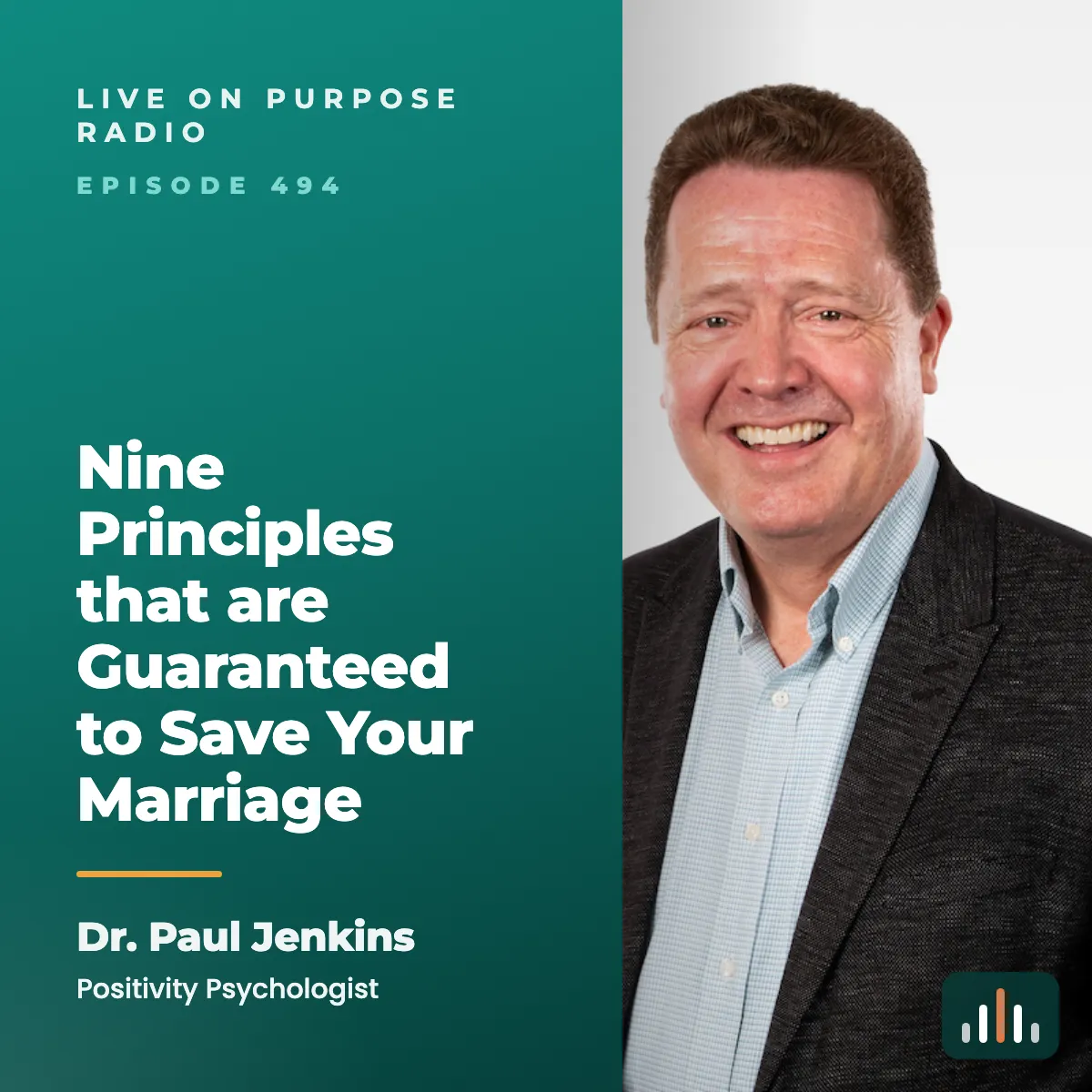
This is Live On Purpose Radio episode four ninety four, nine principles that are guaranteed to save your marriage. Now is the only time to create and live the life you love. I'm doctor Paul Jenkins, the positivity psychologist. My job is to connect you to powerful positive psychology principles that immediately upgrade your relationships, business, and mental health. Are you ready?
Let's jump in. Hello, everybody. Welcome back to Live On Purpose Radio. This is doctor Paul, the shrink who expands your life. And today, maybe we're saving some relationships.
Saving and enriching key relationships. That's what we're all about here at Live on Purpose. And this is not magic. It's not luck. It's based on principle.
And when I say principles, I mean natural laws, like gravity, for example. You never get up in the morning and think, oh, wonder if gravity is on today. It tends to be. And these principles affect your life. So if you were to jump from the top of a tall building, what would happen?
You would fall. Yeah. For sure or maybe. Sometimes or every time. You see how gravity works?
Now what if you're standing at the top of that tall building and you're thinking to yourself, yeah, gravity, whatever. I don't believe in that. And then you jump. Oh, same splat as the believers. K.
Gravity doesn't care if you believe in it or not. It doesn't check-in with you first to make sure that it's okay. So when I talk about principles, I'm talking about natural laws. And principles determine all of life's outcomes. Marriage is no different.
K? Sometimes you'll look around and you'll see people who have a great marriage. And you might think, oh, they're so lucky. It's not luck. It's based on principles.
And those principles are guaranteed because it's just like gravity. They're always on. You don't have to check-in first to see if they're going to work. So here's the nine principles. Now these these principles are some that I discovered years ago, and and it gave me a whole new way to approach marriage coaching.
See, back in shrink school when I was learning to be a psychologist, They taught us that for couples therapy, we were to bring people in, talk to them for about an hour about their problems, and then schedule another appointment. There was some research done by doctor John Gottman and the Gottman Institute that showed that roughly seventy percent of the problems in a relationship are unresolvable. Now that's a little discouraging to some folks. I share that with some people, and they just throw their hands in the air. Well, then what are we supposed to do?
And other people are just relieved because they realize they're not quite so weird. But why... This is why the traditional approaches don't seem to work very well. When people come in and talk about their problems for now, they feel blamed. They feel beat up on.
They feel worse than they did before they came in. So I was so grateful when I finally discovered these nine principles. Let me just share them with you. Now if you want a copy of these, you don't have to write down notes, and you're probably busy anyway. But I will put a copy...
A PDF copy of these nine principles into your inbox. Just go to liveonpurposeradio.com/ nine, the number nine, principles. And that's all one word. Liveonpurposeradio.com/9principles. I'll put it in your inbox so that you can have a copy.
You can print it out. You can refer to it. Now let's get into these nine principles. Number one is positivity. Now when I say positivity, I'm not talking the trite, fluffy, just think positive.
Ignore the problems, paste on a smile. No. I'm talking about two processes that are constantly going on in your mind all the time. This is the foundation of our coaching programs, understanding that your mind is constantly evaluating your current circumstances and creating what is to be. Think about it for a minute.
How important is it to evaluate your marriage in a positive way and then to move forward and create something even better? So when I say positivity, I'm talking about actually operating the equipment of your own mind, and this is where it all starts. So positivity is principle number one. I've got other episodes of the podcast where we get into details about that. Or if you get into some of our coaching programs, we're gonna work you through that and take you right through the course and the curriculum around that.
Okay. Principle number two, values. Meaning, the values that brought you together in the first place. A lot of times when I'm coaching with couples, I'll say, why did you get married in the first place? And they usually have some really great reasons based on values, based on how they define marriage or family, and and how this is going to be better together than separate.
And so they make a conscious choice to come together. What are the values that drive it? For some folks, this gets into the area of religion or spirituality. If it does for you, that's fine. If not, that's okay too.
But what are the foundational values of this marriage? This has to do with the why for the relationship in the first place. And if you can get really clear about the why, the how becomes much more doable. So that's why we put it in there at number two. Number three, principle number three is humility as opposed to destructive pride.
K? Now here's how I define humility. Humility is giving up your need to be right in exchange for being open. My friend Brett Williams wrote a book called You Can Be Right or You Can Be Married, and that's a very clever title. It's also a very good book where he goes through some very practical strategies for keeping your marriage together.
Brett was a guest here on my podcast several episodes ago. You can go look that up in the archives if you'd like. And this is what humility is all about. See, we have a problem. As human beings, we have a problem.
Another one of my guests, doctor Richard Nisbett, who was on the show as well, made his entire career off of studying thinking, basically, reason, logic. And he told me on the show that the number one error we make as human beings is that we believe what we think. Now that I'm asking you guys to go to a level called metacognition. K? Cognition is thinking.
Metacognition is thinking about thinking. And when you turn that on and you really think about your thinking, you'll see something that doctor Nisbett pointed out that you tend to believe what you think. It's important to be able to question that. And so on this humility principle, we give up our need to be right in exchange for being open. This will change the game, and it makes you more willing also to change and to grow and to develop and to correct mistakes that you've made or to apologize.
K? So humility is huge. That's number three. Principle number four, forgiveness. I've got several definitions for forgiveness.
There's a lot of things that it's not too. Let's just get clear about that first. Forgiveness is not saying that what happened to you that hurt you was okay. It's not what it is because it's not okay for somebody to hurt you. It's not, pardoning someone for their sins or crimes or misdeeds.
You don't have that kind of authority. Come on. You can't do that. So what is forgiveness? One of my favorite definitions is giving up our demand for a better past.
Do you like that one? Giving up our demand for a better past. When you forgive, you don't pull out all of the history and beat somebody up with it. This is one of the things that people do in a marriage often that is so destructive. It's it's kind of like applying humility at a different level.
In fact, I think the humility and the forgiveness are two sides of the same coin, really. Forgiveness is also being humble enough to let someone else change and to acknowledge that that change is not only possible, but real. Forgiveness. What hurts? What offenses?
What grievances are getting in your way right now with your key relationships? The answer is forgiveness. That's how we get past some of those those grievances. Remember, it's giving up, oh, I was going back to the other definition. Giving up our need to be right in exchange for being open is the humility.
Forgiveness is where we we give up our demand for a better past. You got it? Next one, respect. I ask kids sometimes, what does respect mean? And they...
I love their answer because they almost always simplify it to to be nice. Yes. Respect. And if you can adopt it this way, this is how I teach it in one of the youth programs that I oversee. I respect myself, others, and everything around me.
Respect has a power that is benevolent and genuine. Ask yourself, what does respect mean for me, and how can I apply that more consistently in my relationship? The next principle, what are we up to? Six, love. Now when I say love, I'm not talking about a feeling.
I'm talking about a choice and a commitment and a declaration. I remember one couple that came to see me, and she slipped out to go freshen up. And while she was out of the room, he said to me, he said this, doctor Paul, I just don't love her anymore. And and I think my response was probably, well, then love her. Duh.
Because to me, it's simply a choice. It's not a feeling. It affects your feelings. If you're wondering what I mean by that choice, my book, The Love Choice, goes into that. I wrote an essay for this book.
It's a collaboration that I did with 17 professional speakers in the National Speakers Association Mountain West chapter, and we all submitted an essay about love. And in my essay, the love choice, I pointed out that it's got to be one or the other. Hate or love? And I use the word hate because people hate the word hate. But think about it.
What's the opposite? What is the alternative if it's not love? It's hate. Either a little or a lot. Your interactions are going to fall on one side or the other.
So there's there's a process around which we choose love. Once we choose love and to be loving and to show up in a loving way, it also affects our feelings and more... We're more likely to feel love. It's kind of a neat process that happens there. Let's go to principle number seven, compassion.
Compassion is kind of like love, and it's kind of like respect, and it has something to do with kindness. But it's interesting that the roots of the word compassion actually get back to suffering. You can go do some etymological research around this and just kinda see... It's an interesting thing to me. Like, right now while I'm recording this episode, it's around Easter time.
And in the Christian tradition, Easter is a celebration of the passion of Christ, which refers to his suffering and crucifixion in the Christian tradition. So that the passion compassion is like being willing to suffer for something. Isn't that interesting? And when we get into a relationship, we are willing to suffer for that relationship and for that person. You think about your role as a parent, for example.
This is the best example I can think of. We put ourselves out there. We we sacrifice and suffer for those children. That's what we're talking about with compassion. K?
But also has to do with kindness and with respect and with love. Those principles are also on the list. Think about that one. K. Let's go to number eight.
Principle number eight is work. Some people that I talk to say it's hard work. I'm not sure it's hard work. Work always implies some kind of effort, But it doesn't have to be hard as long as it's efficient and and targeted. Anything worthwhile has to be created from the elements that are available, The process by which elements transform and take on a different property is work.
K? So whatever your marriage is going to be will only get there as you apply effort, work, intention. That's what we're talking about. K? Don't be surprised when it's a little hard.
And like I said, it doesn't have to be hard, but it does have to be intentional and a process by which you're taking the raw elements that you're working with and transforming them. So that's called the work. Principle number nine. We've come to the end of the list here. And I'll I'll just remind you, if you want a copy of these principles, I'll send one to you.
Live on purpose radio dot com forward slash nine principles. Just go tell me where to send it. I'll get it into your inbox. Principle number nine is wholesome recreational activities. There are three words on this particular one, and they're all important.
There's a reason for each one, wholesome recreational activities. Now I I grown up in and I've done most of my work in my adult career in a very conservative religious community. And some people delete the second word, wholesome activities. And they delete the word recreational. Come on, people.
Lighten up. We gotta be having fun. If we're not having fun, we're doing it wrong. That word is important. And I've been to Vegas.
I know that there are recreational activities that are not particularly wholesome, and those are not going to help or support or enrich your marriage. So all three words are important. Let's be having fun. Let's do it in a way that is wholesome and constructive. Those, my friends, are the nine principles.
Now I wanna give you just a little bit of bonus material today because these nine principles are guaranteed to save your marriage, but you have to do these according to the safety guidelines. I... Often, when I'm counseling or coaching couples, I will give them an assignment. I'll give the same one to you. Memorize the nine principles.
Commit them to memory. And I'd send a couple home with that assignment. They came back a week later worse, not better. Why? Because they took the nine principles that they were memorizing, and they used them to criticize and beat up each other.
You're not being very understanding, compassionate, or forgiving. Oh, so now we're using the principles as weapons? That will not work. Here's the only safe way to use these principles. They are for personal use only.
K? Say that after me. These are for personal use only. I I guarantee as you go into the task of memorizing these principles, you're gonna find five or six that your spouse could be doing better with. And that's probably true, but it's not helpful.
And you will be tempted to think, you know what? This marriage would just be so much better if my husband would just... And then you list three or four of those principles. And you're right. Your marriage would be better if your husband would shape up.
Or you might be reading and think, oh, my wife could really use some work on this principle. And you're right. She probably could use some work on that principle, and your marriage would be better if she did. But that's not helpful because as soon as you identify what someone else can improve, they feel attacked, criticized. And then their hackles go up and they get their defenses up, and it's not productive.
I promise. So even though you can see what your spouse could improve, and that that's true, the only way to use these principles safely is to ask yourself, which of these nine principles can I apply in this situation? I guarantee you're gonna find at least one, probably three or four, that you could work on relative to whatever it is. K. I have been challenged on this.
What if my spouse is abusing me? Okay. Good question. Which of the nine principles can you apply? Maybe respect, maybe compassion, maybe forgiveness.
Because someone's abusing you, they probably could use some forgiveness. And that frees you up, not them. Okay. So I think I've I've reiterated that enough. Go get your copy.
K? Live on burbsradio.comforward slash nine principles. Let's go take these principles and use them to enhance and enrich and maybe even save our marriages. Got this? It's time.
Let's go live on purpose. Did you get what you came for? Give yourself the gift of taking real action on what you realized today. Please share this episode with someone you know would value it, and leave us a rating too. It's time now to live on purpose.
Open the transcript on its own page ↗