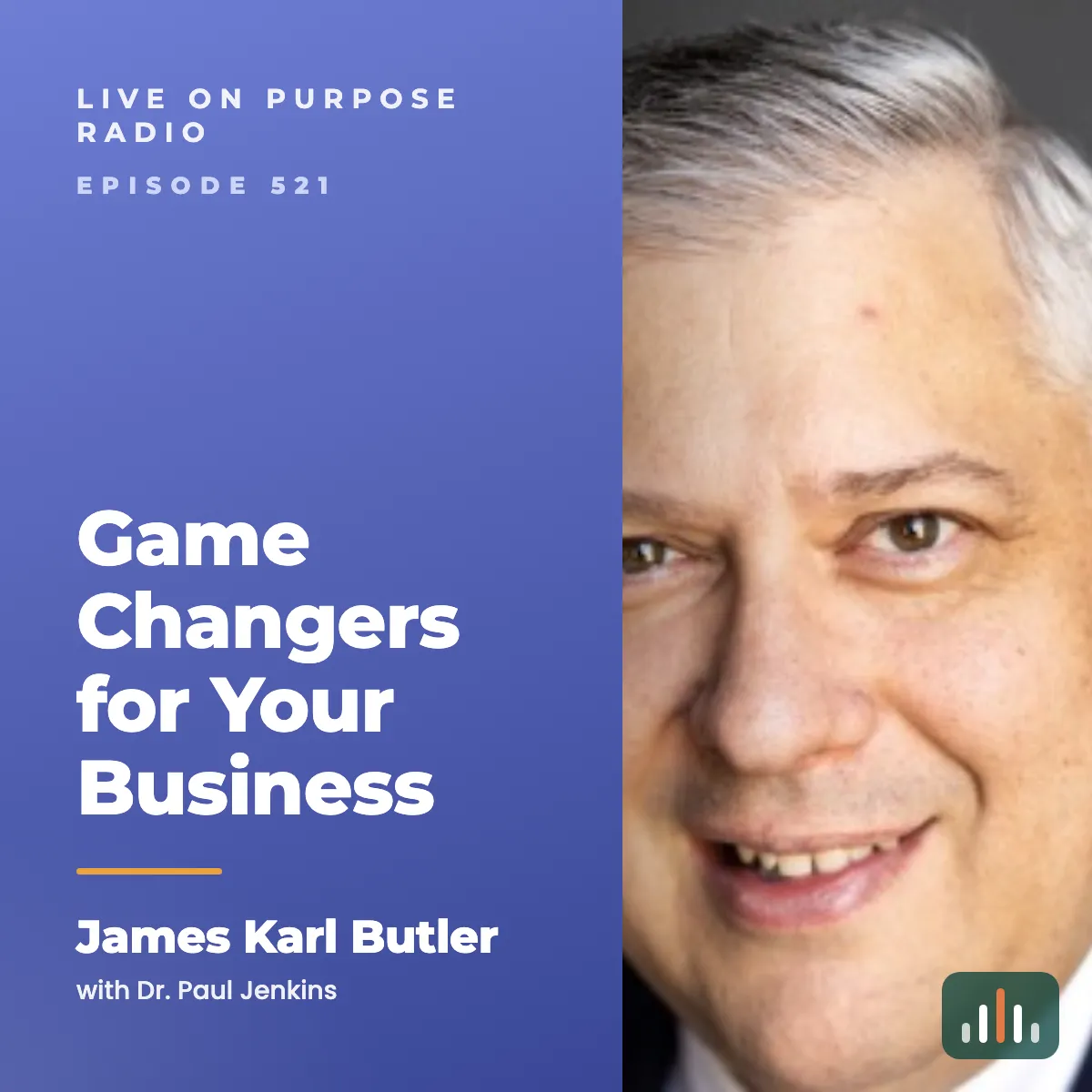
This is Live On Purpose Radio, episode 521, Game Changers for Your Business with James Carl Butler. Now is the only time to create and live the life you love. I'm doctor Paul Jenkins, the positivity psychologist. My job is to connect you to powerful positive psychology principles that immediately upgrade your relationships, business, and mental health. Are you ready?
Let's jump in. Hello, everybody. Welcome back to Live on Purpose Radio. This is doctor Paul, the shrink, who expands your life with another episode of Live on Purpose Radio. We're going to expand your business today.
Joining me on the show is James Carl Butler. He is the author of Clear and Present Game Changers after he published another book, The System is the Secret, all about creating and elevating your business to the next level. Welcome to Live On Purpose Radio, James. Thank you, doctor Paul, for having me. I appreciate it...
The opportunity. This is awesome. Hey. You know, years ago, I would never have thought I'm going to be putting out podcasts about building your businesses. But I do that regularly now because I've discovered that business...
And, you know, we might take some time to define that at some point. I don't know. But business is the mechanism by which we put services and products into people's lives and hands and hearts and minds. It's how it gets there. It's like the vehicle that delivers the goods.
And as a mental health professional, they didn't teach me anything about business back in shrink school. And so I've invested a lot of my time and money and energy into learning how to do this. And when I came across your book, James, Clear and Present Game Changer, Strategies to Turn Around and Transform Your Business, I thought, I wish I woulda had this manual back when I was coming out of graduate school and thinking I'm gonna I'm gonna start my own business. That's the level of of completeness, I think, that you've approached this with. Anyway, that's more of an introduction than maybe you usually give.
But, James, I would love to hear from you about what it is about business that that lights your flame. You know, what is it that... About this that gets you going? Yeah. Great question.
I don't think I would have considered myself to be much of a business person or entrepreneur when I was growing up. I actually have a degree in microbiology and chemistry. So... Oh, really?... On...
Yeah. My older brother is a biochemist, and my father has a PhD and, has taught at colleges for a long time. And, he kinda started his own business, started doing some writing, and then I kinda got into that too. But, it's mostly... I just found I love business more than science.
I got a degree. I went out trying to find a job and just couldn't find something to work for me and ended up starting my own business and learning how to sell. And in the process, I realized there's a lot of of... I don't know if you're... Most of your listeners have probably heard the book The E Myth before by Michael Gerber.
Oh, yeah. He talks in that book about how important it is to have business systems. And And the reason why I kinda got into writing was because there was a... Basically, that book says you need to have them, but it doesn't tell you how to get them or how to build them. And so I've built four of my own businesses now that are gone from the startup phase over $1,000,000 a year in sales.
And I've con... Consult with hundreds of companies across the globe of people wanna learn how to do business better. And so a lot of the lessons that I've learned from those experiences are kinda just been distilled down into my books, into their... My own podcast and the research that I've done and things like that as well. So it's mostly just kinda my own...
I write these manuals, as you said, to help me. It helps me to find the ways... What I've learned about how to put business together and do that. So that's kinda what Yeah. Drives me is my interest in helping other people that actually define and articulate and actually implement these systems and these processes in a place to be more successful in their lives and their businesses.
I'm I'm kinda curious to ask you this. It's not it's not magic. It's not luck. Right? What's your take on principle and what that has to do with setting up a business?
Are you talking about principle like in capital or you're talking about principle like in strategy or like, Oh, yeah. I forgot. I'm talking to a business guy here. When I say principle, I'm talking about, like, natural laws. Okay.
Okay. Yeah. You know, principles of of psychology or principles of, of business. Right? The the founding or the the foundational, principles that actually make this thing work.
Okay. Because I'm guessing it's not luck. It's not magic. There are principles that drive all of this. Am I am I way out in left field here?
Is that what you're doing? I I appreciate you clarifying that. But... Yeah. Absolutely.
So all business skills are learnable. I think that's one thing that's exciting for me about getting the business that I didn't really feel like I knew that much about business. But when I had that realization that all business skills are learnable, just like anything, if you put your mind to it, you learn the law behind it, you follow that principle, you're gonna get a great result at the end. And it's the same thing with business systems. If you follow the system, you'll be successful.
That's why I called my book The System is a Secret because most businesses as a scale, they learn this principle. They realize they can't do it on their... All by themselves. They try to focus so much on skills development. They don't think about systems development.
And that's really the key, I think, to being successful in businesses, getting good systems in place, especially for scaling your business and getting bigger, going from zero to million or million to 10,000,000 or 10,000,000 to a 100,000,000 and beyond. It's all relying upon the systems. You have to have other people do the work that's necessary for... To have the results you're looking for. So you absolutely have to categorize those things into principles for sure and then live those things if you wanna grow and scale your business to become what it should or could be.
I'm just reflecting on what I said when I was introducing you because I wish I would have had this manual years ago, decades ago at this point. I'm getting older. And and what you just said about you can't do it yourself. And this is a trap that I think a lot of entrepreneurs especially fall into because we wear all of the hats. Right.
Right? Especially during that startup phase when you're just getting started. And sometimes we develop habits that are not necessarily supportive of our growth when we think we have to do everything. And... Absolutely.
You mentioned systems, k, for example. So I was consulting with, someone you may know as well, Viral Workman, who is a member of our National Speakers Association chapter where you and I met. Right. And I was consulting with Viral. He has this amazing business.
He's built the systems. And he he told me, he said, Paul, you gotta quit thinking, how do I do this? And start thinking, how do I get this done? That little shift. Right?
Because it speaks to what it... What you're introducing to us here, James, that there are systems. If you build the system, build the machine, and you plug in the parts for that, you don't have to do it. The machine will do it or the system will do it if you build it well. That's correct.
Yeah. That's why McDonald's and franchises in particular are so successful because they can have anybody run the system and they have the same outcome. And I I think that's the challenge most businesses they... Especially if they're trying to build it by their... Themselves, they get...
They're... Like you said, they wear all the hats. They get so consumed in doing all the things that they don't, a lot of times, focus on the most important priorities. So in a business, for example, there's basically three things that you should or you ought to be doing. Number one is, well, if you look at what you...
What a business per... Person does, first off, they do what they do. So what you actually do is is the first thing you're looking at. Second thing is what you should be doing. And most times, there's a big disconnect between what should be doing versus what you could be doing.
You can hire someone else to do those things for you. Right? Then the last one is what you can delegate to other people to do for you. And that's the part about the systems and hiring people. But most most business people is...
Especially if they scale their business, they miss that lesson. They get so consumed in doing things that they don't step back to say, should I really be doing this? Is this the right thing for me to actually focus focus my time on? Or should I be doing other things that help me have more of a high level and have more vision and and look at the future what I should be doing as opposed to just getting to the grind, the day to day of doing the work that needs to be done instead of focusing on, am I headed in the right direction? Am I...
Is my ladder leaned up against the right wall? Am I even going where I wanna go? Otherwise, you'll end up in a very different place. And a lot of business owners are very frustrated because they they try to hire people and they're maybe not the right person. They don't have the systems in place.
They go off and do something on their own, and that person's not doing it well, so they get upset about that. They take it back over, and then they're spinning all these plates and they... It just collapses. And they they just go back to being small or they just say this isn't possible to do. And they're they're getting...
They're focusing on their own skills instead of thinking about how do I build systems and how about my business become systems dependent, not people dependent. That's really key. That's... I think it's almost what defines a business as opposed to a... What should we call it, a self employed job.
Right. Yeah. A big business versus a small business, I think. Yeah. That mentality of...
Especially as you're scaling it, the systems are the critical component of what makes that work. Right. Yeah. I... I'm really resonating with what you're saying maybe because of my own growth and where I am in the development of my business, which I think I can finally call a business.
Because before, it was just a job that I made for myself. I'm thinking about what you said about, getting started. Right? And you have a skill set. You've got some things that you can do.
You can't quite find the right job to match what you're really passionate about, and so you go out and make that. Right. And and that's important to, to create a place for yourself to exist doing what you do for the people who need you to do that for them. And then how are we going to grow that? Well, that's when the business development comes in.
That's why these systems, I think, are so important. Right. Well, you just mentioned a really a really big trap that most entrepreneurs get into is that they... Like Michael Gerber talks about, there's technicians, there's managers, and there's visionaries. And most people start a business do it because they don't like their boss, and they think I could do this better.
I'm the one doing the work anyway, so I'm just gonna go ahead and start my own business. But they don't really know and understand how to manage people, and they don't really know how to have a good vision or plan or articulate that vision and then actually make that happen. And so as a result, they kinda spin their wheels as the technician, and then they they... It limits their ability to grow and really scale and get bigger and bigger. And I think that's the biggest challenge.
The big... The other bigger problem is is that those three people don't like each other very much. You know, the the technician hates the manager looking oversold and says, hey. You should be doing this. This is not what you should be doing.
And, they they don't like the visionaries saying, hey. We can hit this goal within the next six months or a year. And they're like, stop bothering me. I'm trying to do the work. You know?
And so that's the key of a business is build and make... Integrate those different roles and be successful at it. I do a lot of work in franchising. And, again, that's why franchising is so successful because people have already figured out the systems for you. All you have to do is just run the system.
You can hire, buy a business, and the system's already in place. The brand is there. It just makes the job a lot easier for a lot of people because they don't really think about how to build the systems and put things together that way. Right. Which is a much higher level of thinking.
Yeah. It does take a dip... It's it's work. It's work to do systems development and creation. And most people don't want to do the work Yeah.
Because it's too hard. But when when it becomes important is when you lose money. That's when most people say, hey. I should probably have a system here because you lose a client or you make a mistake that cost you a lot of money, and then you say, man, I should do something different. I I learned this lesson myself the hard way.
I thought I had good systems in my business like most of us do. And, I had an employee who made a mistake that cost me tens of thousands of dollars in one of my businesses. And instead of being mad at the employee, I had to get mad at myself and say, look, I didn't have a good system in place and so there's a hole there, and it it made a serious problem. And a lot of about being successful in business is learning how to manage your emotions. Right?
About saying, I need to fix this crisis. When a crisis or a problem comes up, most people get angry about it instead of saying... Stepping back and saying, what can I do to fix this? And then the situation where that happened, it didn't do a lot of good to get mad about the situation because it was really my fault. They were just following not...
A nonexistent system in this particular case and just kinda figuring out things on their own. But when I step back and said, if I put the system in place, that won't happen again. As a result, I fixed that problem. I've... I basically plopped that hole, and then I figured out, what do I need to do to make this doesn't happen again?
And as a result, it never did happen again in that business. So I think that's an important consideration. Again, most people don't do systems work because it's hard, number one. It's not the easiest thing to figure out. And...
But mostly, it's just because you don't... You're just so busy running around doing the details of the business. You don't think about what happens if this goes on. You know, know, one of the things I talk about in my book, the systems of secret, is the... On the on the customer service side, for example, if you don't know all the different possible scenarios of what could happen in your business and you have an employee who's trying to solve something, it's basically the idea is is if you don't have a system for your customer service issues, you're gonna be at the mercy of the person who's calling you and who's angry.
And that's not gonna usually win... Go well for the company. It's gonna end up being better for the customer, because the customer is gonna say I'm always right. That may or may not be true. And Yeah.
But the the reality is is that that's true. Same thing with selling. If you don't have a system for selling, you're at the mercy of the person who's not buying from you. And when you think about that concept, it's like, wow. I really need to put my systems in place.
Otherwise, I wanna make some mistakes and not be where I ought to be. So really important concept. Yes. You said something else that caught my attention, maybe because I'm a psychologist, James. But you you mentioned something about the...
Kind of that that emotional component. Yeah. And it... It's a very emotionally laden process to to build a business. And where our mind is matters.
I'd love to just hear your take on that for a minute about what our mind has to do with with getting into a place where we can actually build our business successfully? What what are your thoughts about that? Well, I think you're absolutely right. It is it is critically important that you you you have to kind of be a little bit of dissociative and step back from the situation for a little bit and say, if I wasn't the owner of this business, what would I do in this situation? What would I expect or what would I wanna have happen?
But more importantly, as the owner of the business, if I objectively look at this, what cannot happen? What do I need to fix and make sure that that's in place? But, again, that comes back, I think, a lot to controlling your emotions. I learned this lesson when I was in college. I was actually working in a chemistry lab, and, I came in and clean...
I was cleaning the lab up like I usually do when I came in. I ended up throwing away with my boss's experiment that he'd been working on for three days. And it cost him tens of thousands of dollars probably because of the mistake that I made by just throwing away his experiment that he'd been working on. And I learned a lot from that experience because number one, he didn't get mad at me. He was mad about the situation, but he didn't.
He he said, look. This has already been ruined. You've already thrown it away. I can't fix this. So it doesn't do any good to be mad about it.
I'm just gonna restart the experiment. And I learned a lot of lesson about that, about his own emotional maturity to not get angry and start punching things and being angry at me or saying, you're fired. I'm... You're out of here. He realized, look, you didn't know.
You were just trying to do your job, and I didn't put a sign on that says, don't touch this experiment. Right? So I think there's a big lesson in that that most people when they encounter a crisis or problem in their business, they let their emotions... They lose control of their emotions. They get angry.
They get frustrated. They get upset because, like, I was counting on that sale. I was counting on that business deal, and it doesn't happen. And then you have to kind of regroup and regather yourself. Again, if your if your if your output is low on the on the end of the business, if you're not bringing in money deals, the problem is not necessarily you're about to sell sell deals.
It's... Probably your problem is your client acquisition strategy is not working. You're not getting clients. You're not bringing in and out business, and so we need to figure that out. Then if you have a lot of clients coming in or a lot of leads coming in, but you're not closing a thing, then it's a sales system type of a thing.
So part of that is looking at the situation and say, what do I need to fix in my business to really get back on track? And so I think the essence of... I don't know if that answered your question on the the the psychology part of it. I think you probably know a lot more about that than me. I'm still learning about that a lot.
Well, I I am putting that together, James, because I... What I heard you say about that is we need to have some level of emotional detachment Yeah. From what's actually happening in our business because it's all data. It's all information. And we can learn from that as long as we don't personalize it too much or as long as we don't get emotionally tipped over when it goes this way or that way.
I've... I had one of my business coaches describe it as you don't wanna be on this emotional roller coaster where you get this huge high if you get the sale. Right. And this huge low if somebody rejects you. But, yeah, you can...
I mean, enjoy the ups and don't get too tipped over by the downs, but it's more of the rolling hills, not the roller coaster because everything is data. And I've seen this in in a lot of the entrepreneurs that I've coached too, and that's my specialty is the emotional... The mindset piece. Mhmm. And when they get so attached to it...
I've done this myself. I think we all do. We're all vulnerable to it. Where I I personalize it to the point where my business is me. And so any failure represents that I'm a failure.
Right? As opposed to realizing what John Maxwell described so well in his book, Failing Forward. Right? That this is just part of the process. You have to try some things and you have to take a few hits now and again.
And that's all part of the game. So if you don't personalize that too much, you can see it just as data. And like you're saying, James, analyze from there. Okay. So what's working?
What's not working? What could be fixed? What adjustments can we make, without throwing out the whole experiment? Right. Well, I think part of the challenge too is is that we each have a self image for every single part of our life, every skill we have.
And so like you said, you might be really good at selling, but you're not very good at being upset when a customer service thing happens. And you... Where you basically feel like someone's rejecting you or says, I don't like your product. I wanna get a refund or whatever it is. That can be very emotionally devastating to someone who spent their whole life figuring out what it is they wanna offer to people, and they choose to reject them.
Right? So part of that ups and downs is learning how to focus on your strengths and not get so consumed by all the things that you're not good at. Because all of us have lots of things we're not good at. And, you know, and I I heard someone say this to me once too. Whenever you...
If you have a 100 people respond to what you say, if there's someone that says this is the best thing that's ever been created in the whole world since sliced bread, and then someone else says this is the worst thing that's ever been created, those people you should ignore because they're the extremes of either side. The one you wanna pay attention to are... Because if you if you if you listen to the person who says you're the most thing person in the world and you know that's not true, and you also listen to this person that says you are the worst person in the world, then what happens is is you're really discounting your own ability of the people that you really are trying to serve, which is the other 98 people. Those people need your gift. They need what you have to share.
And I think if you get caught up in the emotional swings of, I only wanna listen to what the positive feedback is and I... We don't wanna listen to the negative feedback. You know? I think a great example of this is if you go look at Stephen Covey's book, the highly effect... The seven habits of highly impact of people, which I think everybody could agree is a great book.
He has one star reviews on that book. If If you go on the bible, it has one star reviews, you know, or zero stars. You know? So I I think it's, you know, it doesn't really matter what it is you're putting out into the universe. If you're putting something out, you're gonna have people that are gonna negatively respond.
It's more about them typically than about you. But a lot of times, we as individuals take it personally, and that prevents our... Us from being more productive and getting more done than we could do if we were just focused on the things that we can do. That's why I think what I said earlier is so important. There's what you do in your business, there's what you should be doing, and then what you should be delegating to other people.
And most people only focus on the first one, what they do. And so as a result, they don't think about all the opportunities they're missing out on because they could be doing something different or focusing on a different area of their business or focusing on their strengths as opposed to focusing on their weaknesses. You know, this is something that I really appreciated as I was getting into your book, James. There's a... An immediate focus on do what you do well.
And and we get diluted if we start doing all of the other stuff that we should be delegating to other people. I think you've done a nice job in your book of of being very clear about, hey. You have a particular skill set. There's a reason you wanted to have this business in the first place. Right?
Because you've got something that you do well. And I think the sweet spot is where we we do what we love for those who love what we do. Right. And and we provide that service at a level that really really moves the needle for people on what it is that that we can offer. You said, you know, sometimes we'll miss out on people who really need what we're offering because we get caught up in our own head trash.
Yeah. That's absolutely true. You know, you said that some... In the introduction, you were talking about that. And Zig Ziglar used to say all the time about doubling a checkup from the neck up.
You know? And Yeah. That's such an important idea that you have to be inputting positive things with reading or studying or listening to podcasts like this that help you put your focus on where it should be instead of getting drugged down by the news media or negativity, because there's plenty of that. And if you open your mind to that, you'll be drugged down pretty quickly by that instead of what you could be doing because you're focusing on positive things and how you can impact other people's lives. You talked also about the outliers.
You know, those who really love what we're doing and those who really hate what we're doing. And then there's a whole bunch of people in between who can see, hey, here's the upsides, here's downsides, and this is valuable to me. Right? I think as as we get better at marketing, we're going to be repelling some people. And and I say that because sometimes, you know, to take care of our own need to be liked or our own need to have people approve of us, that that we're really careful about what we put out there.
And we don't wanna offend anybody, and we want to make it appealing to everybody. Well, you can't. Right. Make it appealing to everybody. So as you get more clear about who your service is for and you you dial in your messaging to them, you're going to be turning away other people.
And that's how... That's one of the ways you can know you're doing effective marketing is if you're ticking some people off. Yep. I mean, you know, helping them to see this isn't for me. Right.
Right. Yeah. And that's not everything that you offer isn't for everybody. I think that's a really important point. Absolutely.
Right. Right. But it is for who it's for. Right. And so if we can get better at talking to them and serving them.
Right? Yeah. I think that's so critical. I... My father was a speaker and a business owner, and he still he still is now.
He's retired now. But one thing that really impressed me a lot when I was younger was I would hear him speak and he'd have people fill out these evaluation cards. At the end Mhmm. They would read the evaluation cards, and he would never pay attention to the ones that were great. They said, this was awesome.
I learned so much from this. All he would get consumed with, the person who said, that was a terrible presentation. And it was only one person or two people out of that hole, but it prevented him from going out and speaking more because he was worried about the negativity or the... Basically, the basically, the haters or the people who reject his message. And, something I thought about a lot in my own life too is that I've gotta make sure that I'm focusing on the right people that I'm that I'm serving.
And if I get so consumed and and the negativity, I'm not gonna be able to do what I need to do, what I'm what I'm put here to do. I think that's really important. Well, you're talking to the positivity psychologist here, James. Right. And I I think negativity gets in our way in so many facets of our life and and certainly in our business.
You know, what we choose to focus on determines how we feel. How we feel changes how we show up. And I I love the practical advice that you're giving around business. And if we can if we can apply that in the context of choosing a positive attitude no matter what is going on in the world around us, It it sets us up to go do the hard things that we get to do if we're actually going to build this thing to a point where it can make a difference. Yep.
Absolutely. Yeah. For sure. James, you're doing some good work. How can people connect you?
I know you've got a podcast, a website. Where's the best place for people to connect with you? Yeah. My... I have a podcast called The Sound of Oz of Success podcast.
You can probably send... You can follow me on Instagram at James Carl Butler, Carl's with a k, and, or you can email me at JamesCarlButler@Gmail.com. So happy to help any way I can. That's all pretty straightforward. And you mentioned the Sound Laws of Success.
That's also the way they can get to your website and your blog. Is that correct? Right. You can go to soundlawsofsuccess.com. I have a blog page there.
I'm also at james carl butler dot com. You can go on there. So... But, yeah, that's just a Wonderful. Yep.
But on the on the on the website, it has a link to the Amazon. You can buy my books if you want to and stuff like that as well. So the Clear and Present Game Changer is one that we've been talking about in particular. And that's the newer one, Clear Present Game Changers by James Carl Butler. Go get the book, you guys.
Connect with James, especially if you want to have a way to to just check any of the other information you're getting about business. I think James is your encyclopedia. You go there, you're gonna find what you're looking for when it comes to building and growing your business. James, thank you for joining us here at Live on Purpose Radio today. You're welcome.
Happy to be here. Happy to be here. Awesome. You've heard it from James. Time to go do it.
Let's all go live on purpose. Did you get what you came for? Give yourself the gift of taking real action on what you realized today. Please share this episode with someone you know would value it, and leave us a rating too. It's time now to live on purpose.
Open the transcript on its own page ↗